

Domain Buying Guides
-
How to Buy a Domain Name
-
How to Buy a Domain Name Owned by Someone Else
-
Negotiating a Domain Price
-
What is a Premium Domain Name & Why You Should Buy One
-
How to Choose a Domain Name
-
How to Value a Domain Name
-
Domain Names for Startups
-
How to Buy a .com Domain Name
-
Things to Watch Out for When Buying a Domain
-
Domain Name Investing
-
Buy & Selling Domains
-
Best Domains to Buy
Name Experts provides premium
domain service to:






Domain brokers like NameExperts.com help clients buy ‘premium’ domains – but what is a premium name, and how do you get one? In this post, domain name specialist Joe Uddeme lifts the lid on high-value web addresses.
Imagine a business today that didn’t have a website. Seems almost inconceivable, right? The internet is one of a business’ primary channels to entice potential customers, meaning any organization that doesn’t have an online presence is massively missing out.
The best way to showcase yourself online is by having a website stating clearly what you or your organization offers. And the way to do that? With a premium domain name.
The domain name is how people will find you on the web, so unless you strike it luck and some cheap random jumble of letters you’ve bought as a domain name suddenly becomes in vogue, you’ll need to dig deep and buy a premium domain name.
But what are the elements of a premium domain – and how much are you going to have to pay? Read on for the full details.
Key Takeaways
- Understanding what premium means in the domain name world
- Elements of a premium domain
- How to buy a premium domain name
- Why you should buy a premium domain
What are Premium Domains?
Premium domain names are high-quality domain names, giving you greater recognition on the internet. They’re often short, catchy, and memorable. They’re the domain names that people are likely to search for and trust over other names.
A premium domain name would go a long way in drawing organic traffic to your website. They’re usually costly, but one of the best investments you can make.
It’s not a coincidence that most of the successful online businesses we know have premium domain names – see Stripe.com, Amazon.com, Google.com and other big-hitters.
Need help buying a domain? We make the domain buying process easy.
How Do You Know if a Domain Name is Premium?
The easiest way to determine if a domain name is premium is the price you see when you search for it for a domain registrar. Likewise, you can use a premium domain checker for this task.
Premium domain names often range from a few hundred dollars to thousands or tens of thousands. They can go for even larger sums – as our post about the most expensive domains ever sold illustrates.
There are also specific characteristics differentiating premium domain names from the pool of all domains, and they include:
Length
“The shorter the name, the better” is the rule of thumb when it comes to domain names. Most two or three-letter domains are considered premium because they’re easy to imprint on customers’ minds.
These short names are also usually abbreviations adopted by various companies, so there’s intense competition for them.
Generic Value
Domain names consisting of generic words fetch a higher value than those with non-generic words. Generic names are easy to remember and brand, so there’s significant demand for them.
You’d have an advantage over competitors if your domain name consists of a word that broadly relates to your industry.
For example, Checkout.com, Bill.com, and Authorize.net are leading payment providers. Crypto.com and Blockchain.com are two famous cryptocurrency exchanges.
Customers need little effort to memorize such generic domain names, so it gives these companies a significant marketing advantage compared to their peers.
Search engine optimization
Search engines are the primary way people discover websites. Hence, any domain name matching what people mostly search for carries more weight.
CreditCards.com, HouseRepairs.com, and RentalCars.com are examples of domain names with high value stemming from search engine optimization.
Buyer Demand
Some domain names don’t look attractive at first glance but see great demand from prospective buyers for various reasons. These domains command high values because of the bidding war over them.
Numerous domain registrars let you check for available domain names, and it’s easy to identify the premium ones based on their prices and the other factors stated above.
If the domain name you want is already taken, don’t give up. You could still acquire it by making a direct offer (more on that below).
How Do You Get a Premium Domain?
The first step to buying a premium domain name is knowing if it’s available using a premium domain checker. You can buy it straight away if it is. If not, you’ll need to find the owner.
Many domain names are registered but not utilized to a considerable extent. Sometimes, you’ll see a homepage filled with advertisements and affiliate links but hardly any content.
This is an attempt by the owner to monetize what’s basically an abandoned site. If you encounter such a website, then it’s positive news for you. The owner is more likely to sell than someone actively hosting a site and doing good business.
If the website has a contact form, you can use it to reach out to the owner with an offer. If not, you must get creative in finding them. The easiest way to do this is through the WHOIS database.
It is a public database containing the information collected when someone registers a domain name or adjusts their DNS settings. ICANN, or the International Corporation for Assigned Names and Numbers, regulates the WHOIS database.
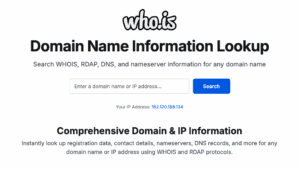
Searching the WHOIS database
ICANN allows anyone to search its public database for domain name ownership information. You can do that through the agency’s online lookup tool or your PC’s command prompt.
Searching WHOIS Online
The official URL of ICANN’s WHOIS lookup tool is lookup.icann.org. Once you open that page, you’ll see a search bar where you can type in any domain name and press the lookup button. We searched for Microsoft.com to demonstrate, and we got the results shown below:
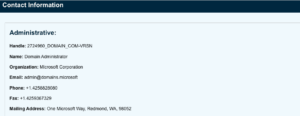
You can see the email assigned to Microsoft’s domain name is [email protected]. Hypothetically, we can contact that email with an offer for the Microsoft.com domain name, but we’re pretty sure the well-known technology company isn’t willing to sell.
Searching WHOIS via Command Prompt
Searching WHOIS through your Windows command prompt is a complex process, so we recommend that only computer geeks take this route.
Step 1:
Download the whois.exe file from this link.
Step 2:
Open the command prompt terminal.
Step 3:
Set the command prompt directory to the folder where you save the whois.exe file.
Step 4:
Type in your query in the following format: Whois domain.com or Whois64 domain.com if you’re running a 64-bit computer. If you want to search for Microsoft’s domain name info, then type Whois Microsoft.com, and you’ll see the contact information.
Sometimes, a domain name owner may have enabled privacy protection through their registrar, meaning you can’t see their information. It implies that they’re likely not interested in selling their domain.
With the contact information, it’s time to negotiate a domain name sale. The process can be hectic and take long periods, so we advise you to hire an experienced domain name broker to help you.
Why Should I Buy a Premium Domain Name?
A premium domain name carries more authority on the web, meaning you’re more likely to get found through search engines or social media. It also brings about better brand recognition, making it easy to attract customers through advertisements.
Many domain registrars have a premium domain checker for their users to find and bid for premium domains without stress. Examples include Name.com and Domain.com.
Who Owns Premium Domain Names?
Anybody or any organization can own a premium domain name. Some are owned by business-savvy people or companies looking to flip them for a profit. Some are owned by domain name registrars themselves hoping to find buyers.
How Do You Value a Premium Domain?
There are various factors to consider when valuing a domain name. They include length, how generic they are, search engine recognition, and historical domain name sales data.
There are numerous appraisal tools available online that combine these attributes to value individual domain names. A good example is GoDaddy’s Domain Name Value & Appraisal tool.
Why are Premium Domains So Expensive?
The price of premium domains can be high because there’s considerable demand for them. The number of premium domain names is significantly less than the number of potential customers vying for them. Hence, premium domain owners can charge high prices and still make easy sales.
As professional domain name brokers, this is the world we live in – and we help people buy and sell premium domains globally every week. Clients choose us for our years of experience – it means we can help them get hold of names that seem impossible to purchase.
Our expert negotiation skills often save clients large sums of money, too.

About the author
Joe Uddeme is Director and Principal of Name Experts, one of the world’s leading domain name brokerage services. He has overseen domain name sales and acquisitions totaling more than $150 million and is renowned worldwide as a go-to expert in buying and selling premium domains. Contact us at: [email protected]
Need help buying a domain? We make the domain buying process easy.
Subscribe for More Domain Buying & Selling Advice
Related posts


The 3 Types of Domain Names and Common Domain Extensions
When you buy a domain name, you purchase a piece of digital real estate. But what, exactly, are you getting for your money? NameExperts.com Director Joe Uddeme unravels the elements of a domain name – so you’ll have a clearer understanding of the architecture behind them. A domain name is an address you type into your web browser whenever you want to visit a website. It is arguably one of the most important assets any business can own. While ‘domain name’ is an all-encompassing term, a domain is actually made up of multiple parts. Understanding these elements can give you a clearer picture of the domain name investing world and ensure you’re well-informed before buying a domain name or asking a skilled domain broker to negotiate the purchase of one on your behalf. Key Takeaways Domain names – an introduction The 3 types of domain name Domain TLDs for beginners Why not check out our article about why choosing a .com domain name still makes sense for most businesses? What are domains? A domain name is a human-readable address that directs you to a particular website available on the internet. It’s akin to the address for your official residence or workplace. When someone wants to visit you, they come to your address. Similarly, when someone wants to visit a website, they type in the domain address in their web browser. Any domain name has four main components; Domain name: The name of the domain itself. Top-Level domain (TLD): The suffix that appears after the domain name, e.g., .COM and .NET. Subdomain: A domain that is part of another primary domain. It is also known as a third-level domain. Protocol: The system that specifies how information from the domain is transferred to your web browser. It is either HTTP (insecure) or HTTPS (secure). Take https://www.nameexperts.com/, for example. NameExperts is the domain name .COM is the top-level domain WWW is the subdomain HTTPS is the protocol The 3 Types of Domain Names There are three main types of domains, including: 1. Top-Level Domains A top-level domain (TLD) is the final section of a domain name. It is the last segment of text appearing after the dot symbol. For example, in Google.com, .COM is the top-level domain. Ever since the world wide web’s inception, .COM has been the most common top-level domain. It was originally used to designate commercial businesses but has become the de-facto TLD for most websites. Another popular TLD is .NET. It was initially meant for internet service providers and networks but is now available to anyone who wants it. Because NET signifies network and technology, this is an ideal option for technology companies. Yet another well-known TLD is .ORG, which was originally used to designate not-for-profit organizations. Till today, most people associate this TLD with non-profit organizations and social causes rather than commercial businesses. The .ai TLD is another popular one today – especially for tech firms. There are two main types of top-level domains; Generic TLD A generic top-level domain refers to domain name endings with three or more characters, the type that you’d most likely recognize. .COM, .NET, .ORG, .INFO, and other common domain endings fall under this category. Before 2011, there were barely two dozen domain extensions classified as generic. That year, the Internet Corporation for Assigned Names and Numbers (ICANN) expanded the number of generic domain extensions from 22 to over 1,200, opening up more opportunities for individuals and businesses to acquire domain names. Country-Code TLD As the name implies, these are domain extensions associated with specific countries. ICANN assigns country domain endings to each formally recognized nation and sovereign state, and these nations collect a royalty on every sale of their assigned TLD. For example, Tuvalu, a small island nation, earns 1/12th of its annual income from its .TV domain extension. Other popular examples of country domain endings include .US for the United States of America .AU for Australia .DE for Germany .CA for Canada .CC for Cocos Islands .AE for the United Arab Emirates (UAE), etc. 2. Second-Level Domains A second-level domain is directly below a top-level domain in the domain hierarchy. It is the part of the domain name that comes right before the top-level domain. For example, in NameExperts.com, NameExperts is the second-level domain. The second-level domain is usually a combination of words describing the business or service of the domain name owner – and it pays to match this to the name of your business whenever possible to strengthen your brand. In the above example, NameExperts describes the business of a professional domain name broker that helps customers to acquire valuable domains. A second-level domain can include letters, numbers, and hyphens. Symbols are not allowed. 3. Third-Level Domains The third-level domain, or subdomain, is the part of the URL that comes before the second-level domain. The most common subdomain is www., which refers to the world wide web. Third-level domains are not mandatory, so you can have a fully functional domain name without the www part. Some website owners create third-level domains to represent a different section of their website. Examples include: Shop.mywebsite.com refers to the e-commerce section of a website. Blog.mywebsite.com refers to a blog attached to the website. Support.mywebsite.com leads to the customer support section of a website. Understanding Domain TLDs A domain name is the most important property for anyone who conducts business online. Hence, it’s crucial to understand what they are and the different types of domain name extensions to use for a website. The information above should help you figure out how to structure your domain, but if you need help, we’re experts at domain selection and helping you buy the perfect domain. About the author Joe Uddeme is Director and Principal of Name Experts, one of the world’s leading domain name brokerage services. He has overseen domain name sales and acquisitions totaling more than $150 million and is renowned worldwide as a go-to expert in buying and selling premium domains. Contact the NameExperts team at: [email protected]

How to Buy a Domain Name – 10 Tips to Follow Before Buying
Picking a domain name for your brand should be given the respect it deserves. After all, says NameExperts.com Director Joe Uddeme, it could make or break your business. Among the most crucial decisions in establishing an internet presence is picking a domain name to buy. Ignore the trends and fads of the day and pick a name that makes sense for your company or subject matter a decade from now. When you choose well, you can rest assured that you have a valuable piece of digital real estate that is woven into the overall success of your business. Here are 10 suggestions that will help you to make a fantastic domain name purchase. 1. Do your homework Just a small amount of research can go a long way when buying a domain name. Find similar websites and check out your competitors’ domains using a website like Compete.com. Use dnpric to determine when a domain name was last sold, for how much, and the web hosting agent. You can search by keyword, which will help provide the popularity of particular words in a domain name. While any research is better than none, plan to put aside days or even weeks to properly research the right name for your brand – something that will help it to grow. If you need some guidance and an insider’s eye, an experienced domain broker can help you come up with – and secure – the perfect name for you. 2. Buy a domain name people can remember Even if you’re planning on optimizing the website for search engines so that it can be found when people search for “used boats in Dallas” or “hair styling near me”, you still need a domain name that individuals can remember and type. Anyone hearing your name needs to know how to get right to your business without you having to say things like “the number 4,” and “dash-dash.” It’s also wise to avoid words that have more than one spelling if your customers are likely to be confused and type in the wrong name. Alternately, you can purchase both versions of the name and guide visitors to the one you prefer – safe in the knowledge that your backup site will scoop them up if they make a mistake. Avoid anything mysterious like “voodrifunk” or “flambinastic” that might sound fun but is so out there that people will have difficulty remembering it. 3. Avoid slang terms Stay away from slang terms and instead select a name that will continue to be meaningful in ten years. This may also help your title be known and remembered by non-native speakers. Even if you don’t intend to conduct business globally, this strategy can help your neighborhood audience also. 4. Purchase a domain that is shorter rather than longer The longer your domain name is, the harder it is for people to remember. And the greater chance you have of someone misspelling some of the words. Most good single word domains are long gone (read “what do to if the domain name you want is taken“), but it’s still possible to avoid super-long alternatives by getting a little creative. For those who have one word in mind that’s not available, consider adding an adjective or verb in front of it and seeing if those variations are available. Perhaps not “GetAppple”, as that would likely lead to a world of trademark issues and other legalities, but you get the idea. Think of your domain name as part of your brand, and be sure it matches how you want visitors to consider you. 5. Stick with .com if you’re able to Most individuals assume that a domain name ends in .com – it’s just become the default for most of us. If you purchase a domain name with a different extension or “TLD” as they are known (.net, .info, .org, etc.), you will have some additional work to do if you want to get people to keep you in mind. However, do not automatically assume you should only ever buy .com domains. Many websites have done very well with different extensions – such as last.fm 6. Do not buy trademarked domains Even if you’re not intentionally trying to create confusion, you are most likely to face some legal challenges by purchasing trademarked terms in your domain name. To be safe, look for U.S. trademarks at www.uspto.gov and be sure no one owns a trademark on the name you’re contemplating. 7. Do not buy a domain name that is too similar to an existing website Even if the wording, name or expression in the domain name that has caught your eye is not trademarked, do not buy it if is is merely a variation of some other domain name. This applies to plurals if the singular is taken (mediatemple.net vs. mediatemples.net) and hyphenating a term (media-temple.net). 8. Avoid buying hyphen domain names If you have to go with hyphens, do not buy a domain with more than three of them. It is just too messy. 9. Avoid numbers People may get confused about whether the amount is a digit (3) or a word (three). If you would like a number on your domain name because there’s a number in your organization’s name, purchase both versions (word and digit ) and redirect one to the other. 10. Check availability on social networking sites When you’ve got a name picked out, see if this word or phrase can be found on social networking sites like YouTube, Twitter, Facebook, Instagram, Pinterest, Google+, and Tumblr. Even if you don’t intend on using social media straight away, you will want the option when you are ready, and it is easiest if you can use the identical phrase on each website. About the author Joe Uddeme is Director and Principal of Name Experts, one of the world’s leading domain name brokerage services. He has overseen domain name sales and acquisitions totaling more than $150 million and is renowned worldwide as a go-to expert in buying and selling premium domains. Contact us at: [email protected]

Why Work with Name Experts
Name Experts offers personalized domain brokerage services, assisting clients in buying or selling premium domain names with expert appraisal, negotiation, and complete transaction management while ensuring confidentiality.
Some of our most
successful stealth acquisition and sales