

Key Takeaways
- Backlink quality matters far more than quantity—look for natural referring domain ratios and diverse link sources
- Domain history is non-negotiable: check for penalties, spam associations, and previous content using archive tools
- Pre-vetted marketplaces save significant time compared to raw auction sites, though they command premium pricing
- Professional evaluation services can prevent costly mistakes by identifying hidden penalties and manipulated metrics
- The true cost includes your time investment—calculate opportunity cost before committing to DIY domain hunting
The expired domain market presents a paradox: massive opportunity meets substantial risk. While a quality aged domain can provide instant authority and established backlinks, a poor choice can saddle your site with Google penalties or worthless spam links. The difference between a valuable asset and an expensive liability often comes down to knowing exactly what to evaluate before purchase.
Through extensive experience evaluating domains for clients ranging from startups to established brands, we've developed a systematic approach that separates genuinely valuable domains from those that merely look good on paper. This guide provides the decision framework you need to make informed purchasing decisions.
What Makes an Expired Domain Valuable (Not Just Old)
Age alone doesn't guarantee value. The critical distinction lies between domains that are simply old and those that possess genuine authority. Understanding this difference prevents wasting money on domains that won't deliver results.
The Backlink Quality Hierarchy
A domain with 100 backlinks from 100 different websites beats one with 10,000 links from just 10 domains every time. This ratio reveals whether link growth occurred naturally or through manipulation. Natural backlink profiles show diversity in:
- Referring domain variety across different industries and topics
- Mix of dofollow and nofollow links that mirrors organic patterns
- Anchor text distribution that avoids over-optimization
- Link acquisition timing that shows gradual, steady growth
According to research on URL migrations, proper handling of link equity transfer is crucial—every indexed URL carries weight, and changing URLs without proper redirects can result in 20% to 70% traffic drops.
Domain Authority vs. Domain Age
The registration date tells only part of the story. Domain age research indicates that while older domains may have more trust and authority because they've had time to build backlinks and establish credibility, age is just one of many ranking factors. A newer domain with proper SEO practices can still rank well.
What matters more than age is the domain's actual authority signals:
- Quality of linking domains and their own authority levels
- Relevance of previous content to your intended niche
- Consistency of the domain's topical focus over time
- Absence of algorithmic penalties or manual actions
Traffic and Ranking History
Existing organic traffic indicates real value. However, you must distinguish between legitimate visitors and bot-driven numbers. Examine traffic patterns for:
- Consistency over time rather than sudden spikes
- Geographic distribution that matches the domain's content focus
- Keyword rankings that align with valuable search terms
- Engagement metrics suggesting real human visitors
The niche relevance to your intended use cannot be overstated. A domain with strong authority in an unrelated field provides minimal benefit when redirected to completely different content.
Clean History Requirements
Previous penalties or spam associations can haunt a domain indefinitely. Red flags include:
- Sudden traffic drops suggesting algorithmic penalties
- History of adult content, gambling, or pharmaceutical promotions
- Previous use in private blog networks (PBN)
- Trademark violations or legal disputes
- Presence on spam blacklists or email reputation databases
These issues don't always disqualify a domain, but they require careful evaluation and may limit its usefulness for certain applications.
The 5-Point Evaluation Framework

A systematic evaluation process prevents costly mistakes. This framework covers the essential metrics that determine whether a domain represents a genuine opportunity or a hidden liability.
| Evaluation Metric | What to Look For | Red Flags | Recommended Tools |
|---|---|---|---|
| Backlink Profile | Natural DP/BL ratio, diverse referring domains, relevant anchor text | Ratio above 1:50, concentrated link sources, over-optimized anchors | Ahrefs, Majestic, SEMrush |
| Domain History | Consistent content focus, professional previous use, clean archive records | PBN use, adult/gambling content, frequent ownership changes | Wayback Machine, WHOIS history |
| Spam Score | Score below 5%, no blacklist presence, clean email reputation | Score above 10%, blacklist listings, spam complaints | Moz, Spamzilla, MXToolbox |
| Traffic Patterns | Steady organic growth, relevant keyword rankings, normal seasonality | Sudden drops, bot traffic indicators, irrelevant keywords | SEMrush, Ahrefs, Google Search Console |
| Content Relevance | Topical alignment with your niche, quality historical content | Unrelated previous content, thin or duplicate content history | Wayback Machine, content analysis tools |
Backlink Profile Analysis
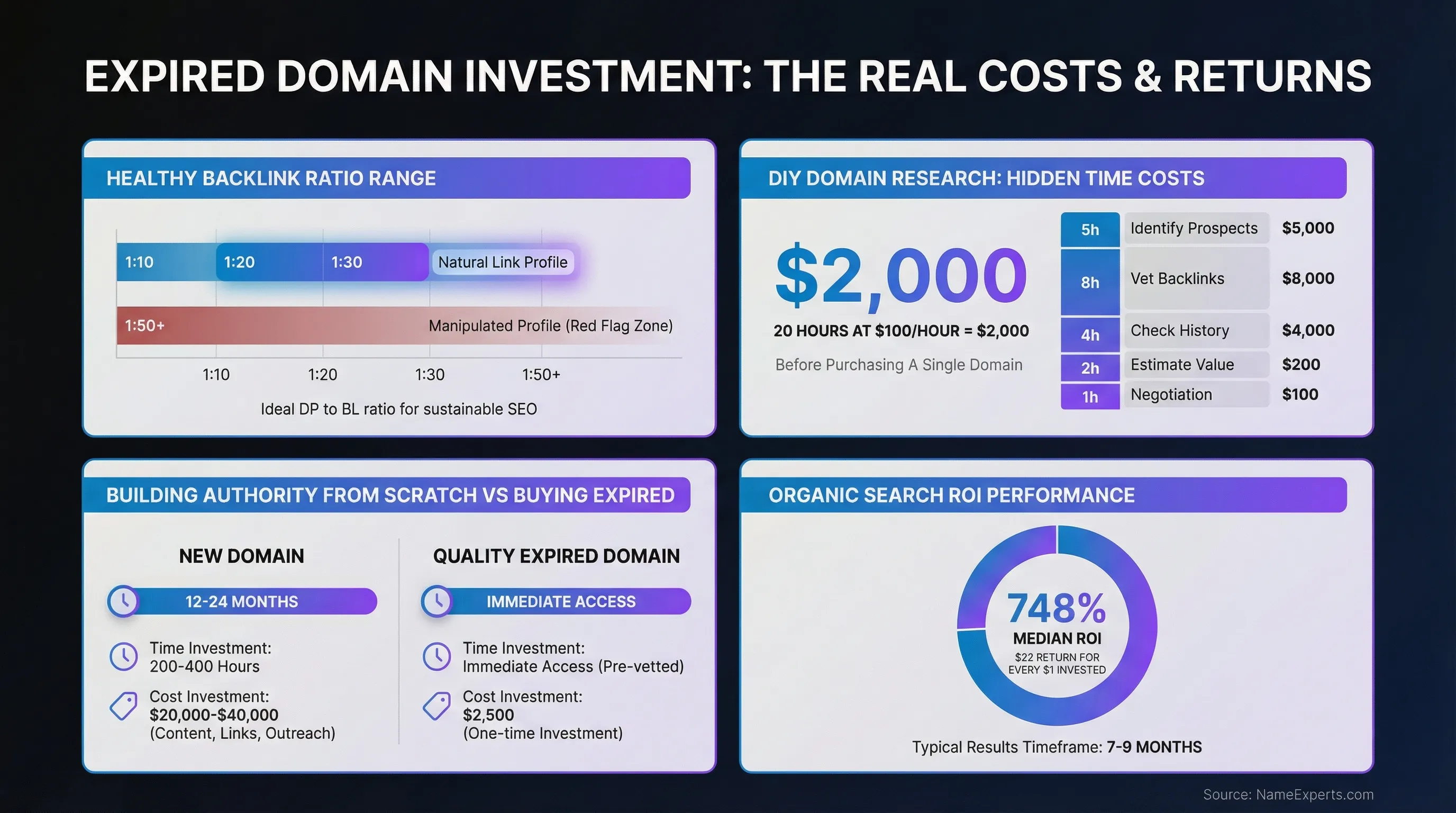
Start with the DP (Domain Pop) to BL (Backlinks) ratio on major auction platforms. A healthy ratio typically falls between 1:10 and 1:30—meaning each referring domain links an average of 10 to 30 times. Ratios significantly higher suggest manipulated link profiles.
Examine referring domain diversity carefully. Links should come from various sources rather than concentrated clusters. Natural profiles include:
- Editorial links from content sites and publications
- Directory listings from relevant industry resources
- Social mentions and community discussions
- Resource page links from educational or reference sites
Anchor text distribution reveals manipulation attempts. Natural profiles show mostly branded anchors, naked URLs, and generic phrases like "click here." Over-optimization with exact-match keywords indicates previous SEO manipulation.
Domain History Deep-Dive
The Wayback Machine provides crucial historical context. Review snapshots across different time periods to identify:
- Consistency in website purpose and content focus
- Professional design and legitimate business operations
- Absence of doorway pages or thin affiliate content
- No evidence of scraping or duplicate content
Previous PBN use leaves telltale signs: minimal original content, excessive outbound links, template-based designs across multiple snapshots, or sudden content changes unrelated to the domain name.
Check for trademark conflicts before purchase. A domain that infringes on established trademarks creates legal exposure regardless of its SEO value. Search the USPTO database and conduct general trademark searches for the domain name.
Technical Health Checks
Domain authority metrics from Moz, Ahrefs Domain Rating, and Majestic Trust Flow provide useful signals, but remember these are third-party estimates that can be manipulated. Use them as initial filters, not final decisions.
Verify indexation status in Google by searching "site:domainname.com" to see if pages remain indexed. Complete de-indexing may indicate severe penalties, though it could also result from the domain simply expiring.
Run blacklist checks across major spam databases. Tools like MXToolbox check email blacklists, while others verify web spam listings. Blacklist presence doesn't always disqualify a domain, but it requires understanding why the listing occurred and whether it can be resolved.
Examine DNS and redirect chains for technical issues. Multiple redirect hops slow page loads and dilute link equity. Clean domains should have straightforward DNS configurations without complex redirect structures.
Traffic and Commercial Potential
Historical organic traffic data reveals actual search visibility. Look for:
- Consistent monthly visitors rather than erratic spikes
- Traffic from relevant geographic regions
- Keyword rankings for terms with commercial intent
- Engagement metrics suggesting quality traffic
Seasonal patterns should make sense for the domain's niche. An e-commerce site with holiday traffic spikes shows normal behavior, while unexplained volatility raises questions.
Evaluate commercial intent of previous content. Domains that ranked for transactional keywords or attracted buyers provide more immediate value than those focused purely on informational content.
Professional domain evaluation services like NameExperts perform comprehensive technical audits that go beyond surface metrics. Our vetting process includes proprietary penalty detection and backlink quality scoring that typical tools miss, saving buyers from costly mistakes that could take months to discover.
Don't Risk Buying a Penalized Domain
The difference between a valuable expired domain and an expensive liability often comes down to evaluation expertise most buyers don't have. If you're considering a significant domain investment, schedule a professional domain evaluation to identify hidden penalties, manipulated metrics, and legal risks before you commit your budget.
Where to Find Pre-Vetted Domains
The source where you find these assets significantly impacts both quality and time investment. Understanding the tradeoffs between different acquisition channels helps you choose the right approach for your situation.
Raw Auction Platforms
Major auction sites offer massive volume and competitive pricing. According to domain aftermarket statistics, the market sees over 100,000 transactions annually with a median sale price between $500-800, demonstrating significant activity across these platforms.
The advantages include:
- Access to thousands of domains daily across 677+ TLDs
- Competitive pricing, often at or near registration fees
- Advanced filtering by metrics like backlinks, age, and traffic
- Opportunity to find undervalued gems others overlook
The disadvantages require consideration:
- Significant time investment to manually vet each domain
- Expertise required to identify quality versus manipulated metrics
- High risk of purchasing penalized or problematic domains
- No recourse if the domain proves worthless after purchase
Raw auction platforms work best when you have the time and expertise to conduct thorough due diligence, or when you're searching for specific domain names rather than general authority domains.
Pre-Vetted Marketplaces
Curated sources provide domains that have passed initial quality screening. What "pre-vetted" actually means varies by marketplace, but typically includes:
- Basic penalty and spam score checks
- Backlink profile review for obvious manipulation
- Domain history verification through archive tools
- Removal of domains with adult or illegal content history
These marketplaces command price premiums—often 2x to 10x higher than raw auction sites—but the premium can be justified by:
- Dramatically reduced time investment in research
- Lower risk of purchasing problematic domains
- Access to domains with verified metrics and clean histories
- Support and guidance in domain selection
The time-versus-expertise tradeoff becomes crucial here. Calculate the real cost of DIY domain hunting by multiplying hours spent by your hourly rate. If you spend 20 hours researching domains at a $100/hour opportunity cost, that's $2,000 in time investment before purchasing a single domain.
Backorder vs. Auction Strategies
Domain backordering allows you to place advance orders for domains before they become available. Services monitor expiration dates and attempt to register the domain the moment it drops. Success rates vary by registrar and competition level.
Auction strategies require different approaches:
- Avoid bidding early—it only drives up prices and reveals your interest
- Watch auctions in the final 10 minutes to gauge competition
- Set a maximum bid based on the domain's actual value to your business
- Walk away from bidding wars on questionable domains
- Remember that winning an auction doesn't guarantee the domain will perform
When to bid aggressively: domains with clean histories, relevant niches, quality backlinks, and names that perfectly match your brand or target keywords. When to walk away: domains with suspicious metrics, irrelevant previous content, or prices that exceed the value they'll provide.
NameExperts' marketplace features domains that have passed rigorous vetting standards, including manual backlink review and penalty screening. This curated approach means buyers can focus on business fit rather than technical due diligence. With 16+ years of experience and 200+ completed transactions, our team understands which domains provide genuine value versus those that merely look impressive on paper.
Real-World Domain Evaluation

Theory becomes clearer through practical application. This evaluation demonstrates how the framework works with actual domain data, showing the decision factors that determine whether a domain justifies its investment.
The Domain Profile
Consider a domain in the financial technology niche, listed at $2,500 on a marketplace. Initial metrics show:
- Domain age: 12 years
- Ahrefs Domain Rating: 42
- Referring domains: 180
- Total backlinks: 3,200
- Historical organic traffic: 800-1,200 monthly visitors
- Previous content: Financial advice blog
Step-by-Step Analysis
Starting with the backlink profile, the DP to BL ratio of 180:3,200 equals roughly 1:18—within the healthy range. Examining referring domains reveals links from:
- Financial news publications (15 domains)
- Personal finance blogs (45 domains)
- Educational institutions (.edu domains: 8)
- Industry resource pages (22 domains)
- General blogs and forums (90 domains)
The diversity looks natural, though the large number of general blog links warrants closer inspection. Checking anchor text distribution shows 60% branded or naked URLs, 25% generic phrases, and 15% keyword-rich anchors—acceptable proportions that don't suggest over-optimization.
Wayback Machine review reveals consistent financial content from 2012-2022, with professional design and regular updates. No evidence of PBN use, spam tactics, or content scraping appears. The site stopped updating in late 2022, likely when the owner moved on to other projects.
Spam score checks return a 3% rating—well below concerning thresholds. No blacklist presence appears across major databases. Google indexation check shows approximately 200 pages still indexed, indicating no severe penalties.
Traffic analysis shows steady monthly visitors ranging from 800-1,200 over the past two years, with rankings for terms like "retirement planning strategies," "investment portfolio diversification," and "financial independence tips." These keywords demonstrate commercial intent and niche relevance.
ROI Projection
The backlink profile provides immediate value. Building 180 quality referring domains organically would require:
- 6-18 months of consistent content creation and outreach
- Estimated 200-400 hours of work
- At $100/hour opportunity cost: $20,000-40,000 in time investment
The existing traffic of 800-1,200 monthly visitors offers immediate audience access. Converting even 2% at $100 average transaction value generates $1,600-2,400 monthly revenue potential.
Time saved versus building authority from scratch represents the most significant value. A new domain typically requires 12-24 months to achieve similar authority levels, during which you're investing in content and promotion without the benefit of existing rankings. Understanding how to value a domain name properly ensures you're making informed investment decisions based on comparable market data.
The Verdict
This domain justifies the $2,500 investment for someone in the financial niche. The clean history, quality backlinks, and relevant traffic provide immediate value that would cost significantly more to build from scratch. The decision factors that made the difference:
- Natural backlink profile without manipulation signs
- Consistent historical content in a relevant niche
- Clean technical profile without penalties or spam issues
- Existing traffic from valuable keywords
- Price point below the cost of equivalent organic development
This analysis mirrors the comprehensive vetting our team performs on every domain in the NameExperts marketplace, ensuring clients invest in assets rather than liabilities. Our evaluation process goes beyond automated tools to include manual review of link quality, content history, and potential issues that software might miss. For high-value acquisitions, consider getting a professional domain appraisal to validate your investment decision with expert analysis.
Common Pitfalls and Prevention
Even experienced buyers make mistakes when evaluating these assets. Understanding these common traps helps you avoid expensive errors that can waste money and damage your SEO efforts.
The High Metrics, Hidden Penalties Trap
Domain Rating and Domain Authority can be artificially inflated through link manipulation. These metrics measure backlink quantity and quality, but they can't detect whether those links resulted from legitimate editorial decisions or paid schemes.
Signs of manipulated authority include:
- High DR/DA but low actual organic traffic
- Backlinks concentrated from a small number of sources
- Links from unrelated or low-quality websites
- Recent spike in backlinks followed by domain expiration
- Links from known PBN footprints or link farms
Always verify metrics against actual traffic and ranking data. A domain with DR 50 but zero organic traffic likely has worthless or penalized backlinks.
Trademark and Legal Landmines
A domain that infringes on established trademarks creates legal exposure regardless of its SEO value. Before purchasing, check:
- USPTO trademark database for registered marks
- Google searches for the domain name plus "trademark"
- Common law trademarks through general web searches
- International trademark databases if operating globally
Understanding your legal exposure matters even for domains that seem generic. A name that combines common words might still infringe if it matches an established brand in your industry.
When a "great deal" is actually a lawsuit waiting to happen: domains previously used by defunct companies may still have trademark protection, domains that closely resemble famous brands invite cease-and-desist letters, and domains with celebrity names or protected terms create liability.
The Redirect Strategy Mistake
Blindly 301-redirecting these assets to your main site can backfire. Search engines evaluate whether redirects make sense for users. Redirecting unrelated content damages rather than helps your SEO.
Proper integration techniques include:
- Matching content themes between the old domain and redirect target
- Recreating valuable content from the old domain on your site
- Redirecting individual pages to relevant pages, not just the homepage
- Maintaining some original content structure to preserve link value
- Monitoring traffic and rankings after implementation
Google's perspective on domain redirects focuses on user experience. If someone clicks a link expecting financial advice but lands on a plumbing website, that's a poor experience that Google may discount.
Overpaying at Auction
Understanding true market value prevents overpaying for domains that won't deliver proportional returns. SEO ROI research shows that organic search delivers a median ROI of 748%, with $22 in returns for every $1 invested, but these returns require proper implementation and realistic timeframes.
When to walk away from bidding:
- Price exceeds the cost of building equivalent authority organically
- Multiple red flags appear in domain history or backlink profile
- Domain relevance to your niche is questionable
- Emotional attachment to winning overrides business logic
- Other bidders drive price beyond reasonable ROI potential
Calculate maximum bid based on concrete factors: time saved in building authority, value of existing traffic, quality of backlink profile, and relevance to your specific business needs. If you can't justify the price through measurable benefits, walk away. Working with an experienced domain broker can help you navigate competitive auctions and avoid overpaying for assets that don't match your strategic needs.
Average ROI data for these strategies shows significant variation. Success depends on domain quality, implementation approach, and niche competitiveness. Most businesses see meaningful results within 7-9 months when using quality domains properly, but poor domain choices can waste months of effort with no returns. For those looking to build a portfolio, understanding domain investment fundamentals helps you make strategic decisions that compound value over time.
The market offers genuine opportunities for those who know how to evaluate them properly. The difference between success and failure lies in systematic evaluation, understanding true value versus surface metrics, and avoiding common pitfalls that trap inexperienced buyers. Whether you choose to invest time in DIY research or work with experienced brokers like NameExperts, the key is making informed decisions based on comprehensive analysis rather than impressive-looking numbers that may mean nothing.
Skip the Research Rabbit Hole
Manually vetting expired domains across auction platforms can consume 20+ hours per quality find—time that costs far more than the domains themselves when you factor in opportunity cost. Our team has already done the heavy lifting: explore our pre-vetted domain marketplace where every listing has passed rigorous backlink analysis, penalty screening, and history verification so you can focus on business fit instead of technical due diligence.
Make Your Next Domain Purchase With Confidence
The expired domain market rewards expertise—knowing which metrics matter, spotting manipulated backlinks, and identifying legal landmines before they become expensive problems. With 16+ years of experience and 200+ completed transactions, we've developed proprietary vetting processes that go beyond what typical tools reveal. Whether you need a comprehensive domain audit, access to pre-vetted premium domains, or stealth acquisition services to secure the perfect name for your brand, connect with
connect with our domain experts today







Frequently Asked Questions
The primary risks include inheriting Google penalties from previous owners, acquiring domains with manipulated backlink profiles that provide no SEO value, facing trademark infringement lawsuits, and purchasing domains previously used for spam or illegal activities that remain on blacklists.
Not inherently—properly vetted aged domains with clean histories and quality backlinks can provide immediate authority and rankings. However, domains with penalties, spam associations, or irrelevant previous content can harm your SEO efforts and should be avoided.
Quality aged domains provide established backlinks, existing organic traffic, and search engine trust that would take 12-24 months and $20,000-40,000 in time investment to build from scratch, offering immediate SEO advantages when properly selected and implemented.
Yes, when properly vetted for clean histories, natural backlink profiles, and niche relevance—search engines still value legitimate authority signals from aged domains, though success requires thorough due diligence to avoid penalized or manipulated assets.