

Acquiring a premium domain name is a significant investment—whether you're securing a brand identity, protecting intellectual property, or purchasing a digital asset. Unlike buying a full website with traffic and revenue, standalone domain acquisitions require a focused verification process. This domain due diligence checklist covers the five critical steps to avoid trademark disputes, fraud, overpayment, and transfer complications.
Key Takeaways
- Verify ownership through WHOIS lookup and registrar confirmation before making any financial commitment
- Conduct comprehensive trademark clearance using USPTO and WIPO databases to avoid legal disputes
- Validate pricing through comparable sales analysis and professional appraisal for premium acquisitions
- Use escrow services for secure transfer and verify all technical configurations post-transfer
- Assess seller credibility and watch for red flags like pressure tactics or unwillingness to use escrow
Ownership Verification & Transfer Security
The foundation of any acquisition begins with confirming who actually owns the asset and whether it can be transferred legally. Domain ownership verification prevents fraud and ensures you're negotiating with the legitimate registrant.
WHOIS Lookup and Registrant Verification
Start by conducting a WHOIS lookup to identify the registered owner. While many registrants use privacy protection services, you should still verify that the seller's information matches the registrant details or that they can provide proof of ownership. Recent ownership changes within 60 days may indicate flipping activity or potential fraud—ask the seller to explain any recent transfers.
Red flags include mismatched seller information, multiple recent ownership changes, or sellers who cannot provide registrar account access for verification. If the listing shows privacy protection, request that the seller temporarily disable it or provide alternative proof such as registrar account screenshots.
Domain History and Age Verification
Use the Wayback Machine to verify the asset's history and age. Check multiple snapshots across different time periods—beginning, middle, and recent. Large gaps in archived pages may indicate the site was parked or inactive during those periods, which affects its true operational age.
Newer assets (less than six months old) carry higher fraud risk and less established value. Verify that the age claimed by the seller matches the historical record. If archive.org shows the site was parked or redirected for extended periods, the actual operational history may be much shorter than claimed.
Registrar Lock Status and Transfer Eligibility
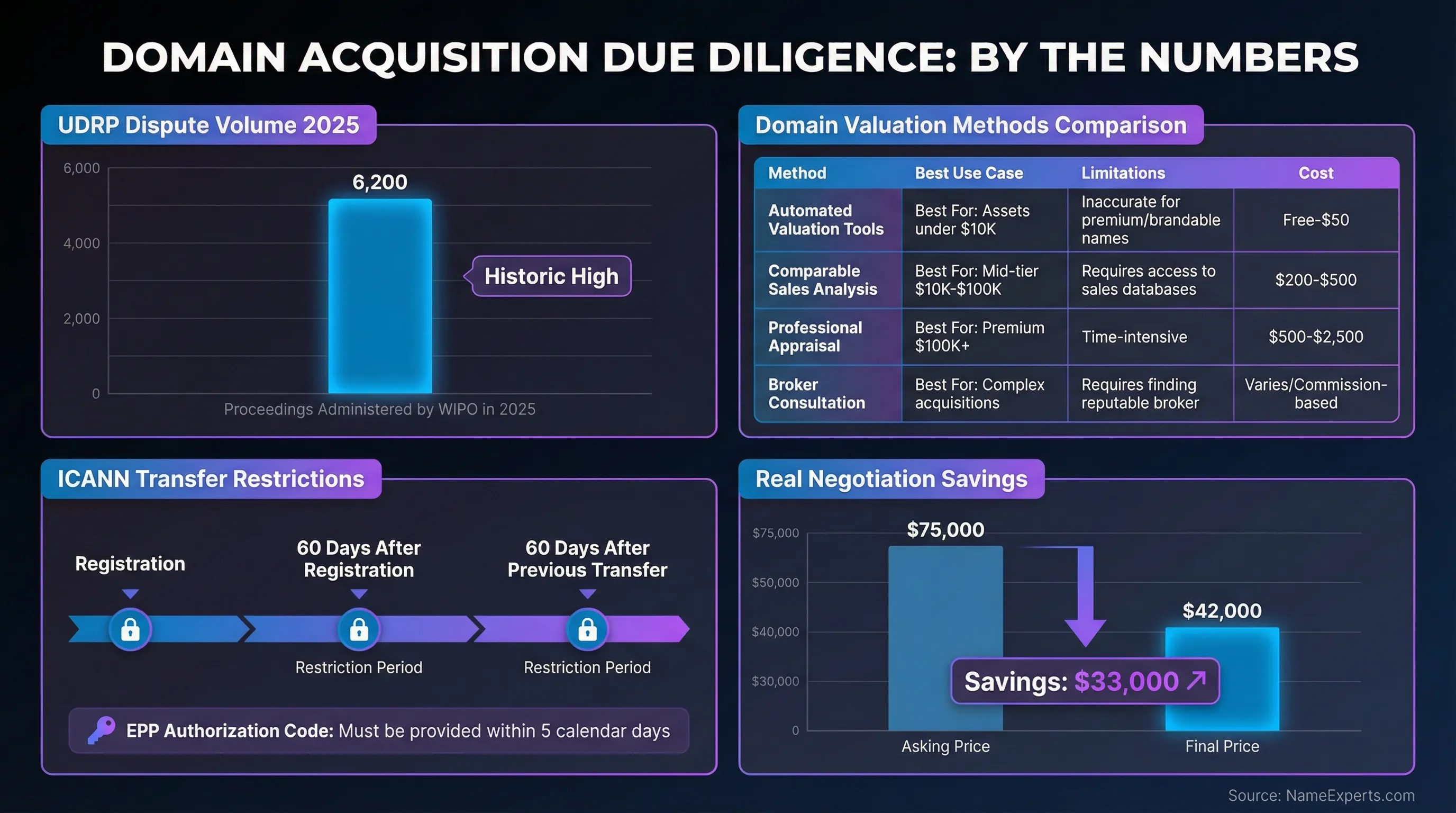
Understanding transfer protocols is essential for a smooth acquisition. According to ICANN policy, registrars must provide EPP authorization codes within five calendar days of a valid request, and transfers cannot occur within 60 days of registration or a previous transfer.
Check the registrar lock status—a locked asset is protected from unauthorized transfers but must be unlocked by the owner before transfer. Verify that the asset is not within the 60-day transfer restriction period. Understanding these technical requirements prevents delays and ensures the seller can actually complete the transfer when you're ready to close.
Escrow and Secure Transfer Protocols
Professional escrow services are non-negotiable for premium acquisitions. Escrow protects both parties by holding funds until the transfer is verified complete. The process typically involves: the buyer depositing funds with the escrow service, the seller initiating the transfer and providing the EPP code, the buyer confirming receipt and control, and finally the escrow service releasing funds to the seller.
Never wire funds directly to a seller before confirming transfer completion. At NameExperts, we coordinate escrow for all transactions to eliminate fraud risk and ensure secure transfers. Our 16+ years of experience means we know exactly how to structure the transfer process to protect your investment.

Don't Navigate Domain Transfers Alone
Verifying ownership, coordinating escrow, and ensuring secure transfers requires expertise that prevents costly mistakes. Our team handles every technical detail from WHOIS verification through post-transfer security—connect with our domain acquisition specialists to eliminate fraud risk and ensure your investment is protected from day one.
Trademark & Legal Risk Assessment
Trademark disputes represent the single greatest legal risk in acquisitions. Even if you purchase a name in good faith, a trademark holder can file a UDRP complaint and force transfer of the asset with zero compensation. Comprehensive trademark clearance is essential before committing to any purchase.
Comprehensive Trademark Clearance
Search the USPTO database for registered trademarks that match or closely resemble your target. Don't assume generic terms are safe—many common words have trademark protection in specific industries. For example, "Apple" is trademarked for technology, and "Delta" is protected for airlines.
Expand your search internationally using WIPO databases, especially if you plan to operate globally. Check trademark classifications relevant to your intended use. A name may be clear for use in one industry but infringe on existing marks in another. Professional trademark screening can identify conflicts that automated searches miss.
UDRP Case History and Dispute Risk
According to WIPO, more than 6,200 proceedings were administered in 2025 under the UDRP and related mechanisms, representing a historic high. This volume confirms that trademark disputes remain a significant risk for buyers.
Check dispute databases for any past UDRP complaints involving your target. Even if a previous complaint was denied, it signals potential ongoing risk. Common trademark pitfalls include typosquatting (registering misspellings of famous brands), incorporating brand names with generic terms, and registering geographic indicators that are protected.
Understanding dispute risk helps you negotiate better terms or walk away from problematic acquisitions. If you're acquiring a name with any trademark proximity, consider obtaining legal clearance documentation from the seller and potentially purchasing trademark insurance.
Existing Legal Encumbrances
Beyond trademarks, verify that the asset has no liens, court orders, or pending litigation. Request legal clearance documentation from the seller confirming no disputes, claims, or legal actions affect the property. This documentation should state that the seller has full authority to transfer ownership and that no third parties have claims against it.
If the seller cannot provide clear legal documentation, consider this a red flag. Professional brokers like NameExperts conduct legal screening as part of our acquisition process, identifying potential issues before they become your problem.
Domain Valuation & Price Validation
Understanding fair market value prevents overpaying and provides negotiation leverage. Valuation for standalone assets differs significantly from website valuations—you're assessing brandability, memorability, and market comparables rather than traffic and revenue.
Comparative Market Analysis
Use sales databases to benchmark pricing for similar names. According to industry research, the aftermarket has become a crucial part of the digital economy, with premium names often commanding high prices based on their branding potential.
Look for comparable sales with similar characteristics: length, extension, keyword strength, and industry relevance. A two-word .com in the fintech space will have different valuation benchmarks than a three-word .io in the tech startup sector. Average transaction values vary significantly by TLD—premium .com names command higher prices than newer extensions like .xyz or .online.
Intrinsic Value Factors
Several factors drive value beyond comparable sales. Length matters—shorter names are generally more valuable and memorable. Memorability depends on pronunciation, spelling simplicity, and brandability. Keyword strength relates to search volume and commercial intent for the terms involved.
Extension quality significantly affects value, with .com remaining the gold standard for commercial use. Industry-specific considerations also apply—a fintech-related name may be worth more to financial services companies than to e-commerce retailers. Assess these intrinsic factors alongside market comparables to determine fair value.
Professional Appraisal Standards
Automated valuation tools provide quick estimates but fall short for premium or highly brandable names. These tools use algorithmic approaches that cannot assess subjective factors like brand fit, emotional appeal, or strategic value to specific buyers.
Professional appraisals use a combination of comparable sales analysis, revenue potential modeling, and linguistic/branding factors. For acquisitions above $100,000, professional appraisal is worth the investment to ensure you're paying fair market value. At NameExperts, our appraisal service leverages real comparable sales data and 16+ years of market expertise to provide accurate valuations.
Negotiation Leverage from Valuation Data
Armed with comparable sales data and professional appraisal, you have concrete evidence to justify offers below asking price. Sellers often inflate asking prices hoping for uninformed buyers. Presenting market data demonstrates you've done your homework and establishes credibility in negotiations.
In one recent acquisition, our team used comparable sales analysis to negotiate a fintech asset from a $75,000 asking price down to $42,000—saving the client $33,000. This kind of savings is only possible when you understand true market value and can present evidence to support your offer.
| Method | Best For | Limitations | Typical Cost |
|---|---|---|---|
| Automated Valuation Tools | Assets under $10K | Inaccurate for premium/brandable names | Free-$50 |
| Comparable Sales Analysis | Mid-tier ($10K-$100K) | Requires access to sales databases | $200-$500 |
| Professional Appraisal | Premium ($100K+) | Time-intensive | $500-$2,500 |
| Broker Consultation | Complex acquisitions | Requires finding reputable broker | Varies/Commission-based |
Technical & Infrastructure Due Diligence
Even standalone acquisitions require technical verification to ensure you're receiving a clean asset without hidden issues that could affect future use or email deliverability.
Configuration and DNS Health
Check for existing DNS records, email configurations, and subdomains. Existing technical setups may need to be preserved or carefully migrated to avoid disrupting any services. Verify nameserver settings and ensure you'll receive complete DNS control upon transfer.
Understanding the current technical configuration helps you plan the transition and avoid unexpected downtime. If the seller has complex DNS setups, request documentation of all records and configurations before transfer.
SEO and Backlink Profile Assessment
Even if you're planning a fresh start, history matters. Use Ahrefs or Moz to check the backlink profile for spam penalties or toxic links. A clean backlink profile is an asset; a toxic one can damage your SEO efforts from day one.
Check Google Search Console for any manual penalties or security issues. If the seller can provide Search Console access, review the penalty history and indexing status. A penalized asset may take months to rehabilitate, affecting your timeline and strategy.
Email Deliverability and Reputation
Check blacklists like Spamhaus and SURBL to verify the asset isn't flagged for spam. A spam-flagged name damages email marketing effectiveness immediately—your messages will land in spam folders or be blocked entirely.
Email reputation affects business communications, customer outreach, and marketing campaigns. Verifying clean email reputation before purchase saves you from inheriting a damaged asset that requires extensive rehabilitation.
Expiration Dates and Renewal Terms
Understand the current registration period, expiration date, and auto-renewal settings. Multi-year registrations may affect transfer timing. Verify whether the registration will expire soon and whether you'll need to renew immediately after transfer.
Grace period and redemption period implications matter if the asset expires during negotiations. Understanding these timelines prevents last-minute complications and ensures smooth transfer completion.
Stop Guessing at Fair Market Value
Automated valuation tools can't assess the brandability, strategic value, and market positioning that determine what you should actually pay. Our 16+ years of market expertise and access to comprehensive comparable sales data means we know exactly what premium domains are worth—and we've saved clients tens of thousands by presenting evidence-based offers that sellers can't dismiss. Request a professional domain appraisal before you commit to any premium acquisition.
Seller Credibility & Transaction Red Flags
The seller's reputation and behavior during negotiations provide important signals about transaction risk. Professional sellers are transparent, responsive, and willing to use standard security protocols.
Seller Verification and Reputation Research
Check the seller's history on marketplaces and forums. Established sellers with positive feedback present lower risk than anonymous sellers with no transaction history. Look for reviews, completed sales, and community reputation.
Red flags include pressure tactics ("another buyer is interested"), unwillingness to use escrow, inconsistent communication, or reluctance to provide verification documents. Professional sellers understand that buyers need time for thorough verification and are comfortable with standard security protocols.
Documentation Requirements
Require a bill of sale, transfer confirmation, and trademark clearance letters. Written documentation protects both parties and provides legal recourse if disputes arise. Verbal agreements are worthless in disputes—everything should be documented in writing.
The purchase agreement should specify exactly what's included in the transfer, the timeline for completion, and remedies if issues arise post-transfer. Professional brokers like NameExperts provide standard purchase agreements that protect buyer interests while ensuring smooth transactions.
Common Acquisition Scams
According to cybersecurity research, phishing and related attacks frequently rely on compromised or fraudulent infrastructure. Hijacking remains a significant threat, with social engineering tactics used to steal high-value assets.
Common scams include fake broker intermediaries who collect payment but never deliver the asset, sellers who don't actually own the name they're selling, and hijacking attempts where criminals compromise registrar accounts to steal valuable properties. Always verify ownership independently and use escrow services to protect your funds.
The "fake broker" scam involves criminals posing as legitimate intermediaries. Verify any broker's credentials independently—check their website, reviews, and industry reputation. At NameExperts, our 16+ years in business and 200+ completed transactions provide the credibility and track record you need for confident acquisitions.
Post-Transfer Verification Checklist
After transfer completion, immediately verify several critical items. Confirm registrant information has updated to your details in the WHOIS record. Test control by making a minor DNS change to verify you have full administrative access. Update nameservers if needed and verify the change propagates correctly.
Secure the asset with two-factor authentication at your registrar to prevent unauthorized access. Enable registrar lock to protect against hijacking attempts. Set up auto-renewal to prevent accidental expiration. Document the transfer completion date and save all transfer confirmations for your records.
These post-transfer steps ensure you have complete control and that the asset is properly secured under your ownership. Skipping these verifications leaves you vulnerable to security issues or administrative problems.
The NameExperts Advantage in Acquisition Due Diligence
Professional brokerage transforms the acquisition process from a risky transaction into a strategic investment. Our 16+ years of experience and 200+ completed transactions mean we've seen every type of deal structure, negotiation tactic, and potential pitfall.
We provide comprehensive verification covering all aspects of this checklist—from trademark screening and ownership verification to valuation analysis and secure transfer coordination. Our stealth acquisition approach prevents price inflation by keeping your identity confidential during negotiations, often saving clients tens of thousands of dollars.
Notable clients including HBO/Max.com, Monday.com, TripAdvisor, and HubSpot trust NameExperts for acquisitions because we combine market expertise with hands-on service. We handle every detail from initial outreach through post-transfer verification, ensuring you acquire valuable assets at fair prices with zero fraud risk.
Whether you're acquiring a single premium name for brand protection or building a portfolio of digital assets, our end-to-end acquisition support makes the process efficient and secure. Contact us to discuss your acquisition needs and learn how our due diligence process protects your investment.
Acquire Premium Domains with Confidence, Not Risk
From trademark clearance and ownership verification to valuation analysis and secure escrow coordination, professional brokerage transforms risky transactions into strategic investments. Our stealth acquisition approach keeps your identity confidential to prevent price inflation, while our comprehensive due diligence process covers every item on this checklist—protecting you from legal disputes, fraud, and overpayment. With 200+ completed transactions for clients like HBO/Max.com, Monday.com, an
Schedule a consultation with our acquisition team







Frequently Asked Questions
Standard registration costs run $10-$20 annually for common extensions, while premium brandable names range from $1,000 to $100,000+ based on length, memorability, keyword strength, and comparable sales data in the aftermarket.
ICANN policies prevent permanent ownership—all registrations operate on renewable terms (typically 1-10 years), though you can maintain long-term control through consistent renewal and auto-renewal settings at your registrar.
Premium names deliver significant branding advantages through memorability and credibility, often appreciate in value over time, and can save substantial marketing costs—making them worthwhile investments for businesses prioritizing strong digital identity.
Including "LLC" in your web address is unnecessary and reduces memorability—your legal business structure belongs in footer disclosures and legal documents rather than your primary digital identity.