
The cost of failing to secure the right domain for enterprise brands extends far beyond the initial price tag. Companies lose credibility, traffic, and competitive advantage when their digital presence doesn't match their brand identity. Enterprise domain acquisition differs fundamentally from standard domain purchases—requiring strategic planning, valuation expertise, and often professional negotiation to avoid price inflation and protect corporate identity.
Key Takeaways
- Enterprises should pursue acquisition for brand launches, market expansion, defensive protection, and M&A scenarios
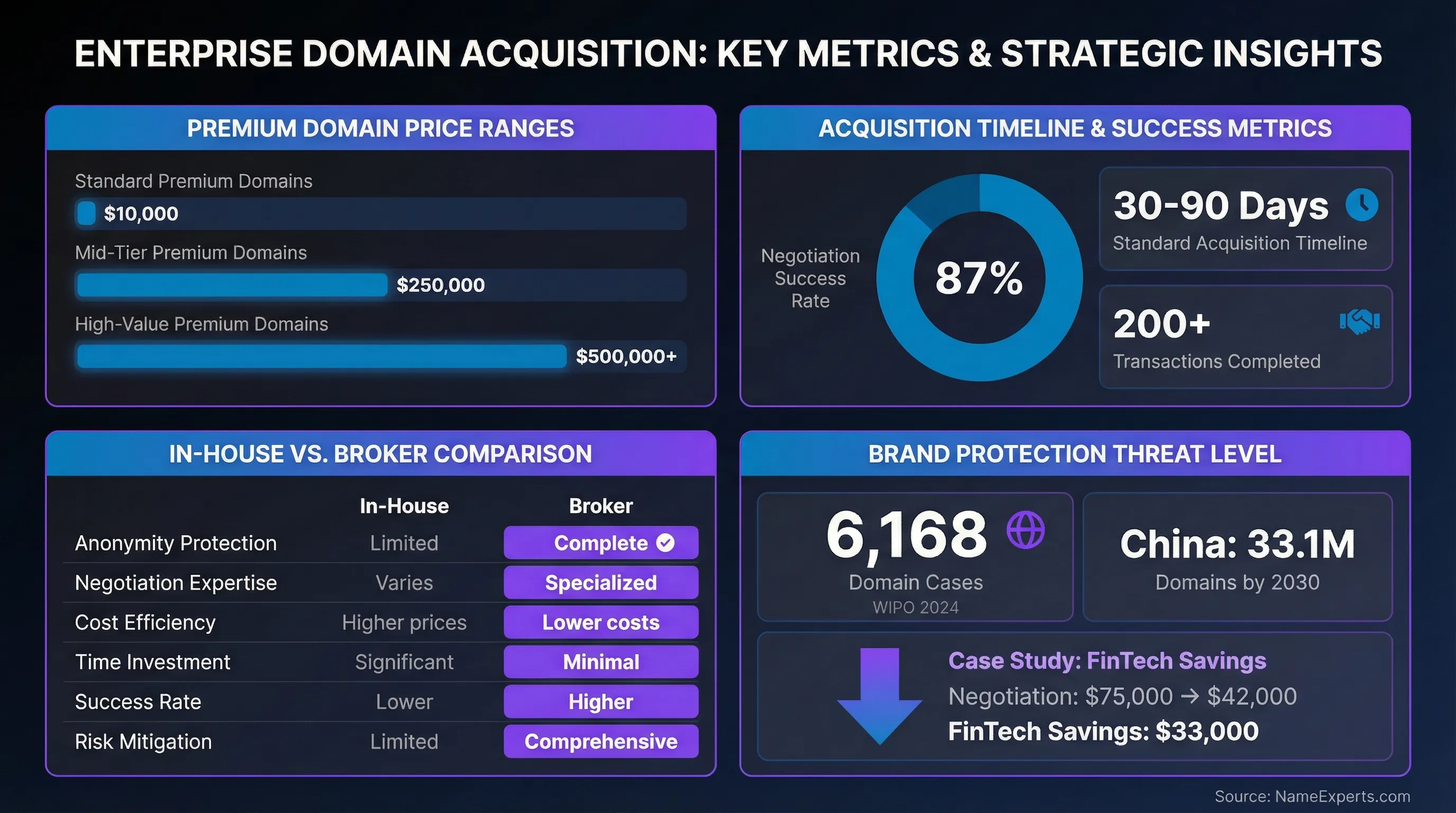
- Premium .com domains typically range from $10,000 to $500,000+ depending on brand alignment, traffic potential, and market demand
- Professional brokers provide anonymity that prevents price inflation when corporate interest becomes known
- The standard acquisition process takes 30-90 days for straightforward negotiations
- Stealth acquisition methodology protects buyer identity throughout the entire transaction
When Enterprises Should Pursue Domain Acquisition
Brand launches and rebranding initiatives create the most urgent need for exact-match domains. When companies introduce new products or rebrand existing services, securing the corresponding digital real estate becomes critical to marketing success. The domain serves as the foundation for all digital marketing efforts, from email campaigns to social media promotion.
Market expansion into new geographies presents another compelling scenario. Companies entering international markets benefit significantly from country-code top-level domains (ccTLDs) that build local trust and improve search visibility. According to market research, the global domain market includes significant regional variations, with China forecast to reach 33.1 million registered domains by 2030.
Defensive brand protection represents a proactive strategy for building a digital moat around intellectual property. Companies register domain variations to prevent competitors and malicious actors from capitalizing on brand recognition. WIPO received 6,168 domain name cases in 2024, demonstrating the ongoing threat to brand integrity.
Mergers and acquisitions scenarios frequently require domain consolidation. When companies merge, they must unify their digital presence under a cohesive brand strategy. This often involves acquiring premium domains that represent the combined entity or retiring legacy domains that no longer serve the business.
Q.How does an enterprise domain acquisition differ from a startup deal?
Startups need more guidance, while corporate buyers are more in tune with the general process. Corporate clients require more layers of communication and requirements and normally more parties involved in the process. It would not be uncommon to have 5-10 internal team members involved in the acquisition process. HubSpot recently completed an acquisition and had a total of eight team members involved. My last startup acquisition upgraded from a gTLD to a four-letter .com. I worked with one member of that team to complete the entire acquisition.
 Joe Uddeme, Director and Principal, Name Experts
Evaluating Domain Value and Acquisition Feasibility
Brand alignment stands as the primary valuation factor. Domains that exactly match a company's name or core product offering command premium prices because they eliminate customer confusion and maximize type-in traffic. The closer the match between domain and brand, the higher the strategic value.
Traffic potential and existing backlink profiles significantly influence pricing. Domains with established visitor patterns and authoritative backlinks provide immediate SEO benefits. The .com TLD maintains premium status due to universal recognition and trust, though category-specific extensions gain traction in certain industries.
Ownership investigation requires thorough WHOIS analysis and historical research. Companies must verify legitimate ownership, identify any legal encumbrances, and assess the seller's motivation. Legal considerations in transfers include ensuring clean title and avoiding domains subject to trademark disputes.
Market pricing benchmarks vary dramatically based on domain characteristics. Single-word .com domains in competitive industries can exceed $1 million, while longer descriptive domains may sell for $5,000-$50,000. Several factors inflate prices: corporate buyer detection, competitive bidding situations, and seller awareness of strategic value to specific companies. Understanding how to value a domain name using comparable sales data and professional appraisal methods ensures you pay fair market value rather than inflated corporate rates.

Protect Your Identity, Protect Your Budget
When corporate buyers approach domain owners directly, prices can inflate dramatically. Our stealth acquisition methodology keeps your identity completely anonymous throughout negotiations, ensuring you pay fair market value—not inflated corporate rates. With 200+ successful transactions and an 87% negotiation success rate, we've saved clients tens of thousands on strategic domain acquisitions.
In-House vs. Broker-Led Acquisition: A Decision Framework
| Criteria | In-House Acquisition | Professional Broker |
|---|---|---|
| Anonymity Protection | Limited—corporate identity often revealed | Complete—buyer identity never disclosed |
| Negotiation Expertise | Varies by team experience | Specialized domain negotiation skills |
| Cost Efficiency | No broker fees but higher purchase prices | Broker fees offset by lower acquisition costs |
| Time Investment | Significant internal resource allocation | Minimal client time required |
| Success Rate | Lower for complex negotiations | Higher due to industry relationships |
| Risk Mitigation | Limited legal and escrow expertise | Comprehensive transaction protection |
When to Handle In-House
- The domain is available for standard registration through registrars
- Current owner has publicly listed the domain for sale with transparent, acceptable pricing
- Low-value tactical domains under $5,000 where anonymity provides minimal benefit
When to Use a Broker
- High-value strategic domains where anonymity prevents price inflation from seller awareness of corporate interest
- Complex negotiations with unresponsive or sophisticated domain investors who require professional outreach
- Portfolio acquisitions requiring industry relationships and bulk negotiation expertise
- Situations requiring legal expertise, such as UDRP proceedings or trademark considerations
With 16+ years of experience and 200+ completed transactions, our team at NameExperts specializes in stealth acquisition methodology. We saved a fintech startup $33,000 on a domain acquisition by negotiating from $75,000 down to $42,000 using comparable sales data and strategic positioning. Our notable clients include HBO/Max.com, Monday.com, TripAdvisor, and HubSpot.
Don't Navigate the Domain Marketplace Alone
The Wild West of domain negotiations requires specialized expertise, industry relationships, and legal knowledge most enterprises don't have in-house. Our team brings 16+ years of experience negotiating with sophisticated domain investors, handling complex transfers, and protecting your interests from initial outreach through final DNS migration. We've helped HBO/Max.com, Monday.com, TripAdvisor, and HubSpot secure their strategic domains.
The Acquisition Process
Strategic assessment begins with gap analysis identifying which domains the enterprise should own to protect brand equity. This includes evaluating budget parameters, timeline constraints, and the strategic importance of each target. Companies must prioritize acquisitions based on business impact and resource availability.
Ownership investigation and outreach involves anonymous contact with current registrants to assess willingness to sell. Professional brokers maintain networks of domain investors and understand industry norms for initial outreach. This phase determines whether acquisition is feasible and what price range might be realistic.
The negotiation phase requires realistic budgeting informed by comparable sales data. Proactive domain acquisition represents a cost-effective strategy compared to reactive brand protection measures. Effective domain negotiation strategies include understanding market value, maintaining anonymity, and knowing when to walk away from overpriced assets.
Secure transfer utilizes escrow services to protect both parties during the transaction. Legal documentation formalizes the agreement, and DNS migration ensures seamless technical transfer. Professional brokers handle all aspects of this process, from fund management to registry-level transfers.
Timeline expectations for straightforward acquisitions typically span 30-90 days. Complex negotiations involving multiple stakeholders, legal review, or unresponsive sellers may extend several months. Our portfolio demonstrates an 87% negotiation success rate across hundreds of transactions.
Strategic domain acquisition requires evaluation expertise, negotiation skill, and often anonymity to achieve optimal pricing. Whether you're launching a new brand, expanding internationally, or protecting your digital presence, working with experienced domain brokers ensures you secure the domains that matter most to your business. Contact NameExperts to discuss your acquisition needs and receive a customized strategy for your domain portfolio.
Work With a Domain Expert
Whether you're launching a new brand, expanding into international markets, or protecting your digital real estate, the right domain acquisition strategy makes all the difference. Don't risk price inflation from revealed corporate interest or overpay due to lack of market expertise. Our no-bullshit approach combines complete anonymity protection, specialized negotiation skills, and 16+ years of industry relationships to secure the domains that matter most to your business—at fair market prices.
Get Started Free







Frequently Asked Questions
Domain acquisition is the process of purchasing an already-registered domain name from its current owner, typically involving negotiation and transfer through escrow services to secure premium digital real estate that matches your brand.
An enterprise domain refers to a premium, strategically valuable web address that aligns with a company's brand identity and supports large-scale business operations, often requiring professional acquisition due to high value and competitive interest.
Domain flipping is legal when conducted ethically, but purchasing domains that infringe on existing trademarks with intent to profit from brand confusion constitutes cybersquatting and violates the Anticybersquatting Consumer Protection Act.
Companies purchase domains to establish brand-aligned digital presence, eliminate customer confusion, capture type-in traffic, protect intellectual property from competitors, and support market expansion or rebranding initiatives.