
The domain you want is already taken—but that doesn't mean you can't acquire it. Most owners will consider selling if approached correctly, and with the right negotiation strategy, you can secure premium names at fair prices. Whether you're pursuing a single-word .com or a brandable keyword domain, understanding how to research, approach, and close deals is essential for building your digital presence without draining your budget.
Key Takeaways
- Always research comparable sales before making an offer to establish fair market value
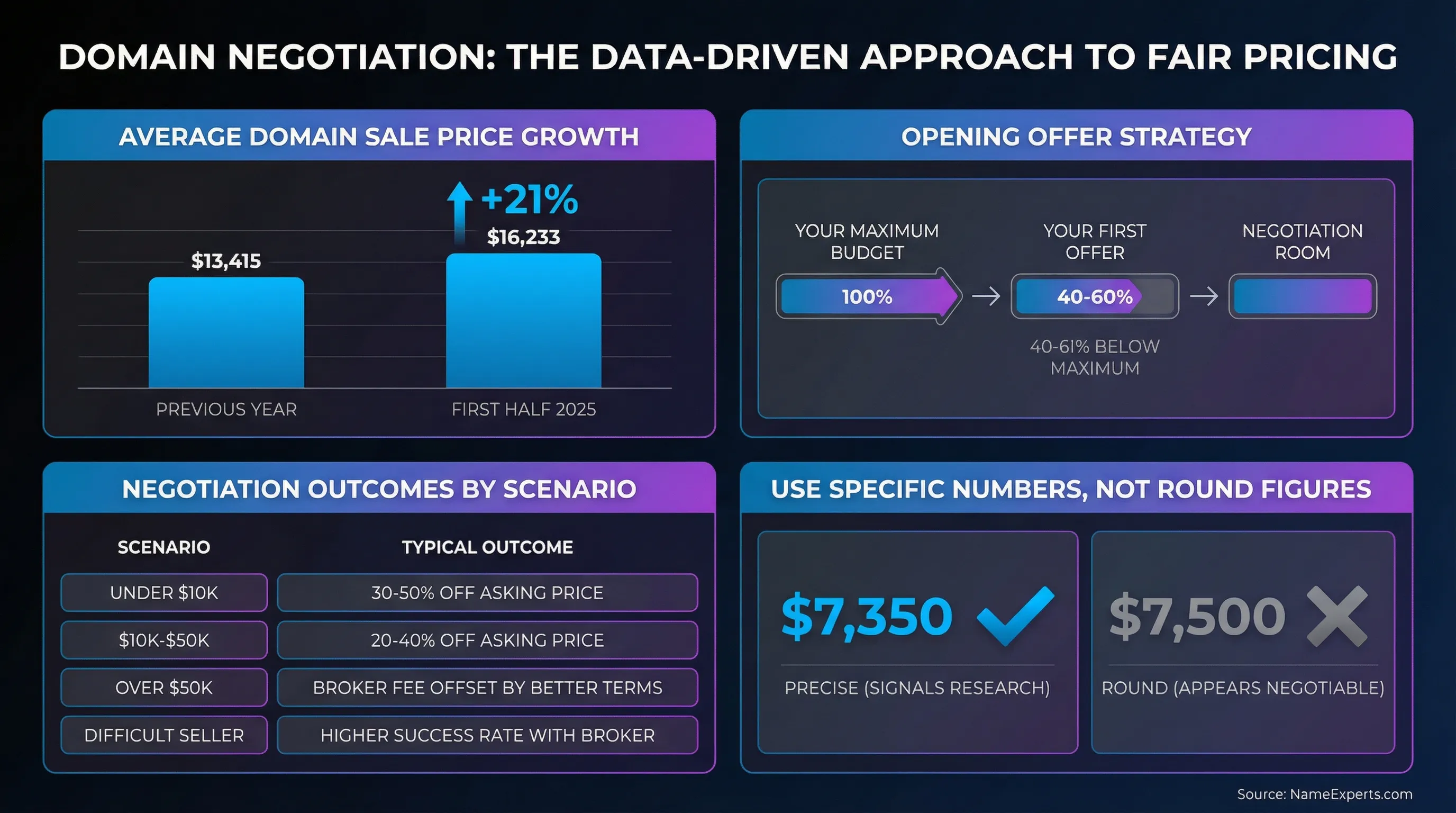
- Start 40-60% below your maximum budget to leave negotiation room
- Use specific numbers ($7,350) during negotiation, not round numbers ($7,500)
- Professional brokers add value for domains over $15K or when dealing with difficult sellers
- Never pay without escrow protection (Escrow.com or similar services)
Pre-Negotiation Research & Preparation
Effective negotiation begins long before your first contact with the seller. Understanding true market value and identifying seller motivations gives you the foundation for productive discussions.
Determine True Market Value
Start by examining comparable sales data to establish a realistic price range. According to industry analysis, the average domain sale price reached $16,233 in the first half of 2025, up 21% from the previous year. However, this aggregate figure masks tremendous variation based on specific characteristics.
Several factors drive pricing: length (shorter is better), keyword relevance and search volume, extension (.com commands premium pricing), brandability, existing traffic, and historical significance. A three-letter .com will command significantly more than a hyphenated five-word alternative, even if both relate to your business.
Professional appraisal tools provide algorithmic estimates, but these should serve as starting points rather than definitive valuations. What matters most is what the name is worth to your specific business and what comparable names have actually sold for recently. At NameExperts, our professional valuation reports provide negotiation leverage backed by 16+ years of market data and real transaction history.
Identify the Seller Type
Not all owners approach sales the same way. Understanding seller psychology helps you adapt your tactics:
Domain Investors: These owners acquired names specifically for resale. They understand market dynamics and typically respond to data-backed offers. They're motivated to sell but want fair market value.
Former Business Owners: These sellers previously used the name for an active business but have since moved on, rebranded, or been acquired. They often have reasonable expectations and may be willing to negotiate if they're not actively using it.
Holdouts: These owners plan future use but haven't launched yet. They're less motivated to sell and may ask premium prices or request unusual terms like retaining partial ownership.
Each type requires different approaches. Investors respond to market data, former owners to straightforward offers, and holdouts may need creative deal structures to consider selling.
Build Your Leverage
Before reaching out, assemble your negotiation ammunition. Document comparable sales from the past 12-24 months showing similar names, keywords, and extensions. If you hold relevant trademarks or intellectual property, note these—they demonstrate you're the most viable buyer and may strengthen your position legally.
Establish your absolute maximum budget and stick to it. This prevents emotional decisions during negotiations. Remember that your first offer should be 40-60% below this ceiling, leaving room for counteroffers without exceeding your limit.
Don't Navigate the Domain Marketplace Alone
Researching comparable sales and determining fair market value takes expertise most buyers don't have. Our professional domain appraisals give you negotiation leverage backed by 16+ years of real transaction data—so you know exactly what a domain is worth before you make your first offer.
Transparency and communication are critical when negotiating. Amateurs tend to shoot themselves in the foot, attempting to low-ball an owner to acquire their domain name. That’s a surefire way to get ignored by most domain owners.
 Joe Uddeme, Director and Principal, Name Experts
Making Contact & Opening the Negotiation
How you initiate contact significantly impacts the negotiation trajectory. A professional, strategic approach opens doors that aggressive or amateur tactics close.
Find the Domain Owner
Start with WHOIS lookup to identify registrant information. Depending on privacy settings, you may see contact details or only a privacy service placeholder. If the name is parked with a "For Sale" message, contact information often appears directly on the landing page.
When privacy protection blocks direct contact, look for alternative paths: contact forms on the parked page, social media accounts associated with the name, or reaching out through the registrar's privacy service. For high-value acquisitions where maintaining confidentiality matters, consider using stealth acquisition services that protect your identity and prevent price inflation.
Craft Your Initial Outreach
Keep your first message brief, professional, and strategic. Avoid revealing your budget, urgency, or the full extent of your interest. Never disparage the owner for "sitting on" the name or call them a squatter—this starts negotiations on hostile footing.
A simple, effective approach: "I'm interested in purchasing [domain.com]. Is this available for sale? If so, please let me know your asking price."
The goal is getting the seller to name their price first. You never know when their expectations are lower than yours. If they ask what you're willing to pay, deflect politely: "I'd prefer to hear your asking price first to see if we're in the same ballpark."
Reading the Response
The seller's reply reveals important information. An extremely high asking price may indicate testing the market rather than serious intent to sell. No response after 7-10 days warrants a polite follow-up—many successful deals begin with persistent but respectful communication.
If the price seems reasonable or negotiable, you're ready to move forward. If it's wildly inflated compared to your research, you'll need to deploy data-backed negotiation tactics.
| Scenario | DIY Approach | When to Use Broker | Typical Outcome |
|---|---|---|---|
| Domain under $10K, responsive seller | Recommended | Rarely needed | 30-50% off asking price |
| Domain $10K-$50K, straightforward | Viable with research | Optional for leverage | 20-40% off asking price |
| Domain over $50K | Possible but risky | Highly recommended | Broker fee offset by better terms |
| Difficult/unresponsive seller | Time-consuming | Recommended | Higher success rate with broker |
| Stealth acquisition needed | Identity may leak | Essential | Protects competitive advantage |
Negotiation Tactics That Work
Once discussions begin, specific strategies help you reach favorable terms without overpaying or losing the deal.
Anchor with Data, Not Desperation
Lead with comparable sales evidence rather than emotional appeals. Research on the anchoring effect shows that the first number mentioned in a negotiation significantly influences the final outcome. When a seller opens with an inflated price, counter with specific market data.
Example: "I've researched recent sales of similar domains. Three-word .com domains in this industry sold for $2,500-$4,200 in the past year. Based on that data, I'm offering $3,150."
Notice the specific number rather than a round figure. Studies indicate that precise numbers ($3,150 vs. $3,000) signal calculated valuations and generate smaller counteroffers because they appear more researched and less negotiable.
Strategic Offer Progression
Your first offer should be 40-60% below your maximum budget—not insultingly low, but leaving substantial room for negotiation. Expect 2-3 rounds of counteroffers before reaching agreement.
If the seller counters at $15,000 and your maximum is $10,000, don't immediately jump to your ceiling. Move incrementally: perhaps counter at $7,500, then $8,750, then $9,500. This demonstrates you're negotiating in good faith while preserving budget flexibility.
Never make your first offer your "final offer." This eliminates negotiation space and may offend sellers who expect back-and-forth discussion. Similarly, avoid artificial deadlines ("decide in 48 hours") unless you're genuinely prepared to walk away—empty threats damage credibility.
Leverage Time & Alternatives
Demonstrate that you're a viable buyer without appearing desperate. Mention that you're considering alternative names or approaches. This creates subtle pressure without ultimatums.
Be genuinely willing to walk away. Most premium names have limited buyer pools—you may be the only serious inquiry the owner has received in months or years. If you walk away from an unreasonable price, there's a strong chance the seller will reconsider and reach out with a better offer.
Patience works in your favor unless you face genuine time pressure (like a product launch). In most cases, taking a week to consider a counteroffer costs nothing and may prompt the seller to sweeten their terms.

Creative Deal Structures
When price negotiations stall, consider alternative structures that provide value to both parties:
Payment Plans: Offer to pay the full asking price in installments over 12-24 months. This reduces your immediate cash outlay while giving the seller their desired price. Ensure the agreement specifies when ownership transfers—typically upon final payment, though you may be able to use the name earlier.
Lease-to-Own: Structure an arrangement where you manage DNS and use the name while making payments, with ownership transferring upon completion. This protects the seller if you default while giving you operational control.
Bundled Acquisitions: If the seller owns multiple related names, offer to purchase several together at a package discount. This increases the seller's total revenue while reducing your per-domain cost.
When dealing with difficult sellers, premium names over $15K, or corporate-held domains, NameExperts specializes in complex negotiations where seller psychology and market positioning matter. Our stealth acquisition approach has saved clients significant sums—including securing a domain for $42,000 against a $75,000 asking price by leveraging comparable sales data and strategic negotiation.
Closing the Deal Safely
Once you've agreed on terms, protecting yourself during the transfer process is critical.
Never Pay Without Escrow
Always use escrow services that specialize in domain transactions. Escrow.com is the industry standard, holding your payment securely until the seller transfers the name to your registrar account. Only after you confirm successful transfer does the escrow service release funds to the seller.
The typical process takes 5-10 business days: you deposit funds, the seller initiates transfer, you accept the transfer at your registrar, you confirm receipt with escrow, and escrow releases payment. This protects both parties and provides recourse if problems arise.
Never wire money directly to a seller or pay through non-specialized payment platforms. Domain theft and fraud are real risks, and escrow services exist specifically to prevent them.
Verify Before Release
Before confirming receipt with escrow, verify several critical items: the name has transferred to your registrar account with full ownership rights, no trademark issues or penalties are attached to it, and the transfer includes all associated assets if applicable (like existing content or social media handles).
Check the domain's history to ensure it hasn't been used for spam or malicious purposes that could affect its reputation with search engines or email providers. Tools for checking history can reveal past usage that might impact your plans.
For acquisitions over $15K or when stealth is critical to prevent competitive bidding, professional representation often pays for itself through better terms and reduced risk. NameExperts' 16+ years of experience and 200+ completed transactions include work with major brands like HBO/Max.com, Monday.com, TripAdvisor, and HubSpot—demonstrating our ability to handle complex, high-value negotiations successfully.
The right name is worth pursuing, but only at the right price. With thorough research, strategic communication, and patient negotiation, you can secure premium domains that build your brand without breaking your budget. Whether you handle the process yourself or engage professional representation, understanding these principles ensures you approach each opportunity with confidence and achieve outcomes that serve your business for years to come.
Protect Your Identity, Prevent Price Inflation
When sellers know who's buying—especially if you're a funded startup or established brand—prices skyrocket. Our stealth acquisition service keeps your identity completely confidential throughout negotiations, preventing the price inflation that costs buyers thousands in unnecessary premiums.
Work With a Domain Expert
Negotiating domain prices without overpaying requires market expertise, strategic positioning, and the confidence to walk away from bad deals. Whether you need a professional valuation to anchor your negotiations, stealth representation to protect your identity, or expert guidance to close a complex six-figure acquisition, NameExperts brings 16+ years of experience and 200+ successful transactions to your corner. Get the domain you need at a price that makes sense—without the risk of going it al
Get Started Free







Frequently Asked Questions
Yes, most domain owners will negotiate if approached professionally with market data—expect to secure 20-50% off the initial asking price through strategic counteroffers and comparable sales evidence.
Premium domains averaged $16,233 in early 2025, though prices vary dramatically based on length, keywords, and extension—a short .com with strong brandability commands significantly more than longer alternatives, while registration-only names cost $10-$20 annually.
Lead with comparable sales data rather than emotional appeals, use specific numbers ($7,350 instead of $7,500) to signal research, and start 40-60% below your maximum budget while demonstrating you're a serious buyer willing to walk away if terms don't align.
Always use specialized escrow services like Escrow.com—they hold your payment until the seller completes the transfer to your registrar account, protecting both parties from fraud and ensuring you receive full ownership rights before funds are released.