

Key Takeaways
- Domain extensions impact brand perception more than SEO—choose strategically to build trust and credibility with your audience.
- New TLDs offer better name availability but require careful evaluation of renewal costs and market perception.
- Industry-specific extensions can enhance credibility in niche markets when aligned with your business goals.
- Geographic extensions matter for local businesses targeting specific regions or countries.
- Cost considerations extend beyond registration—renewal and transfer fees can vary dramatically across extensions.
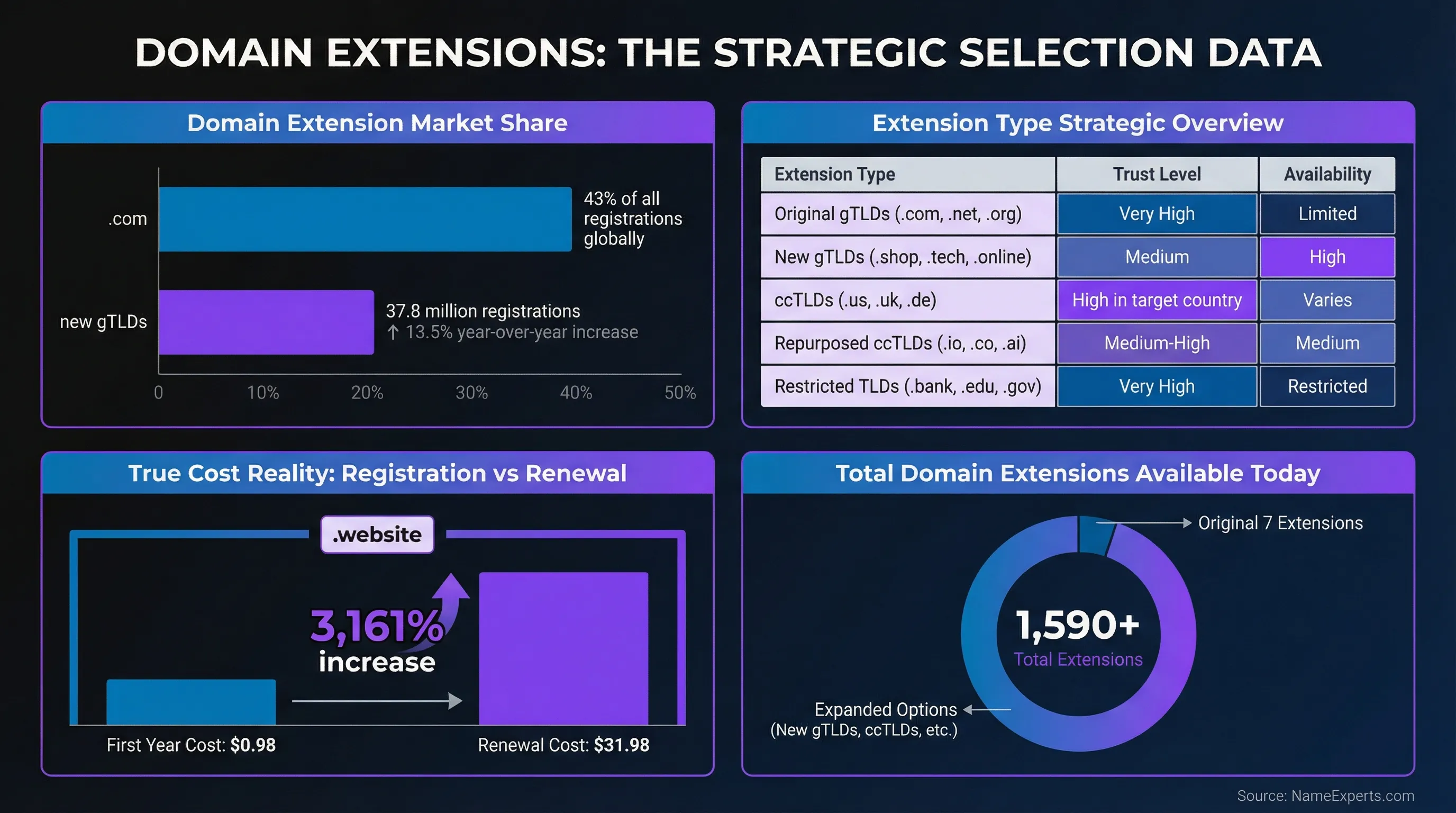
With over 1,590 domain extensions available today, choosing the right one for your business can feel overwhelming. That hidden decision at the end of your web address—the .com, .net, or .shop—carries more weight than most business owners realize. It shapes first impressions, influences click-through rates, and signals credibility before visitors even reach your site.
The domain landscape has evolved dramatically. While .com still dominates with approximately 43% of all registrations globally, hundreds of new options have emerged to serve specific industries, communities, and purposes. This expansion creates both opportunity and confusion. How do you navigate this crowded space to find the extension that strengthens your brand rather than undermining it?
With 16+ years of experience helping businesses make strategic domain decisions across 200+ transactions, we've seen how the right extension choice impacts everything from investor perception to customer trust. This guide cuts through the noise to help you make an informed decision based on your business type, industry, and long-term goals.
Understanding Domain Extension Categories
Before diving into specific recommendations, it's essential to understand how these extensions are organized and regulated. The domain system operates through a hierarchical structure managed by ICANN (Internet Corporation for Assigned Names and Numbers), with different categories serving distinct purposes.
Generic Top-Level Domains (gTLDs)
The original seven extensions—.com, .net, .org, .edu, .gov, .mil, and .int—launched the modern internet. These established options still carry significant recognition and trust. The .com extension remains the default choice for commercial entities, while .org has become synonymous with nonprofit organizations despite never being restricted to them.
Following ICANN's new gTLD program expansion, according to ICANN, hundreds of additional options became available. According to the Domain Name Industry Brief, new generic TLD registrations reached 37.8 million by the end of the first quarter of 2025, representing a 13.5% year-over-year increase. This growth reflects increasing acceptance of alternatives to traditional extensions.
These newer options range from descriptive (.shop, .store, .tech) to creative (.xyz, .online, .site). While they offer better availability for desirable names, they come with trade-offs in recognition and renewal costs that require careful evaluation.
Country Code Top-Level Domains (ccTLDs)
Two-character extensions represent specific countries or territories. Examples include .us (United States), .uk (United Kingdom), .de (Germany), and .ca (Canada). According to Statista, these extensions remain popular for businesses targeting specific geographic markets.
Some country codes have been creatively repurposed beyond their geographic intent. The .io extension (British Indian Ocean Territory) has become the de facto choice for tech startups, while .co (Colombia) serves as a shorter alternative to .com. Montenegro's .me extension works perfectly for personal branding and portfolios.
Registration requirements vary significantly. Some countries restrict their extensions to residents or registered businesses within their borders, while others allow open registration. Always verify eligibility requirements before committing to a specific country code.
Sponsored and Restricted TLDs
Certain extensions require verification of credentials or membership in specific communities. The .bank extension, for example, demands proof of banking licenses and implements enhanced security measures. Similarly, .edu restricts registration to accredited post-secondary institutions.
These restricted options offer a significant trust advantage. When visitors see a .bank or .edu domain, they know the organization has been verified. For eligible businesses, this built-in credibility can justify the additional verification requirements and costs.
| Extension Type | Examples | Best For | Trust Level | Availability |
|---|---|---|---|---|
| Original gTLDs | .com, .net, .org | Established businesses, broad audiences | Very High | Limited |
| New gTLDs | .shop, .tech, .online | Specific industries, creative branding | Medium | High |
| ccTLDs | .us, .uk, .de | Local businesses, geographic targeting | High (in target country) | Varies |
| Repurposed ccTLDs | .io, .co, .ai | Tech startups, modern brands | Medium-High | Medium |
| Restricted TLDs | .bank, .edu, .gov | Verified organizations only | Very High | Restricted |

Strategic Selection Framework: How to Choose Your Extension
Selecting the right extension requires aligning your choice with your business model, target audience, and brand positioning. Rather than defaulting to what's available, consider these strategic factors to make an informed decision.
Business Type Considerations
Your business model should guide your extension choice. E-commerce businesses benefit from extensions that immediately signal shopping capability. Options like .shop, .store, and .online clearly communicate commercial intent, though .com remains the gold standard for established online retailers seeking maximum trust.
Tech startups face a different calculus. The .io extension has become so associated with technology companies that it signals innovation and technical credibility. The newer .ai extension serves a similar purpose for artificial intelligence companies, despite higher registration costs. For software-as-a-service companies, .app provides a clear signal about product type while maintaining professional credibility.
Professional services require extensions that convey expertise and trustworthiness. Traditional options like .com and .net work well, but industry-specific alternatives like .law, .consulting, or .finance can enhance credibility when targeting specialized markets. The key consideration is whether your target clients will recognize and trust the extension you choose.
Local businesses targeting specific geographic areas should seriously consider country code extensions. A .ca domain signals Canadian focus, while .uk immediately identifies British businesses. These extensions can improve local search visibility and build trust with regional customers who prefer supporting local companies.
Nonprofit organizations have traditionally used .org, and this extension still carries strong associations with charitable causes. However, the restriction has never been enforced, so the credibility comes from convention rather than verification. For nonprofits, the .org extension remains the safest choice for building donor trust.
Brand Identity Alignment
Your extension should reinforce your brand message, not contradict it. Creative agencies might successfully use .design or .studio to emphasize their artistic focus. A fitness business could leverage .fit or .fitness to immediately communicate their industry. These descriptive extensions work when they align perfectly with your brand positioning.
However, creative extensions can backfire when they create confusion or appear unprofessional. A financial advisory firm using .xyz might save money on registration but lose credibility with conservative clients who expect traditional business markers. The extension becomes part of your brand identity—choose one that strengthens rather than weakens your positioning.
When helping a fintech startup evaluate their options, we discovered that investor perception heavily favored .ai for innovation signaling, despite .com's broader recognition. The extension choice became part of their funding story, demonstrating forward-thinking technology adoption. This strategic alignment justified the premium pricing.
Market Perception and Trust Factors
Consumer trust varies significantly across extensions. According to the Digital Trust Index, trust in digital services continues to evolve as consumers become more aware of online threats. While the study focuses on broader digital trust, extension choice contributes to that initial credibility assessment.
Established extensions benefit from familiarity. Users instinctively trust .com, .net, and .org because they've encountered them for decades. Newer extensions must overcome this familiarity gap. Some have succeeded—.io now carries strong positive associations in tech circles. Others struggle with perception issues, particularly extensions associated with spam or low-quality content.
Age demographics matter. Younger audiences show more willingness to trust newer extensions, while older demographics often prefer traditional options. If your target market skews conservative or older, prioritizing established extensions makes strategic sense regardless of availability challenges.
Industry-specific trust signals also play a role. A .tech domain might enhance credibility for a software company but seem odd for a law firm. A .shop extension works perfectly for retail but would confuse visitors to a consulting site. The extension should match visitor expectations for your industry.
Availability and Defensive Registration Strategy
One major advantage of newer extensions is availability. Finding your desired name with a .com extension has become increasingly difficult, while alternatives often have the exact name you want available. This availability can be worth the trade-off in recognition, particularly for businesses with unique or creative names.
Defensive registration—securing your brand across multiple extensions—provides protection against confusion and competition. If you secure YourBrand.com as your primary domain, also registering YourBrand.net, YourBrand.org, and relevant industry extensions prevents competitors or bad actors from capitalizing on your brand recognition.
The cost of defensive registration varies dramatically. Protecting your brand across ten extensions might cost anywhere from $150 to $1,000+ annually depending on which extensions you choose. Prioritize extensions where confusion would most likely occur—typically the most popular alternatives in your industry or region.
When choosing a premium domain name becomes critical to your brand strategy, our domain consulting services help you evaluate not just the name, but the optimal extension for your market positioning. We've guided hundreds of businesses through strategic decisions that impact their long-term brand equity, considering factors like industry perception, geographic targeting, and competitive landscape.
SEO and Technical Considerations
One of the most common questions about extension choice concerns search engine optimization. Business owners worry that choosing the wrong extension will hurt their search rankings. The reality is more nuanced than most people expect.
The Real SEO Impact
Google has repeatedly stated that they treat all generic top-level domains equally in their ranking algorithms. A .shop domain has the same ranking potential as a .com domain, all other factors being equal. The extension itself doesn't directly influence where your pages appear in search results.
However, indirect effects matter significantly. If users are less likely to click on your search result because they don't recognize or trust your extension, your click-through rate suffers. Lower click-through rates can signal to search engines that your result isn't meeting user needs, potentially impacting rankings over time.
Geographic targeting represents one area where extension choice does matter. Country code extensions send strong signals about geographic relevance. A .ca domain will typically perform better in Canadian search results, while a .uk domain gets preference in British searches. This geographic boost can be valuable for local businesses but limiting for companies with international ambitions.
The keyword-in-extension myth persists despite being debunked. Having .pizza in your domain doesn't help you rank for pizza-related searches. Google confirmed years ago that keywords in new gTLDs provide no ranking advantage. Choose extensions based on branding and trust, not imagined SEO benefits.
Technical Factors to Consider
Beyond SEO, several technical considerations affect extension choice. DNSSEC (Domain Name System Security Extensions) support varies across extensions. This security protocol helps prevent certain types of attacks, and while not critical for all businesses, it matters for organizations handling sensitive data.
WHOIS privacy availability differs by extension. Some registries include privacy protection by default, while others charge extra or don't offer it at all. If keeping your registration information private matters to you, verify privacy options before committing to an extension.
Transfer policies and restrictions vary significantly. Some extensions make transferring between registrars straightforward, while others impose waiting periods or additional requirements. Understanding these policies upfront prevents frustration if you later want to move your domain to a different provider.
Registry stability deserves consideration, particularly for newer extensions. Some registries have solid backing and long-term viability, while others operate on shakier ground. While rare, extensions can be discontinued, forcing domain holders to migrate. Choosing extensions operated by established registries reduces this risk.
| Technical Feature | Why It Matters | Extensions with Strong Support |
|---|---|---|
| DNSSEC | Enhanced security against DNS attacks | .com, .net, .org, most ccTLDs |
| WHOIS Privacy | Protects personal information from public databases | Most gTLDs, varies by registrar |
| Easy Transfers | Flexibility to change registrars | .com, .net, .org, .io |
| IPv6 Support | Future-proofing for internet protocol changes | All major extensions |
| Registry Stability | Long-term domain availability assurance | Original gTLDs, major ccTLDs |
Struggling to Find the Perfect Domain for Your Brand?
With 16+ years of experience in domain acquisitions, we help businesses navigate the complex landscape of premium domains and extensions. Our boutique brokerage service specializes in stealth acquisitions—securing the exact domain you need at fair market prices while maintaining complete anonymity to prevent price inflation.
Cost and Long-Term Considerations
The sticker price you see when registering a domain rarely tells the complete financial story. Understanding the total cost of ownership over multiple years prevents unpleasant surprises and helps you make economically sound decisions.
True Cost Analysis
Registration pricing often differs dramatically from renewal pricing. Registrars frequently offer promotional first-year rates to attract customers, then charge significantly more for renewals. A .website domain might cost $0.98 for the first year but jump to $31.98 upon renewal—a 3,161% increase that catches many domain owners off guard.
Premium domain pricing adds another layer of complexity. Even within the same extension, certain desirable names command premium prices set by the registry or current owner. A common word or phrase in .com might cost thousands or even millions, while the same name in a newer extension could be available at standard registration rates.
Transfer fees vary by extension and registrar. Some providers include a one-year extension with transfers, effectively making the transfer free. Others charge transfer fees on top of renewal costs. When calculating long-term costs, factor in the flexibility to move your domain if you find better service or pricing elsewhere.
Multi-year registration discounts can provide savings but also lock you into longer commitments. If you're confident in your extension choice, registering for multiple years upfront often reduces the annual cost. However, this strategy backfires if you later decide to rebrand or switch extensions.
Long-Term Ownership Considerations
Registry stability affects long-term planning. While established extensions like .com have decades of proven reliability, newer extensions operated by smaller registries carry more uncertainty. Before committing to a less common extension, research the registry operator's financial stability and track record.
Price increase protections vary by extension. Some registries cap annual price increases, while others can raise prices without restriction. The .org extension, for example, removed price caps in recent years, leading to concerns about future affordability. Understanding pricing policies helps you anticipate long-term costs.
Renewal grace periods and redemption fees matter if you accidentally let a domain expire. Most extensions provide a grace period for renewal after expiration, but the length varies. Redemption fees for recovering expired domains can range from $80 to several hundred dollars, adding significant cost to mistakes.
Our buy-side domain brokerage service includes comprehensive cost analysis for premium domains across all extensions, ensuring you understand the total investment over time, not just the acquisition cost. We've seen too many businesses focus solely on registration price only to face budget challenges when renewal costs prove unsustainable.

Industry-Specific Extension Strategies
Different industries have developed distinct norms and preferences around extension choices. Understanding these patterns helps you make decisions that align with industry expectations while potentially differentiating your brand.
Technology and SaaS
The technology sector has embraced alternative extensions more enthusiastically than most industries. The .io extension has become so associated with tech startups that it now signals innovation and technical credibility. Despite being a country code for the British Indian Ocean Territory, it's understood globally as a tech-focused choice.
The .ai extension serves artificial intelligence companies similarly, though at a significantly higher price point. Companies working in AI often find it worth the premium because it immediately communicates their focus area. The .tech extension offers a more affordable alternative that still signals technology focus.
For mobile applications, the .app extension provides clear communication about product type. It's particularly effective for companies whose primary offering is a mobile or web application. The extension includes built-in HTTPS requirements, adding a security advantage.
E-commerce and Retail
Online retail businesses face a choice between established credibility and descriptive clarity. The .com extension remains the gold standard for e-commerce, providing maximum trust for customers entering payment information. However, .shop and .store extensions immediately communicate commercial intent.
These retail-focused extensions work best for businesses with strong brand recognition or those targeting younger, more digitally native audiences. They can also be effective as secondary domains that redirect to your primary .com site, capturing traffic from users who might search for YourBrand.shop.
The .online extension offers a middle ground—more affordable than .com, more established than .shop, and broadly applicable to any internet-based business. It lacks the specific retail connotation but provides flexibility if your business model evolves.
Professional Services
Professional services firms typically prioritize trust and credibility above creativity. The .com extension remains dominant in this sector, particularly for financial services, legal practices, and consulting firms serving corporate clients. Conservative industries expect traditional markers of professionalism.
Industry-specific extensions like .law, .finance, and .consulting can enhance credibility when they include verification requirements. A .law domain that requires proof of bar membership provides instant credibility. However, extensions without verification requirements offer no trust advantage over traditional options.
The .pro extension was designed for licensed professionals but never gained significant traction. It's now available without restrictions, diluting any credibility benefit it might have offered. For professional services, established extensions typically outperform creative alternatives.
Creative Industries
Design agencies, photographers, artists, and other creative professionals have more flexibility to experiment with extension choices. The .design, .studio, .agency, and .media extensions can reinforce creative positioning when aligned with brand identity.
These creative extensions work best when the business name and extension combine into a memorable, cohesive whole. A photography business named "Capture Studio" using Capture.studio creates a natural, memorable combination. Forced or awkward pairings undermine rather than enhance branding.
Portfolio sites and personal brands often succeed with the .me extension, which naturally fits personal branding. It's particularly effective when the domain name forms a complete phrase, like "HireJane.me" or "AboutJohn.me."
When helping a fintech startup secure their .ai domain, we evaluated not just availability, but how the extension would position them in a crowded market where credibility and innovation signals matter equally. The extension became part of their competitive differentiation, demonstrating technical sophistication to both customers and investors.
Common Mistakes to Avoid
Through hundreds of domain transactions, we've observed recurring mistakes that businesses make when selecting extensions. Avoiding these pitfalls can save significant money and prevent branding challenges down the road.
Choosing extensions based solely on availability represents the most common error. Just because YourBrand.xyz is available doesn't make it the right choice. Consider whether it aligns with your brand positioning and whether your target audience will recognize and trust it. Sometimes paying more for a .com or choosing a different brand name entirely makes more strategic sense.
Ignoring renewal cost disparities leads to budget surprises. Always research renewal pricing before committing to an extension. That $0.98 first-year price might seem attractive, but if renewals cost $32 annually, you're locked into a more expensive long-term commitment than you anticipated.
Misunderstanding geographic restrictions causes registration problems. Some country code extensions require local presence or business registration. Attempting to register these extensions without meeting requirements wastes time and can result in domain suspension if requirements aren't maintained.
Over-investing in defensive registrations drains budgets without proportional benefit. While protecting your brand across key extensions makes sense, registering dozens of variations provides diminishing returns. Focus defensive registration on extensions where confusion would most likely occur—typically the most popular alternatives in your industry.
Neglecting user perception research leads to poor extension choices. What seems clever or creative to you might confuse or concern your target audience. Before committing to an unconventional extension, test it with representative users. Their reactions often reveal perception issues you hadn't considered.
Not Sure What Your Domain Is Really Worth?
Before committing to a premium domain purchase or defensive registration strategy, get a professional domain appraisal from an expert who's guided 200+ transactions. We provide honest, transparent valuations that account for extension choice, market trends, and long-term cost implications—helping you avoid overpaying in the Wild West of the domain marketplace.
Making Your Final Decision
Choosing the right extension requires balancing multiple factors: availability, cost, credibility, industry norms, and brand alignment. No single extension works perfectly for every business, which is why understanding your specific context matters so much.
Start by clearly defining your priorities. If maximum trust and credibility matter most, established extensions like .com, .net, or relevant country codes should top your list. If name availability and cost are primary concerns, newer extensions offer more options at lower prices. If industry signaling is important, sector-specific extensions might justify their premium pricing.
Consider your audience's expectations and technical sophistication. Younger, more digitally native audiences accept newer extensions more readily than older demographics. Tech-savvy audiences recognize and trust extensions like .io, while general consumers still gravitate toward familiar options.
Think long-term about your business evolution. If you plan to expand internationally, country code extensions might limit your growth. If you might pivot your business model, highly specific extensions could become constraining. Choose extensions that provide flexibility for your anticipated trajectory.
Test your shortlist with real users when possible. Share potential domain names (including extensions) with target customers and note their reactions. Do they find it professional and trustworthy? Does it create confusion about what your business does? User feedback often reveals issues that aren't apparent from an internal perspective.
Need help evaluating premium domain options across multiple extensions? Our free domain strategy assessment helps you understand which extensions align with your brand positioning and market goals. With 16+ years of experience in domain acquisitions, we've seen how the right extension choice impacts long-term brand value. Contact our team to discuss your specific situation and get expert guidance on making this critical decision.
The domain extension you choose becomes part of your brand identity for years to come. Taking time to make a strategic, informed decision now prevents costly rebranding efforts later. Whether you choose a traditional extension for its credibility or a newer option for its availability and cost advantages, ensure your choice aligns with your business goals, target audience expectations, and long-term vision.
Work With a Domain Expert
Choosing the right domain extension is just the beginning. Whether you need to acquire a premium domain that's already taken, protect your brand across multiple extensions, or get an honest assessment of what you should pay, NameExperts brings a no-bullshit approach to domain brokerage. With direct access to principal broker Joe Uddeme and his 15+ years of experience, you'll get personalized, boutique service—not corporate distance. From stealth acquisitions for tech startups to strategic domain
Get Started Free







Frequently Asked Questions
The most widely used extensions are .com, .net, .org, .io, .co, .ai, .app, .shop, .uk, and .de, though the best choice depends on your industry, target market, and whether you prioritize global recognition or geographic targeting.
.com offers broader recognition and trust across all demographics, while .io has become the preferred choice for tech startups and signals innovation in the technology sector—making .io better for software companies targeting investors and technical audiences, but .com superior for general businesses prioritizing maximum credibility.
.ai extensions are experiencing the highest demand growth in 2026 due to the artificial intelligence boom, with premium names commanding significant prices, while .com remains consistently sought-after despite limited availability of desirable names.
The four main categories are generic top-level domains (gTLDs like .com, .net, .shop), country code top-level domains (ccTLDs like .us, .uk, .de), sponsored/restricted TLDs requiring verification (.edu, .bank, .gov), and infrastructure extensions (.arpa) used for technical internet operations.