

Your domain name is digital real estate—and sometimes upgrading your property is the smartest business move you'll make. Unlike reactive changes made to fix mistakes, a strategic upgrade positions your brand for growth, improves memorability, and can significantly boost direct traffic. The key is knowing when the timing and execution align to justify the investment.
Key Takeaways
- Domain upgrades are strategic growth investments, not just reactive fixes for problems
- Seven clear signals indicate when upgrading makes business sense, from brand evolution to credibility concerns
- Properly executed migrations typically see 4-6 month SEO recovery with minimal permanent impact
- ROI comes from improved brand recall, enhanced credibility, and reduced customer acquisition costs
- Professional domain brokerage services can secure better domains and guide migration to minimize risk
7 Clear Signs It's Time to Upgrade Your Domain
Not every business needs a new web address, but certain signals indicate when making the change becomes a strategic advantage rather than an unnecessary disruption.
Sign #1: Your Brand Has Outgrown Your Domain
Business expansion often outpaces the original scope reflected in your web address. A domain containing limiting keywords—like "ChicagoPizzaDelivery.com"—becomes awkward when you expand to multiple cities or diversify your menu. Geographic or service-specific terms that once defined your niche now constrain how customers perceive your capabilities. If your current address no longer matches where your business is headed, it's creating friction between your brand promise and customer expectations.
Sign #2: Customers Can't Remember or Spell Your Domain
When you find yourself spelling out your web address letter-by-letter during phone calls, that's a red flag. Email bounce-backs to similar domains and customer service reports of confusion compound the problem. Consider the case of SumoMe.com, which invested $1.5 million to acquire Sumo.com specifically because customers struggled with pronunciation and spelling. While people could spell the original when hearing it aloud, reading it produced confusing pronunciations. The memorability factor directly impacts word-of-mouth referrals and repeat visits—if people can't recall how to find you, they'll find a competitor instead.
Sign #3: Your Domain Lacks Credibility
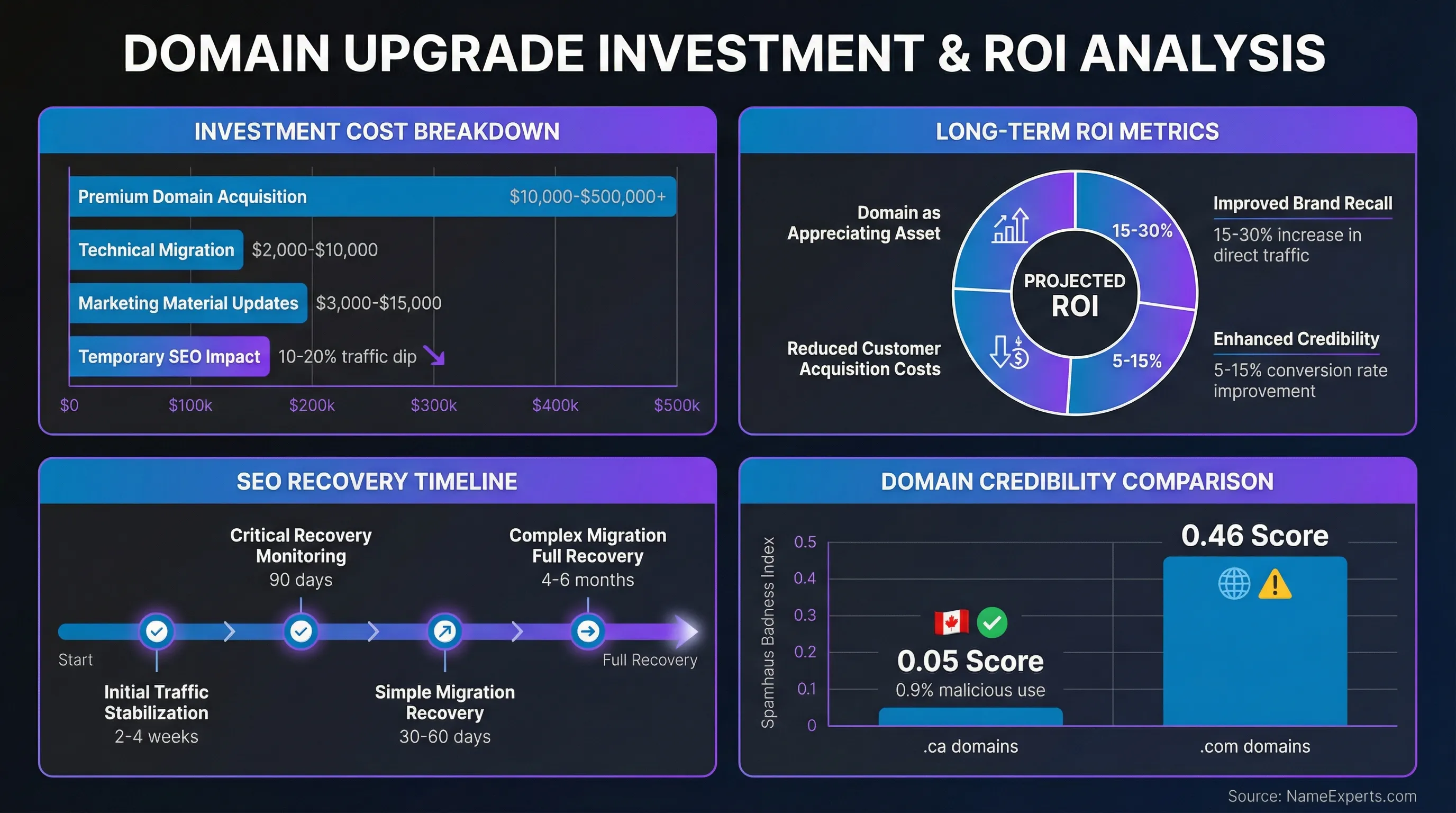
Non-.com extensions, hyphenated addresses, and domains containing numbers all carry subtle credibility penalties. Research shows that .com domains maintain significantly lower abuse rates compared to alternative extensions—.ca domains demonstrate a 0.05 Badness Index score (indicating 0.9% malicious use) versus .com's 0.46 on the Spamhaus Badness Index. While alternative extensions serve specific purposes, the .com extension still carries the strongest trust signals for commercial businesses. If your current address includes hyphens, numbers, or unconventional extensions that make customers pause, you're fighting an uphill credibility battle.

Sign #4: A Premium Domain Becomes Available
Sometimes opportunity knocks when your ideal web address drops or the owner signals willingness to sell. Market research indicates the global domain market is projected to reach 459.9 million registered names by 2030, with premium single-word .com addresses commanding significant value. When a domain that perfectly matches your brand becomes available, the timing window may be narrow. Working with experienced domain brokers at nameexperts.com can help you evaluate whether the acquisition cost justifies the long-term brand benefits and navigate stealth negotiations that prevent sellers from inflating prices.
Sign #5: Competitor Confusion Is Costing You Business
Similar domains creating brand confusion represent more than annoyance—they cost real revenue. When customers accidentally visit a competitor's site or lost traffic flows to businesses with similar names, you're subsidizing someone else's marketing. Trademark proximity concerns add legal complexity to the confusion. Even if you existed first, the ongoing hassle of misdirected customers and the risk of brand dilution may justify making a change rather than perpetually fighting confusion.
Sign #6: SEO Keyword Relevance Has Shifted
Original keyword-rich domains made sense when exact-match domains carried significant SEO weight. Today, brand recognition often outweighs exact-match value, and search behavior evolves. If your domain targets keywords that no longer match how customers search, or if industry terminology has shifted, you're optimizing for yesterday's search patterns. The SEO landscape now rewards brand authority and user engagement over keyword-stuffed addresses, making brandable domains increasingly valuable.
Sign #7: You're Rebranding Anyway
Name changes, mergers, acquisitions, or strategic repositioning all create natural opportunities to upgrade simultaneously. Since you're already managing the disruption of rebranding—updating marketing materials, informing customers, adjusting messaging—adding an upgrade to the project leverages the existing change management effort. Rather than going through two separate transition periods, consolidating the changes minimizes cumulative disruption while ensuring your digital presence aligns with your new brand identity from day one.
Evaluating Whether an Upgrade Makes Financial Sense
Recognition that change would help doesn't automatically justify the investment. A structured cost-benefit analysis determines whether upgrading delivers sufficient ROI to warrant the expense and effort.
| Investment Costs | Long-Term ROI Factors |
|---|---|
| Premium domain acquisition: $10,000-$500,000+ depending on quality | Improved brand recall: 15-30% increase in direct traffic |
| Technical migration: $2,000-$10,000 for proper implementation | Enhanced credibility: 5-15% conversion rate improvement |
| Marketing material updates: $3,000-$15,000 for comprehensive refresh | Reduced customer acquisition costs through better word-of-mouth |
| Temporary SEO impact: 10-20% traffic dip during transition | Domain as appreciating asset with potential resale value |
| Total timeline investment: 4-6 months for full transition | Typical break-even: 12-18 months post-migration |
Investment Costs to Consider
Premium domain acquisition represents the largest variable cost. Single-word .com domains typically range from $50,000 to $500,000 depending on keyword search volume and commercial intent, while shorter brandable names may cost $10,000 to $100,000. Technical migration expenses include proper 301 redirect implementation, SSL certificate updates, and DNS management—budget $2,000 to $10,000 for professional execution. Marketing material updates span business cards, signage, advertising creative, and email signatures, typically requiring $3,000 to $15,000 for comprehensive refresh.
The temporary SEO impact deserves careful consideration. Industry research suggests that website migrations can experience significant SEO-related performance issues, with some sites losing 50% or more of organic traffic initially. However, properly executed migrations typically see 10-20% temporary decline with recovery within 4-6 months for complex migrations. The critical recovery monitoring period spans 90 days, with initial traffic stabilization occurring within 2-4 weeks after implementing fixes.
Long-Term ROI Factors
Improved brand recall drives measurable direct traffic increases. When customers can easily remember and type your address, you capture more repeat visits and word-of-mouth referrals without paying for advertising. Enhanced credibility from a premium, professional domain translates to higher conversion rates—visitors trust businesses with authoritative web addresses more than those with awkward or unprofessional ones. Reduced customer acquisition costs compound over time as better memorability improves referral rates and decreases dependency on paid advertising channels.
Premium domains also represent appreciating business assets. Unlike most marketing expenses that depreciate immediately, quality domains typically increase in value as internet usage grows and available premium names become scarcer. This creates potential future liquidity if business needs change.
When to Walk Away
Not every upgrade makes financial sense. If acquisition costs exceed 2-3 times your annual revenue, the investment likely won't generate sufficient ROI within a reasonable timeframe. When your existing domain has strong established SEO equity—ranking well for valuable keywords with substantial organic traffic—the risk of disruption may outweigh potential gains. If you lack concrete evidence of customer confusion or brand limitation, the problem may be theoretical rather than practical. In these cases, investing in other marketing initiatives typically delivers better returns than forcing an unnecessary change.
Domain evaluation expertise helps make informed decisions. The team at nameexperts.com can audit your current domain's brandability and SEO value, assess acquisition opportunities, and provide objective analysis of whether upgrading justifies the investment for your specific situation. With 16+ years of experience and 200+ completed transactions, they understand the full rebranding lifecycle and can identify when upgrades deliver genuine value versus when existing assets should be maintained.
Unsure If That Premium Domain Is Worth the Investment?
Evaluating whether a domain upgrade justifies the cost requires understanding both current market values and your specific business context. Our team can provide a professional domain appraisal and ROI analysis to help you make an informed decision based on 16+ years of experience with premium domain transactions.
How to Execute an Upgrade Without Losing SEO Value
Proper technical execution separates successful migrations that maintain search visibility from disasters that require months of recovery. Following a structured process minimizes risk and accelerates the transition.

Pre-Migration Preparation
Thorough preparation prevents most migration problems. Start by documenting all existing backlinks using tools like Ahrefs or Moz—you need a complete inventory of sites linking to your current address. Audit your current domain authority, ranking keywords, and page-level performance to establish baseline metrics. Set clear SEO benchmarks including organic traffic levels, conversion rates, and rankings for your top 20 keywords. These baselines provide objective measures for post-migration comparison.
Prepare comprehensive 301 redirect mapping at the page level, not just homepage redirects. Every URL on your old domain should map to the most relevant corresponding page on your new domain. For pages without direct equivalents, redirect to the closest topical match rather than sending everything to the homepage. This granular mapping preserves link equity and maintains user experience for visitors arriving via old bookmarks or external links.
Technical Migration Best Practices
Implementation timing matters—avoid major business periods when traffic disruption causes maximum damage. Implement 301 redirects at the page level as mapped during preparation. Update Google Search Console and Bing Webmaster Tools immediately, using the change of address tools both platforms provide. Maintain consistent site structure and URL patterns where possible to minimize the scope of change search engines must process.
Update all internal links to reference the new domain rather than relying on redirects for internal navigation. While redirects handle external links and old bookmarks, internal links should point directly to new URLs to avoid unnecessary redirect chains that slow page load times. Update your XML sitemap to reflect the new domain and resubmit it to search engines. Verify that your robots.txt file on the new domain doesn't accidentally block important pages.
Post-Migration Monitoring
Intensive monitoring during the first 90 days catches problems before they become permanent. Track ranking fluctuations and traffic patterns weekly, comparing against your baseline metrics. Monitor for broken redirects using crawl tools and fix issues immediately—even small numbers of broken redirects signal poor migration execution to search engines. Watch for redirect chains where one redirect leads to another, as these dilute link equity and slow page loads.
According to migration specialists, brands that follow best practices regarding new domain checks and appropriate 301 redirects still sometimes see rankings decimated when sites go live. The difference between successful migrations and failed ones often comes down to details in technical execution and knowing which critical elements to protect. Expected timeline for full SEO recovery spans 4-6 months for properly executed complex migrations, with simple migrations recovering in 30-60 days.
Professional guidance through technical migration risks significantly improves success rates. Domain consultants at nameexperts.com serve as guides through the technical complexities, helping implement proper redirect strategies, coordinate with development teams, and monitor post-migration performance. Their experience with 200+ transactions across diverse industries means they've encountered and solved the edge cases that derail DIY migrations. When you're investing significantly in a premium domain, professional migration support protects that investment by ensuring technical execution doesn't undermine the strategic benefits you're paying to achieve.
Making the Strategic Decision
Upgrading your domain name represents a significant business decision that requires balancing multiple factors. The seven signs outlined here—brand outgrowth, memorability issues, credibility concerns, premium availability, competitor confusion, SEO shifts, and rebranding opportunities—provide clear indicators that change may benefit your business. However, recognition that change would help differs from confirmation that it justifies the cost.
The financial evaluation framework helps quantify both investment requirements and potential returns. While acquisition costs, technical expenses, and temporary SEO impacts are concrete and immediate, the benefits of improved brand recall, enhanced credibility, and reduced acquisition costs compound over years. Most businesses that make strategic upgrades see break-even within 12-18 months, with ongoing benefits extending far beyond the initial recovery period.
Technical execution determines whether your upgrade delivers promised benefits or becomes a cautionary tale. The difference between migrations that maintain SEO value and those that destroy years of organic growth comes down to preparation thoroughness, implementation precision, and monitoring intensity. Professional support from experienced consultants dramatically improves success rates by applying lessons learned across hundreds of previous migrations.
Ultimately, the decision to upgrade should align with your broader business strategy. If your current domain creates friction with growth plans, confuses customers, or undermines credibility, the cost of maintaining the status quo likely exceeds the investment required to upgrade. When timing, opportunity, and business need converge, strategic upgrades become powerful catalysts for the next phase of growth rather than risky experiments with uncertain outcomes.
Don't Let Migration Mistakes Destroy Your SEO
The difference between migrations that maintain search visibility and those that lose 50% of organic traffic comes down to technical execution details. With 200+ completed transactions across diverse industries, our team has encountered every edge case that derails DIY migrations. Get expert guidance through your domain migration to protect the SEO equity you've spent years building.
Ready to Upgrade Your Domain the Right Way?
Strategic domain upgrades deliver powerful growth benefits—but only when acquisition, valuation, and migration are executed properly. Whether you're evaluating a premium domain opportunity, concerned about protecting your SEO during transition, or need stealth acquisition services to prevent price inflation, we bring a no-bullshit approach to navigating the Wild West of the domain marketplace. Schedule a free domain consultation to discuss your specific situation and explore whether upgrading ma
Schedule a free domain consultation







Frequently Asked Questions
You don't own domains permanently—ICANN rules require periodic renewal to ensure fairness—but you can maintain control indefinitely through continuous registration renewals.
Yes, annual renewal is required to keep your website online, though most registrars offer multi-year registration options (typically 1-10 years) to lock in pricing and reduce administrative overhead.
No legal requirement exists to match your web address with your LLC name—many businesses operate under different trade names online while maintaining separate legal entity names for registration purposes.
.com remains superior for most commercial businesses due to stronger trust signals and lower abuse rates, while .io works well for tech startups targeting developer audiences who recognize the extension's industry association.