

Key Takeaways
- UDRP proceedings succeed in over 90% of cases where complainants prove all three required elements, but fail when legitimate business disputes or competing rights exist
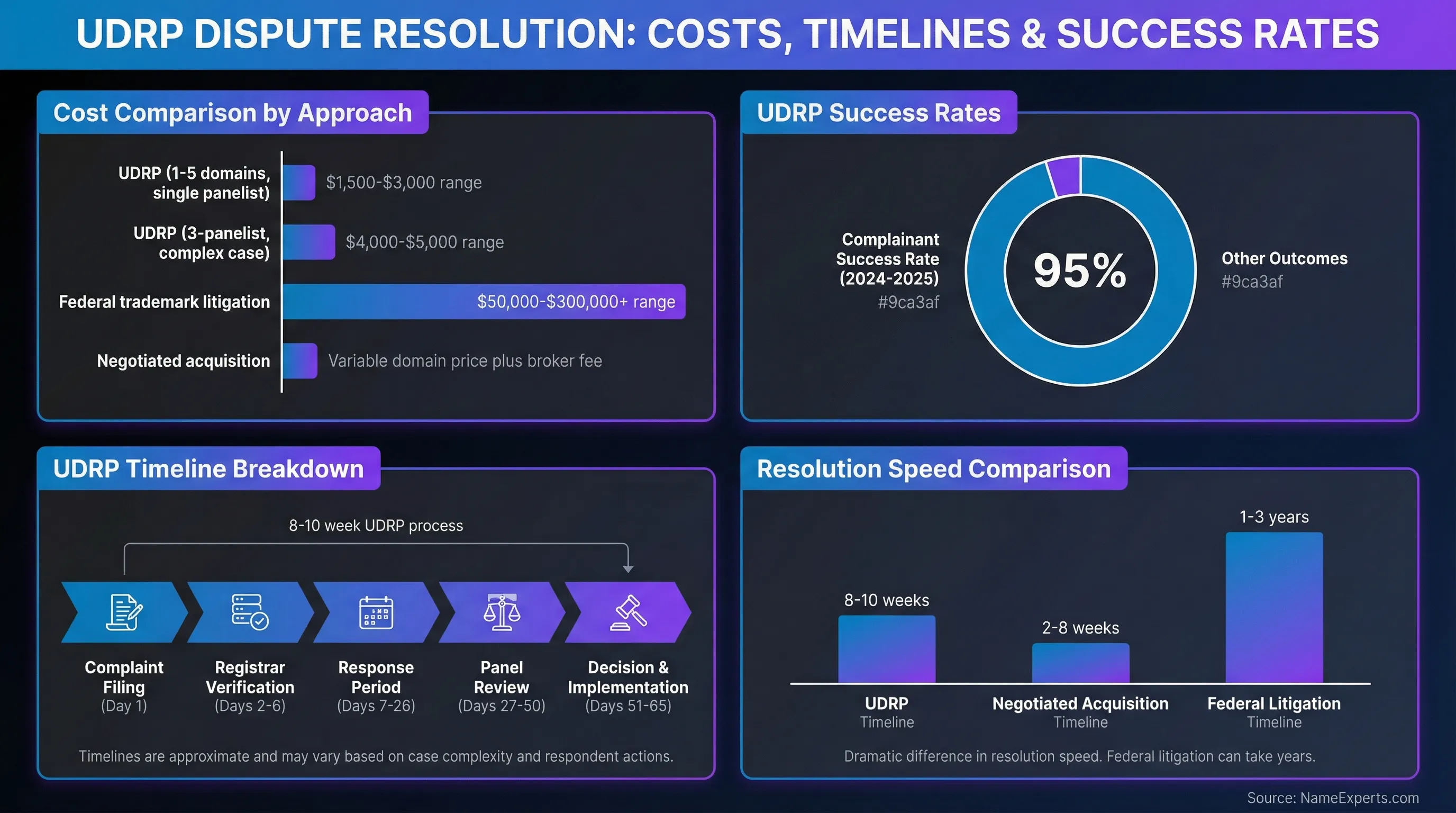
- Average timeline spans 8-10 weeks with filing costs between $1,500-$5,000, significantly faster and cheaper than federal litigation
- The process requires proving identical/confusingly similar trademark use, no legitimate registrant rights, and both registration and use in bad faith
- Negotiated domain acquisition often provides faster resolution in 2-8 weeks without creating public legal records or risking adverse panel decisions
- This policy works best for clear cybersquatting cases but isn't suitable for broken business relationships, free speech domains, or complex trademark conflicts
Discovering that someone has registered your trademark as a domain name triggers immediate frustration. The domain may be parked with competitor advertisements, used for phishing schemes, or simply held hostage with an inflated price tag attached. Your instinct might be to immediately pursue legal action, but the Uniform Domain Name Dispute Resolution Policy offers a faster, more cost-effective alternative—when used correctly.
Understanding when this administrative process will succeed versus when it will waste your time and resources requires examining the mechanics, requirements, and limitations of the system. In our 16+ years helping businesses navigate domain disputes and acquisitions, we've seen trademark owners make critical strategic errors by choosing the wrong enforcement mechanism for their situation.
What Is a UDRP Dispute and When Does It Apply?
The Uniform Domain Name Dispute Resolution Policy represents ICANN's expedited arbitration framework for resolving trademark-based domain name conflicts. According to ICANN's official policy documentation, this administrative procedure went into effect on October 24, 1999, providing an expedient, less expensive alternative to traditional litigation for straightforward cybersquatting cases.
The policy applies to all generic top-level domains including .com, .net, and .org, as well as new gTLDs like .app, .site, and .online. Many country-code top-level domains have also adopted the framework or variations of it, allowing trademark owners to consolidate disputes across multiple extensions when the registrant is the same.
The Three-Element Test: Your Case Must Prove All Three
To succeed in a dispute under this policy, complainants must satisfy three specific requirements simultaneously. Failing to prove even one element results in case dismissal:
- Identical or confusingly similar: The disputed domain must be identical or confusingly similar to a trademark or service mark in which you have rights
- No legitimate rights: The registrant must have no rights or legitimate interests in the domain name
- Bad faith registration and use: The domain must have been registered AND be used in bad faith (both conditions required)
This three-pronged test creates a high bar intentionally. The policy was designed to address abusive registrations—not to resolve legitimate business disputes, competing trademark claims, or situations where multiple parties may have valid interests in similar names.
What This Process Is NOT Designed to Handle
Many trademark owners mistakenly view this procedure as a universal solution for any domain conflict. However, several dispute types fall outside its intended scope:
- Disputes between competing businesses with legitimate trademark rights in different jurisdictions or industries
- Conflicts arising from broken partnerships, licensing agreements, or contractual relationships
- Criticism or commentary websites using trademarks for protected speech purposes
- Domains registered before your trademark rights were established
- Generic or descriptive terms where trademark rights are weak or contested
In these scenarios, pursuing a complaint often wastes time and money while alerting the registrant to your interest—potentially increasing the domain's perceived value or prompting defensive legal action.
When Filing Makes Sense: Evaluating Your Case Strength
Before investing in filing fees and legal preparation, conduct an honest assessment of your case strength. Strong cases share common characteristics that align with the policy's original intent to combat cybersquatting.
Clear Indicators You Have a Strong Case
Certain fact patterns consistently lead to successful outcomes. According to analysis of dispute resolution decisions, complainants prevail in the vast majority of straightforward cybersquatting disputes:
- Obvious typosquatting: Domains that misspell your trademark (gooogle.com, amazom.com) or add hyphens, numbers, or common words (nike-shoes.com, apple-store.com)
- Timeline advantage: Clear documentation that your trademark rights existed before the domain registration date
- Bad faith evidence: Parking pages displaying competitor advertisements, explicit offers to sell the domain to you, phishing attempts, or fraudulent emails
- No plausible legitimate use: The registrant has no connection to your industry, no business using a similar name, and no reasonable explanation for choosing that specific domain
- Pattern of behavior: The registrant has accumulated multiple domains targeting various trademarks, indicating professional cybersquatting
When these factors align, the process works efficiently. Panels can quickly identify abusive registration and order transfer or cancellation without extensive deliberation.
Red Flags That Predict Failure
Conversely, certain circumstances dramatically reduce your likelihood of success, regardless of how strongly you feel about your trademark rights:
- Domain predates your trademark: If the registrant acquired the domain before you established trademark rights, you cannot prove bad faith registration—a required element
- Former business relationships: When a former partner, licensee, distributor, or employee holds the domain, proving bad faith registration becomes nearly impossible since the relationship was legitimate at inception
- Legitimate competing business: If the registrant operates a real business under a similar name, even if that use technically infringes your trademark, panels generally defer to courts for complex infringement analysis
- Generic or descriptive terms: Domains using common words or industry terms (books.com, insurance.com) face higher scrutiny, and registrants can more easily demonstrate legitimate interests
- Criticism or commentary: Websites using your trademark for criticism, parody, or commentary typically qualify as legitimate noncommercial use protected by free speech principles
In our experience helping businesses evaluate domain conflicts, approximately 30-40% of initial inquiries involve situations where this route will likely fail. In these cases, we typically recommend either negotiated acquisition or, when necessary, federal court litigation.
Success Rate Data: Understanding the Numbers
According to comparative analysis of dispute resolution providers, trademark owners have historically prevailed in over 90% of cases when looking at decisions resulting in transfer, cancellation, or denial. Recent data from 2024-2025 shows success rates have increased to over 95% in cases where complainants file with strong evidence. However, these statistics can be misleading.
The high success rate reflects case selection bias—trademark owners with strong, clear-cut cybersquatting cases file complaints, while those with weaker claims often settle, negotiate, or pursue other remedies. The small failure rate typically involves cases where:
- Complainants overestimated their trademark rights (unregistered marks with insufficient proof of secondary meaning)
- Timeline issues emerged during proceedings (domain registration predated trademark rights)
- Registrants presented evidence of legitimate business use or fair use defenses
- The domain consisted of generic terms where the complainant lacked exclusive rights
Before filing, consider whether your case genuinely fits the profile of disputes that succeed, or whether you're attempting to force a square peg into a round hole.

Not Sure If UDRP Is Your Best Option?
Before investing thousands in filing fees and legal preparation, get an expert assessment of your case strength and domain acquisition alternatives. Our team can evaluate whether stealth negotiation might secure your domain faster and cheaper than formal proceedings, often completing acquisitions in 2-6 weeks without creating public legal records.
The Process: Timeline, Costs, and Evidence Requirements
According to Harvard's Berkman Klein Center analysis, resolution under this policy takes significantly less time and costs considerably less than litigation of a domain name dispute in court, which can be protracted and prohibitively expensive. The typical timeline spans 8-10 weeks from filing to resolution.
Step-by-Step Timeline Breakdown
Understanding the procedural timeline helps set realistic expectations:
- Complaint filing (Day 1): Submit your complaint to an approved provider with filing fees and supporting evidence
- Registrar verification (Days 2-6): The provider notifies the domain registrar, who verifies registration details and locks the domain to prevent transfer during proceedings
- Response period (Days 7-26): The registrant receives notification and has 20 calendar days to submit a response defending their registration
- Panel appointment (Days 27-30): If you selected a single panelist, the provider appoints one; if either party requests a three-member panel, three panelists are selected
- Panel review and deliberation (Days 31-50): Panelists review submissions, evidence, and applicable precedent, typically taking 2-4 weeks for complex cases
- Decision issuance (Day 51-55): The panel publishes its decision, which becomes publicly available in the provider's database
- Implementation (Days 56-65): If the complainant prevails, the registrar has 10 business days to implement the transfer or cancellation, unless the registrant files a lawsuit
Total timeline typically spans 8-10 weeks from filing to resolution. Complex cases involving multiple domains or three-member panels may extend to 12 weeks.
Cost Comparison: Administrative Proceedings vs. Alternatives
| Approach | Typical Cost Range | Timeline | Success Outcome |
|---|---|---|---|
| UDRP (1-5 domains, single panelist) | $1,500-$3,000 filing + legal fees | 8-10 weeks | Domain transfer or cancellation |
| UDRP (3-panelist, complex case) | $4,000-$5,000 filing + legal fees | 10-12 weeks | Domain transfer or cancellation |
| Federal trademark litigation | $50,000-$300,000+ | 1-3 years | Transfer + potential damages |
| Negotiated acquisition | Domain price + broker fee | 2-8 weeks | Clean ownership, no legal record |
The filing fees represent only the administrative costs. Most trademark owners engaging legal counsel should budget an additional $3,000-$10,000 for attorney time to research precedent, compile evidence, draft the complaint, and potentially prepare responses to registrant arguments.
Before filing, consider having domain experts assess your case strength and the domain's market value. At NameExperts, we can evaluate whether negotiated acquisition might achieve faster results at lower cost than formal proceedings, particularly when bad faith elements are ambiguous or the domain has legitimate commercial value.
Evidence That Wins Cases
The strength of your evidence directly correlates with your likelihood of success. Panels expect comprehensive documentation supporting each element of your claim:
- Trademark registration certificates: USPTO registrations or international equivalents provide the strongest proof of rights, though common law marks with sufficient secondary meaning can succeed
- Timeline documentation: Evidence that your trademark use predated the domain registration, including dated marketing materials, product launches, or media coverage
- Bad faith use screenshots: Archived captures showing parking pages with competitor advertisements, phishing attempts, or pay-per-click monetization of your trademark
- Sale offers or correspondence: Emails or communications where the registrant offered to sell the domain, particularly at prices far exceeding registration costs
- Pattern evidence: Documentation that the registrant holds multiple domains targeting various trademarks, indicating professional cybersquatting
- Consumer confusion evidence: Customer complaints, misdirected emails, or other proof that the domain is causing actual confusion in the marketplace
Building a strong complaint requires thorough evidence gathering and strategic presentation. Before filing, consider conducting trademark searches and compiling comprehensive documentation. Our team offers consultation services to help trademark owners assess whether evidence meets the three-element test before investing in filing fees. This pre-filing assessment often reveals whether you have a winning case or should pursue alternative strategies.

Alternatives: When Negotiation or Litigation Makes More Sense
The administrative framework represents just one tool in the domain dispute resolution toolkit. Strategic trademark owners evaluate all available options before committing to a specific approach.
Direct Negotiation and Broker-Assisted Acquisition
Negotiated acquisition often provides the fastest, lowest-risk path to domain ownership, particularly when:
- The domain has legitimate commercial value beyond trademark infringement
- Bad faith elements are present but ambiguous or difficult to prove conclusively
- You need immediate resolution rather than waiting 8-10 weeks for panel proceedings
- You want to avoid creating a public legal record that competitors or media might discover
- The registrant operates a legitimate business and might be willing to sell at reasonable prices
Professional domain brokers negotiate anonymously to prevent price inflation that occurs when registrants discover a trademark owner's interest. In our experience completing 200+ domain transactions, stealth acquisition frequently secures domains at lower total costs than formal proceedings, particularly when factoring in legal fees and opportunity costs of delayed resolution.
The negotiation approach also preserves business relationships and goodwill. Rather than creating an adversarial legal proceeding, professional acquisition positions the transaction as a mutually beneficial business deal. This matters particularly when the registrant operates in adjacent markets or could become a future customer or partner.
At NameExperts, we specialize in stealth acquisitions that secure domains without revealing your identity or triggering inflated pricing. We often complete transactions in 2-6 weeks, faster than formal proceedings, with no risk of an adverse panel decision that could weaken your position in subsequent negotiations or litigation.
Federal Court Litigation: When to Escalate
Traditional litigation becomes necessary when administrative proceedings cannot provide adequate remedies:
- Seeking monetary damages: Administrative panels can only order transfer or cancellation, not award damages for past infringement or lost profits
- After panel failure: If you lose a case but believe you have strong trademark infringement claims, federal court provides a second opportunity with different procedural rules
- Injunctive relief beyond the domain: When you need court orders preventing broader trademark infringement beyond just the domain name
- Discovery requirements: Federal litigation includes discovery processes that can uncover evidence unavailable in administrative proceedings, such as registrant financial records or email communications
The Anticybersquatting Consumer Protection Act (ACPA) allows trademark owners to pursue statutory damages up to $100,000 per domain name in cases of willful cybersquatting. However, litigation costs typically range from $50,000 to $300,000+ and require 1-3 years to reach resolution, making it appropriate only for high-value disputes or situations requiring monetary compensation.
Cease and Desist Letters: The Low-Cost First Step
Before pursuing formal proceedings, consider sending a cease and desist letter outlining your trademark rights and requesting voluntary transfer. This approach works effectively when:
- The registrant appears to be unaware of trademark infringement (innocent registration)
- You want to gauge the registrant's willingness to negotiate before investing in formal proceedings
- The domain is not actively being used, suggesting the registrant may have minimal attachment to it
However, cease and desist letters carry risks. They alert the registrant to your interest, potentially increasing the domain's perceived value. They also provide advance warning that may prompt the registrant to strengthen their position, gather evidence of legitimate use, or transfer the domain to a third party in a jurisdiction with less favorable trademark laws.
In our practice, we typically recommend cease and desist letters only when preliminary research suggests the registrant is unsophisticated and likely unaware of infringement. For domains held by professional cybersquatters or registrants with legal sophistication, we generally proceed directly to either formal proceedings or stealth acquisition negotiations.
Decision Framework: Choosing Your Approach
Apply this framework to determine your optimal strategy:
- Choose administrative proceedings for: Clear cybersquatting with strong evidence of all three elements, need for quick resolution (8-10 weeks), and limited budgets ($5,000-$15,000 total cost including legal fees)
- Choose negotiation for: Ambiguous trademark rights, domains with legitimate commercial value, need for fastest resolution (2-8 weeks), desire to avoid public legal records, or situations where the registrant has some legitimate claim
- Choose litigation for: Need for monetary damages, pattern of infringement across multiple channels beyond just the domain, failed proceedings where you have strong underlying trademark claims, or situations requiring extensive discovery
The right choice depends on your specific circumstances, risk tolerance, budget constraints, and timeline requirements. Trademark owners who carefully match their enforcement strategy to their situation achieve better outcomes at lower costs than those who reflexively pursue formal proceedings for every domain conflict.
Provider Selection and Filing Considerations
If you determine that formal proceedings represent your best option, selecting the right provider and avoiding common filing mistakes significantly impacts your likelihood of success.
Comparing Approved Dispute Resolution Providers
According to comparative provider analysis, different providers handle varying case volumes with similar complainant success rates. Both major providers maintain high complainant success rates, but differ in several respects:
- Leading international provider advantages: Largest case volume provides extensive published precedent, international recognition, detailed jurisprudential overview summarizing panel consensus on major issues, slightly lower fees for cases involving 1-5 domains
- Alternative provider advantages: Slightly faster average processing times, strong expertise in U.S. trademark law, competitive pricing for cases involving 6+ domains
- Regional providers: Providers in specific regions may offer advantages for disputes involving country-code domains in their areas
Provider selection typically matters less than case strength. All approved providers apply the same policy and rules, and panelists frequently serve at multiple providers. Choose based on fee structure for your specific number of domains and any geographic considerations relevant to your case.
Single Panelist vs. Three-Member Panel
Complainants select either a single panelist or three-member panel when filing. The choice involves cost-benefit tradeoffs:
- Single panelist: Lower cost ($1,500-$3,000), faster decision timeline, appropriate for straightforward cases with clear precedent
- Three-member panel: Higher cost ($4,000-$5,000), longer deliberation period, provides multiple perspectives for complex cases involving novel legal issues or substantial commercial value
Registrants can elect to convert a single-panelist case to three members by paying half the additional fees, which occasionally occurs when they have strong defenses and want multiple panelists to evaluate their arguments. However, this happens in fewer than 5% of cases.
For most straightforward cybersquatting cases, single panelists provide sufficient expertise at lower cost. Reserve three-member panels for cases involving significant monetary value, novel legal questions, or situations where you anticipate sophisticated opposition from the registrant.
Common Filing Mistakes That Lead to Dismissal
Avoid these frequent errors that result in case dismissal or weakened positions:
- Incomplete WHOIS research: Failing to properly identify the current registrant or registrar, leading to service issues
- Insufficient trademark proof: Submitting complaints based on unregistered marks without adequate evidence of secondary meaning or acquired distinctiveness
- Missing bad faith evidence: Proving the domain is confusingly similar and the registrant lacks rights, but failing to document bad faith registration AND use
- Improper consolidation: Attempting to combine disputes involving multiple registrants without meeting consolidation requirements
- Language issues: Filing in the wrong language when the registration agreement specifies a different language
- Expired domains: Filing complaints against domains that have expired or are in redemption periods, creating jurisdictional issues
These procedural errors waste filing fees and delay resolution. Careful preparation and, when appropriate, consultation with domain acquisition experts or trademark attorneys helps avoid costly mistakes that undermine otherwise strong cases.
Avoid the Risks of DIY Domain Disputes
Sending cease and desist letters or filing weak UDRP complaints can backfire by alerting registrants to your interest and strengthening their negotiating position. Our 16+ years of domain acquisition experience means we can conduct anonymous negotiations that secure domains without revealing your identity or triggering inflated pricing, preserving all your legal options if acquisition discussions don't succeed.
Making the Right Strategic Choice
The administrative dispute resolution framework provides a valuable tool for trademark owners facing clear cybersquatting, offering faster and more affordable resolution than federal litigation. However, it represents just one option in a broader strategic toolkit that includes negotiated acquisition, cease and desist communications, and traditional court proceedings.
Success requires honest assessment of your case strength against the three-element test, realistic evaluation of evidence quality, and strategic selection of the enforcement mechanism that best matches your specific circumstances. Trademark owners who carefully evaluate whether their disputes involve genuine abusive registration or more complex business conflicts achieve better outcomes at lower costs.
Before filing a complaint, consider whether negotiated acquisition might secure the domain faster, at lower total cost, and without creating public legal records or risking adverse decisions. Our team at NameExperts helps businesses evaluate their options, assess case strength, and determine the optimal strategy for securing critical domains while minimizing risk, cost, and timeline.
Whether you ultimately pursue formal proceedings, negotiated acquisition, or another approach, the key is matching your enforcement strategy to your specific situation rather than reflexively choosing the most obvious path. Strategic domain acquisition and protection requires understanding not just the tools available, but when each tool works best—and when alternative approaches serve your interests more effectively.
Get Expert Guidance on Your Domain Dispute Strategy
Whether you're facing clear cybersquatting or a more complex trademark conflict, choosing the right enforcement approach saves time, money, and protects your brand's interests. We help businesses evaluate UDRP case strength, assess domain market value, and determine whether formal proceedings or negotiated acquisition serves your specific situation best. Schedule a consultation to discuss your domain dispute and explore all available resolution strategies with our team of domain acquisition spec
Schedule a consultation to discuss your domain dispute and explore all available resolution strategies







Frequently Asked Questions
The Uniform Domain Name Dispute Resolution Policy (UDRP) is ICANN's expedited arbitration framework that allows trademark owners to resolve cybersquatting cases through administrative proceedings rather than costly federal litigation, typically completing in 8-10 weeks at $1,500-$5,000 in filing costs.
Filing fees range from $1,500-$3,000 for single-panelist cases covering 1-5 domains, or $4,000-$5,000 for three-member panels, plus an additional $3,000-$10,000 in legal fees for complaint preparation and evidence compilation.
Domain registrants have exactly 20 calendar days from receiving notification to submit their response defending the registration, after which the panel proceeds with or without their input.
Complainants must prove the domain is identical or confusingly similar to their trademark, the registrant has no legitimate rights or interests in it, and it was both registered and used in bad faith—failing to establish even one element results in case dismissal.