
Key Takeaways
- Enable domain locks at both registrar and registry levels to prevent unauthorized transfers
- Activate two-factor authentication and use strong, unique passwords for domain accounts
- Set up auto-renewal with backup payment methods to avoid accidental expiration
- Register strategic defensive variations to block typosquatters and brand impersonators
- Monitor continuously for similar registrations and trademark violations targeting your brand
A single forgotten renewal date. One compromised password. That's all it takes to lose control of your domain—and with it, your website, email, customer trust, and online identity. Domain hijacking isn't a distant threat; attacks targeting domains and DNS infrastructure continue to grow in frequency and sophistication. Whether you're launching a startup or managing an established brand, implementing comprehensive protection measures is essential—not optional.
Essential Technical Security Measures
Technical safeguards form your first line of defense against unauthorized access and theft. These measures work together to create multiple barriers that attackers must overcome.
Registry and Registrar Locks
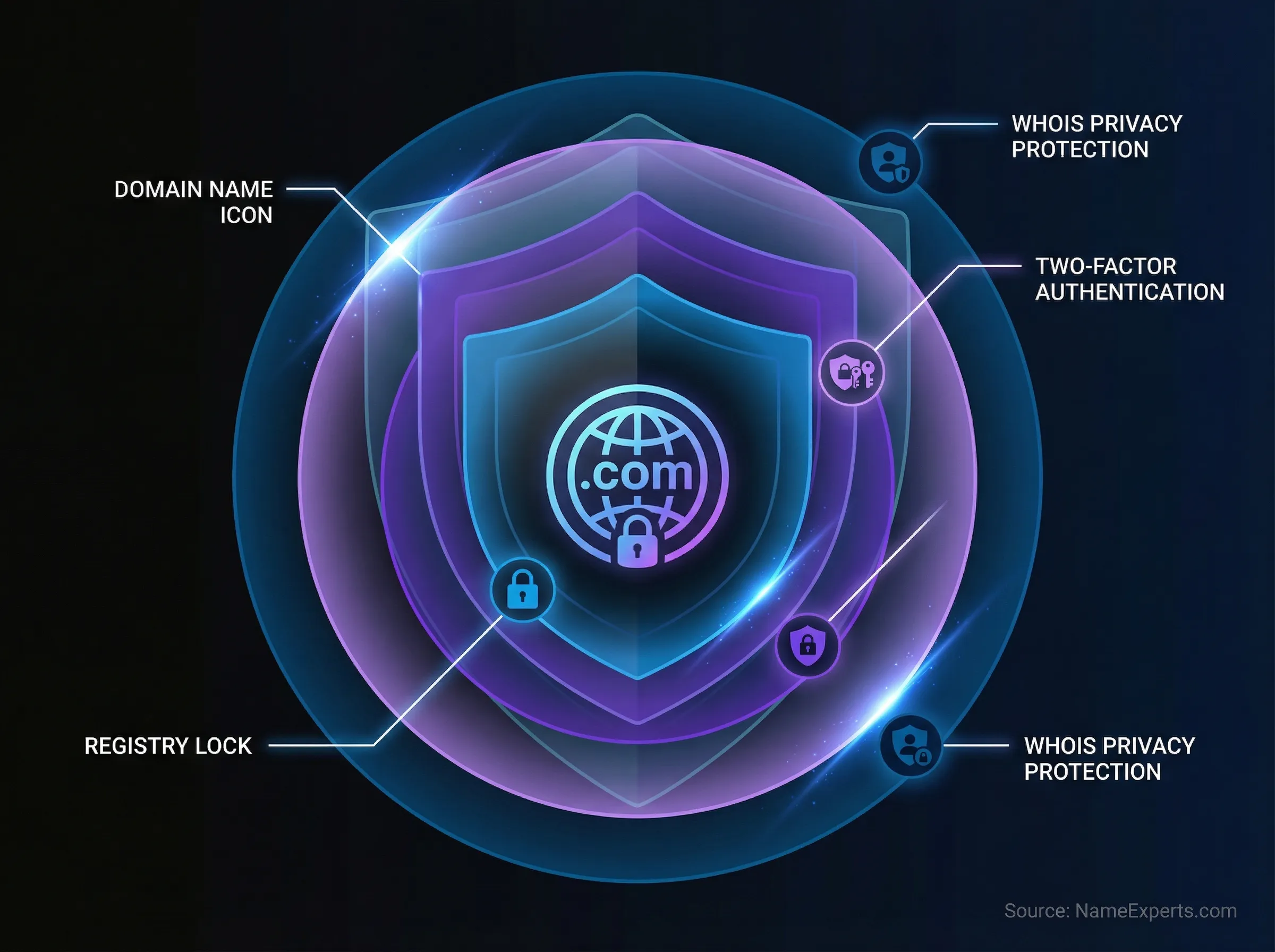
Understanding the distinction between registry and registrar locks is crucial—they provide different protection levels. A registrar lock prevents transfers between registrars and is indicated by a "clientTransferProhibited" status in WHOIS records. This basic protection is typically free and should be enabled immediately.
Registry locks operate at a higher level, requiring multi-step authentication between the registry and registrar before any changes occur. This enterprise-grade protection makes hijacking exponentially more difficult. High-value brands and businesses handling sensitive customer data should implement registry-level protection, while registrar locks adequately serve most small to mid-sized operations.
Two-Factor Authentication and Access Controls
Passwords alone are insufficient. Two-factor authentication (2FA) adds a critical verification layer that protects your account even if credentials are compromised. Hardware security keys (U2F) provide the strongest authentication, followed by time-based one-time passwords (TOTP) through authenticator apps. Avoid SMS-based 2FA when possible—it's vulnerable to SIM-swapping attacks.
For teams, implement role-based access controls. Limit administrative permissions to trusted personnel who require them. Document who has access and review permissions quarterly. When employees depart, immediately revoke their credentials.
Auto-Renewal and Contact Information
Expiration is a preventable disaster that happens more often than you'd think. When registrations lapse, opportunistic squatters can grab them within hours. Configure auto-renewal with at least two backup payment methods. Calendar reminders aren't sufficient—payment failures happen.
Maintain current administrative contact information. If your registrar can't reach you about security issues or renewal problems, you risk losing control. Use a dedicated company email address, not a personal account that might be abandoned if someone leaves.
Strategic Domain Protection Tactics
Beyond technical measures, strategic decisions about which variations to own and how to monitor threats determine your long-term security posture.
Smart Defensive Registrations
Registering every possible variation is financially impractical and unnecessary. Instead, apply a cost-benefit framework based on your brand recognition, industry risk factors, and business size.
High-priority defensive registrations include:
- Common misspellings that omit or transpose letters (gogle.com vs google.com)
- Plural and singular forms of your primary domain
- The same name under .com, .net, and .org if you operate primarily under one
- Hyphenated versions of multi-word brands
- Country-specific extensions for markets where you do business
Lower-priority variations that rarely justify the cost:
- Obscure top-level domains (.biz, .info) unless industry-specific
- Extreme misspellings that no one would reasonably type
- Variations with added generic words unless they're commonly associated with your brand
With 16+ years of experience and 200+ transactions, we've helped businesses identify which variations actually warrant protection versus wasteful spending. The right defensive strategy balances brand protection with budget realities—registering too few leaves vulnerabilities, while registering too many drains resources without meaningful security gains.
WHOIS Privacy Protection
WHOIS privacy (also called domain privacy protection or ID protection) shields your personal or business contact information from public database searches. Without it, your name, email, phone number, and physical address are visible to anyone—including spammers, competitors, and bad actors.
Privacy protection is essential for solo practitioners and small businesses using personal information in registrations. It's also valuable for any organization wanting to reduce spam and prevent information gathering by competitors. Note that GDPR has limited public WHOIS access in some regions, but privacy protection remains important for comprehensive shielding.
Privacy differs from security: it hides your information but doesn't prevent hijacking. You need both privacy and technical security measures. For businesses acquiring premium domains, buying a domain anonymously through privacy services or brokers can prevent price inflation during negotiations.
Monitoring and Portfolio Management
Proactive monitoring detects threats before they escalate. Set up alerts for newly registered domains that closely resemble your brand. Several services monitor trademark violations and similar registrations across hundreds of top-level domains.
As your portfolio grows, centralized management becomes critical. Track renewal dates, registrar accounts, DNS configurations, and security settings in one system. We provide professional monitoring services that detect similar registrations and trademark violations, allowing you to respond quickly to potential threats. Centralized domain portfolio management ensures nothing falls through the cracks as your business scales.
Uncertain Which Domain Variations Actually Need Protection?
With 16+ years navigating the Wild West of the domain marketplace, we've seen businesses waste thousands on unnecessary defensive registrations while leaving real vulnerabilities exposed. If you're unsure which variations warrant protection for your specific brand and industry, get a professional domain security assessment that balances comprehensive protection with budget realities.
Responding to Domain Threats
Despite preventive measures, you may face cybersquatting, typosquatting, or unauthorized use of your brand. Understanding recovery options helps you respond effectively.
Legal Recourse Options
The Uniform Domain Name Dispute Resolution Policy (UDRP) provides an arbitration process for recovering infringing domains. To prevail under UDRP, you must prove: (1) the disputed name is identical or confusingly similar to your trademark; (2) the registrant has no legitimate rights to it; and (3) it was registered and used in bad faith.
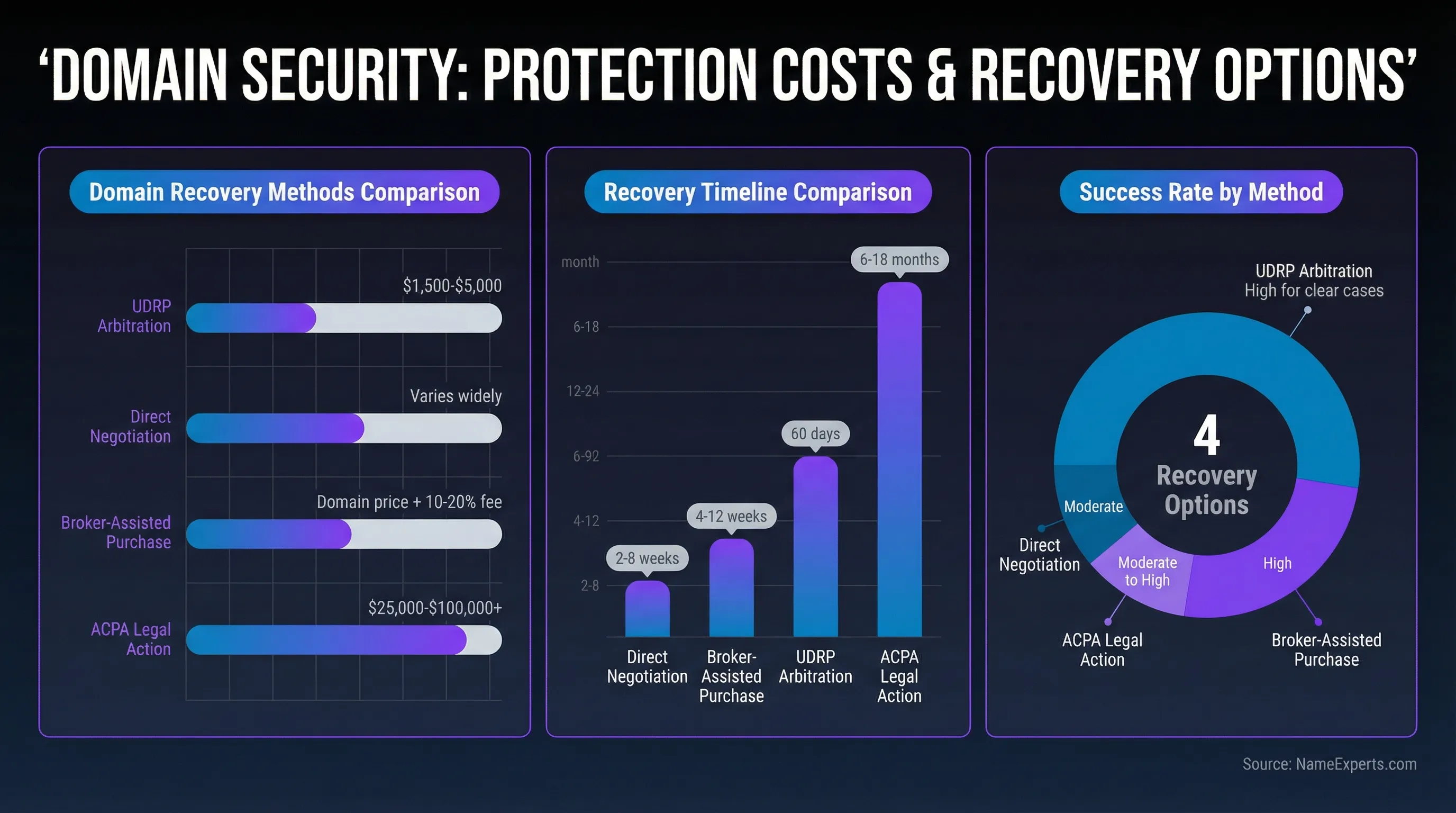
UDRP proceedings are completed in approximately 60 days through written submissions only. No money damages are available—only transfer or cancellation of the registration. This process works well for straightforward cybersquatting cases.
For U.S.-based disputes, the Anticybersquatting Consumer Protection Act (ACPA) provides federal court remedies. ACPA requires proving the registrant had bad faith intent to profit from your distinctive or famous mark. Successful plaintiffs can recover the infringing domain plus actual damages or statutory damages up to $100,000 per name. Given litigation costs, ACPA suits are best reserved for egregious bad faith use.
Domain Recovery Options Comparison
| Recovery Method | Timeline | Cost Range | Success Rate | Best For |
|---|---|---|---|---|
| UDRP Arbitration | 60 days | $1,500-$5,000 | High for clear cases | Straightforward cybersquatting with trademark rights |
| ACPA Legal Action | 6-18 months | $25,000-$100,000+ | Moderate to high | Egregious bad faith use, monetary damages sought |
| Direct Negotiation | 2-8 weeks | Varies widely | Moderate | Legitimate owners, no bad faith, business resolution |
| Broker-Assisted Purchase | 4-12 weeks | Domain price + 10-20% fee | High | Sensitive negotiations, stealth acquisition, complex situations |
Broker-assisted recovery leverages domain expertise to negotiate acquisitions without revealing your identity or urgency—factors that can inflate prices. Our team has successfully navigated sensitive negotiations in complex situations, helping clients recover critical assets while maintaining confidentiality. Professional domain brokers bring market knowledge and negotiation skills that often result in better outcomes than direct approaches.
Building a Domain Security Checklist
Systematic implementation ensures no security measure is overlooked. Use this checklist to audit your current posture and establish ongoing maintenance.

Immediate Actions
- Enable registrar lock: Log into your registrar account, navigate to security settings, and activate transfer lock for all domains. Verify "clientTransferProhibited" status in WHOIS.
- Activate two-factor authentication: Set up 2FA using hardware keys or authenticator apps. Document backup codes securely.
- Configure auto-renewal: Enable automatic renewal with at least two valid payment methods. Set calendar reminders 60 days before expiration as backup verification.
- Enable WHOIS privacy: Activate privacy protection to shield contact information from public databases.
- Register priority defensive variations: Identify and register high-priority misspellings and variations based on your risk assessment.
- Document ownership: Create a centralized record of all domains, registrar accounts, renewal dates, and administrative contacts.
Ongoing Maintenance
Quarterly reviews should include:
- Verify all security settings remain active (locks, 2FA, privacy protection)
- Update payment methods and contact information as needed
- Review access permissions and revoke unnecessary accounts
- Check for new similar registrations or trademark violations
- Assess whether new products or brand changes require additional defensive registrations
Annual strategic audits should address:
- Evaluate which defensive registrations to renew versus let expire
- Review portfolio alignment with current business strategy
- Update succession planning and documentation
- Assess whether registry-level locks are warranted for high-value assets
- Consider professional portfolio management as complexity increases
Your domain represents your digital identity and brand reputation. Protecting it requires both immediate technical implementation and ongoing strategic management. By enabling comprehensive security measures, registering smart defensive variations, and maintaining vigilant monitoring, you create multiple barriers against threats. The investment in protection is minimal compared to the catastrophic cost of losing control—whether through expiration, hijacking, or brand impersonation. Take action today to secure your most critical digital asset.
Facing a Domain Threat or Cybersquatting Situation?
Recovering a hijacked or cybersquatted domain requires strategic negotiation without revealing your identity or urgency—factors that can inflate prices dramatically. Our team has successfully navigated sensitive acquisitions and recovery situations where maintaining confidentiality was critical. If you're dealing with unauthorized use of your brand or need to recover a domain, explore our broker-assisted domain recovery services to resolve the situation professionally.
Secure Your Digital Real Estate with Expert Guidance
Your domain is beachfront property in the digital world—losing it means losing your business identity, customer access, and brand reputation. Whether you need a comprehensive security audit, strategic advice on defensive registrations, professional portfolio management as your business scales, or help recovering a threatened domain, we bring a no-bullshit approach backed by 200+ successful transactions. Contact us for a free domain security consultation and protect your most critical digital ass
Contact us for a free domain security consultation







Frequently Asked Questions
Absolutely—domain protection prevents unauthorized transfers, hijacking, and brand impersonation that can cost you your website, email, customer trust, and thousands in recovery expenses or lost revenue.
Enable registrar locks, activate two-factor authentication using hardware keys or authenticator apps, configure auto-renewal with backup payment methods, maintain current contact information, and enable WHOIS privacy protection.
You can't purchase domains permanently, but you can register them for up to 10 years and set up auto-renewal with multiple payment methods to maintain continuous ownership indefinitely.
GoDaddy automatically includes WHOIS privacy on eligible domains to hide your contact information, but you must still manually enable registrar locks, two-factor authentication, and other security measures to fully protect domain name ownership.