

Key Takeaways
- Premium single-word names typically range from $1,000 to $1M+ depending on TLD and word quality
- .com remains most valuable, but .ai, .io, and other modern TLDs offer viable alternatives for specific industries
- Professional domain brokers significantly improve acquisition outcomes for high-value purchases
- Portfolio fit matters more than prestige—not every business needs a premium single-word name
- Trademark screening is essential before purchasing generic single-word names
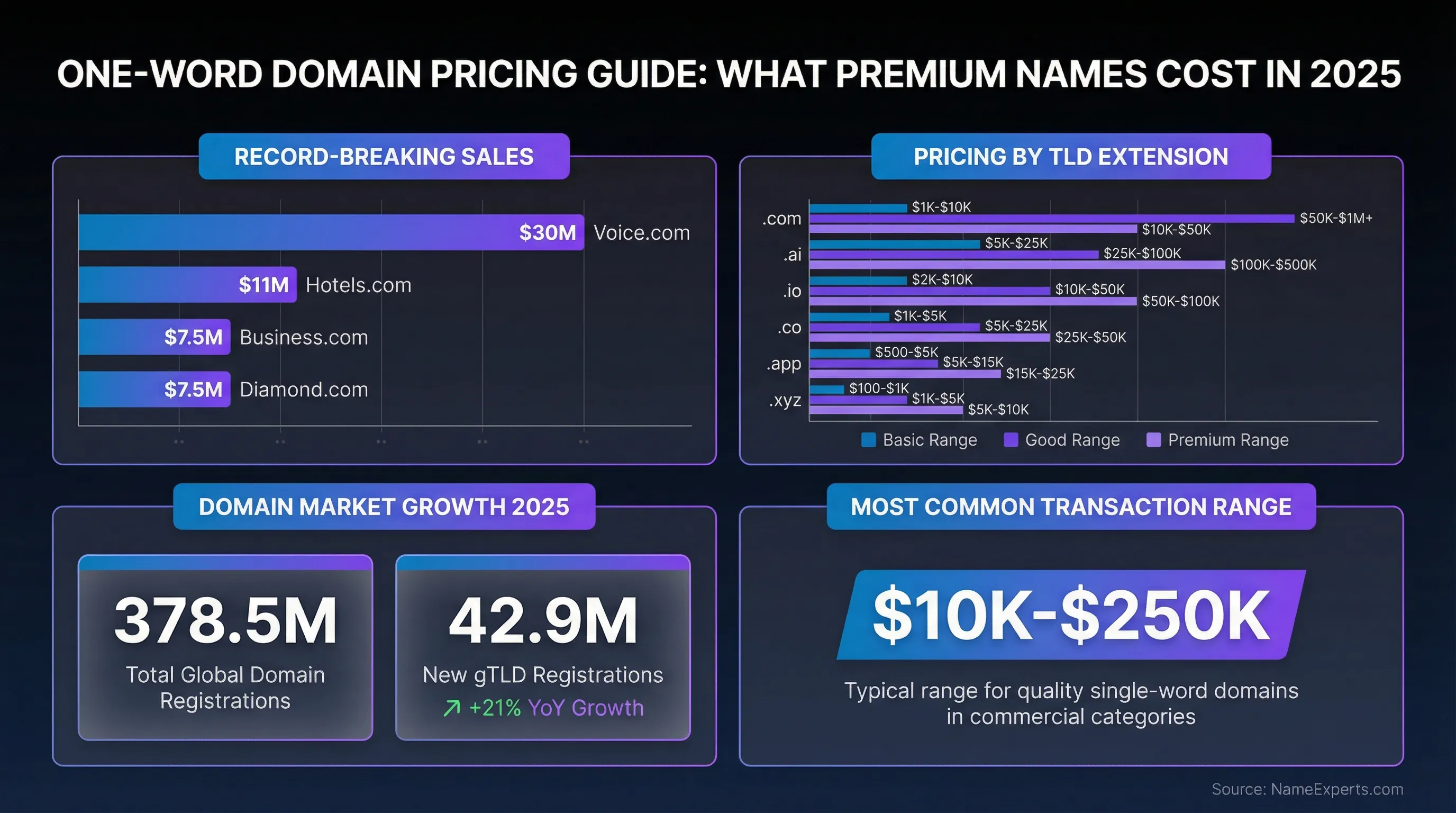
A single-word domain represents the pinnacle of digital real estate—concise, memorable, and instantly brandable. Names like Voice.com ($30M), Hotels.com ($11M), and Business.com ($7.5M) demonstrate the extraordinary value these assets can command. But understanding when to invest in a premium single-word name versus pursuing alternative strategies requires careful consideration of your brand goals, budget, and industry positioning.
What Makes One-Word Domains Valuable
The premium pricing for single-word names stems from fundamental advantages in memorability, brandability, and market positioning. These assets offer immediate recognition that compound or invented names often struggle to achieve.
Memorability and Brand Recall Advantages
Single-word names create powerful cognitive anchors. Research on domain name impact shows that shorter, simpler names significantly improve recall rates and reduce user error when typing addresses. A name like "Focus" or "Clarity" embeds itself in memory far more effectively than multi-word alternatives.
This memorability translates directly to marketing efficiency. When customers can instantly recall and accurately type your domain, you reduce the friction between awareness and action. Voice search amplifies this advantage—users can speak your brand name to virtual assistants without spelling complications or confusion.
SEO Benefits and Direct Navigation Traffic
Single-word names often align with high-volume search terms, creating natural SEO advantages. A domain that matches a generic search query can benefit from exact-match domain signals, though this factor has diminished since Google's algorithm updates. The more significant advantage lies in direct navigation—users who type your domain directly into their browser, bypassing search engines entirely.
Direct navigation traffic indicates strong brand recognition and typically converts at higher rates than search traffic. Premium names in commercial categories can generate substantial type-in traffic even before active marketing begins, particularly if the word relates to a common product or service category.
Scarcity Economics and Market Dynamics
The fundamental driver of premium pricing is scarcity. With approximately 170,000 words in the English language and most common terms already registered across popular extensions, available single-word names represent an increasingly rare commodity. This scarcity intensified during the early internet era when domain investors and businesses claimed the most valuable terms.
Industry data from 2025 shows that while total domain registrations reached 378.5 million globally, new gTLDs grew 21% year-over-year to 42.9 million names. This growth in alternative extensions reflects the scarcity of premium .com names and the market's adaptation to new TLD options.
Historical Sales Data
Notable transactions illustrate the upper bounds of single-word valuations:
- Voice.com – $30 million (2019): Acquired by Block.one for a blockchain social media platform
- Hotels.com – $11 million (2001): Travel industry premium reflecting category dominance
- Business.com – $7.5 million (1999): Early internet era record-setter
- Diamond.com – $7.5 million (2006): Luxury goods category leader
These exceptional sales represent the absolute premium tier. Most single-word transactions occur in the $10,000-$250,000 range for quality terms in commercial categories.

Pricing Expectations Across TLDs
Valuation varies dramatically based on the top-level domain extension, word quality, commercial relevance, and market demand. Understanding these pricing tiers helps set realistic acquisition budgets.
| TLD | Basic Range | Good Range | Premium Range | Best For |
|---|---|---|---|---|
| .com | $1K-$10K | $10K-$50K | $50K-$1M+ | Established businesses, broad audiences |
| .ai | $5K-$25K | $25K-$100K | $100K-$500K | AI/ML companies, tech startups |
| .io | $2K-$10K | $10K-$50K | $50K-$100K | Tech startups, developer tools |
| .co | $1K-$5K | $5K-$25K | $25K-$50K | Startups, modern brands |
| .app | $500-$5K | $5K-$15K | $15K-$25K | Mobile apps, software products |
| .xyz | $100-$1K | $1K-$5K | $5K-$10K | Creative projects, experimental brands |
Factors Affecting Valuation
Several variables influence where a specific name falls within these ranges:
- Word Length: Shorter words command premiums. Four-letter terms typically value higher than seven-letter equivalents.
- Search Volume: Terms with high monthly search volume indicate commercial intent and user demand.
- Commercial Intent: Words directly related to products, services, or transactions ("loans," "insurance," "travel") value higher than abstract concepts.
- Pronunciation: Easy-to-pronounce words that work across languages command premiums for international brands.
- Spelling Simplicity: Common spellings without ambiguity reduce user error and increase value.
- Category Relevance: Terms that define entire industry categories ("cars," "homes," "jobs") represent premium positioning.
Valuation Methodologies
Domain valuation experts use several approaches to assess fair market value:
Comparable Sales Analysis: The most reliable method examines recent transactions for similar terms. Industry databases provide searchable records of historical sales. If "fitness.com" sold for $4,500 and "wellness.com" for $30,000, a term like "health.com" would likely fall within or above that range based on search volume and commercial relevance.
Keyword Metrics: Automated tools analyze search volume, cost-per-click data, and competition levels to estimate commercial value. While useful for initial screening, these tools cannot account for brandability, pronunciation, or strategic fit—factors that often drive premium pricing.
Brandability Assessment: Subjective evaluation of how well a term works as a standalone brand. Words with positive connotations, clear meanings, and broad appeal typically command premiums over technical jargon or niche terminology.
Considering a Premium Domain Investment?
With premium single-word names ranging from $50K to $1M+, understanding fair market value is critical. Our team provides confidential appraisals backed by 16+ years of transaction data and 200+ completed deals—helping you make informed decisions without the Wild West guesswork.
Strategic Considerations: Does Your Business Need a Premium Single-Word Domain?
The prestige of owning a premium single-word name can overshadow practical business considerations. Not every company benefits equally from this investment, and alternative strategies often deliver better returns.
Brand Strategy Alignment
Premium single-word names work best when your business strategy emphasizes:
- Category Leadership: If you're positioning as the definitive solution in your space, a category-defining term reinforces that message.
- Simplicity and Clarity: Businesses serving broad consumer audiences benefit from immediately understandable names.
- Long-Term Brand Building: The investment makes sense when you're committed to building equity in a single brand over decades.
- Premium Positioning: Luxury and high-end brands leverage premium names to signal quality and exclusivity.
Conversely, these investments may not align with:
- Niche Specialization: Highly specialized businesses often benefit more from descriptive compound names that communicate their specific focus.
- Rapid Iteration: Startups testing multiple product directions may find premium names too constraining.
- Limited Marketing Budgets: The domain cost could exceed your entire first-year marketing budget, limiting growth capital.
Industry-Specific Considerations
Technology and SaaS: The tech sector has increasingly embraced alternative TLDs like .io and .ai, reducing pressure to acquire premium .com names. Companies like Notion, Stripe, and Zoom succeeded with invented or compound names rather than generic single-word terms.
E-commerce and Retail: Consumer-facing businesses benefit significantly from memorable, easy-to-type names. However, marketplace platforms and niche retailers often perform better with descriptive compound names that communicate their specific offering.
Professional Services: Law firms, consultancies, and B2B services traditionally rely on founder names or descriptive terms. A premium single-word name can differentiate in crowded markets but may not justify the investment for local or specialized practices.
Financial Services: Banking, insurance, and investment firms benefit from trust signals that premium names provide. Category terms like "trust," "capital," or "secure" reinforce credibility in risk-averse industries.
Portfolio Evaluation Framework
Before committing to a premium acquisition, assess fit using this framework:
- Brand Longevity: Will you use this name for 10+ years, or might your business evolve beyond its current scope?
- Marketing Efficiency: Calculate the customer acquisition cost savings from improved recall and direct navigation traffic.
- Competitive Positioning: Does owning this term create meaningful competitive advantage, or are competitors succeeding with alternative names?
- Trademark Clearance: Can you legally use and protect this term in your target markets and categories?
- Budget Allocation: Does the acquisition cost represent a reasonable percentage of your total marketing and brand-building budget?
Our team at NameExperts has facilitated over 200 domain transactions across 16+ years, and we've seen that portfolio fit matters more than prestige. A $50,000 investment in a premium name that doesn't align with your business strategy delivers less value than a $5,000 alternative that perfectly captures your positioning.
Acquisition Strategies and Best Practices
Successfully acquiring a premium single-word name requires understanding multiple acquisition channels, negotiation dynamics, and transaction security measures.
Acquisition Channels
Domain Marketplaces: Online platforms aggregate listings from thousands of sellers. These marketplaces provide transparent pricing, secure escrow services, and streamlined transfer processes. Expect to pay list prices with limited negotiation flexibility, though "Make Offer" options exist for many listings.
Auction Platforms: Specialized auction sites focus on expired domains and competitive bidding. Auctions can yield below-market prices for quality names but require timing, patience, and willingness to compete with professional investors. Set maximum bids in advance to avoid emotional overpaying.
Direct Owner Outreach: WHOIS lookup reveals current registrant contact information for most names. Direct negotiation can yield better pricing than marketplace commissions but requires careful approach. Many owners receive frequent inquiries and may not respond to generic offers. Personalized outreach explaining your business use case and demonstrating serious intent increases response rates.
Professional Broker Services: Domain brokers specialize in high-value negotiations, offering several advantages for premium acquisitions. Professional representation often justifies its cost through improved outcomes for acquisitions above $25,000.
Negotiation Strategies for Premium Purchases
High-value negotiations involve unique complexities that differ from standard domain transactions:
Stealth Acquisition: Revealing your company identity or specific use case can inflate pricing if the seller perceives significant value to your business. Professional brokers conduct negotiations on your behalf, maintaining confidentiality until terms are agreed.
Market Intelligence: Understanding comparable sales, historical pricing trends, and the seller's acquisition cost provides negotiation leverage. Brokers maintain proprietary databases of transaction history that inform realistic offer strategies.
Payment Structures: Sellers of premium names often accommodate payment plans, lease-to-own arrangements, or revenue-sharing agreements. These structures reduce upfront capital requirements while allowing immediate use of the asset. Typical payment plans span 12-36 months with 20-30% down payments.
Timeline Management: Premium negotiations typically span 2-8 weeks from initial contact to completed transfer. Rushed timelines signal desperation and weaken negotiating position. Patient, professional engagement demonstrates serious intent without urgency that sellers can exploit.
The Role of Professional Brokers
For acquisitions above $25,000, professional representation often justifies its cost through improved outcomes:
- Confidential Negotiation: Brokers shield your identity and business details, preventing price inflation based on perceived ability to pay.
- Market Expertise: Access to proprietary transaction data and industry relationships informs realistic pricing and negotiation strategies.
- Success-Based Pricing: Most brokers work on commission, aligning their incentives with achieving favorable terms rather than simply closing deals.
- Transaction Security: Professional brokers manage escrow, transfer verification, and dispute resolution, reducing fraud risk in high-value transactions.
At NameExperts, our 16+ years of experience and 200+ completed transactions have taught us that the most successful acquisitions result from patient, strategic negotiation rather than impulsive offers. We've helped clients achieve favorable terms through careful market analysis and relationship-building with sellers.
Legal Considerations and Trademark Conflicts
Generic single-word terms present unique trademark challenges. While generic terms cannot typically be trademarked in their primary meaning, existing trademarks in specific categories can create legal conflicts.
WIPO domain name dispute data shows that trademark conflicts remain a significant source of domain disputes. Before acquiring a premium name, conduct thorough trademark screening:
- USPTO Search: Search the United States Patent and Trademark Office database for existing marks in your business categories.
- International Trademark Databases: If operating globally, search WIPO, EUIPO, and relevant national databases.
- Common Law Rights: Unregistered trademarks based on prior use can still create legal challenges, particularly for established brands.
- Category Analysis: A term trademarked in one category (e.g., "Apple" for computers) may be available in others (e.g., "Apple" for groceries).
Consult trademark attorneys before finalizing premium acquisitions to assess legal risk and develop protection strategies for your intended use.
Due Diligence Checklist
Before completing a premium acquisition, verify:
- Clean Title: Confirm the seller has legal ownership and authority to transfer the asset.
- No Liens or Disputes: Verify no pending legal actions, trademark disputes, or ownership challenges exist.
- Transfer Eligibility: Ensure the domain is unlocked, not subject to transfer restrictions, and has valid authorization codes.
- Historical Use: Review Wayback Machine archives to identify any problematic previous content that could affect reputation or SEO.
- Penalty Status: Check for Google penalties or spam associations that could impact search visibility.
- Expiration Protection: Confirm the domain has adequate time before expiration to complete transfer without risk of loss.
Alternatives to Premium Single-Word Names
When premium pricing exceeds budget or strategic fit, several alternative approaches deliver strong branding outcomes at lower cost.
Modern TLD Strategies
New generic top-level domains (gTLDs) offer single-word availability at accessible prices:
.ai for Artificial Intelligence: Companies in machine learning, automation, and AI-adjacent spaces leverage this extension for immediate category association. Names like "predict.ai" or "learn.ai" communicate technical focus while remaining available and affordable.
.io for Technology: The tech startup community has embraced .io as a credible alternative to .com, with successful companies like Notion.io and Itch.io demonstrating mainstream acceptance.
.co for Modern Brands: Originally the country code for Colombia, .co has evolved into a global alternative for companies and startups, offering broader availability than .com.
Industry-Specific Extensions: Extensions like .tech, .app, .dev, and .design provide immediate context about your business focus while offering better single-word availability.
Two-Word Combinations and Compound Names
Combining two words creates brandable names with clearer meaning than abstract single words:
- Verb + Noun: "GetHelp," "FindHomes," "BuildApps" communicate action and outcome.
- Adjective + Noun: "QuickBooks," "SmartHome," "FreshDirect" add descriptive context.
- Noun + Noun: "MailChimp," "DropBox," "LinkedIn" create memorable combinations.
Two-word combinations typically cost $1,000-$10,000 for quality .com names—a fraction of single-word equivalents—while offering superior availability and clearer positioning.
Brandable Invented Names
Companies like Spotify, Zillow, and Etsy demonstrate that invented names can achieve global recognition without generic word foundations. Invented names offer:
- Trademark Clarity: Unique coinages face fewer legal conflicts than generic terms.
- Domain Availability: Invented names remain available across multiple TLDs at registration prices.
- Distinctive Identity: Unique names stand out in crowded markets where generic terms blend together.
- Flexible Meaning: Abstract names allow brand meaning to evolve as your business grows.
Prefix and Suffix Strategies
Adding common prefixes or suffixes to single words creates available variations:
- Get-: "GetResponse," "GetAround" imply action and accessibility.
- -ly: "Bitly," "Friendly," "Costly" create short, memorable variations.
- -ify: "Spotify," "Shopify" suggest transformation and empowerment.
- -able: "Remarkable," "Scalable" emphasize capability and potential.
These strategies maintain single-word simplicity while expanding availability and reducing acquisition costs to $500-$5,000 for quality options.
When Alternatives Outperform Premium Names
Alternative strategies often deliver superior outcomes when:
- Budget Constraints Limit Marketing: Spending $50,000 on a domain leaves insufficient capital for customer acquisition and brand building.
- Niche Positioning Requires Specificity: Descriptive compound names communicate specialized focus better than generic single words.
- Brand Differentiation Matters More Than Category Association: Unique invented names help you stand out rather than blend into generic category terms.
- International Expansion Requires Pronunciation Clarity: Compound or invented names can be designed for global pronunciation, while English single words may not translate well.

Don't Negotiate Alone—Protect Your Identity and Your Budget
Revealing your company name or use case during negotiations can inflate pricing by 2-3x. Our stealth acquisition service maintains complete anonymity while leveraging proprietary market intelligence to secure fair terms on high-value purchases.
Making the Right Decision for Your Brand
Premium single-word names represent powerful branding assets when aligned with business strategy, budget, and long-term vision. The memorability, credibility, and market positioning these names provide can justify significant investment for companies building category-defining brands in competitive markets.
However, the prestige of owning a premium name should not overshadow practical considerations. Many successful brands have achieved global recognition with compound names, invented terms, or alternative TLD strategies that cost a fraction of premium single-word equivalents. The right choice depends on your specific industry, target audience, competitive landscape, and available capital for both acquisition and ongoing brand building.
For businesses considering premium acquisitions above $25,000, professional guidance significantly improves outcomes. At NameExperts, our 16+ years of experience and 200+ completed transactions have taught us that the most successful acquisitions result from patient strategy, thorough market analysis, and clear alignment between domain investment and business objectives.
Whether you're evaluating a specific premium name, exploring alternative strategies, or need confidential representation in high-value negotiations, our team provides the expertise and market intelligence to make informed decisions. Contact NameExperts for a confidential consultation on your domain acquisition strategy.
Work With a Domain Expert
Whether you're evaluating a premium single-word acquisition, need confidential representation in high-stakes negotiations, or want honest guidance on whether alternatives better serve your brand strategy—NameExperts brings 16+ years of no-bullshit expertise to your corner. We've navigated the Wild West of the domain marketplace through 200+ transactions, and we know that portfolio fit matters more than prestige. Let's determine the right path for your business. Get Started Free
Get Started Free







Frequently Asked Questions
Almost all dictionary .com names are registered, but invented terms like Uber or Zoom remain available, and alternative TLDs (.ai, .io, .co) offer significantly more single-word options at accessible prices ranging from $500 to $25,000.
A strong domain is memorable, easy to spell, and relevant to your brand—prioritizing conciseness while avoiding hyphens and numbers that create confusion or typing errors.
The top extensions in 2026 are .com (highest value), followed by .net, .org, .co, .ai (for AI companies), .io (for tech startups), .us, .xyz, .shop, and .pro, with .com commanding 5-10x premiums over alternatives.
The .one TLD works well for brands emphasizing uniqueness or singular focus, though it lacks the universal recognition of .com and may require additional marketing effort to establish credibility with mainstream audiences.