

Simple domain names create significantly less cognitive load than complex ones, determining whether potential customers remember your website—or forget it the moment they close their browser. At NameExperts, we've seen this principle play out across 200+ transactions over 16 years: the most valuable domains aren't always the shortest, but they're always the most memorable.
Key Takeaways
- Cognitive load theory explains why simple, phonetically clear domains stick in memory while complex ones fade
- Brandable domains outperform exact-match keywords in building long-term recognition and trust
- A systematic 4-pillar framework helps you evaluate domain ideas objectively before registration
- Professional validation from naming consultants adds demographic testing and trademark depth that DIY approaches miss
The Psychology Behind Domain Memorability
Understanding why certain domains stick in memory requires examining how our brains process and store information. Three cognitive principles determine whether a domain name becomes instantly recognizable or quickly forgotten.
Cognitive Load Theory: Why Simplicity Wins
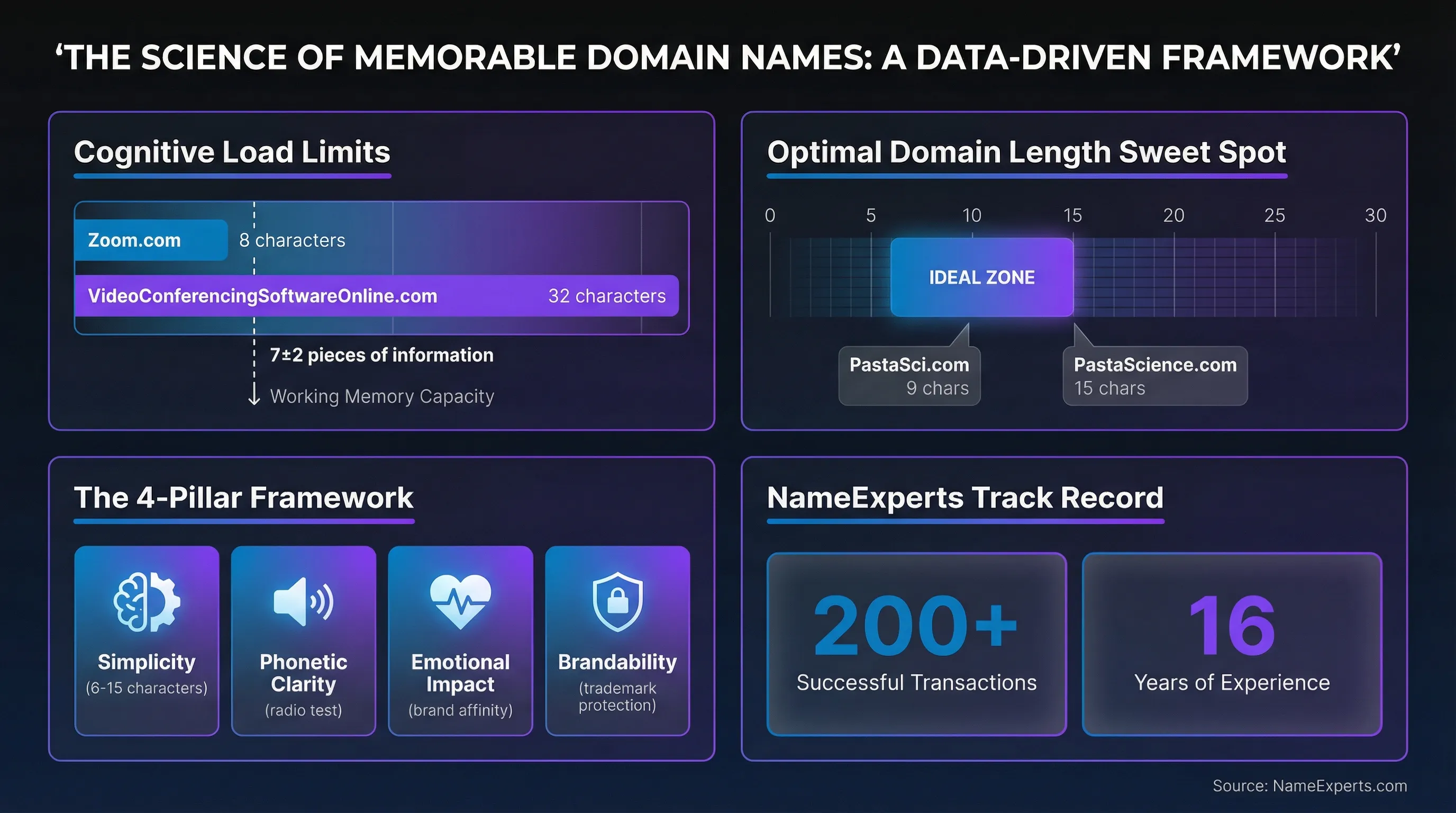
Cognitive load research reveals that our working memory can effectively handle 7±2 pieces of information at once. When a domain exceeds this natural processing limit, the brain struggles to encode it into long-term memory. Compare Zoom.com to VideoConferencingSoftwareOnline.com—the former requires minimal cognitive effort, while the latter overwhelms working memory with 32 characters and multiple concepts.
This processing fluency directly impacts recall. Simple domains create what psychologists call "low cognitive friction," allowing users to remember and type them accurately without conscious effort. That's why our team at NameExperts consistently recommends keeping character counts between 6-15 for optimal memorability.
Emotional Resonance: Domains That Trigger Feelings
Beyond simplicity, the most effective domains evoke positive emotional associations. PayPal conveys trust through its phonetic warmth—the repeated "P" sound and friendly "pal" ending create subconscious comfort. This emotional layer transforms a functional address into a brand people feel good about using.
Neuroscience shows that emotionally charged words activate the amygdala, strengthening memory formation. When evaluating domain candidates, our consultants test for emotional impact: Does it feel trustworthy? Exciting? Professional? These associations become inseparable from your brand identity.
Visual and Phonetic Processing: The Sound Test
The "radio test" remains one of the most reliable evaluation tools: if you can't clearly communicate your domain over the phone without spelling it, you've created unnecessary friction. Linguistic research on brand names demonstrates that phonetically clear domains with strong consonant-vowel patterns achieve higher recall rates.
Flickr works despite its unconventional spelling because the phonetic structure remains clear. The brain processes the sound pattern first, making the visual representation secondary. When NameExperts tests pronunciation across different demographics—from millennials to baby boomers—we ensure your domain passes this critical auditory test.

The 4-Pillar Framework for Evaluation
After analyzing thousands of successful domain acquisitions, we've distilled domain evaluation into four essential pillars. This framework helps you move beyond gut feeling to systematic assessment.
| Characteristic | Memorable Example | Forgettable Example | Why It Matters |
|---|---|---|---|
| Simplicity | Stripe.com | Best-Payment-Processing-Solutions.com | Reduces cognitive load and typing errors |
| Phonetic Clarity | Spotify.com | Xprsv.com | Passes the radio test, easy to share verbally |
| Emotional Impact | Warby Parker | Generic Eyewear | Creates brand affinity and positive associations |
| Brandability | Airbnb.com | Rent-Apartments-Online.com | Enables trademark protection and unique identity |
Pillar 1: Simplicity Metrics
The sweet spot for domain length falls between 6-15 characters. Shorter isn't always better—PastaSci.com sacrifices clarity for brevity, while PastaScience.com maintains both simplicity and meaning. Avoid numbers, hyphens, and special characters entirely. These elements force users to make decisions ("Is it the number 4 or spelled out?") that increase cognitive load and create opportunities for error.
Single words carry inherent advantages, but compound words work beautifully when they form natural combinations. Dropbox succeeds because both elements are familiar, and the combination instantly conveys function.
Pillar 2: Phonetic Excellence
Alliteration and rhyming aren't just creative flourishes—they're memory anchors. PayPal, Best Buy, and Dunkin' Donuts all leverage repeated sounds to enhance recall. The pronounceability index we use at NameExperts evaluates whether a domain can be correctly spoken by someone who's never seen it written.
Cross-cultural pronunciation deserves special attention if you're building a global brand. A domain that works perfectly in English might create confusion or unintended meanings in other languages. Our demographic testing process specifically addresses these potential pitfalls.
Pillar 3: Emotional Connection
Map the associations your domain creates. Etsy evokes something handmade and personal, while Amazon suggests vast selection. These aren't accidents—they're carefully chosen emotional positions. Consider your industry's appropriate tone: a law firm needs gravitas, while a creative agency can embrace playfulness.
Negative connotations kill domains. Before finalizing any choice, research potential meanings across languages and subcultures. What seems clever in one context might be offensive or confusing in another.
Pillar 4: Brandability Score
Trademark clearance forms the foundation of brandability. A domain that infringes on existing trademarks becomes a legal liability, not an asset. Beyond legal availability, consider social media handle consistency—your brand identity strengthens when the same name works across all platforms.
The .com extension remains the gold standard for credibility, though alternatives like .co and .io have gained acceptance in tech sectors. Extension choice subtly influences how users perceive brand professionalism and trustworthiness.

Already Found Your Perfect Domain—But Someone Else Owns It?
The most memorable domains are often already registered. Our stealth acquisition specialists negotiate on your behalf with complete anonymity, preventing price inflation and securing fair market pricing. With 15+ years of experience across 200+ transactions, we know how to get the domain you need.
Your Domain Self-Assessment Checklist
This systematic evaluation framework empowers you to assess domain candidates objectively. Work through each section with your shortlist of potential names.
The Instant Gut Check
Start with these five rapid-fire questions that reveal fundamental issues:
- Can you say it clearly over the phone? If you need to spell it out letter by letter, it fails the radio test.
- Does it sound like a professional brand? Trust your instinct—if it feels amateurish or gimmicky, your customers will sense that too.
- Would you remember it after hearing it once? Ask friends to recall it an hour after you mention it casually.
- Does it avoid confusion with competitors? Similar-sounding domains dilute your brand and create customer frustration.
- Does it have positive or neutral associations? Negative connotations, even subtle ones, undermine trust.
If any answer raises red flags, pause before proceeding. These gut-level responses often reveal problems that rational analysis might miss.
The Technical Validation
Move beyond intuition to systematic verification with this seven-point audit:
- Trademark search completion: Check USPTO and WIPO databases for existing registrations in your industry.
- Domain history verification: Use archive tools to ensure the domain hasn't been associated with spam or questionable content.
- Typing error vulnerability test: Identify common misspellings and consider registering those variations.
- SEO keyword relevance check: While brandability trumps exact-match keywords, relevant terms still provide context.
- Extension availability review: Secure the .com if possible, plus key alternatives to prevent competitor confusion.
- Social media handle consistency: Verify the name works across major platforms for unified branding.
- Length and complexity score: Apply the 6-15 character guideline and avoid numbers or hyphens.
The Professional Layer
At NameExperts, our consultants apply this same framework when evaluating domains for clients—but we add layers that DIY approaches can't replicate. Our demographic pronunciation testing exposes issues that might only surface with specific age groups or regional accents. We conduct trademark searches that go beyond basic database queries to identify potential conflicts with common-law marks and pending applications.
Think of professional validation as refinement, not replacement. You've done the foundational work by applying this framework to your shortlist. Expert consultation adds the final polish: confirming your top choice will work across all demographics, verifying trademark clearance depth, and ensuring you're maximizing memorability and market impact.
When should you consult experts? If you're investing significantly in brand building, if your domain will represent a company (not just a side project), or if you're choosing between multiple strong candidates and need objective validation, professional input pays dividends.
Real-World Examples: What Makes These Domains Stick
Examining successful domains through our framework reveals why certain names achieve lasting recognition while others fade into obscurity.
Tech Sector Success Stories
Slack exemplifies simplicity meeting brandability—a single syllable that's impossible to mispronounce, with no prior strong associations that would limit its identity. The company built meaning into the name rather than trying to describe its function. Notion follows the same principle: short, clear, and open to interpretation.
Dropbox demonstrates how compound words succeed when both elements are familiar and the combination instantly conveys purpose. You immediately understand the concept without explanation, yet the name remains distinctive enough for trademark protection.
E-commerce Winners
Warby Parker breaks conventional wisdom by using two names, yet it works because the combination creates a memorable character. The alliterative "W" and "P" sounds provide phonetic hooks, while the unusual pairing ensures uniqueness. This approach requires more marketing investment than a simple one-word domain, but the distinctiveness pays off in brand recognition.
Glossier invented a word that feels familiar—it sounds like "glossy" with a French twist, perfectly capturing the beauty brand's aesthetic. Made-up words work when they follow natural phonetic patterns and evoke the right associations.
Service Industry Standouts
GrubHub uses rhyming to create instant memorability. The repeated "uh" sound makes it catchy, while both words clearly relate to food delivery. TaskRabbit combines a functional word (task) with a playful animal, creating personality while maintaining clarity about the service offered.
Thumbtack achieves memorability through vivid visual imagery—you can picture a thumbtack, which creates a mental anchor. The name also subtly suggests pinning tasks to service providers, though the metaphor doesn't need to be consciously understood to work.
From Framework to Final Decision
The four pillars—simplicity, phonetic excellence, emotional connection, and brandability—provide a systematic approach to what often feels like an overwhelming decision. Remember that memorable beats short every time. A 12-character domain that passes all four pillar tests will outperform a 6-character domain that's confusing or forgettable.
After applying this framework to your shortlist, you'll have confidence in your top choices. If you want that extra layer of professional confirmation, NameExperts' naming consultants can test pronunciation across demographics, validate trademark clearance at a deeper level, and ensure your choice maximizes both memorability and market impact. Our 16+ years of experience and 200+ successful transactions have taught us that the right domain isn't just available—it's strategically positioned to become a valuable brand asset.
Start your domain evaluation today using this framework, and you'll make a decision you can build on for years to come. When you're ready to move forward with acquiring your perfect domain, our domain acquisition services can help you secure even domains that appear unavailable. We also offer comprehensive domain valuation guidance to ensure you understand fair market pricing before making an investment. Contact our team when you're ready for professional validation and guidance on securing your perfect domain.
Not Sure If Your Domain Passes the Professional Test?
Our naming consultants go beyond basic checks—we test pronunciation across demographics, conduct deep trademark searches including common-law marks, and validate that your choice maximizes memorability and market impact. Get objective confirmation before you commit.
Work With a Domain Expert
Whether you need to acquire a domain that's already taken, validate your shortlist with professional demographic testing, or get expert guidance on maximizing brandability—NameExperts brings 15+ years of no-bullshit domain expertise to your corner. We've completed 200+ successful transactions because we focus on personalized service, stealth negotiations, and getting you the right domain at fair market prices. Stop second-guessing your domain decision. Get the professional validation and acquisi
Get Started Free







Frequently Asked Questions
A great domain name is memorable, phonetically clear, and easy to spell—typically 6-15 characters that pass the radio test and create positive emotional associations while remaining brandable enough for trademark protection.
A unique domain combines a distinctive second-level domain (the main name) with a top-level extension (.com, .io, etc.) that's legally available for trademark registration and creates a singular brand identity not easily confused with competitors.
The best options prioritize brandability over keyword stuffing—short, simple names like Stripe or Notion that reduce cognitive load, pass pronunciation tests across demographics, and allow you to build meaning into them rather than describing your function literally.
Premium domains range from $1,000 for solid brandable names to millions for ultra-premium single words—value depends on length, extension, brandability, and market demand, with .com addresses commanding the highest prices due to established credibility.