

Key Takeaways
- Premium domains typically range from $500 to $500,000+, but pricing is negotiable in most cases
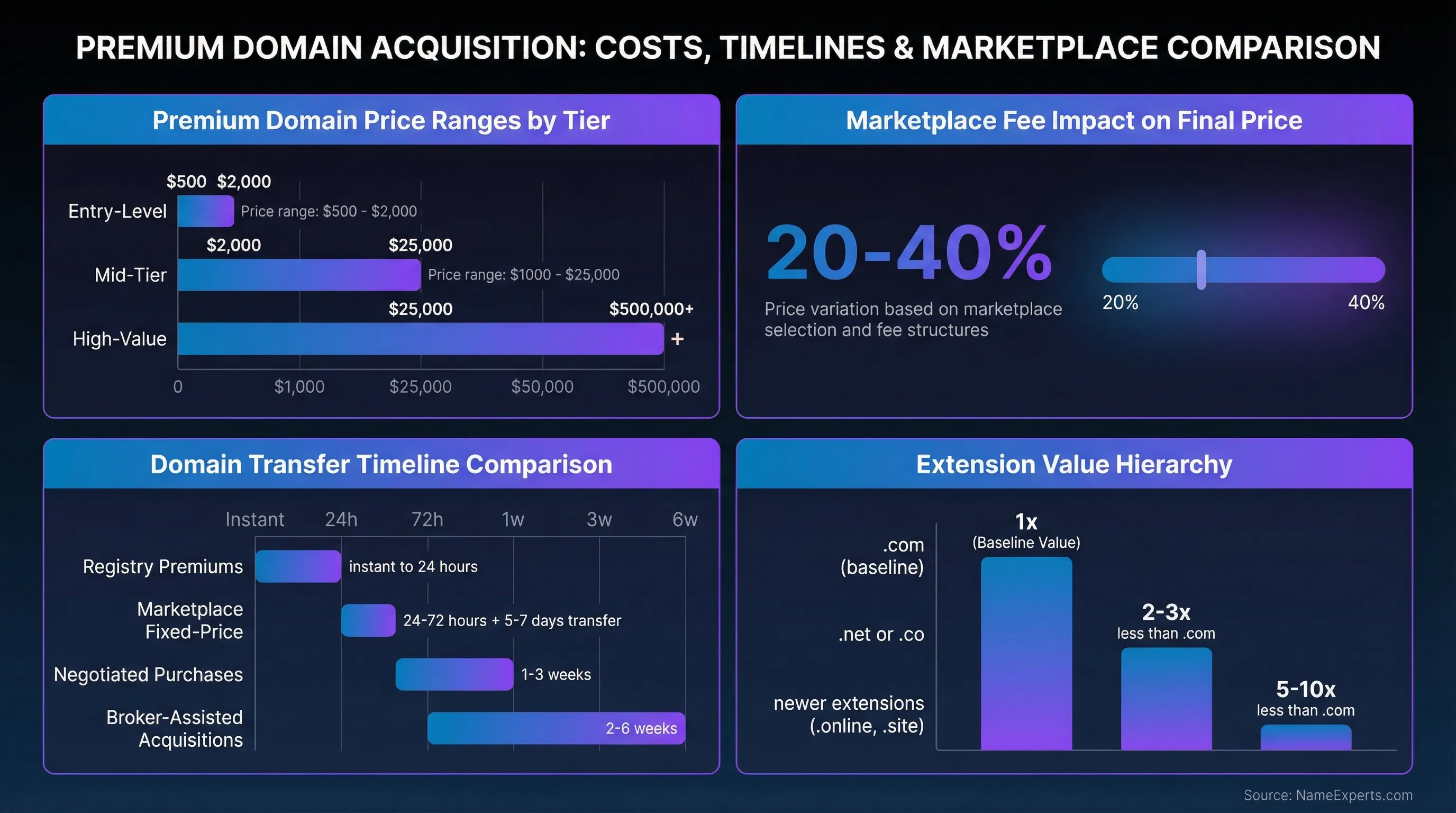
- Marketplace selection impacts your final price by 20-40% due to fee structures and seller motivations
- Expert appraisals prevent overpaying by identifying inflated valuations based on real transaction data
- Broker-assisted acquisitions often secure better deals than self-service platforms through anonymity and professional negotiation
- Understanding domain valuation factors is critical before making offers to avoid costly mistakes
The premium domain market can feel like navigating uncharted territory—opaque pricing, aggressive sellers, and the constant risk of overpaying for what should be a strategic asset. Most buyers lack the expertise to evaluate true domain value and negotiate effectively, leaving money on the table or worse, acquiring overpriced digital real estate that never delivers ROI.
This guide reveals insider strategies for smart acquisition based on our 16+ years of experience and 200+ successful transactions. You'll learn how to identify genuine value, compare marketplaces strategically, negotiate like a professional, and avoid the common pitfalls that cost buyers thousands of dollars.
What Actually Makes a Domain "Premium" (And Worth the Price)
A premium domain is a previously registered web address that commands higher prices due to specific characteristics that make it more valuable than standard registrations. These aren't random names—they're carefully selected digital assets with inherent market appeal.
Several key factors drive value in this market. Length matters significantly, with shorter names commanding premium prices because they're easier to remember and type. A five-character domain will typically cost substantially more than a fifteen-character alternative in the same niche.
Extension quality plays a crucial role. The .com extension remains the gold standard, typically priced 2-3x higher than alternatives like .net or .co for comparable names. Newer extensions like .ai and .io have gained traction in tech sectors, but .com still dominates for broad commercial appeal.
Keyword relevance and search volume directly impact pricing. Domains containing high-traffic search terms or industry-specific keywords carry premium valuations because they offer built-in SEO advantages and instant brand recognition. A domain matching an exact search query can drive significant direct navigation traffic.
Brandability and memorability separate exceptional names from merely good ones. The best options are pronounceable, spell easily, and create immediate mental associations. They work well in conversation, on business cards, and in advertising—critical factors for long-term brand building.
Existing traffic and backlink profiles add tangible value. Some names come with established visitor flows or authoritative backlinks from years of prior use, providing immediate marketing advantages worth thousands in equivalent advertising spend.
Price ranges vary dramatically based on these characteristics. Entry-level options start around $500-$2,000 for decent brandable names with newer extensions. Mid-tier selections run $2,000-$25,000 for quality .com domains with moderate length and good brandability. High-value acquisitions range from $25,000-$500,000+ for short, keyword-rich, or exceptionally brandable .com addresses.
Premium pricing is justified when the name delivers measurable business advantages: instant credibility, reduced marketing costs, improved conversion rates, and long-term brand equity. It's not justified when inflated by seller speculation, artificial scarcity, or misleading appraisals.

Red flags signaling overpriced listings include prices 3x+ above comparable recent sales, sellers with zero negotiation flexibility, names with trademark conflicts, and inflated "appraisals" from seller-affiliated services designed to anchor high prices.
Premium Domain Marketplace Comparison: Where to Buy
Not all marketplaces operate the same way, and your choice significantly impacts both price and purchase experience. Understanding the landscape helps you select the right platform for your specific needs and budget.
| Marketplace Type | Inventory Size | Price Range | Best For | Key Features | Drawbacks |
|---|---|---|---|---|---|
| Large International Marketplaces | 15M-20M+ domains | $500-$1M+ | Large selection, international sellers | Auction + fixed price, escrow service, broker assistance available | Variable seller quality, negotiation often required, complex interface |
| Curated Brandable Platforms | 200K-400K curated | $1,500-$225K | Brandable business names | Hand-curated inventory, instant transfer, logo included, fixed pricing | Higher prices, limited tech-specific inventory, no negotiation |
| Tech-Focused Marketplaces | 200K-400K+ domains | $1,800-$1.2M | AI/tech domains, payment plans | AI-powered search, flexible financing, expert curation, installment options | Newer platforms, smaller inventory than legacy marketplaces |
| Major Auction Platforms | Millions | $100-$500K+ | Budget-conscious buyers | Auction bidding, large volume, integrated registrar services | Cluttered interface, mixed quality, competitive bidding wars |
| Expert-Assisted Acquisition | Unlisted domains | Varies widely | High-value acquisitions, stealth buying | Anonymity, professional negotiation, market expertise, access to unlisted inventory | Broker fees (10-20%), longer timelines |
For startups operating on tight budgets, major auction platforms and large marketplace fixed-price listings offer the widest selection at entry-level price points. You'll need to invest time sorting through inventory and conducting your own due diligence, but deals exist for patient buyers.
Brand-focused businesses prioritizing instant credibility should explore curated brandable platforms. These marketplaces pre-screen inventory for brandability and often include additional assets like logos. The fixed pricing eliminates negotiation stress, though you'll pay a premium for curation.
Tech companies and AI-focused ventures find specialized inventory on tech-focused marketplaces, which emphasize modern extensions like .ai and .io. AI-powered search tools help match your brand vision to available names based on emotional tone and market positioning.
High-value acquisitions above $10,000 benefit significantly from professional brokerage services. At NameExperts, we've brokered transactions for major brands like HBO Max.com and Monday.com, leveraging our 16+ years of market knowledge to secure better terms than self-service platforms typically deliver.
Marketplace selection strategy should consider multiple factors beyond price. Transaction security matters—ensure the platform offers escrow protection. Transfer speed varies significantly, with some marketplaces completing handoffs in days while others take weeks. Customer support quality becomes critical if complications arise during transfer.

Hidden costs deserve scrutiny. Some platforms charge buyer premiums (5-15% of purchase price), transfer fees, or escrow fees that aren't immediately obvious. Always calculate total acquisition cost, not just the listed price.
The Expert-Assisted Advantage
Professional brokers secure better deals than self-service platforms through several mechanisms. Anonymity prevents price inflation—when sellers don't know a well-funded company is interested, they negotiate more reasonably. Our stealth acquisition approach has saved clients 15-30% compared to direct approaches.
Professional negotiation tactics leverage market intelligence that individual buyers lack. With 200+ transactions completed, we know what similar names actually sold for (not just asking prices), which sellers negotiate and which don't, and how to structure offers that get accepted.
Market expertise prevents costly mistakes. We identify overpriced listings immediately, spot trademark issues before you invest, and access unlisted inventory through industry relationships that self-service platforms can't match.
Broker fees typically run 10-20% of purchase price, which sounds significant until you consider the savings on the base price. On a $50,000 acquisition, a 15% broker fee ($7,500) is easily justified if we negotiate the price down from $60,000 to $45,000—you save $7,500 on the purchase and get professional service included.
The investment threshold where brokerage makes sense is typically $10,000+. Below that, self-service platforms usually suffice. Above that amount, the complexity of negotiation and the dollars at stake justify professional assistance.
Avoid Overpaying With Expert Market Intelligence
Choosing the right marketplace is just the first step—knowing what domains actually sell for (not just asking prices) prevents costly mistakes. Our 16+ years of experience and 200+ successful transactions give you the market intelligence that individual buyers lack.
How to Evaluate Domain Value (Before You Buy)
Accurate valuation prevents overpaying and gives you negotiation leverage. Professional appraisal combines multiple methodologies rather than relying on a single metric.
Comparable sales analysis forms the foundation of professional valuation. Research recent transactions for similar names using databases that track actual sale prices. Look for matches in length, extension, keyword relevance, and industry focus. A seven-character .com in the finance sector should be compared to similar finance domains, not random seven-character names in unrelated niches.
Traffic and revenue potential estimates the SEO value and direct navigation traffic the name might generate. Domains matching exact search queries with significant monthly volume carry measurable value. Use keyword research tools to assess search volume for the exact domain name and related terms. Existing traffic data (if available from the seller) provides concrete valuation input.
Brandability assessment requires subjective judgment but follows clear criteria. Pronounce the name aloud—does it roll off the tongue naturally? Check spelling difficulty—will people misspell it when typing or searching? Test memorability by mentioning it once in conversation and seeing if someone recalls it minutes later. Strong brandable names command premium multiples over generic keyword domains.
Extension value hierarchy significantly impacts pricing. The .com extension typically commands 2-3x the price of .net or .co equivalents, and 5-10x the price of newer extensions like .online or .site. Exceptions exist for tech-focused extensions (.ai, .io, .dev) in appropriate industries, but .com remains king for broad commercial use.
Length and composition affect value exponentially, not linearly. Five-character domains are worth substantially more than six-character equivalents—often 3-5x more. Each additional character reduces value. Hyphens and numbers dramatically decrease value (typically 50-70% reduction) because they complicate verbal communication and increase typo risk.
Automated appraisal tools provide quick estimates but have significant limitations. They rely on algorithms that can't assess brandability or industry-specific value. Use them as starting points, not final valuations. Most automated tools overvalue domains to encourage listings on their marketplaces.
Professional appraisal services justify their cost ($100-$500 typically) when you're considering purchases above $5,000. Expert appraisers bring market knowledge and transaction experience that algorithms lack. At NameExperts, our appraisals draw on real comparable sales data from our 200+ transactions, providing objective market valuations that prevent overpaying.
Market trend analysis adds context to static valuations. According to recent market analysis, certain extensions show different retail versus wholesale patterns. For example, .io extensions showed approximately $2 million in retail sales versus $1.3 million wholesale, while .xyz showed $2.3 million retail versus only $0.3 million wholesale, indicating stronger end-user demand for .xyz relative to investor speculation.
Red flags signaling overpricing include listings priced 3x+ above comparable recent sales, sellers citing outdated sales from years ago as justification, inflated appraisals from services affiliated with the seller, and refusal to provide any pricing rationale or comparable sales data.
Trademark conflicts represent hidden costs that destroy value. Before making offers, search USPTO databases and international trademark registries for conflicts. A domain that infringes existing trademarks is worthless regardless of other qualities, and may expose you to legal liability.
Get an Objective Domain Appraisal Before You Buy
Automated tools can't assess brandability or industry-specific value—and often overvalue domains to encourage listings. Our professional appraisals draw on real comparable sales data from 200+ transactions, providing objective market valuations that prevent overpaying and give you negotiation leverage.
Negotiation Strategies for Premium Domain Purchases
Effective negotiation can save 20-40% on final purchase price, but requires preparation and discipline. Most sellers expect negotiation and price domains accordingly.
Pre-negotiation preparation sets you up for success. Research the seller's history—how long have they owned the name? Are they active investors who flip domains, or long-term holders? Check their other listings to gauge pricing patterns and negotiation flexibility. Establish your maximum budget before contact and commit to walking away if negotiations exceed it.
Gather comparable sales data as leverage. When you can reference three similar domains that sold for $15,000-$20,000, it's much easier to justify a $18,000 offer on a name listed at $35,000. Sellers respect buyers who've done homework and present data-driven offers.
Anonymity strategy matters more than most buyers realize. When sellers know a well-funded company desperately wants their domain, prices inflate. Consider using a broker or intermediary for high-value acquisitions to maintain anonymity. This single tactic typically saves 15-30% on final price by preventing competitive bidding and removing emotional leverage.
Opening offer strategy should start at 40-60% of asking price for domains that appear negotiable. This isn't insulting—it's standard practice in this market. Sellers typically price 50-100% above their acceptable range expecting negotiation. Starting low gives you room to negotiate upward while still landing at a fair price.
The power of patience cannot be overstated. Rushing signals desperation and weakens your position. Be prepared to walk away and wait days or weeks for responses. Many sellers test buyer resolve by delaying responses or initially rejecting offers, then returning with counteroffers when they realize you're serious but not desperate.
Anchoring techniques use comparable sales to justify your offer. Instead of saying "I'll offer $15,000," say "Based on recent sales of similar seven-character .com domains in this industry—specifically [domain1.com] at $14,000 and [domain2.com] at $16,000—I'm prepared to offer $15,000." This frames your offer as fair market value rather than arbitrary.
Know when to walk away. Unreasonable sellers who won't negotiate, refuse to provide pricing rationale, or make emotional rather than business-based arguments rarely become reasonable. Your time is valuable—invest it in negotiations with motivated sellers, not ego-driven holders.
Payment terms provide leverage in negotiations. Offering immediate payment (wire transfer within 24 hours of agreement) can justify 5-10% discounts. Sellers value certainty and speed, especially professional investors managing portfolios.
Broker-assisted negotiation eliminates emotional attachment that undermines buyer positions. When you negotiate directly, sellers sense your enthusiasm and attachment to their specific domain. Professional brokers maintain emotional detachment, credibly threaten to walk away, and leverage industry relationships that individual buyers lack.
At NameExperts, our stealth acquisition approach prevents competitive bidding and price inflation. Sellers don't know which company is interested, eliminating the leverage they'd have if they knew a well-funded brand needed their specific domain. This anonymity, combined with professional negotiation tactics honed over 200+ transactions, consistently delivers better outcomes than direct buyer-seller communication.
Marketplace-specific tactics vary by platform. On major marketplaces, use "Make Offer" features strategically—initial offers are often automatically rejected by seller-set thresholds, but persistence pays off. Curated platforms use fixed pricing with limited negotiation, so focus on finding undervalued inventory rather than negotiating listed prices. Auction platforms require bidding strategies—set maximum bids and avoid emotional last-minute bidding wars that inflate prices beyond value.
Direct owner contact through WHOIS lookup can work for unlisted domains you want to acquire. Craft professional outreach that expresses interest without revealing desperation. Avoid phrases like "perfect for our brand" or "exactly what we need"—these signal high willingness to pay and weaken your position.
Common negotiation mistakes cost buyers thousands. Revealing your budget ceiling eliminates negotiation room. Emotional attachment to specific domains removes your ability to walk away. Ignoring alternative domains reduces your leverage—sellers negotiate harder when they know you have no alternatives. Failing to verify ownership before payment exposes you to scams.
The Premium Domain Purchase Process: What to Expect
Understanding the timeline and steps involved prevents surprises and helps you plan your launch schedule appropriately.
Timeline expectations vary significantly by purchase type. Registry premiums (new domains designated as premium by registries) provision instantly to 24 hours—the fastest option. Marketplace fixed-price purchases typically take 24-72 hours for verification plus 5-7 days for transfer completion. Negotiated purchases extend to 1-3 weeks including negotiation time and transfer. Broker-assisted acquisitions run 2-6 weeks including seller outreach, negotiation, and transfer logistics.
The step-by-step purchase process follows a predictable pattern. Domain selection and valuation takes 1-3 days as you research options and assess fair market value. Price negotiation consumes 3-14 days for negotiated deals, though fixed-price purchases skip this step. Payment and escrow setup requires 1-2 days to arrange secure payment through escrow services that protect both parties. Domain transfer initiation takes 1-2 days as the seller unlocks the domain and provides authorization codes. Transfer completion spans 5-7 days for standard registrar transfers as the domain moves between registrars. DNS setup and launch happens immediately after transfer completes and you gain control.
Payment methods and security deserve careful attention. Escrow services protect buyers by holding funds until transfer completes successfully. Never pay sellers directly without escrow protection—scams exist where sellers take payment and never transfer domains.
Payment plan options make high-value acquisitions accessible. Some marketplaces offer installment plans that spread payments over 12-36 months. This financing typically adds 10-20% to total cost but improves cash flow for startups. Evaluate whether the financing premium justifies the cash flow benefit for your situation.
Wire transfer versus credit card considerations affect total cost. Wire transfers avoid processing fees (typically 3-4% for credit cards) and clear faster, making them preferred for high-value transactions. Credit cards offer dispute protection but add fees that sellers often pass to buyers.
Buyer protection mechanisms vary by marketplace. Reputable platforms guarantee domain delivery and offer refunds if sellers fail to transfer as agreed. Verify these protections before purchasing, especially on smaller or newer marketplaces.
Transfer process details require attention to avoid delays. Authorization codes (also called EPP codes) must be obtained from the current registrar to initiate transfers. The domain must be unlocked—sellers sometimes forget this step, causing delays. Registrar transfer moves the domain between registrars (5-7 days typically), while account push transfers between accounts at the same registrar (instant to 24 hours).
The 60-day ICANN transfer lock represents critical timing consideration. Domains cannot be transferred to new registrars within 60 days of registration or previous transfer. If you need to move the domain to your preferred registrar immediately after purchase, verify the domain isn't locked. Otherwise, you'll wait 60 days before transferring.
Post-transfer verification steps ensure everything completed correctly. Confirm WHOIS information updated to show your ownership. Verify DNS settings point to your hosting. Test email forwarding if configured. Check that domain lock is enabled to prevent unauthorized transfers.
Full-service brokerage handles the entire technical transfer process, eliminating complexity and potential errors. At NameExperts, we manage authorization codes, coordinate with registrars, monitor transfer progress, and ensure DNS configuration maintains any existing traffic during transition. This white-glove service proves especially valuable for high-stakes acquisitions where downtime or technical errors carry significant business costs.
The investment in professional assistance pays dividends through faster completion, fewer complications, and confidence that technical details are handled correctly. For domains above $10,000, the broker fee is typically offset by negotiation savings and the value of your time saved managing technical logistics.
Smart acquisition requires valuation knowledge, negotiation skills, and strategic marketplace selection. The difference between overpaying and securing fair value often comes down to preparation and professional guidance. For high-value acquisitions, expert assistance typically delivers better outcomes than self-service approaches through anonymity, market intelligence, and professional negotiation.
Need help acquiring a specific premium domain? NameExperts specializes in stealth acquisitions and professional negotiation to secure the best possible price. With 16+ years of experience and 200+ successful transactions for brands like HBO Max.com and Monday.com, we bring the market knowledge and negotiation expertise that saves clients thousands while eliminating the stress of direct negotiations. Contact us for a free domain strategy consultation.
Work With a Domain Expert
Smart domain acquisition requires more than research—it demands market intelligence, negotiation expertise, and anonymity to prevent price inflation. Our stealth acquisition approach has saved clients 15-30% compared to direct approaches, while our professional negotiation tactics leverage knowledge from 200+ transactions that individual buyers simply can't match. Whether you need an objective appraisal to avoid overpaying or full broker-assisted acquisition for a high-value domain, we bring the
Get Started Free







Frequently Asked Questions
Research comparable sales data to establish fair market value, start negotiations at 40-60% of asking price, and consider using a broker for anonymity on purchases above $10,000 to prevent price inflation—this approach typically saves 20-40% compared to accepting listed prices.
Entry-level brandable names with newer extensions start at $500-$2,000, mid-tier quality .com addresses run $2,000-$25,000, and high-value short or keyword-rich .com names range from $25,000-$500,000+ depending on length, brandability, and existing traffic.
Self-service marketplaces work well for acquisitions under $10,000 where you have time for research and negotiation, while broker-assisted purchases above that threshold typically deliver better outcomes through stealth acquisition tactics, professional negotiation, and access to unlisted inventory that offsets the 10-20% broker fee.
Fixed-price marketplace purchases complete in 1-2 weeks including transfer, negotiated deals take 2-4 weeks, and broker-assisted acquisitions require 2-6 weeks for outreach, negotiation, and secure transfer through escrow services.