
Key Takeaways
- Domain value depends on length, keyword relevance, TLD extension, age, backlinks, and brandability—not just registration cost.
- Free appraisal tools provide starting estimates, but they miss brandability, buyer psychology, and market timing that human expertise captures.
- Professional appraisals matter most for premium domains, brandable names, and high-stakes negotiations where algorithms fall short.
- Comparable sales data from platforms like NameBio provides the most reliable pricing benchmarks for realistic expectations.
- NameExperts brings 200+ real transactions and 16+ years of market intelligence to domain valuation, offering independent assessments free from seller bias.
You own a domain name. Maybe you registered it years ago, or perhaps someone just sent an unsolicited purchase inquiry. Either way, you're asking the same question: how much is my domain worth?
The answer isn't simple. Domain valuation combines measurable data—search volume, backlinks, comparable sales—with subjective factors like brandability and buyer intent that no algorithm fully captures. Understanding what drives value helps you avoid underselling a strong asset or overpricing one that won't attract serious buyers.
This guide explains what actually determines worth, how appraisal tools work, when professional expertise adds value, and how NameExperts' real transaction experience provides accuracy that automated estimates can't match.
What Actually Determines Domain Value?
Domain worth comes from characteristics that make it useful, memorable, and commercially viable. Unlike websites valued on traffic and revenue, domains are judged on their inherent qualities.
Length and Memorability
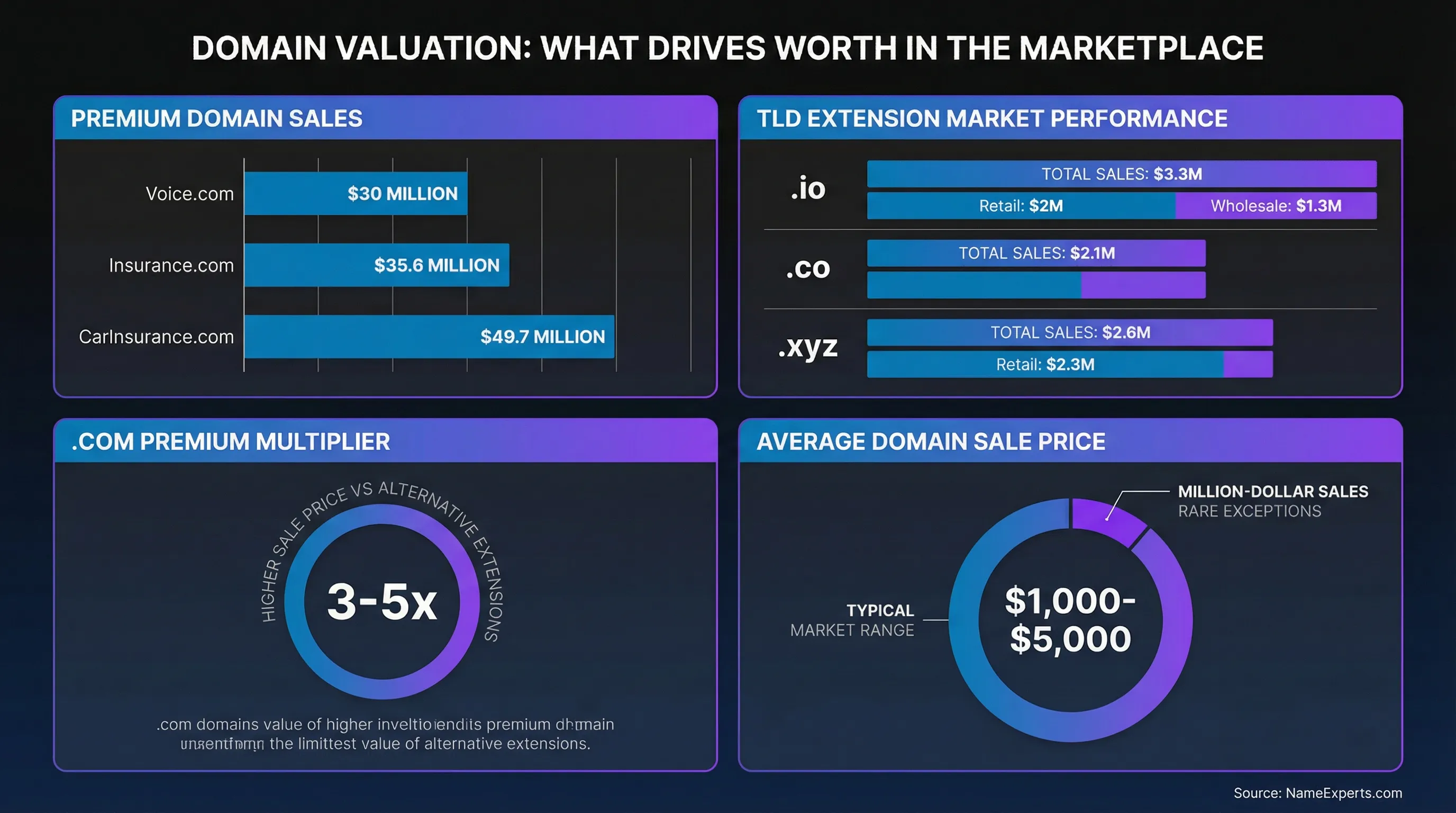
Shorter names command higher prices because they're easier to type, remember, and brand. One-word domains like Voice.com (sold for $30 million) or Insurance.com ($35.6 million) represent peak value. Two-word combinations work well when both terms are common and relevant. Once you hit three or more words, value typically drops as complexity increases and memorability suffers.
But length alone doesn't guarantee worth. A two-letter domain with random characters holds less value than a longer name with clear commercial intent. The key is balancing brevity with meaning.
TLD Extension Hierarchy
The .com extension remains the gold standard, commanding premium prices due to universal recognition and trust. Market data shows .com domains consistently sell for 3-5x more than alternative extensions with identical names.
That said, certain alternatives have carved valuable niches. The .io extension appeals to tech startups, with total sales volume reaching $3.3 million (about $2 million retail, $1.3 million wholesale). The .co extension shows similar patterns at $2.1 million total volume. Meanwhile, .xyz demonstrates strong retail preference with $2.3 million of its $2.6 million total coming from end-user purchases.
Country-code extensions like .co.uk or .de add value when targeting specific geographic markets. A .co.uk domain may actually outperform .com for UK-focused businesses because it signals local presence.
Keyword Relevance and Search Volume
Domains containing high-volume search terms attract more buyer interest because they match what people actually type into search engines. CarInsurance.com sold for $49.7 million partly because the term shows high commercial intent and strong search demand.
But raw search numbers don't tell the whole story. Commercial intent matters more than volume. A term like "buy cars online" shows purchase readiness, while "car history" indicates research behavior. Industry-specific keywords can be goldmines even with lower search volume if companies invest heavily in that space.
Domain Age and Clean History
Older domains with consistent use tend to rank better because search engines trust established addresses. However, age without traffic history adds limited value. A 15-year-old domain with no visitors is worth less than a 3-year-old one with steady monthly traffic.
History matters enormously. Check the Wayback Machine for past site versions and use tools like Ahrefs to review backlink profiles. Red flags that destroy value include spam use, search engine penalties, excessive low-quality links, or association with prohibited industries.
Backlink Profile and SEO Authority
Quality backlinks from reputable sites signal trust to both search engines and potential buyers. A domain with hundreds of authoritative links has built-in SEO value that would take years and thousands of dollars to replicate from scratch.
But toxic backlink histories can actually hurt worth. If a domain was used for spam or has negative search reputation, it may harm SEO efforts rather than help them. Always verify backlink quality before assuming age equals value.
Brandability vs. Generic Descriptiveness
Brandable domains—unique, memorable names that sound like company names—often command premium prices despite lacking exact keyword matches. They're easy to pronounce, spell without thinking twice, and evoke authority or emotion.
Generic exact-match domains have value too, but they need buyer interest to sell. "CloudSecurity.com" might not have massive search volume, but in the tech world it's highly valuable because companies invest heavily in cloud security solutions. The key is understanding what your target market actually searches for and whether those searches show clear intent to purchase or engage.

Domain Valuation Tools Compared
Free appraisal tools provide quick estimates using historical sales data, keyword metrics, and algorithmic scoring. They're useful starting points but vary widely in methodology and accuracy.
| Tool Type | Data Sources | Strengths | Limitations | Best For |
|---|---|---|---|---|
| Machine Learning Appraisals | Historical sales databases and comparable transactions | Fast baseline estimates; considers past sales patterns | Algorithm-based; can't assess brandability | Quick baseline estimates |
| Traffic & Keyword Tools | Traffic stats, ad data, search volume | Detailed value breakdowns; shows calculation factors | Often overly optimistic; misses market nuance | Portfolio reviews |
| AI-Powered Platforms | Auction data and machine learning analysis | Modern algorithms; considers multiple factors | Limited to auction market patterns | Cross-checking other tools |
| Sales Database Research | Actual domain sale records | Real market prices; shows what domains actually sold for | Only covers domains that have sold | Comparable sales research |
| Professional Appraisal (NameExperts) | Human expertise + market intelligence from 200+ transactions | Evaluates brandability, buyer psychology, portfolio fit, market timing | Requires consultation | Premium/brandable domains, high-stakes negotiations |
How Algorithms Weight Factors
Automated tools use machine learning models trained on historical sales to predict value. They analyze patterns in length, keyword search volume, TLD type, and comparable transactions. Some prioritize search metrics heavily, while others focus more on sales data.
The problem? Algorithms can't measure subjective qualities. They don't understand why a particular name feels premium, how emerging industry trends shift demand, or what specific buyer psychology drives negotiations. They also miss portfolio synergies—how owning multiple related domains increases collective value.
That's why using 2-3 tools and comparing results creates more reliable estimates than trusting a single number. Look for consensus ranges rather than precise valuations.
What Automated Tools Cannot Measure
Free appraisal platforms consistently miss several critical factors:
- Brandability and emotional appeal: How memorable and distinctive the name feels
- Industry-specific buyer demand: Niche markets where certain terms command premiums
- Market timing: Emerging trends that suddenly increase value
- Negotiation dynamics: Competitive bidding situations that drive prices above estimates
- Strategic fit: How well the domain aligns with a specific buyer's expansion plans
According to industry analysis, automated tools mainly fall short for their inability to factor context. They can't determine if a domain has suddenly become valuable from a news event or viral trend, for example. They also fail to recognize the strategic fit between domain and brand identity.
Confused by Conflicting Valuations?
Free tools give you numbers, but they can't tell you if your domain is truly brandable or if you're sitting on a hidden gem. NameExperts brings 16+ years of market intelligence and 200+ real transactions to cut through the noise with honest, independent assessments—no seller bias, just straight answers.
To perform a legitimate domain appraisal, there are three important characteristics to consider: anatomy, real-life current events, and fair market comparisons. Two of the best sources for comp sales are DNJournal.com and Namebio.com.
 Joe Uddeme, Director and Principal, Name Experts
When You Need Professional Domain Appraisal
Automated valuations work fine for standard domains with clear comparable sales. But certain situations demand human expertise that algorithms simply cannot provide.
Limitations of Automated Valuations
Tools generate estimates based on historical patterns, but they fundamentally cannot account for:
- Brandability assessment: Whether a name sounds professional, memorable, and trustworthy
- Buyer psychology: What motivates specific industries or companies to pay premium prices
- Market timing: How current events or industry trends suddenly increase demand
- Portfolio strategy: How multiple domains work together to protect brands or dominate niches
- Negotiation positioning: What asking price maximizes sale probability while capturing fair value
These subjective factors often matter more than measurable metrics, especially for unique or premium names.
When NameExperts Human Expertise Matters
Professional appraisal adds significant value in specific scenarios:
Premium domains with short length, one-word names, or exact-match keywords need expert evaluation because their worth depends heavily on finding the right buyer at the right time. Algorithms can't predict which company will see strategic value in a particular name.
Brandable domains with subjective appeal require human judgment. Our appraisers at NameExperts evaluate how names sound when spoken aloud, whether they're easy to spell, and if they evoke the right associations for target industries. We've brokered domains for HBO Max.com, Monday.com, TripAdvisor, and HubSpot—experience that reveals patterns tools miss.
Specialized or emerging industries present unique challenges. A domain in AI, Web3, or niche B2B sectors may have limited comparable sales data. Our 16+ years of market experience helps us understand how new categories develop and what early adopters will pay.
Portfolio acquisition or divestment requires strategic thinking beyond individual valuations. Which domains protect your brand? Which ones have growth potential? Which should you let expire? We help prioritize based on market intelligence, not just algorithms.
High-stakes negotiations benefit from independent third-party assessment. When someone makes an unsolicited offer, our appraisal helps you understand if it's fair or a lowball attempt. When you're ready to sell, we provide data-backed pricing that earns buyer trust.
For example, our appraisers weight factors differently than algorithms for unique cases. While tools heavily emphasize keyword search volume, we know that brandability often matters more for startup acquisitions. A memorable, distinctive name may command higher prices than a generic exact-match domain, even if search data suggests otherwise.
NameExperts offers free domain valuations to help you understand baseline worth. For premium or complex situations, our professional appraisals leverage real transaction data from 200+ deals to provide accuracy that automated estimates simply cannot match. Contact us to discuss your specific needs.

Using Market Data for Accurate Valuation
The most reliable pricing comes from actual transaction records, not algorithmic predictions. Comparable sales data shows what buyers actually paid, revealing true market value.
Sales databases provide searchable records of historical transactions with filters for keywords, TLD, and price ranges. If you own "FitMealPlanner.com," search for similar names. You might find that "FitMealPlans.com" sold for $4,500, "DietMealPlanner.com" for $2,100, and "MealPlanner.com" listed at $30,000 but remains unsold. This suggests your domain sits comfortably in the $3,000-$6,000 range, especially with strong traffic or clean backlinks.
Market awareness matters too. Demand fluctuates seasonally and by industry. E-commerce domains perform better in Q4, while travel names spike in early summer. Tech-related domains see increased interest around major events like CES or product launches. Timing your sale can significantly affect outcomes.
When researching comparables, look for domains with similar characteristics: same extension, comparable length, related keywords, and equivalent age. Three to five solid comparables provide a realistic pricing range that accounts for market conditions.
Remember that asking prices aren't sale prices. Marketplace listings show what sellers hope to get, not what buyers actually pay. Focus on completed transactions for accuracy.
Myths vs. Reality About Domain Valuation
Several misconceptions persist about what makes domains valuable. Let's clear them up with facts.
Myth: All short domains are worth millions. Reality: Length alone doesn't guarantee value. A two-letter domain with random characters isn't automatically worth more than a longer, brandable name with clear commercial appeal. What matters is memorability, brandability, and market demand for that specific combination.
Myth: Domain age automatically equals value. Reality: A 15-year-old domain with no content, traffic, or backlinks isn't valuable just because it's old. Buyers want domains with usage history that includes actual traffic and authority. Age helps, but traffic history matters more.
Myth: Any domain with keywords will sell for big money. Reality: Keywords need to make sense together and feel like real brand names someone would build a business around. "BlueCars.com" contains popular terms but lacks the cohesion that drives premium prices. Context and brandability matter as much as keyword presence.
The biggest reality? Most domains sell for modest amounts. Million-dollar sales are rare exceptions, not the norm. The average domain sells for $1,000-$5,000 according to industry data. Setting realistic expectations based on comparable sales prevents disappointment and helps you price competitively.
That said, you can actively increase value by building content, earning quality backlinks, and generating traffic. A domain worth $500 today might reach $5,000 with strategic development—or drop to $50 if interest fades. Market timing and buyer demand drive ultimate worth more than any inherent characteristic.
Understanding domain valuation helps you make informed decisions whether you're selling, holding, or building a portfolio. Free tools provide useful starting estimates, but they cannot replace human expertise for premium names or complex situations. NameExperts combines real transaction data from 200+ deals with 16+ years of market intelligence to deliver appraisals that capture both measurable metrics and subjective factors algorithms miss. When your domain's value matters, professional assessment ensures you neither undersell a strong asset nor overprice one that won't attract serious buyers.
Don't Leave Money on the Table
Whether you received an unsolicited offer or you're ready to sell, you need to know if the price is fair or a lowball attempt. Our professional appraisals leverage real transaction data from premium deals with HBO Max, Monday.com, and TripAdvisor to give you negotiating confidence backed by market intelligence algorithms can't capture.
Work With a Domain Expert
Understanding domain value is one thing—getting the right price is another. Whether you're evaluating an unsolicited offer, preparing to sell, or building a portfolio strategy, NameExperts delivers the no-bullshit approach you need. With 200+ transactions and 16+ years navigating the Wild West of the domain marketplace, we provide appraisals that capture both hard data and the subjective factors that actually drive premium sales. Stop guessing. Get an expert valuation that protects your interest
Get Started Free







Frequently Asked Questions
A premium domain delivers value when it's central to your brand identity, provides instant credibility, or contains high-commercial-intent keywords that would cost significantly more to rank organically—but for small businesses with limited budgets, a brandable alternative extension often makes more financial sense.
Domain ownership requires annual renewal—there's no permanent purchase option—but you can register for up to 10 years at once and set auto-renewal to maintain continuous control as long as you keep paying the registration fees.
Premium domains at GoDaddy are previously registered names that owners listed for resale in the aftermarket at prices above standard registration costs, often due to desirable characteristics like brevity, keyword relevance, or established SEO authority.
Both registrars offer reliable service, but Google Domains (now Squarespace Domains after 2023 acquisition) provides cleaner interfaces and included privacy protection, while GoDaddy offers more extensive aftermarket access for purchasing premium domain names and resale tools for investors.