

Key Takeaways
- A written agreement protects both buyers and sellers by clearly defining purchase price, payment terms, transfer procedures, and ownership warranties
- Escrow services are essential for transactions over $5,000, holding funds until domain transfer is confirmed and reducing fraud risk
- Essential clauses include domain description, representations and warranties, indemnification provisions, and dispute resolution mechanisms
- Professional help from brokers or attorneys is advisable for high-value transactions (typically $10,000+) or complex negotiations
- Due diligence—including WHOIS verification, trademark searches, and dispute history checks—should always precede finalizing any agreement
Domain name transactions happen daily in a largely unregulated marketplace. While many deals close without incident, the absence of problems doesn't mean your rights are adequately protected. A handshake deal or casual email exchange might feel sufficient when excitement runs high, but these informal arrangements leave both parties vulnerable to misunderstandings, payment disputes, and ownership challenges.
A properly structured agreement transforms a risky transaction into a secure exchange. It establishes clear expectations, defines each party's obligations, and provides legal recourse if something goes wrong. Whether you're acquiring a domain for your business or selling one from your portfolio, understanding what belongs in this contract is fundamental to protecting your interests.
Essential Clauses Every Domain Purchase Agreement Must Include
The foundation of any solid contract lies in its core provisions. These clauses define the transaction's basic terms and establish the framework for a successful transfer.
Purchase Price and Payment Terms
The financial terms form the heart of your agreement. Specify the exact purchase price in a clearly identified currency—ambiguity here invites disputes. For straightforward transactions, a lump sum payment provides simplicity and finality. The buyer pays the full amount, the seller transfers ownership, and the deal concludes.
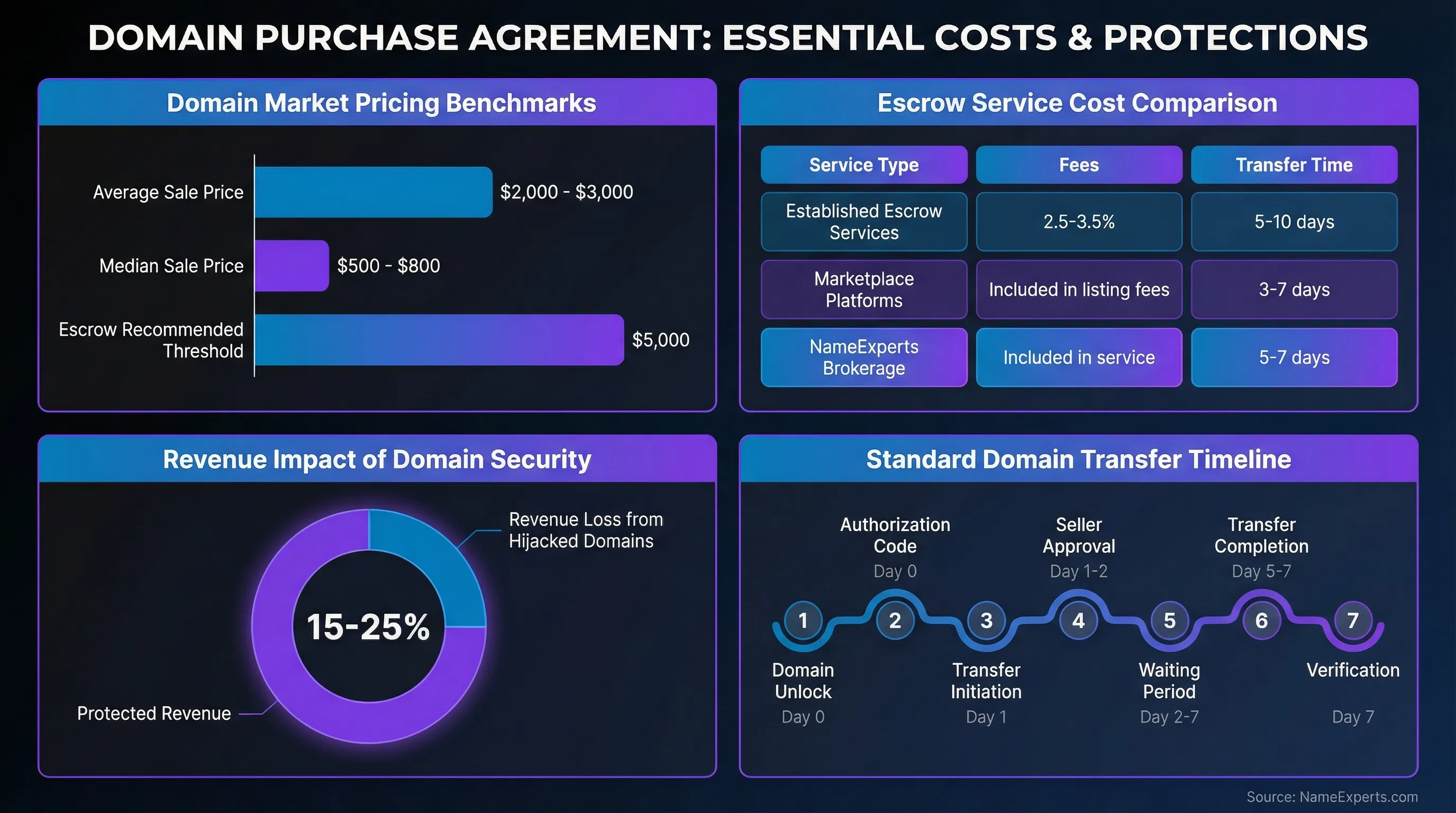
Installment plans introduce complexity but expand accessibility. When structuring payments over time, define the schedule precisely: initial deposit amount, subsequent payment dates, and consequences for missed deadlines. According to market data, the average sale price in the aftermarket ranges from $2,000-$3,000, with median prices between $500-$800. These figures help benchmark reasonable payment structures.
Consider what happens if payment fails. Will the agreement terminate automatically? Does the seller retain any partial payments as liquidated damages? Will interest accrue on late payments? Address these scenarios explicitly rather than leaving them to interpretation or state law defaults.
Payment deadlines should be specific—"within 5 business days of agreement execution" rather than "promptly" or "soon." Vague language creates enforcement problems and invites disagreement about whether obligations were met.
Domain Name Description and Transfer Mechanics
Precision matters when identifying what's being sold. List the exact domain name, including the top-level domain extension (.com, .net, .org, etc.). A typo here could invalidate the entire transaction or create confusion about which asset is changing hands.
Include current registrar information and the registrant name as it appears in WHOIS records. This documentation helps verify the seller's authority to transfer ownership and establishes a clear chain of title.
Transfer procedures vary by registrar and extension, but most follow ICANN's standard process requiring authorization codes and registrant approval. The agreement should outline the step-by-step transfer process: who initiates the transfer, who provides authorization codes, expected timeline (typically 5-7 days for standard transfers), and what constitutes successful completion.
Specify that transfer completion is evidenced by updated WHOIS records showing the buyer as the new registrant. This objective standard eliminates disputes about whether the transfer actually occurred.

Representations and Warranties
These provisions are where the seller makes legally binding promises about what they're selling. The seller should represent that they are the sole legal and beneficial owner of the domain, with full authority to transfer it. This means no co-owners, no liens, no security interests, and no encumbrances of any kind.
The seller should warrant that the domain registration is current, with no outstanding fees owed to the registrar. They should confirm they haven't received any notices of trademark infringement, UDRP complaints, or other legal challenges. According to dispute resolution data, hijacked domain names can result in a 15-25% loss in revenue, making these warranties critical for buyer protection.
The seller should also represent that they registered the domain legitimately, without fraud or misrepresentation, and that the registration complies with all applicable registry policies. For corporate sellers, include representations about corporate authority—that the person signing has the power to bind the company and that no board approval or shareholder consent is required.
Buyers benefit from "as-is" disclaimers that limit the seller's liability for unstated issues. These provisions shift due diligence responsibility to the buyer while protecting the seller from claims that the domain didn't meet the buyer's expectations. However, sellers cannot disclaim liability for their explicit representations—if they promise clear title and it turns out to be false, the "as-is" clause won't protect them.
Escrow and Closing Process
Escrow services solve the fundamental trust problem in domain transactions: sellers won't transfer before receiving payment, and buyers won't pay before receiving the domain. A neutral third party holds the funds while the domain changes hands, releasing payment only when transfer is confirmed.
For transactions over $5,000, escrow is essentially non-negotiable. The modest fee (typically 2-3% of the purchase price) provides invaluable protection against fraud and failed transfers. Established escrow services have developed procedures specifically designed for domain transactions, understanding the technical requirements and typical timelines.
The agreement should specify who pays escrow fees—typically the buyer, though this is negotiable. Define the conditions for fund release: confirmation that WHOIS records show the buyer as registrant, or receipt of a specific confirmation email from the registrar, or manual verification by the escrow agent after a certain number of days.
In our experience facilitating transactions over 16+ years, we've found that integrated services handling both agreement execution and secure fund transfer eliminate the need for separate escrow arrangements. At NameExperts, we manage the entire process—from valuation through final transfer—ensuring both parties are protected throughout the transaction.
| Service Type | Typical Fees | Transfer Time | Additional Services |
|---|---|---|---|
| Established Escrow Services | 2.5-3.5% of purchase price | 5-10 business days | Domain holding, inspection period |
| Marketplace Platforms | Included in listing fees | 3-7 business days | Automated transfer, payment plans |
| NameExperts Brokerage | Included in service | 5-7 business days | Full transaction management, valuation, negotiation support |
Protecting Yourself: Representations, Warranties, and Due Diligence
Trust but verify. Even with strong contractual protections, conducting thorough due diligence before finalizing any agreement protects you from problems that warranties alone cannot solve.
What Sellers Should Represent
Sellers must provide clear assurances about what they're selling. Legal ownership verification starts with confirming that the name in the WHOIS database matches the seller's identity. For corporate sellers, this means the company name should appear as registrant, not an individual employee's name.
WHOIS accuracy matters for more than just verification—it's a requirement under ICANN policy. Sellers should confirm that all registration information is current and correct, as inaccurate WHOIS data can complicate or invalidate transfers.
Representations about pending disputes are critical. The seller should disclose any past or current UDRP proceedings, trademark infringement claims, or cease-and-desist letters related to the domain. Silence on these issues doesn't make them disappear; it simply shifts the problem to the unsuspecting buyer.
For domains previously used for websites, sellers should represent whether they operated the site in compliance with applicable laws. This includes privacy policies, terms of service, data protection regulations, and industry-specific requirements. Buyers inheriting legal liability from a seller's past misconduct face expensive cleanup even with strong indemnification clauses.
Corporate authority representations ensure that the person signing actually has the power to sell the domain. This is particularly important for larger transactions where companies might require board approval or where the domain is a significant corporate asset.
What Buyers Should Verify
WHOIS lookup procedures provide your first line of defense. Verify that the seller's name matches the registrant information. Check the registration date—recently acquired domains might indicate a speculative flip or potential trademark issues. Note the registrar and whether privacy protection is enabled (which is legitimate but requires the seller to temporarily disable it for transfer).
Trademark searching is essential, even for seemingly generic terms. The United States Patent and Trademark Office database (USPTO.gov) allows free searches of registered marks. But don't stop there—common law trademark rights exist even without registration. Search for businesses using similar names in related industries, as these could pose future legal challenges.
Chain of title investigation reveals how the domain changed hands historically. Archive.org's Wayback Machine shows previous website content, helping identify potential trademark conflicts or problematic past uses. WHOIS history services track ownership changes, highlighting domains that have changed hands frequently (a potential red flag) or have been continuously held by one party (generally positive).
Check for UDRP disputes through the WIPO database. Even if the current owner successfully defended against a challenge, the dispute's existence suggests potential trademark conflicts that could resurface.
Common Red Flags
Mismatched WHOIS data should immediately raise concerns. If the seller's name doesn't match the registrant, ask why. Legitimate explanations exist—corporate restructuring, name changes, or domains held by a parent company—but verify these explanations before proceeding.
Recent ownership changes warrant scrutiny. A domain that changed hands within the past 60 days might indicate a quick flip, potentially signaling that the seller knows something about the domain's value or problems that you don't.
Trademark conflicts are the most common source of post-purchase problems. Research shows that less than 1% of typo variations are responsible for more than 50% of traffic diversion from legitimate sites. These statistics underscore the importance of thorough trademark clearance.
Suspicious pricing should prompt questions. A domain offered far below market value might be stolen, subject to legal challenges, or have hidden problems. Conversely, grossly inflated pricing might indicate a seller banking on buyer ignorance or desperation.
According to industry data on secure transfers, common fraud scenarios include payment reversals through credit card chargebacks, transfer failures due to technical issues, impersonation fraud, and contract disputes arising from unclear terms. Each of these risks can be mitigated through proper due diligence and agreement structure.
Don't Navigate Complex Domain Transactions Alone
High-value domain purchases require more than a template—they need expertise to protect your investment and ensure smooth transfers. If you're acquiring a domain worth $10,000 or more, connect with our experienced domain brokers to structure your agreement properly and avoid the costly pitfalls that catch inexperienced buyers.
Payment Terms, Escrow, and Secure Transfers
The financial mechanics of your transaction require careful structuring to protect both parties' interests while facilitating a smooth closing.
Payment Structure Options
Full payment upfront offers simplicity and finality. The buyer pays the entire purchase price, the seller transfers the domain, and the transaction concludes. This approach works well for lower-value domains or when the buyer has sufficient capital and confidence in the deal.
Installment plans make higher-value domains accessible to buyers with limited immediate capital. Structure these carefully: require a substantial initial deposit (typically 20-40% of the purchase price) to demonstrate commitment, establish a clear payment schedule with specific dates, and define consequences for missed payments.
Consider whether the domain transfers immediately or only after final payment. Immediate transfer with a lien or security interest protects the buyer's investment while giving the seller recourse if payments stop. Delayed transfer until full payment protects the seller but requires the buyer to trust that the domain will actually transfer once they've paid in full.
Earnest money deposits signal serious intent. A deposit of 5-10% of the purchase price, held in escrow, demonstrates the buyer's commitment while giving the seller confidence to take the domain off the market during due diligence.
Milestone-based payments tie disbursements to specific achievements: 50% on agreement execution, 25% on domain transfer initiation, 25% on confirmed WHOIS update. This approach distributes risk more evenly between parties.
Why Escrow Is Non-Negotiable
Escrow services protect both parties simultaneously. Sellers gain confidence that funds are secured before transferring valuable assets. Buyers ensure they won't lose money if the domain never arrives. The escrow agent acts as a neutral intermediary, following predetermined release conditions without bias toward either party.
Typical escrow fees range from 2.5-3.5% of the purchase price, with minimum fees often around $50-$100. For a $10,000 domain purchase, expect to pay $250-$350 in escrow fees. While this might seem significant, it's modest insurance against fraud or failed transfers that could cost the entire purchase price.
Release conditions should be objective and verifiable. "Buyer confirms receipt" is subjective and allows a dishonest buyer to delay payment indefinitely. "WHOIS database shows buyer as registrant" or "registrar sends transfer confirmation email" provides objective evidence that the escrow agent can verify independently.
Fraud prevention is escrow's primary value. Payment reversals through credit card chargebacks, fraudulent wire transfer instructions, and impersonation scams all become nearly impossible when a reputable escrow service manages the transaction. The escrow agent verifies identities, confirms payment authenticity, and ensures the domain actually transfers before releasing funds.
Transfer Process Step-by-Step
Understanding the technical transfer process helps set realistic expectations and identify potential problems early.
Step 1: Domain Unlock. The seller logs into their registrar account and disables the domain lock (also called registrar lock or transfer lock). This security feature prevents unauthorized transfers but must be disabled for legitimate ones.
Step 2: Authorization Code. The seller obtains an authorization code (also called EPP code or transfer key) from their registrar. This unique code proves the registrant's consent to transfer and must be provided to the buyer.
Step 3: Transfer Initiation. The buyer initiates the transfer at their chosen registrar, providing the domain name and authorization code. The gaining registrar sends a transfer request to the losing registrar.
Step 4: Seller Approval. The losing registrar sends an email to the administrative contact listed in WHOIS, asking the seller to approve or reject the transfer. The seller must approve this request for the transfer to proceed.
Step 5: Waiting Period. ICANN policy requires a 5-day waiting period during which the losing registrar can reject the transfer for valid reasons (domain locked, invalid authorization code, etc.). Many registrars expedite this if the seller explicitly approves.
Step 6: Transfer Completion. Once approved and the waiting period expires, the domain transfers to the gaining registrar. WHOIS records update to show the new registrant information. The registration is typically extended by one year as part of the transfer.
Step 7: Verification. The buyer verifies that WHOIS records show them as the new registrant and that they can access the domain's management interface at the new registrar.
What can go wrong? Domains registered or transferred within the past 60 days are typically locked and cannot be transferred. Domains with pending WHOIS updates might have transfer restrictions. Expired domains cannot transfer until renewed. Some country-code TLDs have unique transfer requirements that differ from the standard ICANN process.
Timeline expectations should be realistic. Standard transfers take 5-7 days, though expedited transfers can complete in 24-48 hours if both parties actively cooperate and the registrars support fast transfers. International transfers or those involving country-code domains might take longer due to additional verification requirements.
Risk Management: Dispute Resolution and Post-Sale Obligations
Even well-structured agreements can face challenges. Building in dispute resolution mechanisms and defining post-sale obligations helps manage these risks.
Indemnification Clauses
Indemnification provisions allocate risk between parties. The seller typically indemnifies the buyer against claims arising from the seller's pre-sale use of the domain—trademark infringement, copyright violations, privacy breaches, or other legal issues stemming from how the seller operated any associated website.
This protection has limits. Indemnification doesn't prevent third parties from suing the buyer; it simply gives the buyer a contractual right to recover their losses from the seller. If the seller lacks assets or disappears, the indemnification clause provides little practical protection.
Buyers should understand that indemnification doesn't guarantee freedom from trademark disputes. A trademark owner can still file a UDRP complaint or lawsuit against the new owner. The indemnification clause means the buyer can seek reimbursement from the seller for defense costs and any damages, but it doesn't prevent the dispute from occurring.
Sellers should limit their indemnification obligations to known issues. An "as-is" disclaimer combined with specific representations about known problems strikes a reasonable balance—the seller doesn't warrant that no problems exist, but they do promise to disclose any issues they're aware of.
Set caps on indemnification liability. Unlimited liability for a $5,000 domain sale creates disproportionate risk. Consider capping the seller's total indemnification obligation at the purchase price, or some multiple of it for more significant transactions.
Dispute Resolution Mechanisms
When disagreements arise, how will you resolve them? Litigation is expensive, time-consuming, and unpredictable. Alternative dispute resolution mechanisms offer faster, cheaper options.
Mediation involves a neutral third party helping the parties reach a voluntary settlement. It's non-binding—if mediation fails, you can still pursue other remedies. Mediation works well for disputes involving misunderstandings or good-faith disagreements about contract interpretation.
Arbitration is binding dispute resolution outside the court system. An arbitrator (or panel of arbitrators) hears evidence and renders a decision that courts will enforce. Arbitration is typically faster and less expensive than litigation, though it eliminates the right to appeal except in very limited circumstances.
Litigation in court provides the most formal process, with extensive discovery, motion practice, and the possibility of appeal. It's also the most expensive and time-consuming option. For high-value disputes or those involving complex legal issues, litigation might be necessary despite its costs.
Choice of law provisions determine which state's (or country's) laws govern the contract. This matters because contract law varies significantly by jurisdiction. Choose a jurisdiction with well-developed commercial law and predictable court systems.
Jurisdiction clauses determine where disputes must be filed. Both parties agreeing to exclusive jurisdiction in a specific location prevents forum shopping and provides certainty about where any dispute will be resolved.
In our brokerage practice, we've found that many disputes can be resolved through informal mediation when both parties worked with experienced intermediaries. Our team at NameExperts often facilitates resolution of post-closing issues, leveraging our 16+ years of experience to find practical solutions that preserve business relationships while protecting our clients' interests.
Post-Transfer Restrictions
What happens after the domain transfers? Post-sale restrictions define the seller's ongoing obligations and limitations.
Non-compete provisions prevent the seller from registering similar domains that could compete with the buyer's use. For example, if you sell "BestWidgets.com," a non-compete clause might prohibit you from registering "TopWidgets.com," "BestWidget.com," or other confusingly similar variations.
These restrictions should be reasonable in scope and duration. Prohibiting the seller from ever registering any domain containing the word "widgets" is likely unenforceable as overly broad. Prohibiting registration of domains that are confusingly similar to the sold domain for 2-3 years is more reasonable.
Forbearance periods for data extraction address situations where the seller operated a website on the domain. The agreement might give the seller 7-14 days after transfer to extract customer data, content, or other information before the buyer takes control of the site. This prevents disputes about lost data while ensuring the buyer doesn't have to wait indefinitely to use their new asset.
Future use limitations might restrict how the buyer can use the domain. These are less common and typically appear only in specialized situations—for example, when a seller wants to ensure the domain won't be used for adult content, gambling, or other purposes that could damage the seller's reputation if the connection becomes known.
What Happens When Things Go Wrong
Despite best efforts, some transactions encounter problems. Understanding common failure modes helps you respond effectively.
Failed transfers occur when technical issues prevent the domain from moving to the buyer's registrar. The authorization code might be incorrect, the domain might be locked, or the registrar might reject the transfer for policy reasons. These issues are usually fixable—the seller provides a corrected code, unlocks the domain, or addresses the registrar's concerns.
Payment disputes arise when buyers claim they paid but sellers claim they didn't receive funds, or when payment methods fail or reverse. Escrow services eliminate most of these disputes by providing independent verification of payment receipt.
Trademark claims emerging post-sale represent the buyer's nightmare scenario. You've paid for the domain, completed the transfer, and then receive a cease-and-desist letter or UDRP complaint from a trademark owner. Strong seller representations and indemnification clauses provide contractual recourse, but they don't prevent the dispute or guarantee recovery.
Breach of contract remedies depend on which party breached and how. If the seller refuses to transfer after receiving payment, the buyer can seek specific performance (court order forcing the transfer) or damages (refund plus consequential losses). If the buyer refuses to pay after transfer, the seller can seek monetary damages or, if the agreement included a security interest, potentially reclaim the domain.
Working with Professionals: When to Hire a Broker or Attorney
While many domain transactions can be handled independently, certain situations benefit from professional assistance.
High-Value Transactions
For domains valued at $10,000 or more, professional help is typically worth the investment. At this price point, the potential downside of a failed transaction or legal dispute justifies the cost of expert guidance.
Legal counsel becomes essential when the transaction involves complex terms—installment payments, revenue sharing, licensing arrangements, or integration with broader business transactions. An attorney experienced in domain transactions can identify issues that generic contract templates miss and draft provisions tailored to your specific situation.
Complex negotiations benefit from professional representation. When parties are far apart on price, have competing interests, or face time pressure, experienced negotiators can bridge gaps and structure creative solutions that satisfy both sides.
Domain Broker Value Proposition
Domain brokers provide services beyond simple transaction facilitation. Stealth acquisitions prevent sellers from inflating prices when they learn a well-funded buyer is interested. Our team conducts acquisitions without revealing the buyer's identity until terms are agreed, often saving clients 30-50% compared to direct approaches.
Valuation expertise helps both buyers and sellers understand fair market value. With access to proprietary sales data and 16+ years of market experience, we provide domain valuation services that consider comparable sales, keyword value, extension, length, brandability, and industry-specific factors.
Negotiation skills make the difference between a failed deal and a successful acquisition. Professional brokers understand seller psychology, know when to push and when to wait, and can structure terms that address both parties' underlying interests rather than just their stated positions.
Transaction management eliminates the administrative burden of coordinating escrow, managing transfer procedures, and ensuring all documentation is properly executed. For busy executives or those unfamiliar with domain transactions, this service alone justifies the broker's fee.

Attorney vs. Broker vs. DIY
Attorneys provide legal advice and draft or review contracts to protect your interests. They're essential when legal issues are complex, when the transaction involves significant risk, or when you need someone who can represent you in court if disputes arise. Expect to pay $250-$500 per hour for experienced domain counsel, with total costs ranging from $1,500-$5,000 for a straightforward transaction to $10,000+ for complex deals.
Brokers facilitate transactions and provide market expertise. They're valuable when you need help finding a buyer or seller, negotiating price, or managing the transaction process. Broker commissions typically range from 10-20% of the purchase price, though this varies based on the domain's value and transaction complexity.
DIY approaches work well for straightforward transactions involving lower-value domains (under $5,000), when both parties are experienced with domain transfers, and when standard terms are acceptable to both sides. Use established escrow services, follow registrar transfer procedures carefully, and document everything in writing.
Cost-benefit analysis should consider not just professional fees but also the value of your time, the risk of mistakes, and the potential cost of disputes. A $500 domain might not justify a $2,000 attorney bill, but a $50,000 domain acquisition certainly does.
When templates are sufficient: straightforward sales with standard terms, experienced parties who understand domain transfers, lower-value transactions where professional fees would be disproportionate, and situations where both parties are acting in good faith with aligned interests.
When customization is needed: high-value transactions, installment payment arrangements, transactions involving related assets (websites, trademarks, customer lists), international transactions, or situations involving corporate buyers or sellers requiring special provisions.
At NameExperts, we've completed over 200 transactions for clients ranging from startups to Fortune 500 companies. We've helped Monday.com rebrand from Dapulse.com, advised HBO on their Max.com acquisition, and guided countless other businesses through strategic domain acquisitions. Our boutique approach means personalized service tailored to your specific situation, whether you need a simple transaction facilitation or comprehensive strategy consulting for your entire domain portfolio. Learn more about our buy-side representation services or portfolio management offerings.
Protect Yourself From Overpaying and Legal Disputes
Due diligence and proper valuation are critical, but they require access to proprietary market data and years of transaction experience. Our team has completed over 200 domain acquisitions and can conduct stealth negotiations that prevent price inflation while ensuring clear title. Schedule a free consultation to discuss your domain acquisition strategy and learn how professional representation often pays for itself through better negotiated terms.
Conclusion
A well-crafted agreement transforms domain transactions from risky handshake deals into secure, legally protected exchanges. The essential clauses we've covered—purchase price and payment terms, domain description and transfer mechanics, representations and warranties, escrow and closing procedures—form the foundation of any solid contract.
Due diligence protects you from problems that contracts alone cannot solve. Verify WHOIS information, search for trademark conflicts, investigate the domain's history, and check for existing disputes before finalizing any deal. These steps take time but prevent costly mistakes.
Escrow services are non-negotiable for transactions over $5,000. The modest fee provides invaluable protection against fraud, failed transfers, and payment disputes. Choose established services with specific experience in domain transactions.
Professional help—from brokers or attorneys—becomes worthwhile as transaction value and complexity increase. For domains valued at $10,000 or more, or when negotiations prove difficult, experienced representation often pays for itself through better terms, avoided mistakes, and peace of mind.
Whether you're buying your first domain or managing a portfolio of premium assets, understanding what belongs in a purchase agreement and how to structure a secure transaction protects your interests and facilitates successful deals. The template and guidance provided here offer a starting point, but remember that every transaction is unique. Adapt these principles to your specific situation, conduct thorough due diligence, and don't hesitate to seek professional assistance when the stakes justify it.
For complex transactions or high-value acquisitions, our team at NameExperts brings 16+ years of experience and over 200 completed transactions to guide you through every step of the process. Contact us to discuss how we can help with your next domain acquisition or portfolio strategy.
Ready to Secure Your Perfect Domain With Expert Protection?
Whether you're acquiring a premium domain for your rebrand or navigating a complex negotiation, the right agreement and professional guidance make all the difference between a successful transaction and a costly mistake. With 16+ years of experience and clients ranging from startups to Fortune 500 companies like Monday.com and HBO, we bring the expertise, market knowledge, and no-bullshit approach you need to close your deal securely. Get in touch with our team today to discuss how we can help s
Get in touch with our team today







Frequently Asked Questions
Essential clauses include the exact purchase price and payment terms, precise domain identification with transfer procedures, seller representations about clear ownership and no disputes, escrow arrangements for transactions over $5,000, and dispute resolution mechanisms with indemnification provisions.
Escrow is essential for transactions over $5,000, protecting both parties by holding funds until transfer confirmation. The typical 2-3% fee provides critical protection against fraud, payment reversals, and failed transfers that could cost you the entire purchase price.
Standard transfers take 5-7 business days following ICANN's required waiting period, though expedited transfers can complete in 24-48 hours with active cooperation from both parties and registrar support.
Professional help is advisable for domains valued at $10,000 or more, complex negotiations involving installment payments or related assets, stealth acquisitions where buyer anonymity matters, or when trademark issues and legal disputes pose significant risk.