
Key Takeaways
- 90% of organizations suffered DNS attacks in 2023, costing an average of $1.1 million each, making domain security essential for business continuity.
- Enable registrar lock and two-factor authentication immediately—these free security measures prevent the majority of unauthorized domain transfers.
- Register lookalike domains and common misspellings to protect against typosquatting attacks that target your customers.
- Implement DNSSEC and DMARC protocols to defend against DNS spoofing and email impersonation attacks.
- Businesses with 10+ domains need centralized portfolio management to prevent the "forgotten domain" problem that leads to accidental expirations and security gaps.
Your domain name represents far more than a web address—it's your digital storefront, customer gateway, and brand identity rolled into one critical asset. Yet according to security research, 90% of organizations experienced DNS attacks in 2023, with each incident costing an average of $1.1 million. When your domain is compromised, hijacked, or accidentally expires, the consequences extend beyond immediate financial losses to include business disruption, reputation damage, and customer trust erosion.
Why Domain Name Security Matters for Your Business
Domain security isn't just a technical concern—it's a business continuity imperative. When attackers compromise your infrastructure, they can redirect your web traffic, intercept customer communications, or hold your digital assets hostage. The threat landscape has evolved significantly, with cybercriminals deploying increasingly sophisticated techniques to exploit vulnerabilities in management practices.
The Real Cost of Domain Compromise
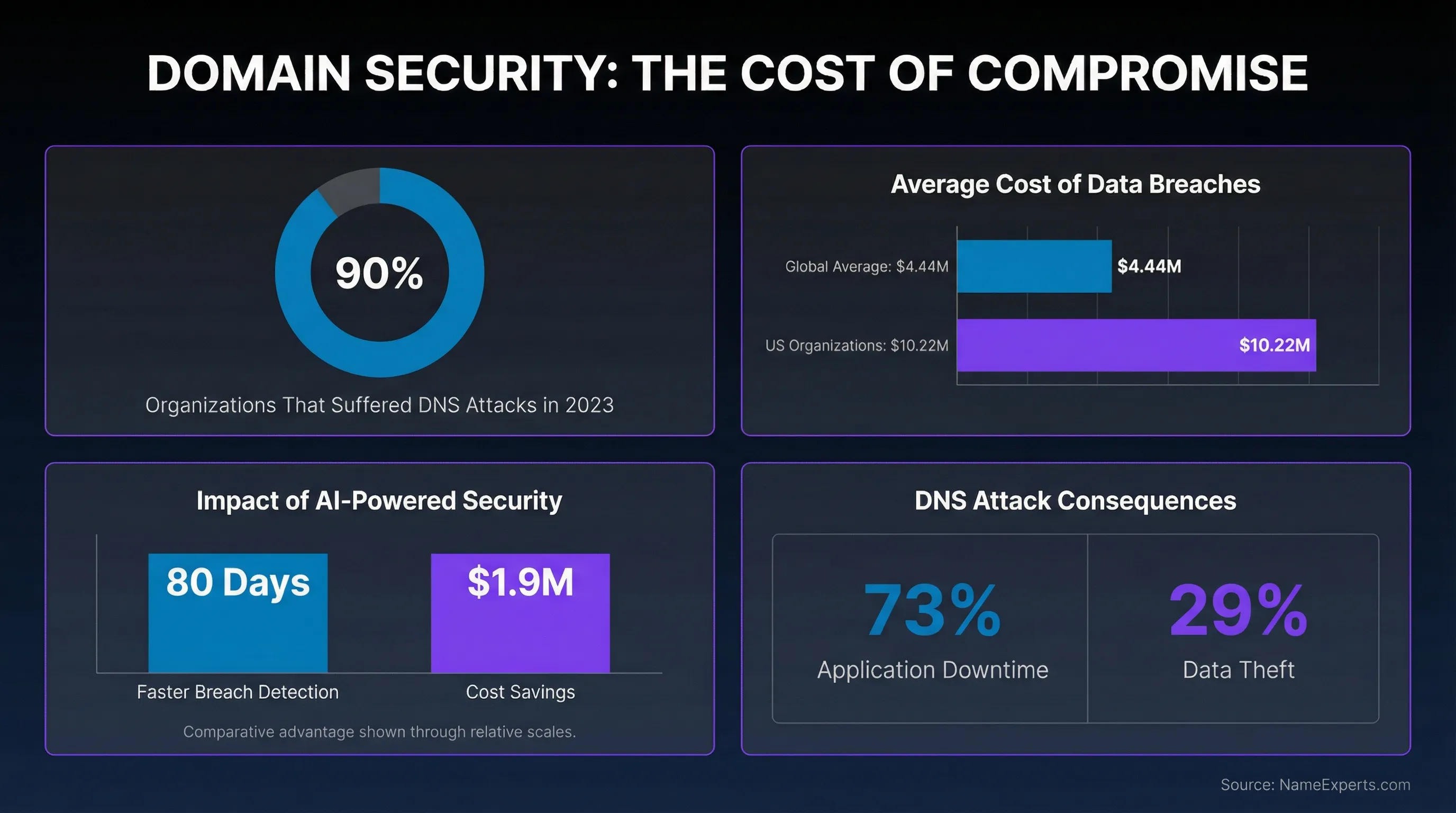
Data breaches now cost organizations USD 4.44 million globally, with US organizations facing an all-time high of USD 10.22 million on average. These figures underscore the financial imperative for robust security programs. When infrastructure is compromised, the impacts cascade: 73% of organizations suffer application downtime, while 29% experience data theft. Beyond direct financial damage, businesses face brand erosion, regulatory penalties, and customer churn.
Organizations using AI-powered security tools detect breaches 80 days faster and save USD 1.9 million compared to those without such capabilities. The lesson is clear: proactive protection delivers measurable ROI by preventing costly incidents before they occur.
Premium Domains Are Prime Targets
The aftermarket domain industry is projected to reach $1.17 billion by 2033, reflecting the substantial value concentrated in premium digital assets. In 2025, icon.com sold for a staggering $12 million, making it the most expensive domain of the year. This value makes high-quality domains attractive targets for cybercriminals who recognize that businesses will pay significant sums to recover compromised assets.
Attackers specifically target valuable domains because they know these assets are mission-critical. A compromised premium domain can be leveraged for ransom demands, sold on underground markets, or used to launch sophisticated phishing campaigns that exploit your brand's established trust.
The Multi-Domain Portfolio Challenge
As businesses grow, they accumulate domains—for marketing campaigns, product launches, geographic variations, and defensive registrations. Companies with 10+ domains face unique challenges: tracking renewal dates across multiple registrars, maintaining consistent security policies, and ensuring all assets remain properly configured. The "forgotten domain" problem is surprisingly common, where businesses lose track of registrations until they expire or are compromised.
This portfolio complexity creates security gaps. A single unsecured asset in your portfolio can serve as an entry point for attackers to compromise your broader digital infrastructure or launch convincing impersonation attacks against your customers.

Essential Domain Security Checklist
Implementing comprehensive protection requires a layered approach. The following checklist provides actionable steps organized by priority, starting with foundational security measures that every domain owner should implement immediately.
Registration & Registrar Security
1. Choose an ICANN-accredited registrar with security focus. Your registrar serves as the gatekeeper for your assets. Select one that demonstrates investment in cybersecurity through robust authentication systems, security protocols, and staff training. ICANN accreditation ensures the registrar adheres to established industry standards and dispute resolution procedures.
2. Enable registrar lock (clientTransferProhibited status). This prevents unauthorized transfers by requiring manual authorization for any transfer requests. While not foolproof, it adds a critical layer of protection. Some registrars offer enhanced registry lock services that require phone verification before any DNS changes can be made.
3. Use a dedicated business email not tied to your domain. If your domain is hijacked and you use an email address on that domain for registrar communications, you'll lose access to critical recovery notifications. Instead, use an email address on a separate domain or a major provider like Gmail for your registrar account contact information.
4. Set up auto-renewal with payment method monitoring. Expiration is one of the most common—and preventable—ways businesses lose their digital assets. Enable automatic renewal and set calendar reminders to verify your payment method remains current. Consider registering for the longest term possible (typically 10 years) to reduce renewal frequency.
Access Control & Authentication
5. Implement two-factor authentication (U2F/TOTP). Two-factor authentication adds a second verification step beyond passwords, typically through a mobile app, SMS code, or hardware security key. This dramatically reduces the risk of account compromise even if your password is stolen. Hardware security keys using the U2F standard provide the strongest protection against phishing attacks.
6. Create strong, unique passwords with a password manager. Your registrar account password should be complex, unique, and never reused from other services. Use a password manager to generate and store passwords securely. A strong password contains at least 12 characters with a mix of uppercase, lowercase, numbers, and symbols.
7. Establish a domain registration policy for organizations. Document who can request new registrations, how requests are submitted and approved, and what security standards must be met. This prevents shadow IT scenarios where employees register business-critical domains under personal accounts or without proper security controls.
Technical Security Protocols
8. Implement DNSSEC for DNS integrity. DNS Security Extensions (DNSSEC) add cryptographic signatures to DNS data, ensuring that responses haven't been tampered with. This protects against cache poisoning attacks where attackers inject false DNS information to redirect your traffic. While implementation requires technical configuration, many registrars now offer simplified DNSSEC setup options.
9. Deploy DMARC to prevent email spoofing. Domain-based Message Authentication, Reporting, and Conformance (DMARC) works with SPF and DKIM standards to validate email authenticity. This prevents attackers from sending emails that appear to come from your domain—a common tactic in phishing campaigns. Even domains that don't send email should implement DMARC with a reject policy to prevent spoofing.
10. Install SSL certificates on all active domains. SSL certificates encrypt data transmitted between your website and visitors, protecting sensitive information from interception. They also verify your website's identity and improve search engine rankings. Modern browsers display warnings for sites without SSL, damaging trust and conversion rates.
| Security Feature | Budget Registrar | Mid-Tier Registrar | Enterprise Registrar |
|---|---|---|---|
| Registrar Lock | Basic (manual unlock) | Enhanced (email verification) | Registry Lock (phone verification) |
| Two-Factor Authentication | SMS only | SMS + TOTP apps | SMS + TOTP + U2F hardware keys |
| DNSSEC Support | Limited or none | Standard implementation | Full support with management tools |
| WHOIS Privacy | Paid add-on ($10-15/year) | Included free | Included with enhanced options |
| Domain Monitoring/Alerts | Basic expiration reminders | Expiration + DNS change alerts | Comprehensive monitoring dashboard |
| Customer Support | Email only (24-48hr response) | Email + chat (business hours) | 24/7 phone + dedicated account manager |
| Typical Annual Cost | $10-15 per domain | $15-30 per domain | $30-100+ per domain |
Protecting High-Value Domain Portfolios
When you manage multiple valuable domains or a premium portfolio, standard security measures need to be supplemented with advanced portfolio management practices. The complexity of tracking numerous assets across different registrars, renewal dates, and configurations creates unique vulnerabilities that require systematic approaches.
Portfolio Management Best Practices
Centralized tracking is essential once your portfolio exceeds 10 domains. Maintain a comprehensive inventory that includes registration dates, renewal dates, registrar information, DNS configuration, associated services, and security status for each asset. Conduct annual audits to verify all information remains current and identify domains that may no longer serve business purposes.
Implement a brand tier categorization system that classifies domains by business criticality. Tier 1 assets (primary brand domains) receive the highest security controls and monitoring. Tier 2 (product or campaign domains) get standard protections. Tier 3 (defensive registrations) maintain basic security. This risk-based approach ensures resources are allocated appropriately.
Universal request forms standardize how employees request new registrations, ensuring all requests include business justification, intended use, required security level, and budget approval. This prevents ad-hoc registrations that bypass security protocols.
Defensive Domain Registration Strategy
Proactive registration of lookalike domains prevents typosquatting attacks where criminals register domains similar to yours to intercept traffic or scam customers. Register common misspellings, singular and plural variations, hyphenated versions, and alternative top-level domains (.com, .net, .org, .co).
For example, if your primary domain is "brandname.com," consider registering "brandname.net," "brand-name.com," "brandnames.com," and common typos like "branname.com." Redirect these to your primary site to capture misdirected traffic and prevent their misuse.
This defensive strategy is particularly important for premium domains and established brands. The relatively small investment in additional registrations provides substantial protection against reputation damage and customer fraud.
When to Use Professional Domain Management
Signs you need centralized professional management include: difficulty tracking renewal dates across multiple registrars, inconsistent security policies across your portfolio, lack of technical expertise for implementing advanced protocols like DNSSEC, or concerns about acquisition security when purchasing premium domains.
For businesses with 10+ domains or those managing high-value assets, professional portfolio management provides peace of mind through consolidated oversight, automated monitoring, and expert guidance on security best practices. In our 16+ years advising businesses on strategy across 200+ transactions, we've seen how professional management prevents the costly mistakes that occur when domains are treated as afterthoughts rather than strategic assets.
When acquiring premium domains, security vetting is crucial. Before purchase, verify clean ownership history, check for previous compromises or blacklisting, and ensure secure transfer protocols. Working with experienced brokers who understand acquisition security helps protect your investment from the start.
Acquiring a Premium Domain? Don't Skip Security Due Diligence
Before investing thousands or millions in a premium domain, ensure you're getting a clean asset with verified ownership and no hidden security issues. Our experienced brokers conduct comprehensive security vetting during domain acquisitions to protect your investment from day one, checking transfer history, blacklist status, and ownership chains across every transaction.
Monitoring & Incident Response
Proactive monitoring enables early detection of security issues before they escalate into full-blown crises. Reactive incident response procedures ensure you can act quickly and effectively when problems occur.
Proactive Monitoring Essentials
WHOIS monitoring alerts you to unauthorized changes in registration information. Set up automated alerts that notify you immediately if registrant details, nameservers, or status codes change unexpectedly.
SSL expiration alerts prevent the security warnings and trust issues that occur when certificates lapse. Most certificate authorities offer automated renewal, but monitoring provides a backup safeguard.
DNS change detection identifies unauthorized modifications to your DNS records that could redirect traffic or intercept email. Many registrars offer built-in monitoring, or you can use third-party services that provide comprehensive DNS surveillance.
Establish a dedicated security email address ([email protected]) where the public and security researchers can report observed issues. Make this address easy to find on your website and in WHOIS information.
What to Do If Your Domain Is Compromised
If you discover unauthorized changes or suspect hijacking, act immediately. Time is critical—the sooner you respond, the better your chances of recovery and the less damage attackers can inflict.
Step 1: Contact your registrar immediately. Inform them of the unauthorized activity and request they freeze the account to prevent further changes. Most registrars have dedicated security teams for these situations.
Step 2: Document everything. Take screenshots of unauthorized changes, save all related emails, and create a timeline of events. This documentation is essential for dispute resolution and potential legal action.
Step 3: Request transfer reversal. If your domain was transferred without authorization, request that your registrar initiate transfer reversal procedures. Under ICANN policy, registrars must be able to produce a completed Form of Authorization (FOA) for any transfer. Failure to provide this documentation is grounds for reversal.
Step 4: File an ICANN complaint if needed. If your registrar is unresponsive or unable to assist, submit an Unauthorized Transfer Complaint with ICANN. The Transfer Dispute Resolution Policy provides a formal arbitration process for ownership disputes.
Step 5: Implement additional security measures. Once you regain control, immediately change all passwords, enable two-factor authentication if not already active, enable registrar and registry locks, and review all DNS and account settings for lingering unauthorized changes.
For premium domains or complex recovery situations, professional brokers with legal expertise in disputes can significantly improve recovery outcomes. We've helped clients navigate the ICANN dispute process and recover compromised high-value assets through our understanding of transfer policies and registrar procedures.

Advanced Security for Premium Domain Investors
Premium portfolios and high-value individual domains warrant additional security considerations beyond standard best practices. The substantial financial investment and strategic importance of these assets justify enhanced protective measures.
Privacy Protection Strategies
WHOIS privacy services mask your personal information in public databases, reducing exposure to spam, social engineering attacks, and competitive intelligence gathering. However, privacy protection requires careful balance—you need to maintain proof of ownership for dispute resolution while protecting sensitive contact details.
For high-value assets, consider keeping your name as the registrant of record while using privacy protection for address, phone, and email fields. This approach provides evidence of ownership while limiting exposure of personal details that could be exploited.
Some premium investors use corporate entities for registrations, providing a layer of separation between personal identity and ownership. This strategy offers legal and privacy benefits but requires proper corporate structure and compliance.
Legal Safeguards
Documentation best practices are essential for protecting your ownership rights. Maintain copies of all registration confirmations, renewal receipts, transfer authorizations, and correspondence with registrars. Store these documents securely in multiple locations, including offline backups.
When working with web designers, developers, or other contractors who need access to your settings, never provide your registrar login credentials. Instead, use your registrar's delegation features to grant limited access, or provide specific DNS information they need without account access. Include clear contractual language specifying that you retain all ownership rights and that contractors have no claim to your domains.
Trademark considerations intersect with security. Registering trademarks for your brand names strengthens your position in disputes and provides additional legal recourse against cybersquatting. The Uniform Domain-Name Dispute-Resolution Policy (UDRP) heavily favors trademark holders in disputes over confusingly similar domains.
Security Vetting During Domain Acquisition
When purchasing domains in the aftermarket, security due diligence protects your investment. Red flags include domains with frequent recent transfers, those involved in spam or malware distribution, domains with active UDRP complaints, or unclear ownership chains.
Check the transfer history through WHOIS historical data services. Frequent transfers may indicate disputes or problems. Research whether the domain has been blacklisted by email providers or security services, which could impact its future utility.
Verify the seller actually controls the domain by requesting they make a temporary DNS change or add specific text to the WHOIS record. This simple verification prevents scams where fraudsters attempt to sell domains they don't own.
Use escrow services for high-value transactions. Escrow.com and similar services hold payment until the domain is successfully transferred to your account, protecting both buyer and seller. The modest escrow fee is worthwhile insurance for transactions involving thousands or millions of dollars.
Through our stealth acquisition services, we help clients purchase premium domains securely while preventing sellers from inflating prices based on buyer identity. Our 16+ years of experience includes security vetting that identifies potential issues before acquisition, ensuring clients receive clean assets with clear ownership chains. This proactive approach has protected our clients across 200+ transactions, including high-profile acquisitions for companies like Monday.com and HBO.
Secure Your Digital Assets
Domain name security is not a one-time checkbox but an ongoing commitment to protecting your business's digital foundation. The checklist provided in this guide offers a comprehensive framework for securing individual domains and entire portfolios against the evolving threat landscape.
Start with the foundational measures: enable registrar lock, implement two-factor authentication, use strong unique passwords, and set up auto-renewal. These free or low-cost steps prevent the majority of security incidents. Progress to technical protocols like DNSSEC and DMARC that defend against sophisticated attacks. For businesses managing multiple domains or premium assets, invest in centralized portfolio management and professional guidance.
The cost of implementing comprehensive security is minimal compared to the potential losses from compromise, hijacking, or accidental expiration. With domain-related attacks costing organizations an average of $1.1 million per incident, proactive protection delivers clear ROI.
At NameExperts, we've spent 16+ years helping businesses protect and manage their portfolios. Whether you're securing a single premium domain or managing hundreds of assets across your organization, we provide the expertise and tools to ensure your digital real estate remains secure, compliant, and strategically aligned with your business objectives. Don't wait for a security incident to prioritize protection—implement these measures today to safeguard your valuable digital assets.
Struggling to Manage Security Across Your Domain Portfolio?
When you're tracking renewal dates, security settings, and DNS configurations across 10+ domains and multiple registrars, critical assets can slip through the cracks. If you're experiencing inconsistent security policies or difficulty maintaining oversight of your valuable digital real estate, our centralized portfolio management services provide the consolidated oversight and expert guidance that prevents costly mistakes and security gaps.
Protect Your Digital Assets with Expert Guidance
Domain security isn't just about implementing technical protocols—it's about having experienced professionals who understand the Wild West of domain management and can protect your investments through acquisition, ongoing management, and crisis response. With 16+ years securing premium domains across 200+ transactions for clients like Monday.com and HBO, we bring the no-bullshit expertise your business needs to safeguard its digital foundation. Whether you're acquiring your first premium domain
connect with our team for a consultation on securing your domain assets







Frequently Asked Questions
Enable registrar lock and two-factor authentication immediately, use a strong unique password with a password manager, set up auto-renewal with payment monitoring, and implement technical protocols like DNSSEC and DMARC to protect against DNS spoofing and email impersonation.
Domain name security encompasses the practices and protocols that protect your DNS infrastructure and registration from cyberattacks, unauthorized transfers, hijacking, and spoofing—ensuring your web traffic, email, and brand identity remain under your control and free from malicious interference.
Absolutely—with DNS attacks costing organizations an average of $1.1 million per incident and data breaches reaching $4.44 million globally, the minimal cost of implementing security measures like registrar locks, authentication protocols, and monitoring delivers substantial ROI by preventing catastrophic business disruption and reputation damage.
While you can't purchase a domain permanently, register it for the maximum term (typically 10 years), enable auto-renewal with reliable payment methods, set calendar reminders to verify payment information remains current, and use registrar lock to prevent unauthorized transfers—these measures ensure continuous ownership.