

The hidden cost of rushing into a domain rebrand without strategic planning can devastate years of SEO investment and customer trust. While changing your web address may seem like a straightforward technical task, it's actually a complex business transformation that touches every aspect of your digital presence—from search rankings and backlink equity to customer recognition and email deliverability. The difference between a successful transition that maintains visibility and a catastrophic one requiring months of recovery often comes down to treating domain selection as the critical first decision, not an afterthought.
Key Takeaways
- Domain selection is the foundation that prevents future rebrands—choosing the wrong domain creates costly problems that proper vetting would have avoided
- Strategic timing matters: rebrand during business transitions like mergers or market repositioning, not for temporary trends or minor pivots
- Technical execution requires comprehensive URL mapping, proper 301 redirects, and realistic expectations of 7-12 weeks for traffic recovery
- Expert domain acquisition prevents inflated prices through stealth negotiation and ensures you secure the right domain before committing to the rebrand
- Pre-transition planning covering SEO audits, stakeholder communication, and legal clearance is as important as the technical implementation itself
When Domain Name Rebranding Makes Business Sense
Not every business evolution requires changing your web address. The decision to rebrand should be driven by strategic necessity, not fleeting trends or founder preferences. Understanding when this transition makes business sense—and when it doesn't—can save significant resources and prevent unnecessary disruption.
Strategic timing indicators that justify a change include merger or acquisition scenarios where unified branding strengthens market position, significant market repositioning that requires distancing from previous associations, trademark conflicts that create legal liability, or geographic expansion where the current address limits international appeal. These situations represent fundamental business shifts where the investment in rebranding delivers measurable returns.
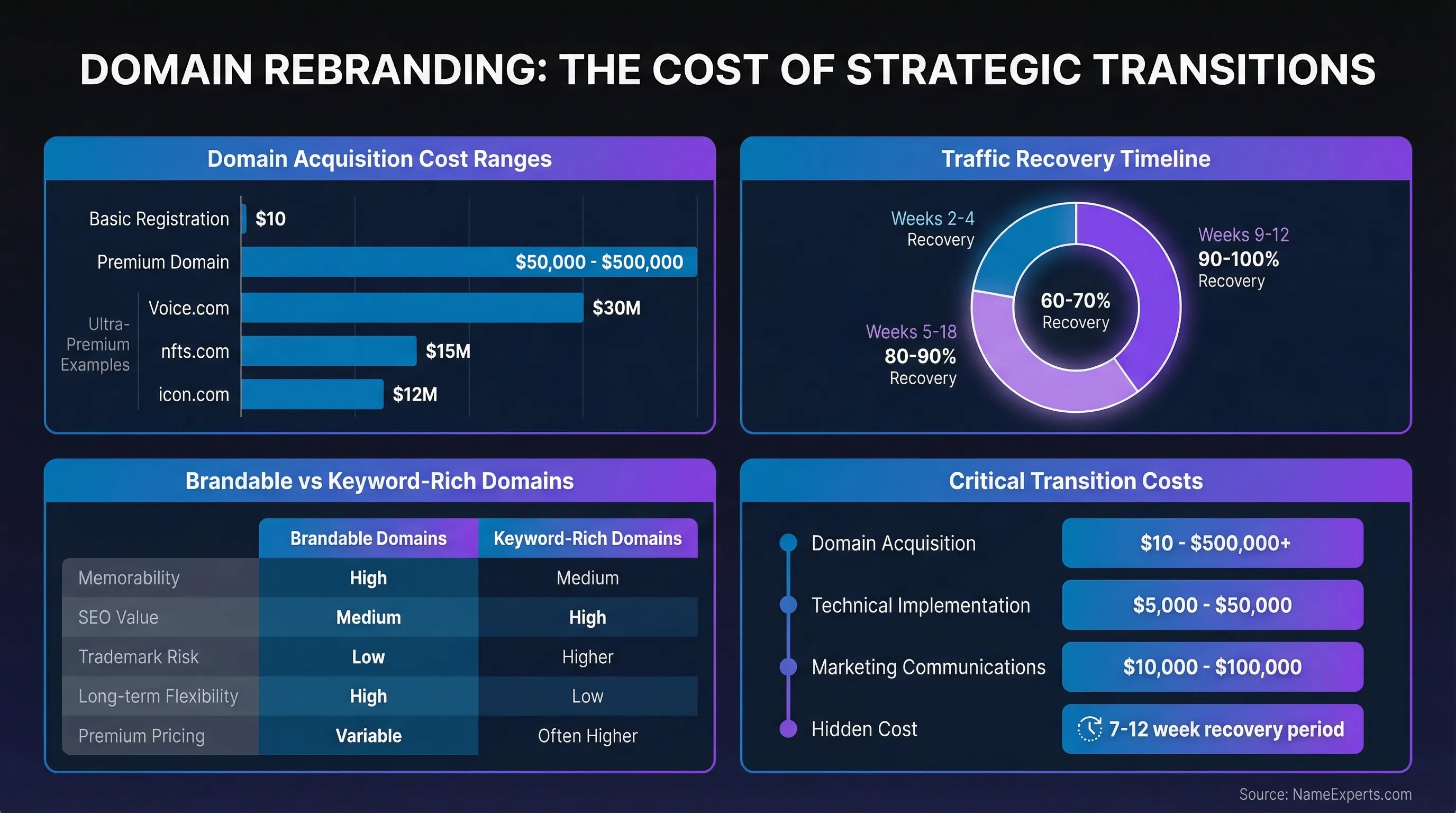
The cost-benefit analysis framework should weigh rebranding expenses—including domain acquisition, technical implementation, marketing communications, and temporary traffic loss—against long-term brand equity gains. A premium domain that perfectly aligns with your evolved business may cost $50,000-$500,000 upfront, but delivers decades of improved memorability, trust signals, and search relevance. Conversely, a hasty change to save $10,000 annually on trademark licensing could sacrifice millions in established search equity.
Red flags indicating you should not rebrand include chasing temporary naming trends that will feel dated within two years, making minor business pivots that don't fundamentally change your market positioning, or founder ego driving the decision rather than customer needs. If your primary motivation is "the current name feels boring" rather than "the current name creates measurable business problems," reconsider the transition.
Industry research suggests that up to one-third of website migrations experience significant SEO-related performance issues, with some sites losing 50% or more of their organic traffic virtually overnight according to analysis of migration failures. The critical recovery monitoring period typically spans 90 days, with most properly executed transitions recovering approximately 90% of organic traffic within 7-12 weeks when proper redirects are implemented.
These statistics underscore why the decision to rebrand must be strategic, not impulsive. The temporary disruption is only justified when the long-term benefits—stronger brand alignment, improved market positioning, or resolved legal issues—clearly outweigh the short-term costs and risks.
Choosing Your New Domain: The Foundation of Successful Rebranding
The domain you select becomes the foundation of your rebranded identity. This decision determines whether you'll need another costly transition in three years or whether you've secured a permanent digital asset that grows in value. Rushing this selection or choosing based solely on availability creates problems that proper vetting would have prevented.
Domain selection criteria require balancing multiple factors. Brandability—how memorable, distinctive, and pronounceable the name is—often conflicts with keyword-rich options that signal relevance to search engines but feel generic. The comparison reveals important trade-offs:
| Selection Criteria | Brandable Domain | Keyword-Rich Domain |
|---|---|---|
| Memorability | High - unique and distinctive | Medium - descriptive but generic |
| SEO Value | Medium - builds over time | High - immediate relevance signals |
| Trademark Risk | Low - invented terms | Higher - common industry terms |
| Long-term Flexibility | High - adapts as business evolves | Low - limits pivots |
| Premium Pricing | Variable - depends on length/appeal | Often higher - competitive demand |
TLD (top-level domain) options extend beyond .com, though that extension remains the gold standard for credibility in most markets. Alternative TLDs like .io, .co, or industry-specific options (.tech, .agency) can work for certain audiences but require stronger marketing to overcome the instinctive .com assumption most users make.
Length considerations matter significantly for memorability and typing accuracy. Domains under 12 characters are easiest to remember and least prone to typos, while longer descriptive names may rank better initially but create friction in word-of-mouth marketing and direct traffic.
Domain valuation methodologies help you understand fair market pricing and avoid overpaying. According to industry data on valuation techniques, several factors contribute to a domain's desirability and price. The most important include domain age and historical traffic data, keyword search volume and commercial intent, TLD extension and brandability, existing backlink profile and authority metrics, and comparable sales data from recent transactions.
Premium domains command premium prices for good reason. Voice.com sold for $30 million in 2019, while nfts.com fetched $15 million in 2022, and icon.com changed hands for $12 million as recently as April 2025. While most businesses won't invest at this level, understanding that quality domains are valuable assets—not commodities—helps frame appropriate budget expectations.
This is where expert domain acquisition becomes invaluable. At NameExperts, our 16+ years advising businesses on domain strategy with 200+ completed transactions has taught us that stealth acquisition prevents sellers from inflating prices when they know a specific company needs their domain. We've helped clients like Monday.com successfully rebrand from Dapulse.com by understanding the full rebranding lifecycle and securing the right domain before public announcement.
Vetting your domain thoroughly before purchase prevents costly surprises. Check the domain's history using archive tools to identify previous content that might have been spammy or controversial. Analyze the backlink profile to ensure incoming links come from quality sources rather than link farms. Verify previous ownership didn't involve trademark disputes or penalties. Run trademark searches to confirm your intended use won't infringe existing rights.
The hidden cost of choosing an unavailable or overpriced domain without proper research compounds exponentially. If you publicly announce a rebrand before securing it, the current owner can demand ransom-level pricing. If you skip trademark clearance, you may face legal action requiring another rebrand within months. If you ignore the domain's history, you might inherit SEO penalties that take years to overcome.
Professional domain brokers access premium inventory through industry relationships and negotiate better prices through experience with domain valuation benchmarks and seller psychology. The brokerage fee—typically 10-15% of the purchase price—often saves multiples of its cost through better negotiation outcomes and risk mitigation.

Don't Settle for the Wrong Domain
Choosing a suboptimal domain because the perfect one seems out of reach creates problems that proper acquisition would have prevented. Our team can help you secure premium domains through stealth negotiation that prevents sellers from inflating prices when they know you need their domain.
Pre-Transition Strategic Planning
The technical domain switch represents just one component of successful rebranding. The strategic planning that occurs before any DNS records change determines whether your transition preserves value or destroys it. This phase requires coordinating multiple workstreams across departments and stakeholders.
SEO equity audit forms the foundation of preservation strategy. Identify your high-value pages by analyzing which URLs attract the most organic traffic, rank for your most important commercial keywords, and have accumulated quality backlinks. Create a comprehensive backlink inventory showing which external sites link to which of your pages, as these represent SEO value you must preserve through proper redirects.
Document your ranking keywords for each important page using tools like Google Search Console to see exactly which phrases drive traffic to specific URLs. This intelligence ensures your new pages maintain keyword relevance for the phrases that matter most to your business. When you rewrite content for the new site, preserving this relevance prevents ranking drops.
Stakeholder communication timeline should begin at least 30-60 days before the technical transition. Different audiences need different messaging at different times. Customers require clear explanation of what's changing, what stays the same, and what actions they need to take. Partners and vendors need advance notice to update their systems and records. Employees need to understand the rebrand rationale and their role in the transition. Investors want to understand the business case and risk mitigation strategy.
The sequencing matters significantly. Internal stakeholders should learn about the change before external announcement to prevent confusion and enable them to answer questions. Key partners and customers might receive personal outreach before mass communication. Public announcement should occur only after you've secured the new domain and prepared redirect infrastructure.
According to guidance on legal and regulatory implications, it's wise to make your legal department an ally early in the rebranding process. In fact, seeking advice from legal counsel before developing any other implementation plans is recommended. Legal considerations become especially important if you're changing your organization's name, transferring ownership, or otherwise fundamentally altering your brand identity.
A simple way to change your organization's name is filing or updating your DBA ("doing business as"), which informs the public that you operate under a name other than your legal entity name. However, this may not be the right choice if your rebrand is more complex. Your legal team will need to understand the rationale for your rebrand, requiring as much strategic context and market analysis as possible to choose the best long-term course of action.
Technical infrastructure assessment identifies dependencies that could break during transition. Review your hosting environment to ensure it can handle the new configuration. Audit email systems since changing domains affects sender reputation and deliverability—you'll need to maintain old email addresses for a transition period while gradually moving to new ones. Catalog third-party integrations that reference your domain, from payment processors to marketing automation platforms, as each will require updating.
Creating your comprehensive URL mapping document is perhaps the most critical pre-transition deliverable. This spreadsheet maps every important URL on your old domain to its corresponding destination on the new one. The mapping should be one-to-one whenever possible—each old page redirects to a specific new page with similar content and keyword focus. For pages you're consolidating or retiring, map them to the most relevant alternative rather than defaulting everything to the homepage.
Budget allocation should account for both obvious and hidden costs. Domain acquisition may range from $10 for a basic registration to $500,000+ for a premium domain. Technical implementation including developer time, redirect setup, and testing typically costs $5,000-$50,000 depending on site complexity. Marketing communications covering announcement campaigns, updated materials, and customer education might require $10,000-$100,000. The hidden cost of temporary traffic loss during the 7-12 week recovery period should factor into cash flow planning.
Technical Implementation: Executing the Domain Transition
With strategic planning complete and stakeholders prepared, the technical execution phase begins. This is where careful preparation pays dividends through smooth implementation, while shortcuts create problems that take months to resolve. Following a systematic approach minimizes disruption and preserves SEO value.
Step-by-step technical execution:
- Secure the new domain before any public announcement. This is where expert domain acquisition services prove invaluable—securing the right domain through professional negotiation prevents the need for future rebrands caused by settling for a suboptimal alternative. At NameExperts, we've seen clients avoid six-figure overpayments through stealth acquisition strategies that keep seller leverage minimal.
- Set up 301 redirects following Google's official guidance. According to best practices for permanent redirects, a 301 redirect signals a permanent move and tells search engines the redirect is permanent, treating the destination URL as canonical and transferring most ranking signals over time. This is essential for situations like moving your website to a new domain. The redirects should remain in place for at least a year, and you should avoid redirect chains by ensuring one hop only from old URL to new URL.
- Update Google Search Console and submit Change of Address. Verify ownership of both old and new domains in Search Console, ideally using the same Google account that has edit access in Google Analytics. Use the Change of Address tool to inform Google about your migration, which helps migrate your search results from the old site to the new site. This doesn't guarantee immediate recognition but provides important signals to search engines.
- Migrate content while maintaining URL structure. Where possible, preserve the URL path structure so that /services/consulting on the old domain becomes /services/consulting on the new one. This makes redirect mapping simpler and helps users who have bookmarked specific pages. When you must change URL structure, ensure your redirect mapping accounts for every important page.
- Update internal links and canonical tags. Every internal link on your new site should point directly to new URLs rather than relying on redirects. Update canonical tags to reference the new domain to prevent duplicate content issues. While redirects will work if you miss some links, direct links perform better for user experience and pass link equity more efficiently.
- Configure DNS and SSL certificates. Update DNS records to point your new domain to your hosting environment. Install SSL certificates for the new domain to ensure secure HTTPS connections—search engines favor secure sites, and browsers display warnings for non-secure sites that damage trust. Test thoroughly in a staging environment before making DNS changes live.
Common technical pitfalls to avoid include redirect chains where URLs pass through multiple redirects before reaching the final destination, which dilutes link equity and slows page loads. Forgetting to redirect subdomains represents another frequent mistake—tools, blogs, or services hosted on subdomains need their own redirect strategy. Neglecting to update robots.txt and XML sitemaps on the new domain can prevent search engines from properly crawling and indexing your content.
Overlooking email system migration creates communication blackouts. Set up email forwarding from old addresses to new ones, maintain old MX records active for at least three months, and gradually transition to new email addresses in all communications. Train sales and support teams so every touchpoint reinforces the new identity without confusing customers.
Timeline expectations help set realistic goals. In the first week post-launch, expect some confusion as search engines begin discovering redirects and users encounter the change. During weeks 2-4, you'll see initial traffic stabilization as redirects take effect and search engines start indexing new URLs. The 30-60 day period brings more significant traffic recovery as search engines re-evaluate rankings under the new domain. By 90 days, most properly executed transitions have recovered to pre-launch traffic levels or better.
This recovery timeline assumes proper technical execution. Sites that skip comprehensive redirect mapping, fail to maintain keyword relevance, or neglect to update high-value backlinks may experience prolonged recovery periods or permanent traffic loss.
Protecting Your SEO Investment During the Transition
Preserving the SEO value you've built over years requires proactive protection during the transition. While some temporary ranking fluctuation is inevitable as search engines re-evaluate your site under the new domain, strategic actions minimize the impact and accelerate recovery.
Redirect strategy determines how much link equity you preserve. One-to-one mapping where each old URL redirects to a specific, relevant new URL passes the most value and provides the best user experience. Users and search engines land on content that matches what they expected. Consolidated redirects where multiple old URLs point to a single new page work when you're streamlining content, but should be used sparingly and only when the destination page genuinely covers the topics of the redirected pages.
Avoid the temptation to redirect everything to your homepage. This approach is technically simple but destroys SEO value and frustrates users who followed a link expecting specific content. Search engines interpret mass homepage redirects as a signal that the old content no longer exists, rather than recognizing it as a proper site migration.
Backlink reclamation involves identifying and updating high-value external links to point directly to your new domain. While your redirects will pass users and some link equity from old URLs to new ones, direct links perform better. Use tools like Google Search Console's "Top linking sites" report to identify which external sites link to your content most frequently.
Prioritize outreach based on link value—focus first on links from high-authority domains, links that drive significant referral traffic, and links in content that's closely related to your business. A polite email to editors explaining your rebrand and requesting a link update often succeeds, especially when you have an existing relationship. These reclaimed links provide better SEO value than redirected links and ensure your backlink profile remains strong even if you eventually retire the old domain.
Monitoring tools and metrics should track several key indicators during transition. Organic traffic by domain (old vs. new) shows the migration pattern—traffic to the old domain should decline as traffic to the new one rises. Keyword rankings for your most important phrases indicate whether you're maintaining visibility for commercial terms. Crawl errors and 404 reports in Google Search Console reveal broken links or missing redirects that need attention.
Page load speed and Core Web Vitals ensure the new domain's technical performance doesn't introduce new problems. Conversion rates confirm that the rebrand isn't negatively impacting business results beyond the expected temporary traffic dip. Set up custom alerts to notify you immediately of significant ranking drops or traffic changes so you can investigate and respond quickly.
Recovery timeline based on realistic expectations helps you evaluate whether your transition is proceeding normally or experiencing problems. In weeks 2-4, expect to see 60-70% of your previous organic traffic as search engines begin recognizing redirects. By weeks 5-8, you should recover to 80-90% of previous levels as re-indexing progresses. By weeks 9-12, most sites return to 90-100% of previous traffic, often exceeding it as the benefits of the rebrand take effect.
If you're significantly below these benchmarks, investigate potential issues: Are redirects properly implemented? Did you maintain keyword relevance on important pages? Are there technical problems preventing search engines from crawling the new site? Did you lose high-value backlinks that need reclamation?

Legal considerations for ownership transfer and trademark alignment require attention throughout the transition. Ensure the transfer process follows proper protocols with your registrar, using escrow services for high-value transactions to protect both parties. Update WHOIS records to reflect accurate ownership information. Verify that your new domain doesn't infringe on existing trademarks in your target markets, as discovering conflicts after launch creates expensive problems.
The investment in protecting your SEO during transition pays dividends through faster recovery, maintained visibility, and preserved business results. Cutting corners on redirects, neglecting backlink reclamation, or failing to monitor key metrics can turn a manageable 8-week recovery into a 6-month struggle to regain lost ground.
Protect Your SEO Investment During Transition
The difference between recovering 90% of your traffic in 7-12 weeks versus losing it permanently often comes down to expert planning and execution. If you're navigating a complex rebrand and want to preserve the SEO equity you've built over years, connect with our domain strategy team to ensure your transition is built on the right foundation from day one.
Post-Launch: Monitoring and Optimization
The transition doesn't end when DNS records update. The post-launch period requires vigilant monitoring, rapid response to issues, and ongoing optimization to ensure your rebrand achieves its strategic objectives. This phase typically spans 90 days but may extend longer for complex sites.
Immediate post-launch priorities include verifying that all redirects function correctly by testing a sample of important URLs to confirm they land on the intended destination. Monitor server logs for 404 errors indicating broken links or missing redirects. Check that your new SSL certificate is properly installed and all pages load securely. Verify that tracking codes in Google Analytics, Tag Manager, and other tools are firing correctly on the new domain.
Submit your new XML sitemap to Google Search Console to help search engines discover and index your new URLs quickly. While this doesn't guarantee immediate crawling, it provides clear signals about your site structure. Monitor the Index Coverage report to track how many of your new URLs are being indexed and identify any crawl errors that need resolution.
Communication follow-through ensures stakeholders remain informed throughout the transition. Send follow-up messages to customers confirming the change is complete and providing any necessary instructions for updating bookmarks or login credentials. Update all directory listings including Google Business Profile, industry directories, and review sites to reflect your new domain. Revise email signatures, business cards, and marketing materials to feature the new web address.
Monitor customer support channels for confusion or questions about the rebrand. Track the volume and nature of rebrand-related inquiries to identify communication gaps or technical issues that need addressing. Empower support teams with clear talking points and troubleshooting guides specific to the change.
SEO monitoring and adjustment should occur weekly during the first month, then bi-weekly through the 90-day critical period. Track your most important keyword rankings to identify any phrases experiencing significant drops that require investigation. Monitor organic traffic patterns comparing the new domain to historical performance on the old one. Analyze which pages are gaining or losing traffic to understand what's working and what needs optimization.
Review your backlink profile to identify any high-value links that still point to the old domain and prioritize them for reclamation outreach. Check for new 404 errors weekly and create redirects for any important URLs you initially missed. Monitor page load speed and Core Web Vitals to ensure the new domain's technical performance meets or exceeds the old site.
Business metrics validation confirms the rebrand is achieving its strategic objectives beyond just preserving SEO. Track conversion rates to ensure the new domain isn't introducing friction in your sales funnel. Monitor lead quality and customer acquisition costs to verify that the traffic you're attracting remains commercially valuable. Analyze brand search volume for both old and new brand names to gauge how quickly awareness is shifting.
Measure customer retention and churn during the transition period to identify any negative impacts on your existing base. Survey customers about their perception of the rebrand to gather qualitative insights beyond quantitative metrics. This feedback can reveal opportunities to refine messaging or address concerns you hadn't anticipated.
Long-term domain management requires decisions about the old domain. Most experts recommend maintaining ownership and redirects for at least 12 months, with many businesses keeping them indefinitely. The annual renewal cost of $10-50 is minimal insurance against losing traffic from old bookmarks, links, or brand searches. After 12-24 months, evaluate whether traffic from the old domain has dropped to negligible levels that justify letting it expire.
Some businesses choose to keep the old domain permanently, either maintaining redirects indefinitely or repurposing it for a different use like a campaign-specific microsite. Others eventually let it expire once they're confident the transition is complete. The decision should be based on data showing how much value the old domain still provides through redirected traffic and preserved backlinks.
Continuous improvement extends beyond the initial transition. Use insights gained during the rebrand to optimize your new site's content, structure, and technical performance. Identify pages that haven't recovered their previous rankings and investigate whether they need better keyword optimization, improved content, or additional backlinks. Look for new keyword opportunities that align with your rebranded identity and create content to capture them.
The rebrand represents a fresh start and an opportunity to improve on what came before. While preserving your existing SEO value is critical, don't let that prevent you from making strategic improvements that position your rebranded business for even greater success.
Making Your Domain Rebrand a Strategic Success
Domain rebranding represents one of the most significant digital transformations a business can undertake. When executed strategically—with careful domain selection, comprehensive planning, meticulous technical implementation, and vigilant post-launch monitoring—it can strengthen brand positioning, improve search visibility, and support long-term business growth. When rushed or poorly planned, it can destroy years of SEO investment and damage customer relationships.
The key differentiator is treating domain selection as the critical first decision rather than an afterthought. Securing the right domain through expert acquisition prevents the need for future rebrands caused by settling for suboptimal alternatives. At NameExperts, our 16+ years of experience with 200+ successful transactions has taught us that stealth acquisition, thorough vetting, and strategic negotiation make the difference between overpaying for a mediocre domain and securing a premium asset at fair market value.
The technical execution—comprehensive redirect mapping, proper 301 implementation, and Search Console configuration—determines whether you preserve your SEO equity or start from scratch. The pre-transition planning covering stakeholder communication, legal clearance, and infrastructure assessment prevents the surprises that derail transitions. The post-launch monitoring and optimization ensure you identify and resolve issues quickly while the recovery window is still open.
Most properly executed transitions recover 90% of organic traffic within 7-12 weeks, with many exceeding previous performance as the benefits of improved branding and positioning take effect. This recovery is only possible when every phase—from strategic decision-making through post-launch optimization—receives the attention and resources it deserves.
If you're considering a rebrand, begin with the strategic questions: Does this change solve a real business problem? Have you secured the right domain through proper vetting and negotiation? Do you have the resources and expertise to execute the transition properly? The answers to these questions determine whether your rebrand becomes a catalyst for growth or a cautionary tale of what not to do.
For businesses ready to rebrand with confidence, working with experienced domain brokers makes the difference between a smooth transition and a costly struggle. Whether you need help evaluating options, negotiating acquisition, or planning your technical implementation, working with specialists who understand the full rebranding lifecycle helps you avoid the pitfalls that have derailed others. Your domain is too important to your business to leave its selection and transition to chance.
Ready to Rebrand With Confidence?
Your domain is the foundation of your entire rebranding strategy—choosing the wrong one or overpaying for the right one creates costly problems that proper expertise prevents. With 16+ years of experience and 200+ successful transactions, we've helped businesses like Monday.com navigate complex rebrands by securing premium domains through stealth acquisition and strategic negotiation. Whether you need help evaluating options, acquiring your ideal domain at fair market value, or planning your tec
schedule a free consultation with our domain experts







Frequently Asked Questions
Basic registration costs $10-$50 annually, but premium domains range from $50,000-$500,000+ for acquisition, plus $5,000-$50,000 for technical implementation and $10,000-$100,000 for marketing communications during the transition.
No, you cannot directly rename a registered domain—you must acquire a new one and redirect your existing content through 301 redirects while maintaining the old domain active for at least 12 months to preserve SEO equity and user access.
Rebranding is legal when done properly, though you must file DBA updates or amend Articles of Incorporation/Organization depending on entity type, conduct trademark searches to avoid infringement, and consult legal counsel before making structural changes.
Yes, domain spoofing occurs when fraudsters use similar-looking domains or manipulate DNS records to impersonate legitimate websites for phishing or ad fraud—which is why securing exact-match premium domains and monitoring for typosquatting protects your brand.