
Key Takeaways
- Domain cybersquatting costs $20K-$150K+ to recover versus $10-20 to prevent through proactive registration
- Register defensive domains before trademark publication or product announcements to avoid price inflation
- Priority domains include exact match, common misspellings, and major TLD variations (.net, .org, .io)
- UDRP proceedings have 85-90%+ success rates for trademark owners but cost $1,500-5,000 and take 60+ days
- Use domain brokers for stealth acquisitions to prevent squatters from inflating prices when they know you're interested
Domain cybersquatting is the illegal practice of registering, using, or selling domain names that infringe on trademarks or brand names with bad faith intent to profit. Under the Anticybersquatting Consumer Protection Act (ACPA), cybersquatters can face legal action and be forced to transfer domains to rightful trademark owners. For business owners, this threat represents a critical vulnerability in brand protection strategy—one that's far easier and less expensive to prevent than to remedy after the fact.
What Domain Cybersquatting Really Costs Your Business
The financial impact of cybersquatting extends far beyond the initial domain registration fee. When squatters target your brand, the recovery costs escalate quickly across multiple dimensions.
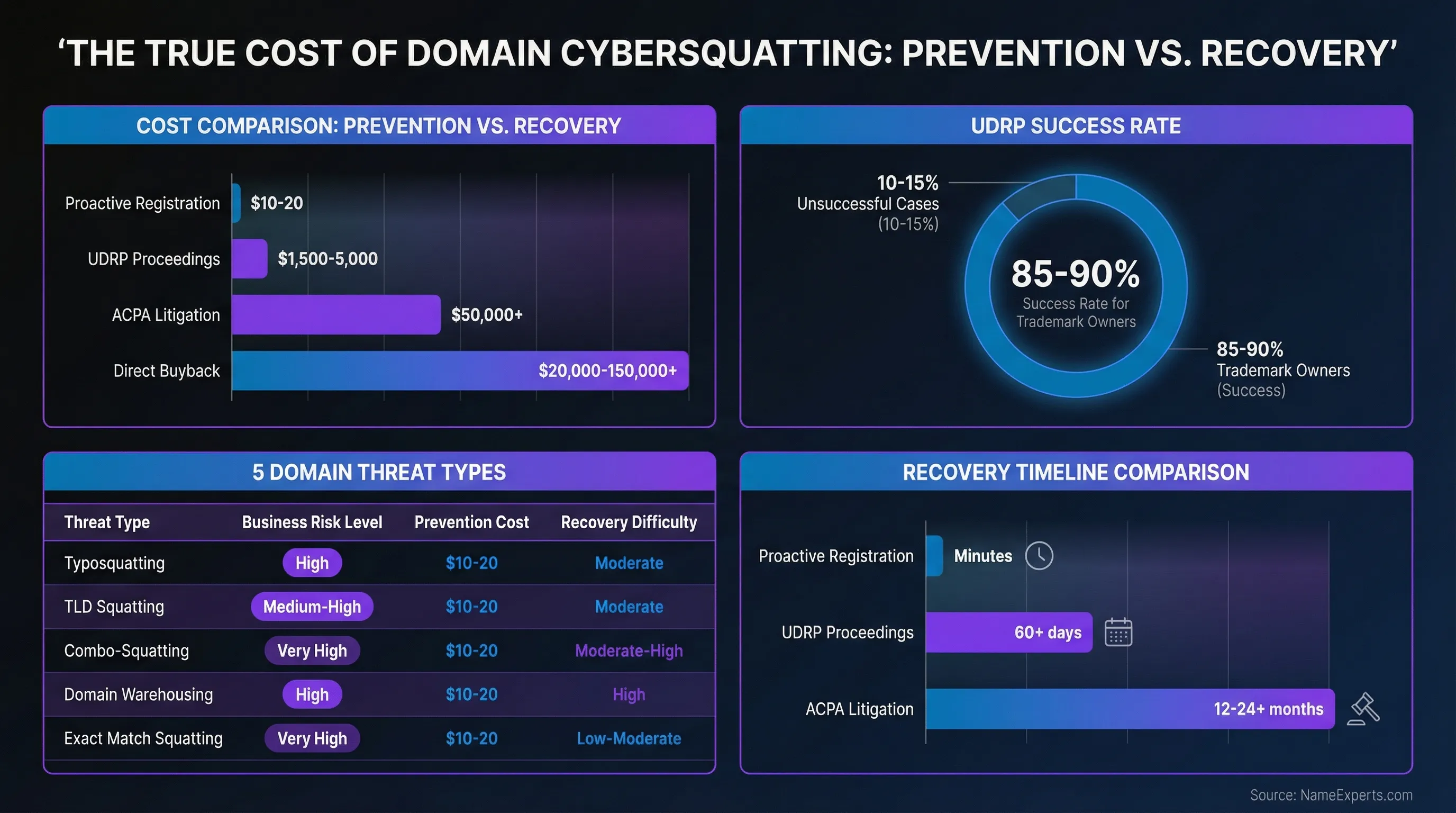
Prevention versus recovery costs reveal a stark disparity. Proactive domain registration typically costs $10-20 per domain annually. In contrast, recovery through UDRP proceedings requires filing fees of $1,500-5,000, plus legal counsel expenses. ACPA litigation in federal court can exceed $50,000 in legal fees alone. Direct buyback negotiations with squatters frequently demand $20,000-150,000+ depending on the perceived value of your brand.
Beyond direct costs, businesses face revenue loss from diverted traffic. When customers land on squatted domains instead of your legitimate site, you lose sales opportunities. If the squatter serves competitor ads or affiliate links, they're literally profiting from your brand equity while you lose customers.
Brand damage compounds these losses. Squatted domains often host inappropriate content, phishing schemes, or malware. When customers encounter these experiences while searching for your business, trust erodes. Rebuilding reputation after such incidents requires significant marketing investment and time.
Timeline considerations matter significantly. Proactive registration takes minutes. UDRP proceedings typically require 60+ days from filing to resolution. ACPA litigation can extend 12-24 months or longer. During this entire period, the squatter continues exploiting your brand while you invest resources in recovery.

The 5 Types of Domain Threats Every Brand Owner Must Know
Understanding the specific tactics squatters employ helps you build comprehensive protection strategies. Each threat type requires different defensive approaches.
Typosquatting
Typosquatting exploits common typing errors by registering misspelled versions of your domain. If your brand is "example.com," squatters might register "exmaple.com," "examlpe.com," or "exampel.com." Users who mistype your URL land on these fraudulent sites, where they encounter phishing pages, malware downloads, or competitor advertisements.
Business impact extends beyond lost traffic. Typosquatted domains frequently host credential harvesting schemes that steal customer login information. When your customers' accounts get compromised through these fake sites, they blame your brand—even though you don't control the fraudulent domain.
TLD Squatting
TLD squatting involves registering your brand name across different top-level domains. If you operate on a .com domain, squatters register the .net, .org, .co, .io, or country-code versions. This tactic works because users often guess at domain extensions or assume all variations belong to the same company.
The threat intensifies with new generic TLDs. Hundreds of extensions now exist (.tech, .store, .online, .app), creating exponentially more squatting opportunities. Prioritizing which extensions matter for your brand becomes essential.
Combo-Squatting
Combo-squatting combines your brand name with common terms like "login," "support," "secure," "shop," or "help." These domains appear legitimate at first glance: "examplebrand-login.com" or "examplebrand-support.net." Users searching for customer service or account access fall victim to these convincing fakes.
This approach proves particularly effective for phishing. When customers receive emails claiming to be from "examplebrand-security.com," the domain looks official enough to bypass suspicion. Credential theft and account takeovers follow.
Domain Warehousing
Domain warehousing occurs when squatters monitor trademark filings, business registrations, and expired domains to snap up names before legitimate owners can secure them. They build portfolios of potentially valuable domains, then demand premium prices when rightful owners come calling.
This tactic targets businesses at vulnerable moments. Startups filing LLC paperwork, companies launching new products, or organizations rebranding all face warehousing risks. Squatters scan public records specifically to identify these opportunities.
Exact Match Squatting
Exact match squatting represents the most straightforward form: registering a domain identical to your trademark before you do. This typically happens when businesses delay domain registration after choosing a name, or when they fail to renew existing registrations.
Recovery proves most straightforward for exact matches when you hold trademark rights. However, the process still requires legal action and associated costs. Prevention through timely registration remains the superior strategy.
| Threat Type | How It Works | Business Risk Level | Prevention Cost | Recovery Difficulty |
|---|---|---|---|---|
| Typosquatting | Misspelled domain variations | High | $10-20 per variation | Moderate - UDRP often successful |
| TLD Squatting | Same name, different extensions | Medium-High | $10-20 per TLD | Moderate - depends on bad faith proof |
| Combo-Squatting | Brand + common terms | Very High | $10-20 per combination | Moderate-High - requires trademark strength |
| Domain Warehousing | Bulk registration for resale | High | $10-20 proactive registration | High - often requires negotiation or litigation |
| Exact Match Squatting | Identical trademark domain | Very High | $10-20 immediate registration | Low-Moderate with trademark, High without |
Don't Let Squatters Discover Your Brand Interest
When you need to acquire a domain already registered by a squatter, direct contact reveals your identity and can inflate prices from $5,000 to $50,000+ overnight. Our team can handle stealth domain acquisitions that protect your anonymity throughout negotiations, leveraging our 16+ years of experience to secure fair market pricing without revealing who's buying.
Building Your Defensive Domain Portfolio Strategy
Proactive domain protection requires strategic thinking about which variations actually matter for your brand. Budget constraints mean most businesses can't register every possible permutation. Prioritization becomes essential.
Essential domains to register before launch include your exact brand name across major TLDs (.com, .net, .org at minimum). Add country-code TLDs for markets where you operate or plan to expand. Register the most common misspellings—typically those involving transposed letters, doubled letters, or omitted letters in your brand name.
Consider combo domains that combine your brand with high-value terms. "Brandname-login," "brandname-support," and "brandname-shop" represent prime phishing targets. Securing these variations prevents credential harvesting schemes that damage customer trust.
Portfolio Prioritization Matrix
Not all domain variations carry equal risk. Prioritize based on likelihood of user error and potential for abuse. High-priority registrations include single-character typos of your .com domain, the .net and .org versions of your exact brand, and any combo domains using "login," "support," or "secure."
Medium-priority domains encompass less common TLDs where you operate (.co, .io, .app), two-character typos, and combo domains with "shop," "store," or "official." Low-priority registrations include obscure TLDs, complex misspellings unlikely to occur naturally, and combo domains with generic terms.
Budget allocation should reflect this hierarchy. Invest first in high-priority protection, then expand to medium-priority as resources allow. Low-priority domains can wait unless specific threats emerge.
Timing Strategy
When you register domains matters as much as which domains you register. Squatters monitor trademark filings, business registrations, and press releases to identify registration opportunities before you act.
Register domains before filing trademark applications. Trademark databases are public, and squatters scan them daily. Similarly, secure domains before submitting LLC paperwork or DBA registrations. State business registries provide another rich source of squatter intelligence.
For product launches or rebranding initiatives, register all priority domains before any public announcement. Press releases, social media teasers, and marketing campaigns all signal squatters to register related domains. Once your plans become public, registration costs may skyrocket if squatters beat you to valuable variations.
Stealth Acquisition Through Domain Brokers
When you need to acquire a domain already registered by someone else—whether a squatter or a legitimate owner—direct contact often backfires. If the current owner discovers your identity and recognizes your brand, prices inflate dramatically.
Professional domain brokers provide stealth acquisition services that mask your identity during negotiations. At NameExperts, we've completed 200+ transactions over 16+ years, including high-profile acquisitions where confidentiality proved essential to securing reasonable pricing.
The stealth approach works because sellers can't gauge your willingness to pay when they don't know who's buying. A domain that might cost $5,000 in a blind negotiation could jump to $50,000+ once the seller learns a well-funded company needs it for brand protection.
Our team handles the entire acquisition process: initial outreach, price negotiation, escrow coordination through Escrow.com for secure transactions, and final transfer. This approach saved clients like Monday.com significant costs during their rebrand from Dapulse.com, where maintaining confidentiality throughout the acquisition process prevented price inflation.
Detection and Monitoring: Catching Squatters Early
Even with comprehensive defensive registration, monitoring for new threats remains essential. Squatters continuously identify new variations and tactics. Early detection enables faster, less expensive responses.
Domain monitoring tools and services track new registrations containing your brand name or similar variations. WHOIS databases provide registration information for all domains. Setting up automated alerts notifies you when domains matching your brand patterns get registered.
Several approaches exist for monitoring. Basic WHOIS alerts notify you of exact-match registrations. More sophisticated services use algorithms to identify similar domains based on edit distance, phonetic similarity, and visual similarity. These catch typosquatting and combo-squatting attempts that exact-match alerts miss.
Early warning signs extend beyond new registrations. Traffic analysis may reveal users attempting to reach your site but landing elsewhere—indicating active typosquatting. Customer service inquiries about suspicious emails or websites provide another signal. Phishing reports from customers or security researchers often identify squatted domains before they cause widespread damage.
For high-value brands, professional domain portfolio management services provide comprehensive protection. At NameExperts, our domain portfolio management service includes continuous monitoring across all major TLDs and registrars. We identify threats early and coordinate appropriate responses, whether that means filing UDRP complaints, negotiating acquisitions, or pursuing legal action.
The monitoring investment pays for itself by enabling early intervention. Catching a squatted domain within days of registration—before the squatter invests in building out a phishing site or establishing traffic patterns—significantly improves recovery prospects and reduces costs.
Your Legal Options When Prevention Fails
Despite best efforts, some businesses discover squatted domains after the fact. Understanding your legal options helps you choose the most effective and cost-efficient recovery path.
UDRP Process Overview
The Uniform Domain-Name Dispute-Resolution Policy provides an administrative process for recovering domains without court litigation. UDRP complainants achieve success rates of 85-90%, making this the preferred first option for most trademark owners.
To prevail in a UDRP proceeding, you must prove three elements: the domain is identical or confusingly similar to your trademark, the respondent has no legitimate interest in the domain, and the domain was registered and is being used in bad faith. According to ICANN data, complainants succeeded in obtaining disputed domains in approximately 78% of cases during recent observation periods.
The process moves relatively quickly. After filing your complaint with an approved dispute resolution provider, the respondent has 20 days to submit a response. Administrative panels typically render decisions within 60 days of panel appointment. Total timeline from filing to resolution usually spans 90-120 days.
Costs remain moderate compared to litigation. Filing fees range from $1,500 for single-panelist cases to $5,000 for three-panelist cases, depending on the provider and complexity. Legal counsel fees add to this base cost, but total expenses typically stay well below $10,000 for straightforward cases.
ACPA Requirements and Federal Litigation
The Anticybersquatting Consumer Protection Act provides a federal cause of action against cybersquatters in U.S. courts. Under ACPA, statutory damages range from $1,000 to $100,000 per domain name, with courts having discretion to determine appropriate amounts based on case circumstances.
ACPA litigation makes sense when UDRP proves insufficient—typically when you need monetary damages beyond domain transfer, when the squatter operates in the United States making jurisdiction clear, or when you're pursuing multiple domains and want to establish precedent.
The requirements mirror UDRP but add jurisdictional elements. You must prove the squatter registered, trafficked in, or used a domain name that's identical or confusingly similar to your trademark, with bad faith intent to profit. Bad faith factors include intent to divert customers, offers to sell the domain, registration of multiple infringing domains, and lack of legitimate use.
Litigation costs escalate significantly. Legal fees for ACPA cases typically start at $50,000 and can exceed $200,000 for complex disputes. Timeline extends 12-24+ months from filing to resolution. These factors make ACPA most appropriate for high-value disputes where UDRP remedies prove inadequate.
Direct Negotiation Through Domain Brokers
Sometimes negotiation proves faster and more cost-effective than legal proceedings. This approach works best when the squatter shows willingness to sell, when your trademark rights are unclear or weak, or when you need immediate resolution.
However, direct negotiation carries risks. Contacting squatters yourself reveals your identity and interest, enabling them to inflate prices. Emotional responses to cybersquatting—understandable frustration at someone exploiting your brand—can undermine negotiation effectiveness.
Professional domain brokers provide experienced negotiators who've handled hundreds of acquisitions. At NameExperts, our 16+ years of experience includes numerous cybersquatting recovery cases where negotiation achieved faster, less expensive outcomes than legal proceedings.
We assess whether negotiation makes strategic sense based on the squatter's behavior, your trademark strength, and the domain's value to your business. When negotiation is appropriate, we handle all communications, leverage market knowledge to establish fair pricing, and coordinate secure transfers through escrow to protect both parties.
The broker approach particularly benefits businesses that need multiple domains or face time pressure. Legal proceedings take months; negotiation can conclude in days or weeks when squatters are motivated sellers.

Launching or Rebranding? Protect Your Domains First
Squatters actively monitor trademark filings and business registrations to identify valuable domains before companies secure them. If you're planning a product launch, rebrand, or market expansion, our domain consulting services help you build a strategic protection portfolio before any public announcements, preventing the domain warehousing that cost other businesses $20,000-150,000+ in recovery fees.
Proactive Protection: Your Action Plan
Implementing comprehensive protection requires systematic execution across multiple fronts. This action plan provides concrete steps for businesses at any stage.
Immediate actions include registering your primary domain if you haven't already, securing .net and .org versions of your exact brand name, and registering the most obvious typosquatting variations (single-character transpositions and omissions).
Within 30 days, expand protection to include country-code TLDs for markets where you operate, combo domains using "login," "support," and "secure," and any domains combining your brand with product names or service categories.
Within 90 days, implement monitoring systems for new domain registrations containing your brand, establish relationships with domain brokers for future acquisition needs, and document your trademark rights through federal registration if you haven't already.
Ongoing maintenance requires annual domain renewals with auto-renewal enabled to prevent accidental expiration, quarterly reviews of monitoring alerts for new threats, and periodic reassessment of your domain portfolio as your business evolves.
Budget allocation should prioritize prevention over recovery. Spending $500-2,000 annually on defensive domain registrations and monitoring prevents the $20,000-150,000+ costs of recovery through legal action or negotiation.
For businesses launching new brands, rebranding existing companies, or expanding into new markets, professional domain consulting provides strategic guidance on which domains matter most and optimal timing for registration. Our team at NameExperts has guided companies through major transitions—including Monday.com's rebrand from Dapulse.com—where comprehensive domain strategy proved essential to protecting brand equity.
The investment in proactive protection pays dividends through avoided recovery costs, maintained customer trust, and protected revenue streams. Domain cybersquatting represents a preventable threat when businesses prioritize strategic domain portfolio management from the outset.
Protect Your Brand Before Squatters Strike
Domain cybersquatting costs businesses $20,000-150,000+ to recover through legal proceedings or buyback negotiations—expenses that dwarf the $10-20 per domain for proactive protection. Whether you need defensive domain registration strategy, stealth acquisition of squatted domains, or ongoing portfolio monitoring, our no-bullshit approach has guided 200+ transactions over 16+ years, including high-profile rebrands like Monday.com. Don't wait until squatters force your hand— get expert domain pro
get expert domain protection guidance today







Frequently Asked Questions
A cybersquatting domain is a web address registered with bad faith intent to profit from someone else's trademark or brand name, typically by demanding payment for transfer, diverting traffic, or exploiting customer confusion.
No, the Anticybersquatting Consumer Protection Act (ACPA) makes it illegal to register domains in bad faith that infringe on trademarks, with statutory damages ranging from $1,000 to $100,000 per domain name.
Search WHOIS databases for domains containing your trademark, then evaluate whether the registrant has legitimate business interests or is using the domain in bad faith to profit from your brand through resale offers, competitor ads, or phishing schemes.
Register defensive variations before trademark publication or product announcements, including exact matches across major TLDs (.com, .net, .org), common misspellings, and combo domains with terms like "login" or "support" that cost $10-20 each versus $20,000-150,000+ to recover later.