
Most corporate domain strategies focus purely on defense—protecting against cybersquatters and typosquatters—but miss the growth opportunity. The modern challenge balances brand protection with strategic expansion across new TLDs, international markets, and M&A integration. This guide provides an actionable framework bridging legal and brand protection with business objectives, helping you audit portfolios, plan acquisitions, architect international presence, and manage ongoing security.
Key Takeaways
- Domain strategy serves dual purposes: defensive brand protection and offensive growth enablement
- Start with comprehensive portfolio audit to identify gaps, redundancies, and risks
- Balance exact-match .com domains with strategic new TLD acquisitions for specific markets
- Plan domain architecture for M&A scenarios before they happen
- International expansion requires ccTLD vs. subdirectory decisions based on market strategy
Understanding the Dual Purpose of Domain Strategy
Beyond brand protection, your domain portfolio impacts SEO, direct navigation traffic, and customer trust. Research shows that domain name choice significantly influences brand recall and whether customers type your address directly into browsers. When users remember and trust your web address, they bypass search engines entirely, reducing acquisition costs and increasing conversion rates.
The cost of reactive approaches adds up quickly. UDRP proceedings through dispute resolution services require legal resources and time, while defensive gaps lead to lost traffic when customers land on competitor or parked domains. Premium domain acquisition costs inflate dramatically once your brand gains visibility, as domain investors recognize leverage in negotiations.
Growth-oriented thinking transforms domains from defensive assets into market entry vehicles. Strategic acquisitions support product launches, facilitate geographic expansion, and smooth acquisition integration. Companies that plan domain architecture proactively position themselves to move quickly when opportunities arise, rather than scrambling to secure assets after announcing initiatives.

Phase 1: Conducting a Strategic Portfolio Audit
Centralize and inventory all domains across departments, registrars, and business units. This common chaos scenario occurs when marketing registers campaign domains, IT manages technical infrastructure, regional offices secure local variants, and legal protects trademarks—all without coordination. The first step consolidates this fragmented landscape into a single source of truth.
Implement a categorization framework that groups assets by purpose: primary brand domains anchor your core identity, defensive registrations protect against confusion, product and service domains support specific offerings, geographic variants enable local market presence, legacy and M&A domains represent historical acquisitions, and expired or at-risk domains require immediate attention.
Conduct gap analysis by mapping trademarks to corresponding domains, analyzing competitive domain holdings, and assessing typosquatting vulnerability. This process reveals where competitors control valuable variations, where common misspellings remain unprotected, and where trademark coverage doesn't extend to digital assets.
When portfolios exceed 50 domains or span multiple business units, domain experts can conduct comprehensive assessments that reveal hidden risks and missed opportunities internal teams typically overlook. Our 16+ years of experience across 200+ transactions helps identify patterns and vulnerabilities that emerge only through specialized expertise.
Uncover Hidden Risks in Your Domain Portfolio
Fragmented domain management across marketing, IT, legal, and regional teams creates vulnerabilities that only become visible through specialized expertise. If your portfolio exceeds 50 domains or spans multiple business units, schedule a comprehensive portfolio assessment to identify gaps, redundancies, and infringement risks before they become expensive problems.
Q.How does an enterprise domain acquisition differ from a startup deal?
Startups need more guidance, while corporate buyers are more in tune with the general process. Corporate clients require more layers of communication and requirements and normally more parties involved in the process. It would not be uncommon to have 5-10 internal team members involved in the acquisition process. HubSpot recently completed an acquisition and had a total of eight team members involved. My last startup acquisition upgraded from a gTLD to a four-letter .com. I worked with one member of that team to complete the entire acquisition.
 Joe Uddeme, Director and Principal, Name Experts
Phase 2: Building Your Acquisition and Registration Strategy
Prioritize acquisitions using a matrix that weighs exact-match .com domains against new TLDs based on audience and use case. While .com maintains universal recognition and trust, extensions like .ai, .tech, and .io have gained legitimacy for specific contexts—particularly among developer and technology-savvy audiences who view these alternatives as modern and innovative.
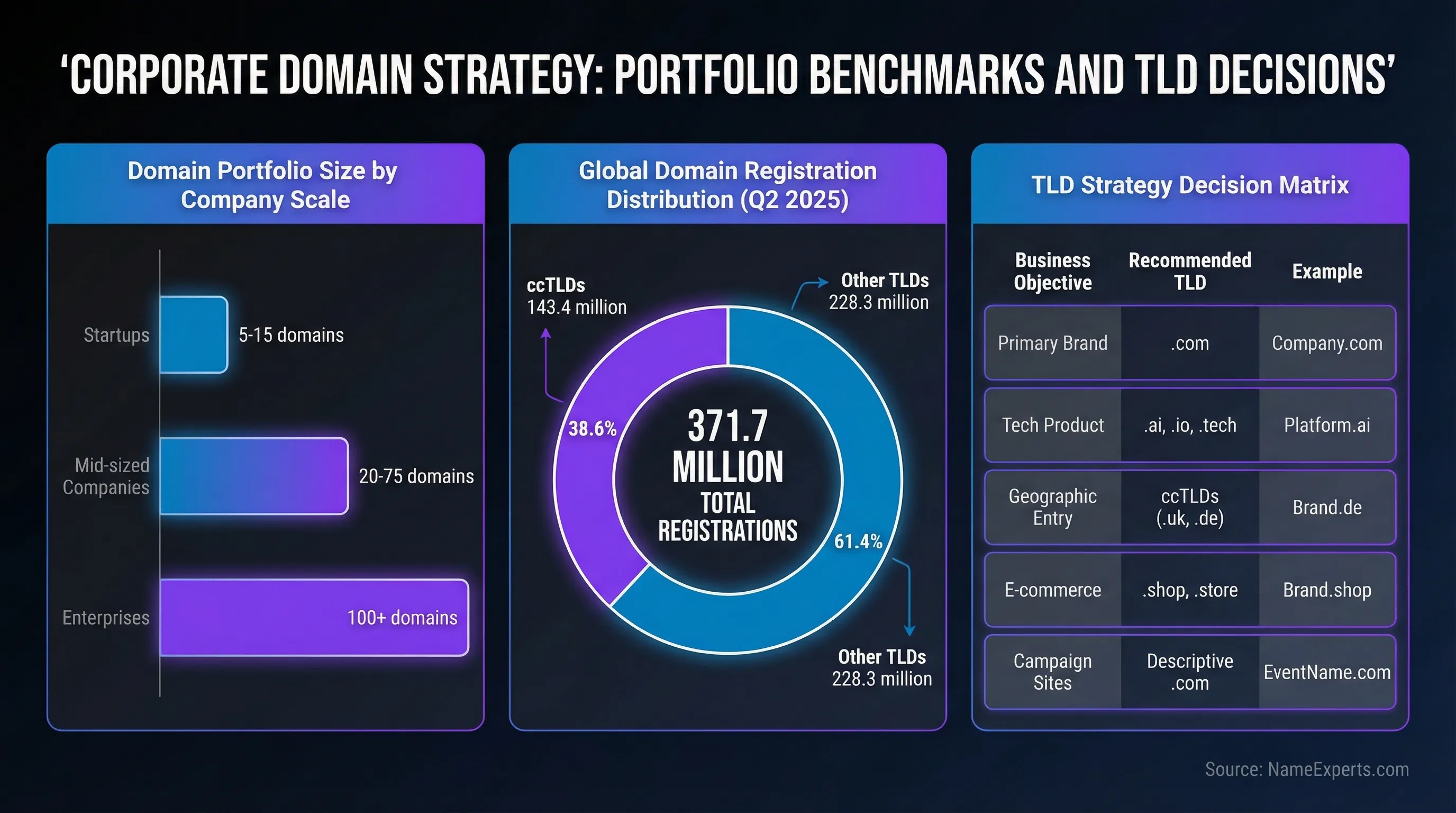
Establish defensive registration guidelines covering common misspellings, plural and singular variants, hyphenated versions, and homophone domains. Portfolio size benchmarks vary by company scale: startups typically maintain 5-15 domains, mid-sized companies hold 20-75, and enterprises manage hundreds or thousands. The key is proportionality—defensive coverage should match brand visibility and infringement risk.
Premium domain acquisition requires strategic thinking about when to invest in ultra-premium assets. Research on domain parking and monetization shows that valuable domains generate ongoing traffic and revenue even when undeveloped, indicating strong type-in traffic and brand potential. Understanding domain valuation helps determine whether premium acquisitions align with business objectives and budget constraints.
For contested or premium domains owned by competitors or investors, domain brokerage services conduct stealth acquisitions that prevent price inflation and maintain negotiation leverage. When sellers don't know the buyer's identity or urgency, prices remain rational rather than inflated by perceived desperation or deep pockets.
| Business Objective | Recommended TLD Strategy | When to Use | Example Scenario |
|---|---|---|---|
| Primary brand presence | .com (priority acquisition) | Always—maximum trust and recall | Company.com as primary digital asset |
| Tech product launch | .ai, .io, .tech | Developer/tech-savvy audiences | Platform.ai for AI-focused SaaS |
| Geographic market entry | ccTLDs (.uk, .de, .ca) | Localized trust building needed | Brand.de for German market expansion |
| E-commerce vertical | .shop, .store | Dedicated shopping experience | Brand.shop for product catalog |
| Campaign microsites | Descriptive .com or branded TLD | Temporary marketing initiatives | EventName.com for limited promotion |
Phase 3: International Expansion Domain Architecture
The ccTLD versus subdirectory decision carries significant SEO implications, local trust factors, operational complexity, and cost considerations. Country-code top-level domains like .de, .fr, or .jp signal local presence and often rank better in country-specific search results, but they fragment link equity across multiple root domains and require separate hosting, security certificates, and management overhead.
Subdirectories under a unified domain (company.com/de/, company.com/fr/) consolidate authority and simplify technical management, but may sacrifice some local trust signals. The optimal choice depends on market strategy: companies prioritizing unified global brand presence typically choose subdirectories, while those building distinct regional operations often implement ccTLDs.
Multi-market domain governance prevents regional chaos through naming conventions, approval workflows, and centralized oversight. Without clear policies, regional teams register inconsistent variations, create duplicate content, and fragment brand identity. Establishing who can register domains, under what circumstances, and how they integrate into overall architecture prevents expensive mistakes.
Language and cultural considerations complicate international strategy when direct translations fail, local trademark conflicts emerge, or market-specific preferences differ from headquarters assumptions. According to domain industry data, the second quarter of 2025 closed with 371.7 million registrations across all TLDs, with country-code domains representing 143.4 million—demonstrating continued strong preference for localized web addresses in many markets.

Phase 4: M&A Domain Integration Strategy
Pre-acquisition domain due diligence assesses the target company's portfolio, identifies IP conflicts, maps existing customer traffic patterns, and uncovers hidden liabilities. This evaluation should occur during the letter of intent phase, not after closing, since domain issues can materially impact valuation or deal structure. Key questions include: What domains does the target own? Are renewals current? Do any domains infringe third-party trademarks? Where does customer traffic originate?
Post-merger integration approaches balance brand preservation against consolidation. Some acquisitions benefit from maintaining the acquired brand as a distinct entity with separate domains, particularly when the target serves different customer segments or maintains strong independent brand equity. Other scenarios call for full consolidation under the acquiring company's domain architecture, especially when eliminating confusion and presenting unified offerings drives value.
Common M&A pitfalls include losing valuable acquired domains to expiration when renewal responsibility falls through organizational cracks, creating customer confusion through hasty migrations that break bookmarks and search rankings, and causing SEO damage from improper redirects that fail to preserve link equity. The technical implementation of 301 redirects, canonical tags, and search engine notifications requires careful coordination between IT, marketing, and SEO specialists.
Consider a scenario where a logistics software company acquires a smaller competitor with strong regional presence. Preserving the acquired domain for 12-18 months while gradually migrating customers maintains continuity and prevents churn. Conversely, immediately consolidating a small feature acquisition into the parent company's subdirectory structure eliminates confusion and accelerates integration. The key is matching technical decisions to business strategy rather than applying one-size-fits-all approaches.
Acquire Premium Domains Without Price Inflation
When sellers discover your identity or sense urgency, premium domain prices skyrocket beyond rational market value. Our stealth acquisition approach maintains your anonymity throughout negotiations, ensuring you secure strategic assets at fair prices. Connect with our acquisition specialists to discuss contested or premium domains that support your growth objectives without overpaying.
Phase 5: Ongoing Management, Security, and Enforcement
Governance frameworks establish cross-departmental roles spanning legal, IT, and marketing functions. Clear approval processes prevent unauthorized registrations while enabling agility when legitimate needs arise. Renewal management systems with automated alerts and redundant oversight prevent the catastrophic scenario of losing critical domains to expiration—an occurrence that happens more frequently than companies admit, often due to outdated contact information or credit card expirations.
Security protocols include domain locking to prevent unauthorized transfers, DNSSEC implementation to protect against DNS spoofing, two-factor authentication on registrar accounts, registrar consolidation to reduce attack surface, and WHOIS privacy to shield registration details from public databases. Each layer adds defense against increasingly sophisticated threats targeting valuable digital assets.
Enforcement mechanisms range from informal cease-and-desist letters to formal UDRP proceedings and federal court actions under the Anticybersquatting Consumer Protection Act. According to legal analysis of trademark disputes, the framework governing conflicts between trademark rights and domain ownership varies by jurisdiction, but generally favors trademark holders who can demonstrate bad faith registration and use by domain owners.
Companies lacking dedicated domain management resources benefit from ongoing consulting services that monitor portfolios, flag renewal risks, identify infringement threats, and execute enforcement actions without requiring internal expertise. This approach proves particularly valuable for mid-sized companies that have outgrown simple portfolios but haven't reached the scale justifying full-time specialized staff.
Conclusion
Effective domain strategy functions as both shield and sword—protecting existing brand equity while enabling market expansion. The framework progresses through five phases: audit your current portfolio to understand what you have, acquire strategically to fill gaps and support growth, architect international presence to enter new markets, integrate domains from mergers and acquisitions, and manage ongoing security and enforcement.
Implementation reality means most companies underestimate complexity until problems arise. The executive who dismisses domain strategy as a technical detail often changes perspective after a cybersquatter demands ransom, a merger integration fails due to domain conflicts, or an international launch stalls because the desired local domain is unavailable. Proactive planning prevents these expensive lessons.
Next steps begin with portfolio audit, identifying critical gaps, and prioritizing based on business objectives. Whether you're a startup securing your first domains, a mid-sized company expanding internationally, or an enterprise managing thousands of assets, treating domain strategy with the same rigor as product development or market expansion positions your organization for sustainable digital success. Your domain is your digital home—build it wisely, protect it fiercely, and let it grow with your vision.
Build Your Domain Strategy With Expert Guidance
Whether you're conducting your first portfolio audit, planning international expansion, navigating M&A integration, or securing premium domains for market entry, the complexity exceeds what most internal teams can handle alone. Our 16+ years of experience across 200+ transactions helps companies transform fragmented domain holdings into strategic assets that protect brands and enable growth. Get in touch for a no-obligation consultation to discuss how domain strategy can support your specific bu
Get in touch for a no-obligation consultation







Frequently Asked Questions
A domain strategy is a comprehensive framework for managing your organization's web addresses—identifying, acquiring, protecting, and organizing all domains, subdomains, and digital properties to support both brand protection and business growth objectives.
A corporate domain is the unique web address that identifies your business online (like yourcompany.com), serving as your primary digital identity and the foundation for customer trust, direct navigation traffic, and brand recognition.
Corporate portfolios typically include primary brand domains (core identity), defensive registrations (typosquatting protection), product and service domains (specific offerings), and geographic variants (international market presence), with each category serving distinct strategic purposes.
Corporate strategy focuses on balancing defensive brand protection with offensive growth enablement—selecting web addresses that prevent customer confusion and trademark infringement while simultaneously supporting market expansion, product launches, and M&A integration.