
Key Takeaways
- Professional brokers achieve 25-40% better pricing through stealth acquisition tactics that prevent seller price inflation
- Brokerage makes sense for domains valued at $10,000+ where expertise and anonymity provide measurable ROI
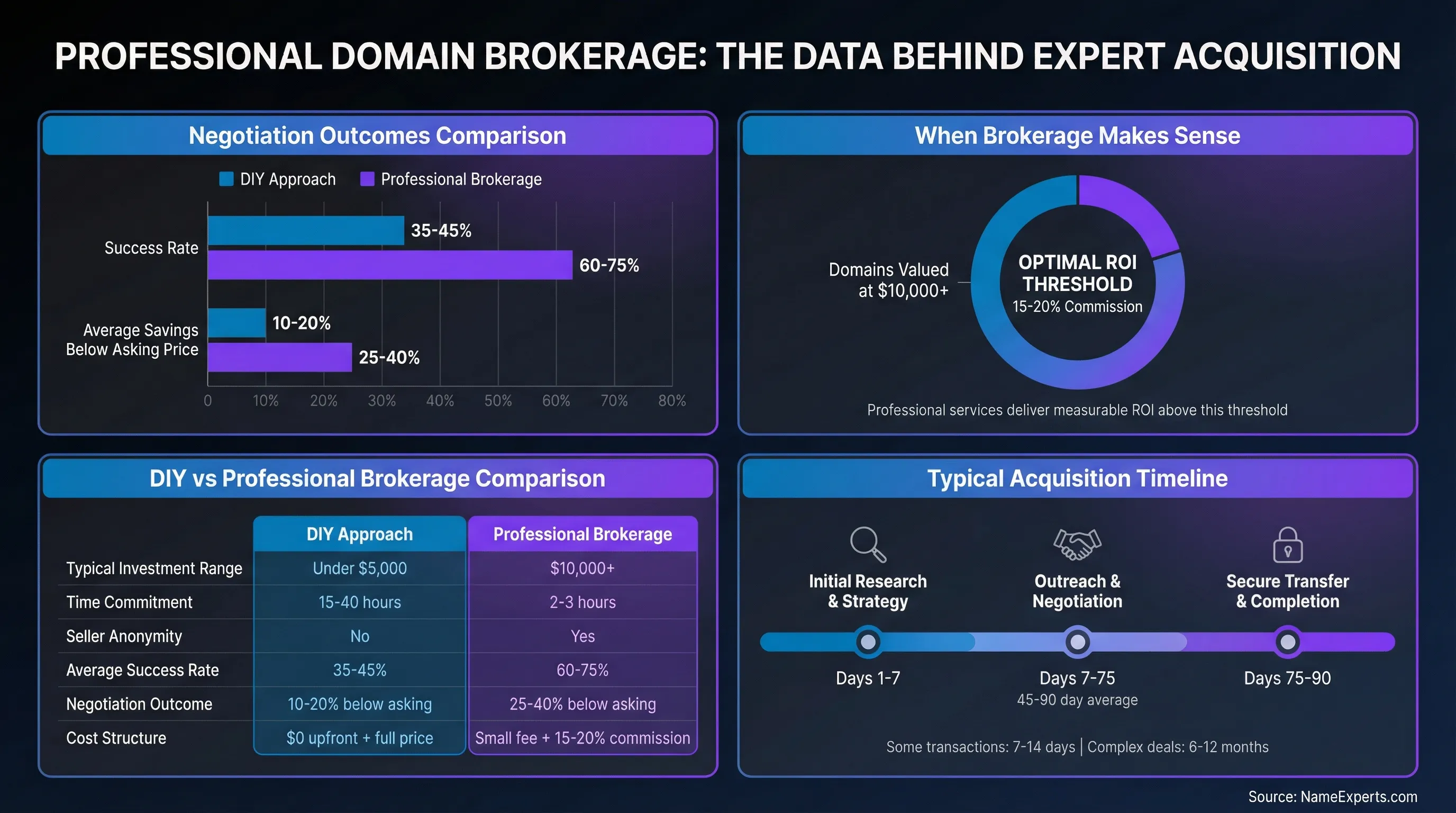
- Success rates for broker-assisted premium domain acquisitions range from 60-75% versus 35-45% for individual buyers
- Commission-based pricing (typically 15-20%) aligns broker incentives with securing the best possible deal
- Experience with your specific domain type and transaction size matters more than general brokerage credentials
The domain you want is already registered. The seller knows you're interested. And suddenly, that $15,000 domain now costs $45,000.
This scenario plays out thousands of times annually when buyers approach domain owners directly. The moment sellers identify corporate interest or detect urgency, prices inflate dramatically. Professional domain brokers exist specifically to solve this problem through stealth acquisition strategies and expert negotiation.
This guide examines how to evaluate and select professional domain acquisition services, when the investment makes strategic sense, and what separates effective brokers from expensive middlemen.
Understanding Professional Domain Brokerage Services
Domain brokerage involves hiring specialists to acquire domains on your behalf while keeping your identity confidential. These professionals handle owner identification, valuation research, negotiation strategy, and secure transfer coordination.
The core value proposition centers on three advantages: anonymity that prevents price inflation, market expertise that establishes fair valuations, and established relationships that increase success rates. When a seller receives an inquiry from an anonymous broker rather than a funded startup or established corporation, they negotiate based on market data rather than perceived buyer resources.
Professional services typically operate on success-based commission models, charging 15-20% of the final purchase price only when transactions complete. This structure aligns incentives—brokers win when you secure favorable terms. Some also charge modest upfront engagement fees ($99-$199) to cover initial research and outreach costs.
The Stealth Acquisition Advantage
Stealth acquisition represents the primary tactical advantage of professional representation. When sellers don't know the end buyer's identity, they can't research company valuations, recent funding rounds, or strategic importance of specific domains to your business model.
Consider a fintech startup pursuing a premium financial domain. Direct outreach reveals the company name, enabling sellers to research funding history and infer maximum budget capacity. The same inquiry from an established broker provides no such intelligence—the seller negotiates against comparable market data rather than perceived buyer resources.

This anonymity advantage compounds with domain value. For acquisitions under $5,000, the benefit may not justify commission costs. For premium domains valued at $50,000+, stealth tactics routinely save 20-35% compared to direct negotiation attempts.
When Professional Brokerage Makes Strategic Sense
Not every domain acquisition requires professional assistance. The decision hinges on transaction value, competitive dynamics, and internal resource availability.
Professional services deliver measurable ROI in these scenarios:
- Premium domains valued above $10,000: Commission costs become negligible relative to potential savings from expert negotiation and stealth positioning
- Competitive acquisition situations: When multiple buyers pursue the same domain, professional relationships and negotiation expertise provide decisive advantages
- Strategic domains with high business impact: When a specific domain significantly affects brand positioning or market entry strategy, expertise minimizes acquisition risk
- Time-sensitive acquisitions: Professional networks accelerate owner identification and negotiation timelines compared to individual research efforts
- Corporate buyers with public funding information: When your financial position is publicly known, anonymity becomes essential for fair pricing
Conversely, DIY approaches work effectively for available domains under $5,000, non-urgent acquisitions where you can invest research time, and situations where you've already established positive seller relationships.
| Factor | DIY Approach | Professional Brokerage |
|---|---|---|
| Typical Investment Range | Under $5,000 | $10,000+ |
| Time Commitment | 15-40 hours (research, outreach, negotiation) | 2-3 hours (consultation and approval) |
| Seller Anonymity | No—identity revealed through direct contact | Yes—stealth acquisition protects leverage |
| Average Success Rate | 35-45% for premium domains | 60-75% for premium domains |
| Negotiation Outcome | 10-20% below initial asking price | 25-40% below initial asking price |
| Market Data Access | Public databases only | Proprietary transaction data and relationships |
| Cost Structure | $0 upfront + full purchase price | Small engagement fee + 15-20% commission on savings |
Protect Your Budget with Stealth Acquisition
Don't let sellers inflate prices by researching your funding history. Our 16+ years of experience and 200+ completed transactions mean we secure premium domains at fair market prices—saving clients an average of 25-40% through anonymous negotiation tactics.
Evaluating Domain Broker Expertise and Specialization
Professional credentials vary significantly across the brokerage industry. Selecting effective representation requires evaluating specific expertise areas rather than accepting generic "domain broker" credentials.
Transaction History and Domain Type Experience
The most reliable expertise indicator is documented transaction history within your domain category and price range. A broker with extensive experience in six-figure .com acquisitions brings different capabilities than one specializing in four-figure brandable domains or country-code TLDs.
Request specific examples of comparable transactions. A broker claiming premium domain expertise should readily provide anonymized case studies demonstrating successful acquisitions in your target value range. With 16+ years of experience and 200+ completed transactions, we've brokered domains for major brands including HBO/Max.com, Monday.com, TripAdvisor, and HubSpot—providing the specialized expertise that premium acquisitions demand.
Geographic expertise also matters for international domains. Brokers with established relationships in specific markets navigate cultural negotiation differences and local market dynamics more effectively than generalists.
Valuation Methodology and Market Intelligence
Effective brokers ground negotiations in objective market data rather than seller asking prices or automated appraisal tools. During initial consultations, assess how thoroughly they research comparable sales, analyze domain characteristics, and factor market timing into valuation estimates.
Professional valuation considers multiple data points: recent comparable sales through transaction databases, domain length and keyword strength, TLD premium positioning (.com commands 3-5x premiums over alternatives), existing traffic and SEO authority, and current market conditions affecting domain pricing.
Brokers relying primarily on automated valuation tools or accepting seller asking prices without market validation lack the expertise to negotiate optimal outcomes. The best services provide detailed valuation reports citing specific comparable transactions and market analysis supporting their pricing recommendations. Learn more about how to value a domain name using professional methodologies.

Communication Style and Process Transparency
Professional relationships require clear communication about process, timeline expectations, and negotiation strategy. During initial consultations, effective brokers should explain their specific approach to owner identification, initial outreach strategy, negotiation tactics, and how they'll keep you informed throughout the process.
Red flags include vague promises about guaranteed acquisitions, pressure to commit without detailed strategy discussion, reluctance to explain fee structures clearly, or inability to provide client references or transaction examples.
The best services establish clear expectations: typical timeline ranges (45-90 days for successful premium acquisitions), communication frequency (weekly updates minimum), decision points requiring your input, and specific circumstances that might extend negotiations or require strategy adjustments.
Negotiation Strategy and Pricing Psychology
Professional brokers employ specific negotiation frameworks that individual buyers rarely execute effectively. Understanding these strategies helps evaluate broker capabilities during selection.
Information Asymmetry and Leverage Management
Skilled negotiators control information flow to maintain leverage throughout discussions. This means revealing only necessary details about buyer interest while gathering maximum intelligence about seller motivation, timeline flexibility, and price expectations.
Effective brokers ask strategic questions to assess seller psychology: ownership duration (recent purchases suggest investment intent versus long-term holdings), original purchase motivation (resale versus intended use), current or planned domain usage, previous offers received, and specific circumstances that might motivate sale timing.
These conversations reveal whether sellers are professional domain investors (sophisticated, data-driven, expect negotiation), accidental owners (bought for abandoned projects, often accept 50-70% of asking price), or active business owners (highest difficulty, require premium pricing to overcome switching costs).
Anchoring and Offer Structuring
Initial offers establish negotiation ranges through psychological anchoring effects. Professional brokers typically open at 40-50% below target pricing, supported by comparable sales data that provides credible justification rather than appearing arbitrary.
This approach serves dual purposes: creating negotiation room to reach target pricing while establishing market-based expectations rather than seller asking prices as the reference point. When sellers counter, skilled brokers move in progressively smaller increments, using time delays between responses to signal careful evaluation and alternative option consideration.
For example, we recently saved a fintech startup $33,000 on a domain acquisition by leveraging comparable sales data—negotiating from a $75,000 asking price down to $42,000 through systematic market-based positioning and strategic patience.
Alternative Deal Structures
When price gaps persist, creative deal structures often bridge negotiation impasses. Professional brokers propose payment plans (6-24 month terms for domains above $10,000), lease-to-own arrangements when cash flow is limited, or revenue-sharing agreements for startups with growth potential.
These structures maximize buyer upside while minimizing downside risk. A seller demanding $50,000 might accept $30,000 upfront plus revenue percentage over 12 months, achieving their target number only if the domain generates significant business value—aligning both parties' interests in successful deployment.
The Professional Acquisition Process
Understanding the typical brokerage workflow helps set realistic expectations and identify process gaps during broker evaluation.
Initial Research and Strategy Development
Professional engagements begin with comprehensive domain research: ownership identification through WHOIS databases and privacy service navigation, valuation analysis using proprietary transaction data, seller background research to identify motivation indicators, and competitive landscape assessment for alternative options.
This research informs the negotiation strategy presented during your consultation. Effective brokers explain their planned approach, estimated timeline, budget recommendations based on comparable sales, and specific tactics for your situation before you commit to engagement.
Outreach and Negotiation Execution
Once engaged, brokers initiate contact through carefully crafted outreach that balances interest indication with information control. Initial messages typically request availability confirmation and asking price without revealing buyer identity or urgency.
Negotiation timelines vary by seller type and domain value. Broker-assisted premium acquisitions average 45-90 days from initial contact to completed transfer, with some transactions resolving in 7-14 days and others requiring 6-12 months of periodic re-engagement.
Throughout negotiations, professional services provide regular updates on seller responses, strategy adjustments based on new information, and decision points requiring your input on offer increases or alternative structures. For detailed tactics, explore our guide on how to negotiate a premium domain name purchase.
Secure Transfer and Transaction Completion
Once terms are agreed, brokers coordinate secure transfer through established escrow services. This protects both parties—your payment is held until domain transfer completes successfully, and sellers receive guaranteed payment upon fulfilling transfer obligations.
Professional services handle all transfer logistics: escrow account setup and fee coordination, domain unlock and authorization code procurement, registrar transfer initiation and verification, and post-transfer confirmation that all access is properly transferred. Understanding what is domain name escrow and how it works is crucial for secure transactions.
This comprehensive coordination eliminates the technical complexity and risk that often derails individual buyer transactions.
Get Expert Valuation Before You Negotiate
Stop guessing what your target domain is really worth. We provide detailed market analysis backed by proprietary transaction data and 16+ years of brokerage experience—ensuring you never overpay for premium domains.
Cost Structures and ROI Evaluation
Professional brokerage involves two primary cost components: engagement fees and success-based commissions. Understanding these structures helps evaluate total investment and expected ROI.
Most services charge modest upfront engagement fees ($99-$199) covering initial research, owner identification, and outreach costs. These fees are typically non-refundable regardless of acquisition outcome, compensating brokers for preliminary work.
Success-based commissions (15-20% of final purchase price) represent the primary cost, charged only when acquisitions complete. This structure aligns broker incentives with securing favorable terms—they earn more by closing deals, but earn nothing from inflated prices that prevent transactions.
ROI evaluation should consider both direct savings and indirect value. A broker charging 20% commission on a $40,000 acquisition costs $8,000. If stealth tactics and expert negotiation secured that domain for $40,000 versus the $65,000 you would have paid directly, the net savings ($25,000 - $8,000 = $17,000) represents clear positive ROI.
Indirect value includes time savings (40+ hours of research and negotiation), reduced acquisition risk through proven processes, and strategic advantage from faster deal completion enabling earlier market entry or brand launch.
Q.What should a first-time buyer ask any broker before signing, and what answer should make them run?
“How much is this gonna cost me? What are your fees?” Two of the most common questions when onboarding a new client. I work on a success-fee model and never charge a fee unless I successfully buy or sell your domain. I'll map out the fees, including any applicable escrow fees to transact. Clients spend time looking for a broker that has a solid reputation and track history. I'm always going to keep the details confidential. Some other brokers charge a fee to keep your information private. I do not charge hidden fees and offer a no-BS approach towards domain acquisitions and divestments.
 Joe Uddeme, Director and Principal, Name Experts
Selecting the Right Professional Partner
Choosing effective representation requires evaluating multiple brokers against your specific acquisition needs.
Start by requesting initial consultations from 2-3 services specializing in your domain type and price range. During these discussions, assess their valuation methodology and market data quality, specific strategy proposed for your acquisition, communication style and process transparency, transaction history with comparable domains, and fee structure clarity.
Request client references or case studies demonstrating successful acquisitions similar to yours. Established services readily provide anonymized examples showing their negotiation effectiveness and typical outcomes.
Red flags warranting caution include guaranteed acquisition promises (no broker controls seller decisions), pressure to commit without detailed strategy review, vague or evasive answers about process and timeline, or unwillingness to discuss fee structures transparently.
The best partnerships begin with clear expectations about timeline, communication frequency, decision points requiring your input, and specific circumstances that might require strategy adjustments. This foundation enables effective collaboration throughout the acquisition process. For a comprehensive comparison, review our analysis of the top 10 best domain brokers of 2026.
For premium domain acquisitions where stealth positioning and expert negotiation provide measurable value, professional brokerage represents strategic investment rather than unnecessary expense. The right partner transforms domain acquisition from risky direct negotiation into systematic process with predictable outcomes and optimal pricing.
Ready to acquire your ideal domain without overpaying? Contact our team to discuss your specific acquisition needs and learn how our 16+ years of experience can secure the domain you need at the best possible price.
Work With a Domain Expert
Stop risking price inflation and wasting weeks on DIY negotiations. With 16+ years of experience brokering domains for HBO/Max.com, Monday.com, TripAdvisor, and HubSpot, we bring the stealth acquisition tactics and market expertise that routinely save clients 25-40% on premium domains. Our no-bullshit approach means transparent pricing, proven negotiation strategies, and direct access to experienced professionals who've completed 200+ successful transactions. Get the domain you need at the price
Get Started Free







Frequently Asked Questions
Yes, domain prices are highly negotiable—professional brokers routinely secure 25-40% reductions from initial asking prices through market data analysis and strategic positioning, with success rates improving significantly when buyers maintain anonymity during discussions.
Start with offers 40-50% below target pricing supported by comparable sales data, maintain anonymity to prevent price inflation based on your financial position, and move in progressively smaller increments while using strategic delays to signal careful evaluation of alternatives.
The 70/30 rule suggests spending 70% of negotiation time listening and asking strategic questions while talking only 30%—this approach reveals seller motivation, timeline flexibility, and price expectations that inform optimal offer structuring.
Reference specific comparable sales data to establish market-based pricing context, then propose a figure supported by that evidence rather than arbitrary discounts—for example, "Based on recent sales of similar domains at $30K-$35K, would you consider $32,000?"