
Choosing between .com and .net is one of the first foundational decisions you'll make when building your online presence. While both extensions have been around since 1985, they carry different connotations that can significantly impact how customers perceive your brand, remember your website, and trust your business. With extensive domain brokerage experience and hundreds of successful transactions, we've seen firsthand how this seemingly simple choice affects long-term brand equity and business growth.
Key Takeaways
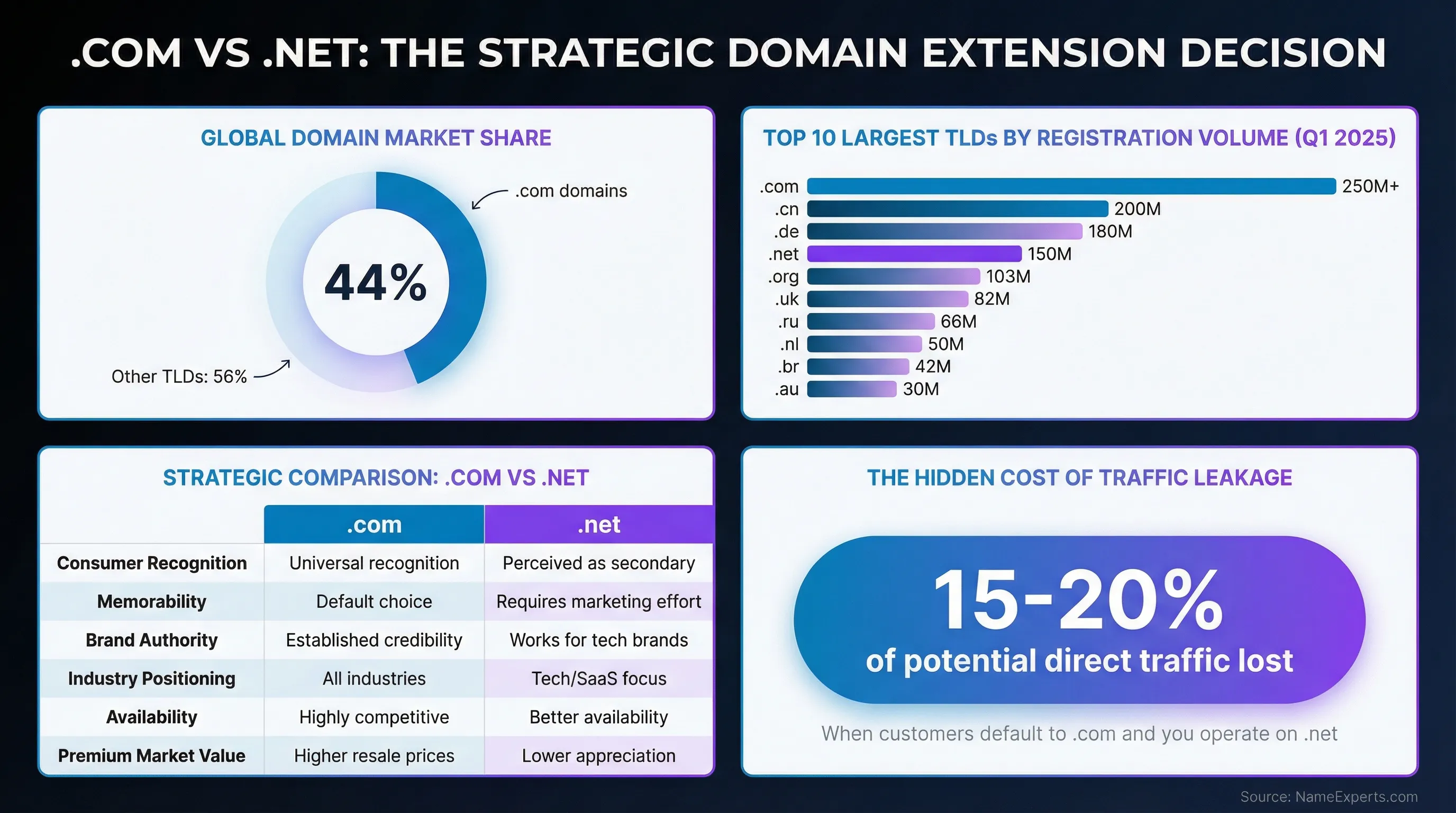
- .com domains dominate with 44% of global websites and carry instant credibility and memorability advantages for most businesses
- .net was originally designed for network infrastructure but now serves as a viable alternative for tech companies and when your preferred .com is unavailable
- Domain extensions don't directly impact SEO rankings, but .com provides indirect advantages through higher click-through rates and direct traffic
- Securing both extensions protects your brand from traffic leakage and competitor confusion
- When your ideal .com is already registered, expert consultation can help you navigate premium domain acquisition or strategic alternatives
Understanding Domain Extensions: Strategic Context
Domain extensions, also called top-level domains (TLDs), are the letters that appear after the final dot in your web address. They were originally created to categorize websites by purpose or organization type. When the internet's domain name system launched in 1985, only a handful of extensions existed, each with a specific intended use defined by the Internet Assigned Numbers Authority (IANA).
The .com extension stood for "commercial" and was meant for businesses, while .net represented "network" and targeted internet service providers and infrastructure companies. Over the decades, these strict boundaries have blurred considerably. Today, anyone can register either extension regardless of their business type or purpose.
What hasn't changed is how these extensions signal credibility and purpose to your audience. Even though the technical restrictions have disappeared, consumer perception remains strongly influenced by these original associations. Understanding domain extensions is essential when making your domain choice.
As of Q1 2025, the top 10 largest TLDs by registration volume were .com, .cn, .de, .net, .org, .uk, .ru, .nl, .br and .au. This ranking demonstrates that while new extensions have proliferated, the original generic TLDs continue to dominate the domain landscape.

The Brand Strategy Comparison: .com vs .net
When evaluating these two extensions from a strategic branding perspective, several factors come into play beyond simple availability and cost. The extension you choose becomes part of your brand identity and affects how customers discover, remember, and trust your business.
| Strategic Factor | .com | .net |
|---|---|---|
| Consumer Recognition | Universal recognition as the default web extension | Recognized but often perceived as secondary choice |
| Memorability | Customers default to .com when remembering URLs | Requires additional marketing effort to reinforce |
| Brand Authority | Signals established, credible business presence | Works well for tech brands, less authoritative for general commerce |
| Industry Positioning | Appropriate for all industries and business types | Strongest fit for technology, networking, and SaaS companies |
| Availability | Highly competitive; many premium names already registered | Better availability for desired names |
| Premium Market Value | Commands significantly higher resale prices | Lower premium pricing but also lower long-term appreciation |
The memorability factor deserves special attention. In our experience helping clients navigate domain strategy, we've observed that customers instinctively add ".com" when typing a brand name they've heard about. This ".com bias" means that if you operate on a .net domain, you may lose a portion of your direct traffic to whoever owns the corresponding .com version—even if that site is completely unrelated to your business.
This traffic leakage represents not just lost visitors, but lost revenue and brand confusion. We've worked with clients who spent years building their brand on a .net domain, only to discover they were inadvertently driving customers to a competitor or domain squatter on the .com version. The cost of this mistake—in both lost business and eventual domain acquisition—far exceeds the investment of securing the right domain from the start.
Losing Traffic to the Wrong Domain?
If your ideal .com is already registered, you don't have to settle for second-best. Our stealth acquisition approach helps you secure premium domains at fair market prices—often 30-50% below what you'd pay through direct negotiation. With 15+ years of experience and a no-bullshit approach to the Wild West of the domain marketplace, we'll help you avoid costly mistakes and traffic leakage.
Strategic Decision Framework: When to Choose Each Extension
The decision between these two extensions should align with your business goals, target audience, and long-term brand strategy. Here's how to evaluate which extension serves your specific situation.
.com Strategic Use Cases
For most businesses, a .com domain is the optimal choice. This extension has become synonymous with the internet itself, carrying instant credibility that transcends industries and geographic boundaries. If you're building a mainstream brand that needs to reach a broad audience, this extension provides the strongest foundation.
eCommerce businesses particularly benefit from this choice. When customers are entering payment information, the familiar extension provides subconscious reassurance. The same principle applies to any consumer-facing business where trust is paramount—professional services, healthcare, financial services, and education all gain credibility advantages from this universally recognized extension.
Personal brands and professional portfolios also perform better with this extension. When potential clients or employers look you up, they'll instinctively try the .com version first. Using a different extension creates an unnecessary barrier between you and the people you're trying to reach.
Long-term brand equity is another crucial consideration. If you envision your business growing, pivoting, or eventually being acquired, a .com domain maintains its value across these transitions. It doesn't limit your future options or create rebranding challenges down the road.
.net Strategic Use Cases
While .com dominates overall, certain situations make a .net extension the strategic choice. Technology companies and SaaS platforms can leverage the extension's network-oriented heritage to reinforce their positioning. When your audience consists primarily of tech-savvy users who understand its original purpose, it can actually enhance your credibility rather than diminish it.
Internet service providers, hosting companies, and network infrastructure businesses align naturally with this extension. For these organizations, it signals industry expertise and appropriate specialization. The extension tells visitors exactly what category of service to expect.
It also serves as a viable alternative when your ideal .com creates confusion with an existing brand. If there's already a well-established company using your preferred name with a .com extension—especially in a related industry—choosing .net allows you to differentiate while maintaining a professional web presence.
Cost considerations sometimes favor this alternative as well. When a premium .com domain carries a six-figure price tag that's prohibitive for your current budget, a .net version of the same name might be available at standard registration rates. However, this decision requires careful analysis of the long-term trade-offs.
In our experience brokering domain acquisitions, we often help clients evaluate whether the savings of choosing an alternative extension justify the potential brand limitations. Sometimes the answer is yes—particularly for startups that need to preserve capital. Other times, the investment in the right .com domain pays dividends that far exceed the initial cost.
The Hidden Costs of the Wrong Extension
Choosing the wrong domain extension creates ongoing challenges that compound over time. Understanding these hidden costs helps you make a more informed decision from the outset.
Traffic leakage is the most immediate and measurable impact. When customers hear your brand name through word-of-mouth, radio ads, podcasts, or other audio channels, they don't hear the extension. They remember your brand name and instinctively add ".com" when they look you up later. If you're operating on a different extension, a portion of this traffic goes to the .com version instead.
We've seen cases where businesses lost 15-20% of their potential direct traffic this way. One SaaS client came to us after two years of building their brand on a .net domain, frustrated that their competitor on the corresponding .com was receiving customer inquiries meant for them. The confusion was costing them both revenue and brand clarity.
Email deliverability and professional perception present another challenge. While .net email addresses are perfectly legitimate, some recipients perceive them as less professional than .com addresses. In B2B contexts where first impressions matter, this subtle perception can affect response rates and business development success.
Marketing efficiency suffers when you need to constantly clarify your extension. Every advertisement, business card, and verbal mention requires extra emphasis on the ".net" to prevent customers from going to the wrong site. This additional cognitive load reduces the effectiveness of your marketing spend and creates friction in the customer journey.
The long-term brand equity implications are perhaps most significant. If your business grows successfully, you'll eventually want to acquire the .com version of your domain. By that time, the owner may recognize your brand's success and price it accordingly. What might have cost $2,000-5,000 initially could become a $50,000-100,000 acquisition several years later.
Domain Extension and SEO: The Indirect Impact
One of the most common questions we receive is whether domain extension affects search engine rankings. The direct answer, confirmed by Google's official documentation, is no—search engines don't inherently rank .com domains higher than .net domains or vice versa. The extension itself isn't a ranking factor in Google's algorithm.
However, this technical truth obscures the more nuanced reality of how extensions impact your search visibility. While Google doesn't give direct ranking preference to any extension, the indirect effects on user behavior create meaningful SEO advantages for .com domains.
Click-through rate (CTR) from search results is one of these indirect factors. When users see search results, they're more likely to click on familiar, trustworthy-looking URLs. The .com extension carries inherent credibility that can improve your CTR compared to less familiar extensions. Since Google monitors user engagement signals like CTR, this behavioral difference can indirectly influence your rankings over time.
Direct traffic—when users type your domain directly into their browser—is another positive ranking signal. Search engines interpret direct traffic as a sign of brand strength and user intent. Because .com domains benefit from the "default extension" effect, they naturally receive more direct traffic than alternative extensions, even when marketing efforts are identical.
The extension also affects link-building success. When reaching out for backlinks or partnerships, a .com domain typically receives better response rates. Publishers and webmasters perceive these domains as more authoritative and are more willing to link to them. Since backlinks remain a crucial ranking factor, this indirect advantage compounds over time.
User behavior metrics like bounce rate and time on site can also be influenced by your choice. If visitors arrive at your site but immediately leave because they're uncertain about your credibility, these negative engagement signals can hurt your rankings. The instant recognition and trust associated with .com domains helps reduce this friction.
Portfolio Strategy: Protecting Your Brand Across Extensions
Regardless of which extension you choose as your primary domain, a comprehensive portfolio strategy protects your brand from confusion and competition. The most effective approach is to secure multiple extensions and redirect them to your main site.
Defensive registration means purchasing the .com, .net, and potentially .org versions of your brand name, even if you only actively use one. This strategy prevents competitors, domain squatters, or confused customers from registering these variations. The annual cost of maintaining these defensive registrations is minimal compared to the potential cost of brand confusion or future acquisition.
When implementing defensive registration, proper domain forwarding is essential. You'll want to set up 301 redirects from your secondary domains to your primary site. This ensures that anyone who types in the wrong extension still reaches your website, and it consolidates any SEO value from links pointing to the alternative extensions.
The cost-benefit analysis of portfolio protection is straightforward. Domain registrations typically cost $10-20 per year. For an investment of $30-60 annually, you eliminate the risk of losing traffic to alternative extensions and prevent potential brand confusion. This is particularly important as your business grows and your brand becomes more valuable.
For growing businesses, we often recommend a tiered approach to portfolio management. Start by securing the most critical extensions (.com and .net) immediately. As your brand gains traction and value, expand to include .org, relevant country-code domains, and newer industry-specific extensions that might create confusion.
In our portfolio management work with clients, we've identified cases where competitors registered similar domain variations to capture misdirected traffic. One client discovered that a competitor had registered their brand name with a .net extension and was running ads targeting their brand terms. By securing the defensive domains proactively, you prevent these opportunistic tactics.
Not Sure What Your Domain Is Really Worth?
Before you commit to a .net alternative or overpay for a premium .com, get expert insight on your options. We provide honest valuations and strategic guidance on whether premium acquisition, defensive portfolio protection, or alternative naming makes sense for your specific situation. No hidden fees, just transparent advice from someone who's brokered hundreds of successful domain transactions.
Premium Domain Acquisition Strategy
The reality of the domain market in 2026 is that many ideal .com domains are already registered. This doesn't mean you're out of options—it means you need a more sophisticated acquisition strategy.
Premium domains are previously registered names that owners are willing to sell, often at prices ranging from a few thousand to several million dollars. The premium domain market has its own dynamics, pricing factors, and negotiation strategies that most businesses don't understand.
Understanding premium domain valuation helps set realistic expectations. Factors that influence value include domain length (shorter is more valuable), keyword relevance, brandability, existing traffic, search volume for the term, and comparable sales data. A short, memorable .com domain in a commercial category can easily command five or six-figure prices.
Negotiation considerations are where most businesses make costly mistakes. Approaching a domain owner directly often signals your interest and budget, potentially inflating the asking price. Domain owners can research your company, assess your funding, and price accordingly. What might have been a $15,000 domain can become a $75,000 domain once the owner knows you want it specifically.
Stealth acquisition through experienced brokers prevents this price inflation. When we acquire domains on behalf of clients, we approach owners without revealing the end buyer's identity. This allows us to negotiate based on the domain's market value rather than the buyer's perceived ability to pay. The brokerage fee is typically far less than the premium you'd pay through direct negotiation.
We've helped clients secure premium domains at 30-50% below the prices they were initially quoted when approaching owners directly. Our market expertise and negotiation experience, built over hundreds of transactions, allows us to structure deals that work for both parties while protecting our clients from overpayment.
For businesses facing a situation where their ideal .com is registered but not actively used, acquisition is often more feasible than it appears. Many domain owners are willing to sell at reasonable prices—they just need to be approached professionally with a fair offer backed by market data.

Decision Assessment Tool
To help you determine which extension is right for your specific situation, work through this decision framework systematically. Each question helps narrow down the optimal choice based on your business context and goals.
Question 1: Is your target audience primarily tech-focused professionals or developers?
If yes, a .net extension may actually reinforce your positioning and credibility within this niche. Tech audiences understand its network heritage and may perceive it as appropriate specialization. If no, continue to the next question.
Question 2: Is your ideal .com domain available at standard registration rates?
If yes, register it immediately. This is the clearest path forward and eliminates the need for further decision-making. If no, continue to the next question.
Question 3: Is the .com version owned by a direct competitor or similar business in your industry?
If yes, this situation requires expert consultation. The brand confusion risk is high, and you may need to either negotiate acquisition, choose a different name entirely, or develop a strategy to differentiate clearly. If no, continue to the next question.
Question 4: Does the .net extension align with your brand positioning and long-term vision?
If yes, and you're comfortable with the trade-offs discussed earlier, a .net domain can work for your business—particularly if you implement a strong brand reinforcement strategy. If no, you should explore alternative .com options, consider premium domain acquisition, or consult with domain experts about your specific situation.
Complex cases that benefit from expert consultation include: premium domain negotiations where significant investment is required, rebranding situations where domain strategy has broader implications, portfolio management for multiple brands or product lines, and situations where trademark concerns or competitor conflicts create legal or strategic complexity.
If you're facing any of these complex scenarios, our team provides complimentary strategy consultations to help you make the decision that supports your long-term brand goals. With extensive experience and deep market knowledge, we can help you evaluate options you might not have considered and avoid costly mistakes. Contact our domain experts to discuss your specific situation.
Making Your Final Decision
The choice between these two extensions ultimately comes down to your specific business context, but the general principle remains clear: for most businesses, a .com domain provides the strongest foundation for long-term brand success.
The universal recognition, memorability advantages, and credibility signals associated with this extension create compound benefits over time. While the initial registration cost may be similar, the long-term value proposition strongly favors the more established option.
That said, a .net domain isn't a failure or compromise in every situation. For technology companies, network services, and online communities, it can reinforce appropriate positioning. When your ideal .com is genuinely unavailable or prohibitively expensive, it serves as a professional alternative that allows you to move forward with your business.
The key is making an informed decision based on strategic considerations rather than simply accepting whatever's available. Understand the trade-offs, implement protective measures like defensive registration, and be prepared to invest in the right domain when your business growth justifies it.
Remember that your domain is a long-term asset, not just a technical requirement. The decision you make today will affect your marketing efficiency, brand equity, and customer acquisition costs for years to come. Taking the time to get it right from the beginning is one of the highest-return investments you can make in your online presence.
Whether you choose .com, .net, or decide to pursue premium domain acquisition, the most important factor is that your decision aligns with your brand strategy and business goals. If you're uncertain about the right path forward, our team is here to help you navigate these decisions with the expertise that comes from years in the domain industry and hundreds of successful transactions.
Work With a Domain Expert
Your domain choice affects everything from customer trust to marketing efficiency to long-term brand equity. Whether you're deciding between .com and .net, evaluating premium domain acquisition, or protecting your brand with a defensive portfolio strategy, you don't have to navigate these decisions alone. With direct access to a principal broker who brings 15+ years of domain expertise and a personalized, boutique approach, you'll get honest guidance tailored to your business goals—not corporate
Get Started Free







Frequently Asked Questions
Yes, .net remains a credible and versatile top-level domain that's particularly strong for technology companies, SaaS platforms, and network infrastructure businesses, though it doesn't carry the universal recognition of .com.
Google treats both extensions equally in its ranking algorithm, but .com typically generates higher click-through rates and more direct traffic due to user familiarity, creating indirect SEO advantages over time.
Choosing .com is generally the safer decision due to universal recognition and memorability, though securing both extensions protects your brand from traffic leakage and prevents competitors from registering the alternative version.
Yes, .net websites are credible and professional, especially for tech-focused businesses, though they require additional marketing effort to overcome the default consumer assumption that brands use .com extensions.


