

Finding the right premium domain for sale requires knowing where to look and which acquisition method suits your needs. The domain aftermarket is a multi-billion-dollar industry with platforms ranging from massive registrar marketplaces to specialized brokerage firms. Leading options include Name Experts, which has facilitated over $150 million in domain transactions with anonymous buying capabilities, GoDaddy with its extensive auction platform, Sedo serving over 18 million users worldwide, Network Solutions managing 7 million-plus domains across 500+ extensions, and value-focused platforms like Domain.com and Namecheap. Whether you browse a premium domain names list on a marketplace, bid at auction, or engage a professional broker for private negotiation, understanding each channel’s strengths is the key to acquiring the right domain at the right price.
A great domain name usually has a price tag to match – it’s why we call them ‘premium’ domains. In this post, domain name expert Joe Uddeme explains where to find high-value names that can help your business grow.
Premium domains are the best type of domains because they are memorable and tend to draw a lot of organic traffic.
They are short, catchy, and quickly feel familiar – with a high potential to become popular web addresses. They also present great branding opportunities for up-and-coming businesses.
The best places to find premium domains for your business include:
- Name Experts
- GoDaddy
- Sedo
- Network Solutions
- Domain.com
- Namecheap
In this post, we’ll look at each of these and discuss their pros and cons.
Key Takeaways:
- The steps to take when buying a premium domain
- Brokers and marketplaces for premium domain names
- Discover some FAQs about premium domain names
How Do I Buy Premium Domains?
Buying a premium domain name isn’t as easy as buying your average everyday domain name. They’re premium, meaning there’s high demand for them. You’d need to adhere to specific procedures to maximize your chances of securing a premium domain.
The best places to find a premium domain name for sale include:
- Domain Name Registrars
Domain name registrars are the first place to search for premium domain names. After deciding on the domain name you want, you can consult any registrar to see if the name is available and purchase it if it is. There are hundreds of domain registrars, so you have a broad range of choices.
Need help buying a domain? We make the domain buying process easy.
Get a Free Domain Buying Consultation- Domain Marketplaces
There are dedicated online marketplaces connecting domain name sellers with potential buyers.
If you want a premium domain name that has already been registered by someone else, chances are it’s available in one of these marketplaces.
In this area, it’s crucial to have good negotiation skills so that you can get the best possible deal.
If you think you aren’t up to the task, you can enlist the services of a specialized domain name broker to help you negotiate a deal.
- Online Forums
There are many online forums where webmasters and domain name owners discuss various topics and the latest events relating to their work.
Occasionally, you can find a premium domain name for sale from a participant in these forums. Some forums even have dedicated sections for users to list domain names for sale.
- Domain Auction Sites
Many registrars host auctions for domain names expiring on their platform, giving potential buyers a good opportunity to get their hands on useful domains.
Periodically, you can find a valuable domain name on these auction sites and acquire them. But, note that you’ll be bidding against other moneyed buyers, and the competition can be tough.
Here are some examples of reputed platforms where you can acquire premium domains;
Name Experts
Name Experts is a domain name broker specializing in premium domains. It has a select number of premium domain names listed for sale. Here are a few of the types of premium domains offered for sale:
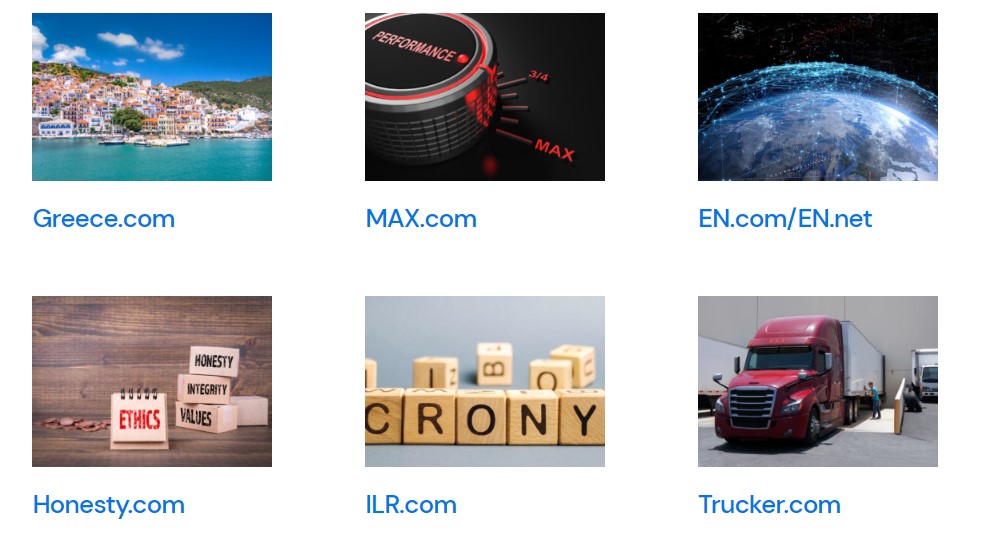
Domains like Trucker.com, Greece.com and Max.com are the type of premium domains sold by Name Experts, which currently lists proud.com and eight.com as available.
If you have a specific domain name in mind that’s already registered, you can enlist Name Experts’ experienced brokers to help you track down the owner and negotiate a possible deal.
Name Experts has considerable experience in brokering premium domain sales for third-parties, so you’ll be in safe hands. Since inception, the business has brokered over $150 million in domain name sales.
One of the main advantages of using a domain broker like Name Experts is that you can protect your anonymity while purchasing a premium domain.
If the seller knows your identity, they may assume you have deep pockets and hike the prices, but going through a domain broker prevents that from happening.
In case you’re not able to get the domain name you want, a domain broker can also give you great advice on finding an alternative one.
GoDaddy
GoDaddy is one of the world’s largest domain registrars, serving millions of customers. You can search for any domain name on the platform to see if it’s available and register it straight away if it is.
Alongside typical domain registration, GoDaddy also holds auctions for domain names expiring on its platform, and you can bid for them.
Millions of customers use GoDaddy, so you’ll be in good company if you choose it. But, over the years, many people have accused the platform of domain name front-running, which entails registering a domain name after one of its users searches for it for the purpose of flipping it for profit. GoDaddy has continued to deny such practice, but the accusation lingers.
To err on the safe side, you should check for availability on other domain registrars before heading to GoDaddy to register a domain.
GoDaddy’s domain prices are pretty reasonable, and the platform gives significant discounts to new buyers.
One downside of GoDaddy is that it offers many extra services outside domain registration and tends to upsell them. As a result, a beginner may find it difficult to navigate the platform.
Sedo
Sedo is a dedicated domain name marketplace and one of the most popular in its space, with over 18 million registered users.
It allows domain name owners to list their domains for sale and prospective buyers to get in touch with them. If there’s a premium domain name for sale, chances are it’s listed on Sedo.
When you head to the Sedo website, there’s a search bar where you can input any keyword and generate a list of premium domain names for sale matching that keyword.
To demonstrate, we searched for “laptops” and got the results displayed in the below image;
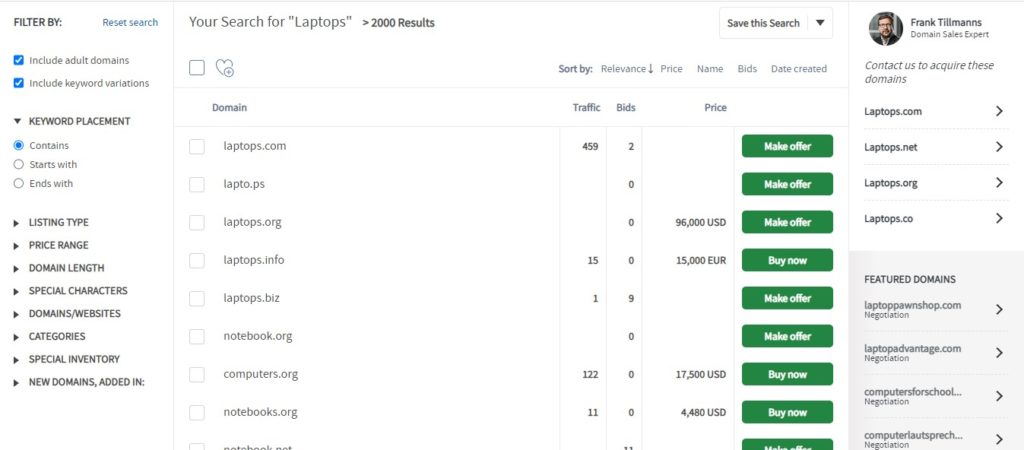
You can see the domains laptops.info, computers.org, and notebooks.org readily listed for sale with a “buy now” button next to them.
These are domains that their owners have listed with a set price. You can also see others, like laptops.com and lapto.ps, which their owners have listed without a set price and are entertaining offers.
Sedo also hosts auctions for some domain names listed on its platform. These auctions present reliable opportunities to get your hands on premium domains without strenuous effort.
Network Solutions
Network Solutions is a well-known domain registrar with over 7 million domains registered on its platform. It offers over 500 domain name extensions, including popular ones like .com, .org, .net, and .info.
Alongside typical domain registration, Network Solutions also offers premium domain names for sale on its platform.
There’s a marketplace on the platform where domain owners list their domains and seek potential buyers. You can get in touch with these owners and negotiate a deal.
Likewise, Network Solutions holds auctions for expiring domain names. You can place back-orders to give you the chance to acquire these domains once they become available for sale.
Network Solutions also offers domain brokerage services. For a fee, the company’s representatives can make offers for domain names you want.
There’s no guarantee that you’ll get the domain name this way, but there’s no harm in trying.
Domain.com
Domain.com is a typical example of a premium domain name bringing great value to a business. The URL generates a lot of organic traffic for this domain name registrar, which is valuable considering the intense competition in the industry.
On Domain.com, you can find premium domains at competitive prices. There’s a search bar where you can insert your keyword and get a corresponding list of premium domain names for sale.
Our investigation indicates that Domain.com has a large inventory of premium domains available for immediate purchase.
If a domain name you want has already been taken, you can use Domain.com’s WHOIS lookup tool to check for the owner’s contact details.
The details should be available if the owner hasn’t enabled domain privacy protection. If you find the details, you can get in touch with them directly or enlist the services of a domain name broker to help you negotiate a deal.
The downside of Domain.com is that it has no domain name marketplace connecting owners and potential buyers.
Namecheap
Namecheap stays true to its name – in that its domain names are pretty affordable.
It’s a proven place for finding a list of premium domain names for sale associated with a specific keyword for reasonable prices.
You can use the Namecheap search bar to search for available domain names. Likewise, there’s a dedicated marketplace where you can buy listed domains instantly or participate in auctions.
Frequently Asked Questions About Buying a Premium Domain Name
How Long Does it Take to Get a Premium Domain?
Getting a premium domain can take anywhere from a few hours to a few days or even months. It ultimately depends on availability. If a premium domain name is listed at a set price, you can acquire it immediately. Otherwise, direct negotiations can take a long time, depending on the owner’s responsiveness.
Do Premium Domains Expire?
Yes, they expire just like any other domain. That’s why you can find some expiring ones on the auction block. It’s essential to ensure your domain name doesn’t expire by placing it on automatic renewal. Check out our guide about what to do if you lose your domain name.
What Qualifies as a ‘Premium’ Domain?
There is no single definition for this, though most domain name brokers consider a premium domain name to be one listed for a significant five-figure sum or higher. Some premium domain names can fetch millions, such as cars.com, which sold for almost a billion dollars. If you are interested in high-value domain names, take a look at our analysis of the most expensive domain names ever sold.
About the author
Joe Uddeme is Director and Principal of Name Experts, one of the world’s leading domain name brokerage services. He has overseen domain name sales and acquisitions totaling more than $150 million and is renowned worldwide as a go-to expert in buying and selling premium domains. If you’d like help with buying or selling a domain name, contact us at: [email protected]
Need help buying a domain? We make the domain buying process easy.
Get a Free Domain Buying ConsultationSubscribe for More Domain Buying & Selling Advice
Let Us Source the Perfect Premium Domain for You
With over $150 million in facilitated transactions, Name Experts connects businesses with premium domains through anonymous negotiation, fair-market valuations, and secure transfers. Tell us what you are looking for and we will handle the rest.
Start Your Domain Search







Frequently Asked Questions
You can find a premium domain for sale on registrar marketplaces like GoDaddy and Namecheap, global platforms like Sedo, and through specialized brokers like Name Experts. Each platform offers different inventory, pricing structures, and transaction support. For the widest selection, it is worth searching across multiple sources and consulting a broker who may have access to off-market premium domains not listed publicly.
Most major domain marketplaces maintain a searchable premium domain names list that you can filter by price, TLD, length, and keyword. Platforms like Sedo, Afternic, and GoDaddy Auctions all offer browsable inventories. However, many of the most valuable premium domains are sold privately and never appear on public lists, which is why engaging a domain broker can surface inventory you would not find on your own.
The safest way to buy a premium domain is through an escrow service or a professional broker who manages the entire transaction. Escrow services hold payment until the domain transfer is verified, protecting both buyer and seller. Reputable platforms like Sedo and Name Experts include escrow as part of their transaction process, reducing the risk of fraud or failed transfers.
Auctions work well for domains with clearly established market value and when you are comfortable with competitive bidding. A broker is the better choice when you want to acquire a specific premium domain that may not be publicly listed, when you need anonymity during negotiation, or when the transaction value is high enough to warrant professional guidance. Brokers can also prevent you from overpaying by leveraging their knowledge of comparable sales.
While GoDaddy is one of the largest domain platforms, it has faced accusations of domain front-running — the practice of registering domains that users have searched for, then reselling them at higher prices. Buyers should also watch for inflated renewal fees on premium domains purchased through registrar marketplaces. Conducting independent research on a domain's value before purchasing through any single platform is always recommended.
Premium domain prices range from a few hundred dollars for mid-tier brandable names to millions for short, keyword-rich .com domains. Factors influencing price include domain length, keyword search volume, TLD, existing traffic, backlink profile, and comparable past sales. Working with a broker or using an appraisal tool can help you determine whether a listed price represents fair market value before you commit.