Key Takeaways
- Domain extensions (TLDs) are the letters after the final dot in a web address, like .com, .org, or .net
- Your extension affects brand perception, credibility, and memorability more than search rankings
- .com remains the most trusted option, but specialized TLDs can differentiate your brand effectively
- The right extension depends on your business type, target audience, and geographic location
- Domain extensions don't directly affect SEO, but they impact user trust and click-through rates
When you type a web address into your browser, you're using a domain name—and the letters that appear after the final dot matter more than you might think. These letters, known as domain extensions or top-level domains (TLDs), serve as digital signposts that tell visitors what to expect before they even click. With over 1,590 options now available, choosing the right one has become both an opportunity and a challenge for business owners.
Understanding Domain Extensions and TLDs
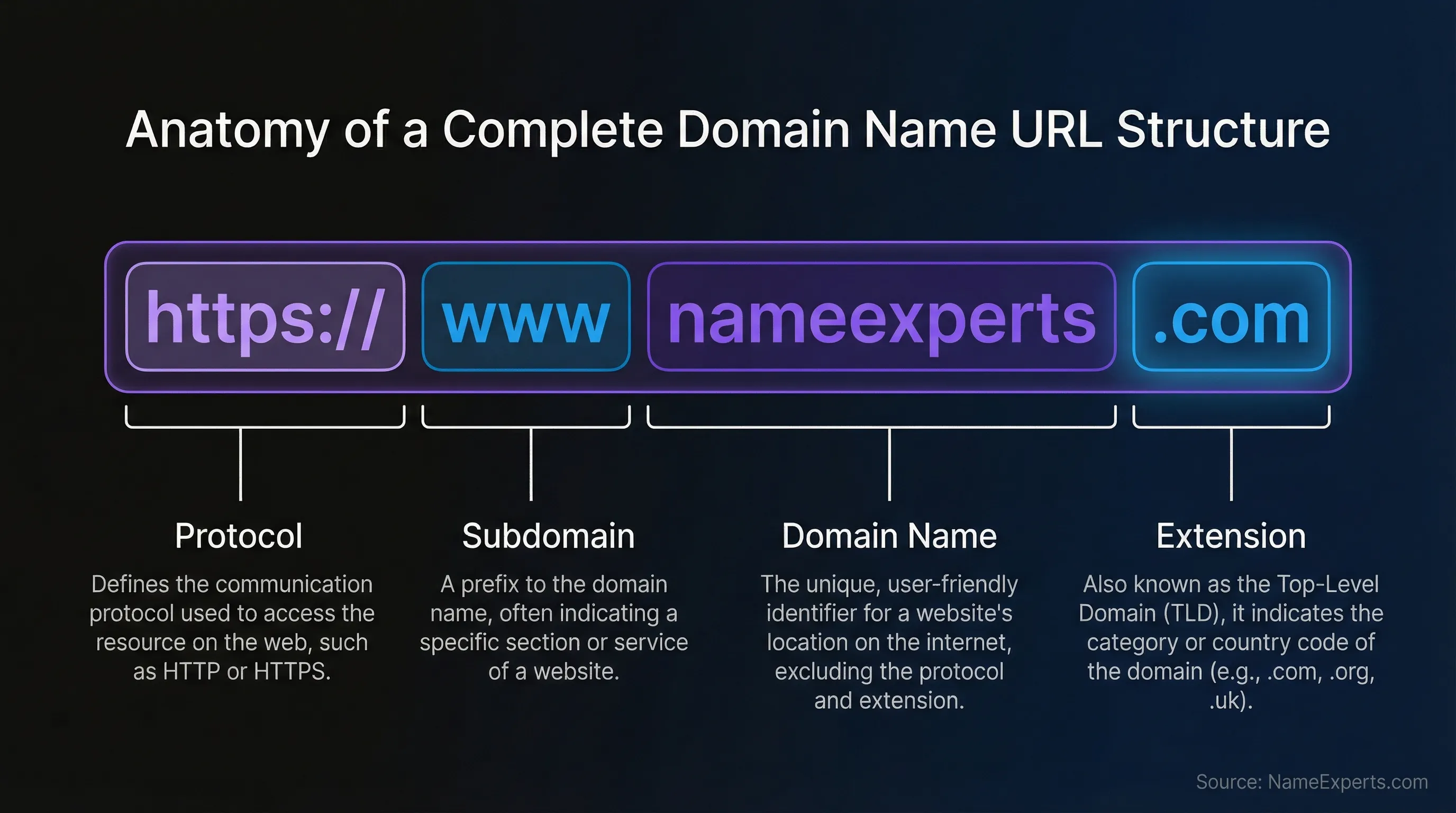
A domain extension is the suffix that follows the domain name in a web address. In the URL nameexperts.com, the ".com" portion represents the extension. These extensions form part of the Domain Name System (DNS), the hierarchical structure that translates memorable domain names into the numerical IP addresses computers use to locate websites.
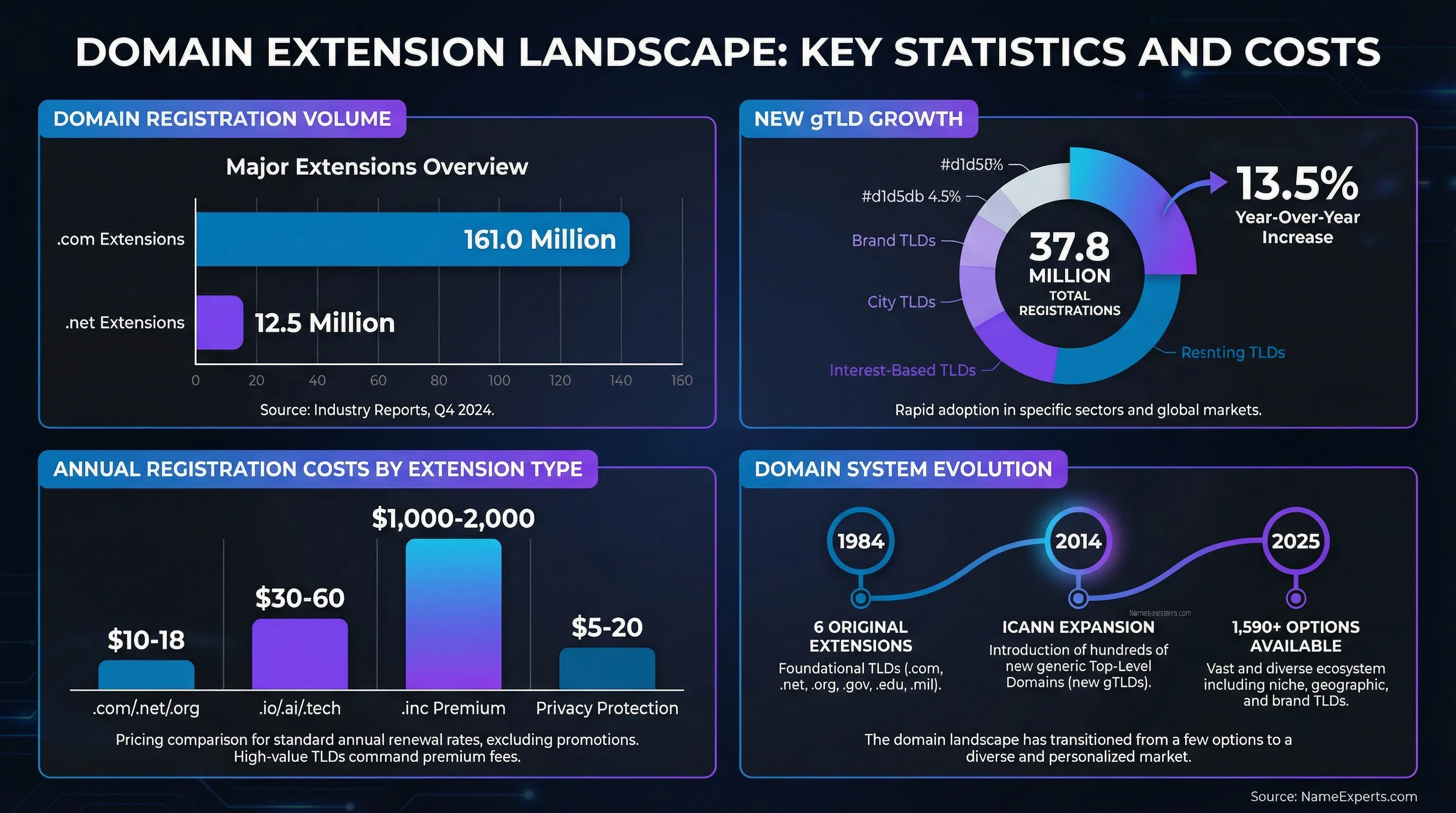
The Internet Corporation for Assigned Names and Numbers (ICANN) oversees the management and coordination of these extensions. According to industry data, the domain landscape has grown substantially, with new generic TLDs reaching 37.8 million registrations at the end of the first quarter of 2025, representing a 13.5% year-over-year increase.
The evolution from six original extensions in 1984 to today's expansive catalog reflects the internet's maturation. What began as a simple categorization system—.com for commercial, .org for organizations, .edu for education—has transformed into a sophisticated branding tool. This expansion gives businesses unprecedented flexibility in how they present themselves online.
How the Domain Name System Works
When someone enters your domain into their browser, DNS servers use the extension as the first lookup point. There are 13 root name servers worldwide that maintain information for all TLDs. The .com root server, for instance, contains data about every registered .com domain but nothing about .uk addresses. This hierarchical structure ensures efficient routing of internet traffic to the correct destination.
Types of Domain Extensions: A Strategic Framework
Understanding the different categories helps you make informed decisions about which extension aligns with your goals. Each type serves distinct purposes and comes with its own set of considerations.
| Extension Type | Examples | Best For | Trust Level | Restrictions |
|---|---|---|---|---|
| Generic TLDs (gTLD) | .com, .net, .org | Global businesses, general websites | Highest | None |
| Country Code TLDs (ccTLD) | .uk, .ca, .de, .sg | Local businesses, regional targeting | High (in country) | Varies by country |
| Sponsored TLDs (sTLD) | .edu, .gov, .mil | Educational, government institutions | Very High | Strict requirements |
| New Generic TLDs | .io, .tech, .app, .shop | Niche industries, modern startups | Medium-High | None |
Generic Top-Level Domains (gTLDs)
Generic extensions represent the foundation of the domain ecosystem. The .com extension dominates with 161.0 million registrations, while .net accounts for 12.5 million. These extensions carry universal recognition—people instinctively trust them because they've encountered them countless times over decades of internet use.
The .org extension, though open to anyone, maintains strong associations with nonprofit organizations and community groups. This perception creates an immediate credibility boost for charitable entities, advocacy groups, and educational resources. When visitors see this extension, they often expect mission-driven content rather than commercial offerings.
.Net originally targeted network infrastructure providers but has evolved into a general-purpose alternative. It works well when your preferred .com is unavailable, though it lacks the same instant recognition. Many technology companies and online services successfully use this extension without any negative impact on their brand perception.
Country Code Top-Level Domains (ccTLDs)
Geographic extensions like .uk, .ca, .de, and .sg serve businesses targeting specific countries or regions. Search engines use these extensions as geographic signals, potentially boosting your visibility in local search results. A London-based business using .uk may rank higher for UK-based searchers than a competitor using .com.
Registration requirements vary significantly by country. Some nations allow anyone to register their ccTLD, while others require local presence, citizenship, or business registration. The .us extension, for example, requires registrants to have a genuine connection to the United States. Before committing to a country code extension, verify that you meet the eligibility criteria.
The strategic value of ccTLDs extends beyond SEO. They signal local commitment to customers who prefer supporting domestic businesses. A .ca domain tells Canadian consumers you understand their market, accept their currency, and operate under their regulations. This localization builds trust that generic extensions cannot match.
New gTLDs and Industry-Specific Extensions
The 2014 ICANN expansion introduced hundreds of specialized options like .io, .app, .shop, and .tech. Industry analysis shows these newer extensions continue gaining traction as businesses seek differentiation in crowded markets.
The .io extension has become synonymous with technology startups and software-as-a-service companies. Originally the country code for British Indian Ocean Territory, it's now embraced globally by tech entrepreneurs who appreciate its brevity and modern feel. Similarly, .app provides instant clarity for mobile and web applications, while .shop clearly signals ecommerce functionality.
Industry-specific options like .law, .doctor, and .restaurant allow businesses to communicate their specialty immediately. A domain like smithfamilydental.doctor eliminates ambiguity about what services you provide. However, these newer extensions lack the universal recognition of .com, requiring additional marketing effort to establish familiarity with your audience.
How Domain Extensions Impact Your Business
The extension you choose influences multiple aspects of your online presence, from first impressions to long-term brand equity. Understanding these impacts helps you make strategic rather than arbitrary decisions.
Brand Perception and Trust
Consumer psychology plays a significant role in how people evaluate websites. Decades of internet usage have conditioned users to view .com as the default, trustworthy option. When people see an unfamiliar extension, they may hesitate before clicking, questioning whether the site is legitimate or potentially suspicious.
This trust factor varies by industry and audience. Technology-savvy users readily accept .io and .tech domains because they've become established within that community. However, older demographics or less tech-oriented audiences may view these same extensions with skepticism. Consider who you're trying to reach when evaluating trust implications.
In our experience helping clients acquire premium domains over 16+ years and 200+ transactions, we've seen how extension choice affects perceived company size and stability. A .com domain suggests an established business, while a .xyz or .club extension might signal a newer, smaller operation. Neither perception is inherently wrong, but they should align with your actual brand positioning.
One client approached us after launching with a .consulting extension for their boutique advisory firm. While the extension clearly communicated their service offering, they found potential enterprise clients questioned their legitimacy compared to competitors using .com. We helped them acquire the .com version of their domain, and they reported increased response rates from Fortune 500 prospects within six months. The extension change didn't alter their service quality, but it removed a psychological barrier for conservative buyers.
Memorability and User Behavior
Cognitive load—the mental effort required to remember information—affects how easily people recall your domain. The .com extension benefits from automatic recall because it's the default assumption. When someone hears your business name, they'll likely try businessname.com first, even if you told them a different extension.
This default behavior creates challenges for businesses using alternative extensions. You'll need to emphasize your full domain in all marketing materials and repeat it more frequently to overcome ingrained habits. A .shop or .tech extension requires conscious thought to remember, while .com operates on autopilot.
Typing errors increase with uncommon extensions. Users accustomed to typing .com may automatically add those letters without thinking, sending traffic to a competitor or a parked domain. This leakage represents lost opportunities and potential revenue. Many businesses defensively register the .com version of their domain and redirect it to their primary site to capture this misdirected traffic.
Mobile users face additional challenges with non-standard extensions. Smartphone keyboards often feature a dedicated .com button but require extra taps to access other extensions. This friction, though minor, can discourage direct domain entry in favor of searching for your business name—which introduces competition from other search results.
SEO and Search Rankings
Google has explicitly stated that domain extensions don't directly influence search rankings. A .shop domain has the same ranking potential as a .com domain, all else being equal. The algorithm evaluates content quality, backlinks, user experience, and hundreds of other factors—but not the letters after the dot.
However, extensions create indirect SEO effects through user behavior. Click-through rates from search results vary based on perceived trustworthiness. If users skip your .xyz listing in favor of a competitor's .com listing, Google interprets this as a quality signal. Lower click-through rates can eventually impact your rankings, even though the extension itself isn't a ranking factor.
Country code extensions do affect geographic targeting. If you use a .uk domain, Google assumes you're primarily targeting UK users and may rank you lower for searches originating from other countries. This geographic association helps local businesses but limits global reach. Generic extensions like .com don't carry geographic assumptions, giving you flexibility to target multiple markets.
Domain experts recommend prioritizing user trust over novelty when SEO matters to your business model. A memorable .com that users confidently click will outperform a creative .ninja extension that generates skepticism. The indirect effects of trust and click-through behavior ultimately matter more than any direct ranking factors.
Is Your Perfect .com Already Taken?
Don't settle for a compromised domain name or unfamiliar extension. Our stealth acquisition specialists negotiate fair market prices for premium domains—often 40-60% less than direct approaches. With 16+ years of experience and 200+ successful transactions, we help you secure the domain that truly fits your brand.
Choosing the Right Extension: A Step-by-Step Strategy
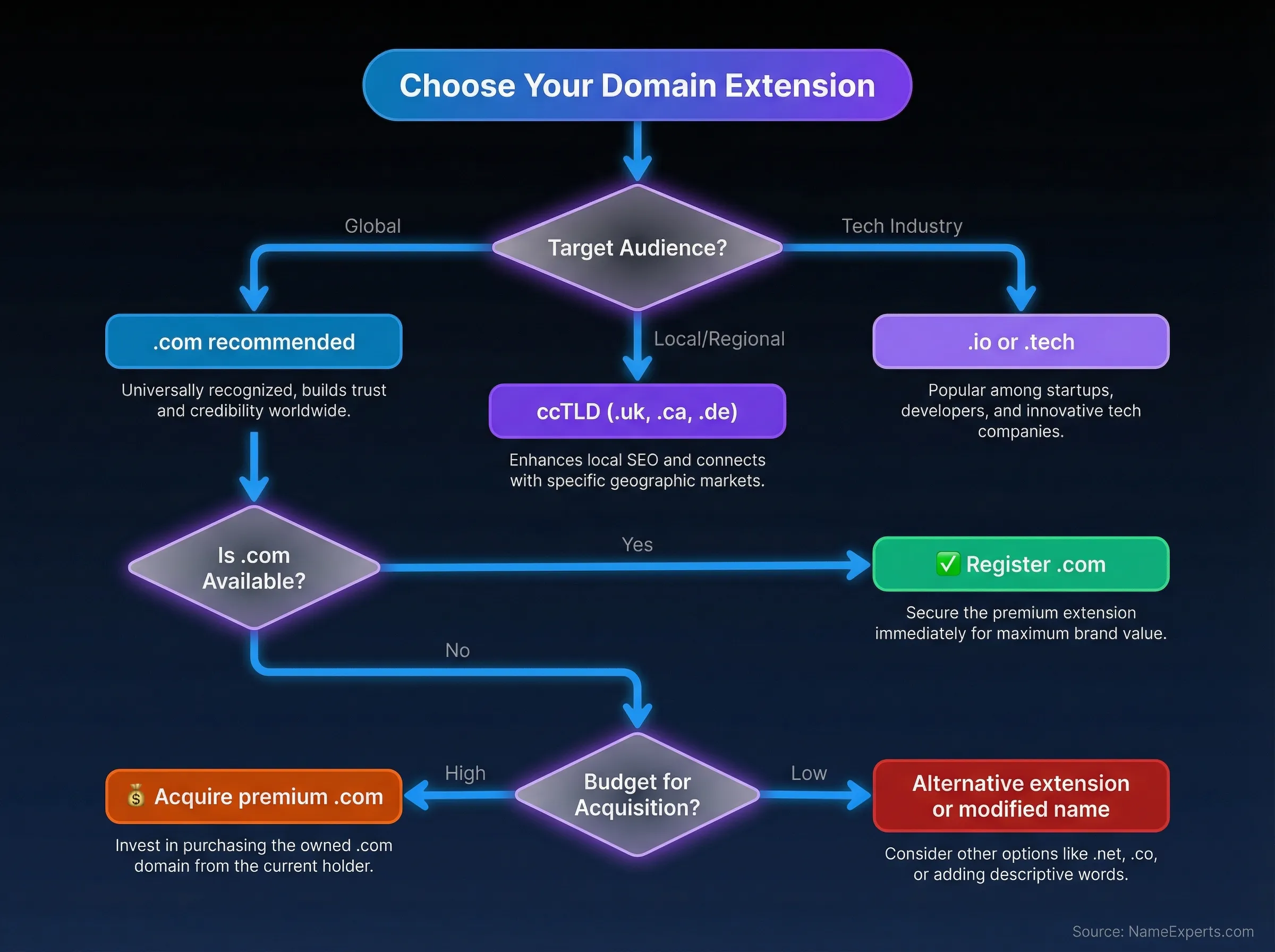
Selecting your extension requires balancing multiple considerations. This framework helps you evaluate options systematically rather than choosing based on availability alone.
Step 1: Define Your Target Audience
Start by identifying who needs to find and trust your website. A local restaurant targeting neighborhood diners has different needs than a SaaS company pursuing global enterprise clients. Geographic considerations matter—if you only serve customers in one country, a ccTLD reinforces your local presence.
Industry norms shape expectations. Legal professionals typically use .com or .law, while tech startups commonly embrace .io. Deviating from industry standards can differentiate you or raise questions, depending on execution. Research what successful competitors use to understand baseline expectations.
B2B versus B2C audiences respond differently to extension choices. Business buyers, especially in conservative industries like finance or healthcare, often prefer traditional .com domains. Consumer-facing brands have more flexibility to experiment with creative extensions that reinforce their brand personality.
Step 2: Evaluate Brand Positioning
Your extension should reinforce your brand identity. Premium brands typically stick with .com because it signals establishment and stability. Innovative or disruptive brands might choose .io or .tech to emphasize their forward-thinking approach. Nonprofit organizations benefit from .org's credibility associations.
Consider how the extension sounds when spoken aloud. "Visit us at smithlaw.com" flows naturally in conversation. "Visit us at smithlaw.attorney" requires clarification and repetition. If you rely on word-of-mouth marketing, verbal clarity matters significantly.
The extension can also create wordplay opportunities. A portfolio site might use "mywork.design" or a photography business could use "moments.photography." These combinations make the extension part of your brand name rather than just a technical requirement. However, this approach works best when the extension genuinely enhances rather than complicates your branding. For more guidance on this critical decision, explore our comprehensive guide on choosing the right domain name for your business.
Step 3: Check Availability and Alternatives
Your ideal domain name might already be registered, forcing you to choose between alternative names or alternative extensions. This decision point significantly impacts your long-term brand equity.
When your preferred .com is unavailable, you face several options. You can modify your domain name by adding words like your location (austinplumbing.com), using a descriptor (fastplumbing.com), or changing the structure entirely. Alternatively, you can keep your preferred name and accept a different extension.
Professional domain consultants help navigate these tradeoffs. At NameExperts, we use specialized search tools to explore available alternatives across all extensions, evaluating each option's branding implications. Our experience with 200+ transactions has shown that the right .com alternative often outperforms a compromised .com name.
When Your Ideal .com Is Taken
Discovering that someone owns your desired .com domain doesn't necessarily end your pursuit. Domain acquisition services specialize in negotiating purchases of registered domains. The current owner may be willing to sell, especially if they're not actively using it.
Cost-benefit analysis becomes critical here. Is acquiring the .com worth $5,000, $50,000, or more? The answer depends on your business model, marketing budget, and long-term brand strategy. A venture-backed startup might justify significant investment in the perfect .com, while a bootstrapped small business might better allocate those funds to customer acquisition.
Professional domain brokers conduct stealth acquisitions to prevent price inflation. When sellers know a specific buyer wants their domain, prices often increase dramatically. Experienced brokers approach owners without revealing the end buyer's identity, negotiating fair market value rather than inflated prices. We've helped clients secure premium domains for 40-60% less than they would have paid through direct contact.
Sometimes the strategic choice is accepting an alternative extension rather than overpaying for .com. A strong brand can succeed with .co, .io, or industry-specific extensions if you commit to consistent marketing. The money saved on domain acquisition can fund advertising that builds brand recognition regardless of extension.
Step 4: Consider Multiple Extensions for Protection
Defensive registration prevents competitors and cybersquatters from capitalizing on your brand. If you operate as businessname.com, someone could register businessname.net or businessname.org and create confusion. Customers might accidentally visit these sites, and competitors could use them to divert your traffic.
Strategic defensive registration focuses on the most likely sources of confusion. At minimum, consider registering the .com, .net, and .org versions of your domain. If you operate internationally, add relevant country codes. If your industry has a specific extension like .tech or .shop, secure that as well.
Redirect alternative extensions to your primary website. This ensures that users who misremember or mistype your extension still reach your site. The redirects also prevent competitors from acquiring these variations and using them against you.
Budget constraints require prioritization. You don't need every possible extension—focus on those that pose genuine confusion risk or strategic value. A local bakery probably doesn't need .global or .international, but should secure their city's geographic extension if available.
Domain Extension Pricing
Registration costs vary significantly by extension. Understanding pricing structures helps you budget appropriately and avoid surprises.
The .com extension typically costs $10-15 annually for initial registration through most registrars. This affordability combined with universal recognition makes it the default choice for many businesses. The .net and .org extensions fall in a similar price range, usually $12-18 per year.
Newer extensions like .io, .ai, and .tech command premium prices, often $30-60 annually. These higher costs reflect their popularity among well-funded technology companies willing to pay more for modern, relevant extensions. The .io extension, despite being a country code, costs more than most generic extensions due to demand from the tech sector.
Specialized extensions like .inc target specific audiences and price accordingly. A .inc domain can cost $1,000-2,000 for the first year, positioning it as a premium option for incorporated businesses. The high price creates exclusivity but limits adoption to companies where the extension provides substantial branding value.
Premium domains—short, memorable names or dictionary words—carry acquisition costs far beyond standard registration fees. These domains trade in the aftermarket for hundreds, thousands, or even millions of dollars depending on their commercial value. The extension affects premium pricing, with .com domains commanding the highest premiums due to their universal appeal. For accurate pricing guidance, consider using professional domain appraisal services to understand fair market value.
Annual renewal costs typically match initial registration prices, though some registrars offer discounted first-year rates that increase upon renewal. Read the pricing terms carefully to understand your long-term costs. Budget for renewals as a recurring business expense rather than a one-time purchase.
Additional costs include privacy protection (hiding your personal information from public WHOIS databases), SSL certificates for secure connections, and potential trademark monitoring services. These add-ons typically cost $5-20 per year each but provide important security and privacy benefits.
Common Domain Extension Mistakes to Avoid
Learning from others' missteps helps you avoid costly errors in your own domain strategy.
Choosing trendy extensions that confuse your audience: An extension that seems clever to you might puzzle potential customers. The .ninja or .guru extensions work for certain brands but create confusion for traditional businesses. If you need to repeatedly explain your domain extension, it's creating friction rather than value.
Ignoring geographic restrictions on ccTLDs: Some country codes require local presence, business registration, or citizenship. Purchasing a restricted ccTLD without meeting requirements can result in losing your domain after registration. Verify eligibility requirements before committing to a country-specific extension.
Overlooking trademark conflicts: Your domain name and extension combination might infringe on existing trademarks. This creates legal liability and could force you to surrender your domain. Conduct trademark searches before finalizing your domain choice, especially for .com domains where trademark enforcement is most active.
Selecting extensions that don't match business type: A .org extension for a for-profit ecommerce business creates cognitive dissonance. Users expect certain extensions to correspond with specific business models. Mismatched extensions undermine credibility rather than building it.
Failing to secure alternative extensions: Leaving obvious variations available allows competitors or cybersquatters to capitalize on your brand. Once you've established brand recognition, acquiring these defensive domains becomes more expensive as owners recognize their leverage. Register key alternatives early when prices remain reasonable.
Unsure If That Domain Is Worth the Investment?
Choosing between a $50,000 .com and a .io alternative isn't just about budget—it's about long-term brand equity. Our boutique domain consulting service evaluates your specific business context, target audience, and growth plans to determine the smartest investment for your situation.
The Future of Domain Extensions
The domain landscape continues evolving as technology and user behavior change. Understanding emerging trends helps you make forward-looking decisions.
New gTLD adoption continues growing, with registrations increasing 13.5% year-over-year. As users encounter these extensions more frequently, familiarity and trust will increase. The extensions that seem novel today may become mainstream tomorrow, just as .com evolved from a specific designation to the universal default.
Voice search and smart speakers influence how people interact with domains. Speaking "visit example dot shop" feels less natural than "visit example dot com." Extensions that work well verbally may gain advantages as voice interfaces proliferate. This shift could reinforce .com's dominance or create opportunities for phonetically simple alternatives.
Blockchain domains and Web3 technologies introduce decentralized alternatives to the traditional DNS system. Extensions like .crypto and .eth operate on blockchain networks, offering censorship resistance and cryptocurrency integration. While still niche, these technologies could disrupt conventional domain structures if they achieve mainstream adoption.
Internationalized domain names (IDNs) allow extensions in non-Latin scripts, expanding internet accessibility for billions of users. Chinese, Arabic, and Cyrillic extensions enable businesses to serve audiences in their native languages and scripts. This localization trend will continue as internet penetration grows in non-English-speaking markets.
How to Register Your Domain Extension with Confidence
Once you've selected your extension, the registration process requires attention to detail to avoid common pitfalls.
Choose a reputable domain registrar with strong security practices, transparent pricing, and reliable customer support. Look for ICANN accreditation, which ensures the registrar meets industry standards. Read reviews from other customers to gauge their experience with renewals, transfers, and support responsiveness.
Domain privacy protection shields your personal information from public WHOIS databases. Without privacy protection, your name, address, email, and phone number become publicly searchable, inviting spam and potential security risks. Most registrars offer privacy protection for a small annual fee—it's worth the investment.
Enable two-factor authentication on your registrar account to prevent unauthorized access. Domain hijacking—where attackers gain control of your domain—can devastate your business. Strong account security protects your digital assets from theft.
Set up automatic renewal to prevent accidental expiration. Domains that expire become available for others to register, and recovering an expired domain costs significantly more than maintaining continuous registration. Calendar reminders provide backup protection, but automatic renewal eliminates the risk of oversight.
Understand the registrar's transfer policies before committing. Some registrars make transfers difficult or expensive, effectively locking you in. Choose registrars that follow standard transfer procedures and don't impose unreasonable restrictions on moving your domain elsewhere.
Working with Domain Experts for Strategic Acquisitions
Complex domain acquisitions benefit from professional expertise. When the perfect domain is already registered, when you're building a domain portfolio, or when you need strategic guidance on extension choice, domain brokers provide valuable services.
Professional brokers conduct stealth acquisitions that protect your identity during negotiations. This anonymity prevents sellers from inflating prices when they know a specific buyer wants their domain. Our team at NameExperts has completed 200+ transactions using negotiation strategies that secure fair pricing rather than paying emotional premiums.
Domain portfolio management becomes important as your business grows. Managing renewals, security, and DNS settings across multiple domains requires organization and expertise. Professional services handle these technical details, ensuring your domains remain secure and properly configured.
Strategic consultation helps you evaluate tradeoffs between different domain options. Should you pay $50,000 for the perfect .com or launch with a .io alternative? What defensive registrations provide genuine protection versus unnecessary expense? Our 16+ years of experience helps clients make informed decisions based on their specific business context rather than generic advice.
Making Your Domain Extension Decision
Your domain extension represents more than a technical requirement—it's a strategic branding decision that affects how customers perceive and remember your business. The .com extension remains the gold standard for most businesses, offering universal recognition and trust. However, the expanding ecosystem of alternatives provides valuable options when .com isn't available or when a specialized extension better serves your positioning.
Evaluate extensions based on your target audience, brand positioning, industry norms, and budget. Prioritize clarity and memorability over cleverness. Consider the long-term implications of your choice, including how the extension sounds in conversation, how easily people remember it, and whether it reinforces or undermines your brand identity.
Don't let perfect be the enemy of good. A strong brand can succeed with various extensions if you commit to consistent marketing and clear communication. The extension matters, but your product quality, customer service, and marketing execution matter more.
Need help securing the perfect domain for your business? NameExperts specializes in strategic domain acquisitions for businesses launching or rebranding. Our 16+ years of experience and 200+ successful transactions mean you avoid overpaying while getting the domain that truly fits your brand. Contact us to discuss your domain strategy.
Work With a Domain Expert
Whether your ideal .com is taken, you're weighing extension alternatives, or you need strategic guidance on building a domain portfolio, NameExperts brings 16+ years of no-bullshit expertise to your corner. We conduct stealth acquisitions that protect your identity and prevent price inflation, negotiate fair market prices, and provide honest counsel on when to invest versus when to pivot. Stop navigating the Wild West of the domain marketplace alone. Our personalized, boutique service means you
Get Started Free







Frequently Asked Questions
A domain extension is the suffix following the period in a web address—in nameexperts.com, the ".com" portion represents the extension, while other common examples include .org, .net, .uk, and .io.
For most businesses, .com remains the best choice due to universal recognition and trust, though .net and .org serve as strong alternatives when your preferred .com is unavailable, and specialized options like .io or country codes work well for tech startups or local businesses respectively.
Standard extensions like .com, .net, and .org typically cost $10-18 annually, while newer options such as .io or .tech range from $30-60 per year, and premium specialized extensions like .inc can reach $1,000-2,000 for initial registration.
The .com extension dominates with 161 million registrations globally, followed by country codes like .cn (China) and .de (Germany), then .net with 12.5 million registrations, .org, and increasingly popular options like .io for technology companies.