
Key Takeaways
- Domain valuation depends on multiple factors including length, TLD, brandability, and market demand—free tools provide starting points but expert appraisal matters for premium assets
- Choose marketplaces based on your domain's value and your comfort with negotiation—each platform offers different commission rates and audience reach
- Always use escrow services to protect transactions—never transfer ownership before payment clears
- Professional brokers deliver ROI on high-value domains ($10k+) through expert negotiation, buyer networks, and market positioning
- The transfer process takes 5-7 days on average—understanding the steps prevents costly delays and ensures smooth handoff
Owning a valuable domain name is one thing. Knowing how to turn that digital asset into cash without leaving money on the table is another. Whether you registered a domain years ago that's now in demand, built a portfolio ready to liquidate, or simply want to move on from an unused web address, understanding the complete sales process—from accurate valuation through secure transfer—makes the difference between a disappointing sale and maximum returns.
This guide walks you through every step of successfully selling your domain, covering valuation methods, marketplace selection, listing optimization, negotiation tactics, and the technical transfer process. We'll also help you determine when DIY selling makes sense versus when expert representation pays for itself.
Understanding What Your Domain Is Actually Worth
Accurate valuation is the foundation of any successful sale. Price too high and you'll scare away serious buyers. Price too low and you'll leave thousands on the table. Several key factors determine what buyers will actually pay for your web address.
The Valuation Factors That Matter
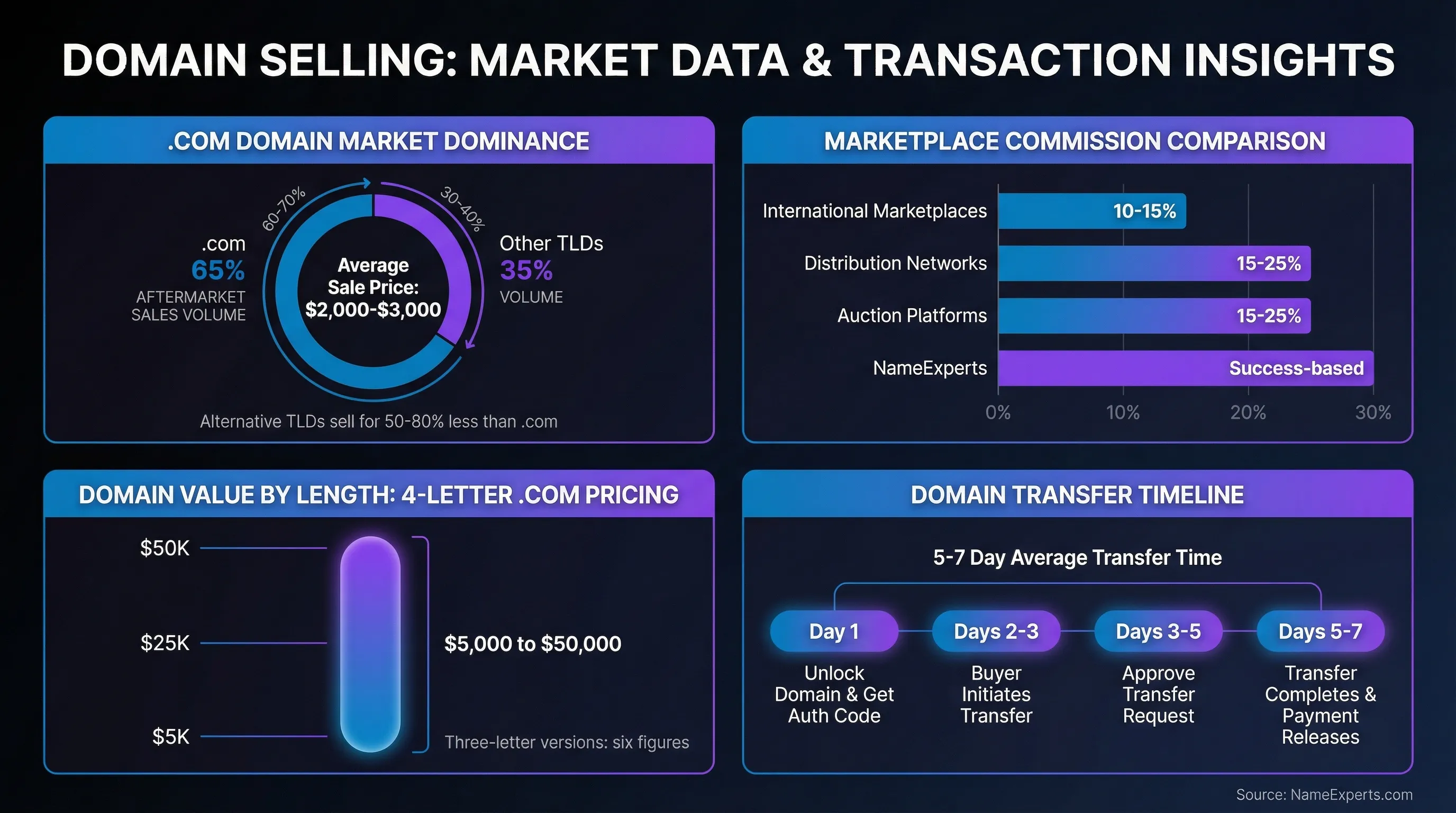
Length and memorability: Shorter domains command premium prices. Four-letter .com domains typically sell between $5,000-$50,000 depending on letter combination and brandability. Three-letter versions can fetch six figures. Longer domains need exceptional keyword relevance or branding potential to justify higher prices.
Top-level domain (TLD): The extension matters significantly. According to industry analysis, .com domains represent approximately 60-70% of aftermarket sales volume, with average sale prices of $2,000-3,000. Alternative TLDs like .net, .org, and newer extensions typically sell for 50-80% less than comparable .com versions.
Brandability: Pronounceable, memorable names that work as business brands hold more value than generic keyword strings. "CloudVault.com" has more branding potential than "OnlineDataStorageSolution.com" despite the latter containing more keywords.
Keyword relevance: Domains containing high-value commercial keywords—insurance, loans, travel, legal services—attract corporate buyers willing to pay premium prices. The keyword must align with profitable industries and demonstrate clear commercial intent.
Existing traffic and backlinks: Domains with established organic traffic, quality backlinks, and search engine history carry additional value. These assets provide immediate SEO benefits to buyers, justifying higher prices.
Age and history: Older domains (10+ years) with clean histories often command premiums. However, age alone doesn't guarantee value—the domain must also meet other criteria like brandability and keyword relevance.
Free Appraisal Tools and Their Limitations
Several automated tools provide quick valuation estimates. Various domain appraisal services use algorithms combining historical sales data, keyword popularity, and market trends to generate price ranges.
These tools work reasonably well for straightforward domains with clear comparables. They struggle, however, with brandable names lacking obvious keyword patterns, portfolio valuations requiring strategic pricing, and premium domains over $10,000 where nuanced market positioning matters.
Automated appraisals also can't account for current market dynamics, specific buyer interest, or strategic value to particular companies. Use them as starting points, not final answers.
Researching Comparable Sales
The most reliable valuation method involves studying actual market transactions. NameBio maintains a searchable database of over 6 million domain sales totaling more than $3 billion, according to market research. Industry publications regularly report significant transactions.
When researching comparables, focus on domains with similar characteristics: same TLD, comparable length, similar keyword patterns, and recent sale dates (within 12-18 months). Market conditions shift, so older sales data becomes less relevant.
Pay attention to sale context. Auction prices often differ from brokered private sales. Domains sold through premium marketplaces may command higher prices than those listed on smaller platforms.
When DIY Valuation Isn't Enough
For premium domains valued over $10,000, brandable names without clear comparables, or portfolio sales requiring coordinated strategy, professional appraisal delivers more accurate pricing. At NameExperts, our 16+ years of experience and 200+ completed transactions provide the market intelligence automated tools can't match.
We analyze your domain within current market context, identify potential buyer segments, and develop pricing strategies that maximize returns while maintaining realistic expectations. Our real comparable sales data—not algorithm estimates—informs accurate market positioning.
Professional appraisal becomes especially valuable when you're considering whether to accept an offer, determining reserve prices for auctions, or pricing an entire portfolio. The investment in expert valuation often pays for itself by preventing underpricing or helping you avoid overpricing that stalls sales.

Not Sure What Your Domain Is Really Worth?
Automated appraisal tools can't account for current market dynamics, strategic buyer interest, or nuanced positioning that premium domains require. If you're selling a domain valued over $10,000 or need expert guidance on pricing strategy, get a professional domain appraisal from NameExperts backed by 16+ years of market intelligence and 200+ completed transactions.
Choosing the Right Sales Channel
Where you list your domain significantly impacts visibility, sale speed, and final price. Different platforms serve different purposes, and the right choice depends on your domain's value, your timeline, and your negotiation comfort level.
Marketplace Comparison
The domain aftermarket offers several major platforms, each with distinct advantages. Understanding your options helps you make informed decisions, though for premium domains over $10,000, professional brokerage consistently delivers superior results. According to platform analysis, commission rates and audience reach vary significantly:
| Platform Type | Typical Commission | Key Features | Best For |
|---|---|---|---|
| International Marketplaces | 10-15% | Global reach, multiple sales options, broker services available | International buyers, premium domains, sellers wanting flexible sales methods |
| Distribution Networks | 15-25% | Fast transfer capabilities, distribution to multiple registrars, high-converting landing pages | Maximum exposure, quick sales, broad registrar integration |
| Auction Platforms | 15-25% | High volume marketplace, large buyer base, auction and Buy Now options | Competitive bidding, established buyer community, time-sensitive sales |
| Registrar Marketplaces | Varies | Built-in marketplace for existing customers, simple listing process | Current registrar customers, straightforward sales, existing customer base |
| NameExperts | Success-based | Boutique brokerage, stealth acquisition, direct buyer networks, expert negotiation | Premium domains $10k+, privacy concerns, complex negotiations, maximum price |
Each platform attracts different buyer demographics. International marketplaces work well for domains with global appeal. Distribution networks provide broad exposure across multiple registrars. High-traffic auction platforms suit domains likely to attract competitive bidding. However, these self-service platforms lack the strategic positioning, buyer networks, and expert negotiation that premium domains require to achieve maximum value.
DIY Listing vs. Broker Representation
Self-service platforms work well for domains under $5,000 with clear market value. If you have time to manage inquiries, comfort negotiating, and realistic price expectations, DIY listing keeps more money in your pocket.
Professional representation makes sense when dealing with premium domains, complex negotiations, privacy concerns, or time constraints. Brokers bring buyer networks, negotiation expertise, and market positioning skills that justify their fees on high-value transactions.
Consider the math: A 15% commission on a $50,000 sale costs $7,500. But if broker expertise and buyer access increase the sale price from $40,000 to $50,000, you net $42,500 instead of $40,000—coming out ahead despite the commission.
The NameExperts Advantage for High-Value Sales
For premium domains, our boutique approach delivers results that marketplace listings can't match. With 16+ years of experience and 200+ successful transactions, we've worked with clients including HBO/Max.com, Monday.com, TripAdvisor, and HubSpot.
Our stealth acquisition capabilities prevent seller price inflation—we saved a fintech startup $33,000 on an acquisition, negotiating from a $75,000 asking price to a $42,000 close. This same expertise works in reverse when representing sellers, positioning domains strategically to extract maximum value from qualified buyers.
We provide personalized service with direct access to experienced broker Joe Uddeme, no-nonsense market assessment, and success-based fees that align our incentives with yours. For domains where expertise truly matters, our transparent approach delivers results corporate brokerages can't match.
Hybrid Approach
Some sellers successfully combine marketplace exposure with broker backup. List your domain on a major platform to capture passive interest while having professional representation ready for serious inquiries requiring expert negotiation.
This approach works particularly well for domains in the $10,000-$50,000 range where you're uncertain about optimal pricing. The marketplace listing tests buyer interest while broker expertise ensures you don't undersell when qualified buyers emerge.
Creating a Listing That Attracts Serious Buyers
How you present your domain directly impacts buyer interest and final sale price. Professional listings convert browsers into buyers by highlighting value, building trust, and making the purchase process clear.
Pricing Strategy: Fixed Price vs. Make Offer vs. Auction
Fixed "Buy Now" pricing works best when you have strong comparable sales data supporting your price point. According to marketplace data, Buy Now domains sell up to three times faster than other listing types. This approach attracts decisive buyers who value speed and certainty.
Set your Buy Now price 10-20% above your minimum acceptable price to allow negotiation room while still attracting serious inquiries. Domains priced at exact market value often sell quickly, while those priced 30%+ above market comparables languish.
"Make Offer" listings invite negotiation, useful when you're uncertain about optimal pricing or want to gauge market interest. This approach attracts more inquiries but requires time managing lowball offers and serious negotiations.
Set a minimum offer threshold to filter out unrealistic buyers. If your domain is worth $5,000 based on research, set a $2,500 minimum offer to avoid wasting time on $500 inquiries.
Auctions create urgency and competition, potentially driving prices above market value when multiple buyers want the same domain. Reserve prices protect you from selling too low while still enabling competitive bidding.
Auctions work best for domains with broad appeal likely to attract multiple bidders. Niche domains with limited buyer pools often perform better with fixed pricing or Make Offer approaches.
Writing Compelling Domain Descriptions
Effective descriptions highlight branding potential, keyword relevance, and practical use cases without overselling. Focus on facts and benefits rather than hyperbole.
Structure your description:
- Opening hook: One sentence capturing the domain's primary value proposition
- Key features: Length, TLD, memorability, keyword relevance
- Use cases: 2-3 specific industries or business types that would benefit
- Existing metrics: Traffic, backlinks, domain age (if positive factors)
- Call to action: Clear next steps for interested buyers
Example: "CloudVault.com—premium 10-letter .com perfect for cloud storage, data security, or backup services. Highly brandable, easy to remember, and immediately communicates secure cloud solutions. Ideal for SaaS startups, enterprise software, or cybersecurity companies. Registered 2015. Contact for pricing."
Avoid empty claims like "perfect domain" or "million-dollar opportunity." Serious buyers dismiss hyperbole. Instead, provide specific, verifiable information that helps them assess fit and value.
Landing Page Best Practices
Professional landing pages signal legitimacy and make purchasing easy. Key elements include:
- Clean design: Simple, mobile-responsive layout without distracting elements
- Clear pricing: Display your asking price or "Make Offer" option prominently
- Contact method: Email, phone, or inquiry form—make it easy to reach you
- Trust signals: Mention escrow protection, registrar information, domain age
- Value proposition: Brief description highlighting key benefits
Many marketplaces provide templated landing pages automatically. If creating your own, keep it simple and professional. Overly designed pages with stock photos and marketing copy often appear less trustworthy than straightforward, information-focused designs.
Marketing Your Premium Domain
Beyond passive marketplace listings, proactive marketing can accelerate sales—especially for premium domains. Strategies include:
Industry targeting: Identify companies that would benefit from your domain and reach out directly. A domain like "FinanceAI.com" has obvious appeal to fintech companies developing AI products.
Social media promotion: Share your listing in domain investor communities, industry forums, and relevant LinkedIn groups. Avoid spam, but strategic sharing can surface interested buyers.
Broker outreach: Professional brokers maintain buyer networks and can conduct targeted outreach to qualified prospects. For premium domains, this personalized approach often delivers better results than passive listings.
At NameExperts, our buyer networks and industry relationships enable targeted outreach that surfaces qualified buyers marketplace listings never reach. This proactive approach, combined with expert positioning, consistently delivers premium prices for high-value domains.
Negotiating and Closing the Sale Safely
Once inquiries arrive, skilled negotiation and secure transaction handling protect your interests while maximizing sale price. This phase separates successful sellers from those who leave money on the table or fall victim to scams.
Handling Buyer Inquiries
Respond to serious inquiries within 24 hours. Quick responses signal professionalism and keep interested buyers engaged. However, not all inquiries deserve equal attention.
Qualifying serious buyers: Ask questions that reveal buyer intent and budget. "What's your intended use for this domain?" and "What's your budget range?" help separate tire-kickers from qualified prospects.
Lowball offers (50%+ below asking price) typically come from opportunistic buyers hoping for desperate sellers. You can counter at your minimum acceptable price or politely decline. Don't waste time negotiating with buyers who clearly can't meet reasonable market value.
Negotiation tactics: Start high but remain reasonable. If your domain is worth $10,000 based on comparables, listing at $15,000 provides negotiation room while staying within realistic range. Dropping from $15,000 to $12,000 feels like a win for buyers while exceeding your target.
Use silence strategically. After making a counteroffer, wait for the buyer to respond rather than immediately offering further concessions. Patience often results in buyers accepting your terms rather than continuing to negotiate.
Justify your price with comparable sales data. "Similar domains like [example].com sold for $12,000 last month" provides objective support for your asking price and moves negotiations away from arbitrary haggling.
The Critical Role of Escrow
Never transfer a domain before payment clears. Never accept direct payment without escrow protection. These rules are non-negotiable for safe transactions.
Escrow services act as trusted intermediaries, holding payment securely until the domain transfer completes successfully. According to industry standards, the process takes 3-7 business days: buyer pays escrow → seller transfers domain → buyer verifies receipt → escrow releases payment to seller.
Leading escrow providers charge tiered fees based on transaction value, typically ranging from 2-4% for smaller transactions to lower percentages for high-value deals. This cost eliminates fraud risk, ensures legal transfer, and provides dispute resolution.
Reputable escrow services include established industry providers and services built into major marketplaces. Avoid buyers who resist escrow or suggest alternative "safer" payment methods—these are red flags for potential scams. For more details on how escrow protects both parties, read our comprehensive guide on what domain name escrow is and how it works.
Understanding Commission Structures and Fees
Calculate your net proceeds before accepting offers. If you're selling through a marketplace charging 15% commission, a $10,000 sale nets you $8,500. Escrow fees (typically 2-4%) come from either buyer or seller depending on agreement, further reducing net proceeds.
Some platforms charge listing fees, featured placement fees, or auction setup costs. Factor these into your pricing strategy to ensure you meet your minimum acceptable net amount.
When comparing offers, consider total costs. A $10,000 offer through a 10% commission platform nets more than a $10,500 offer through a 20% commission platform.
When Expert Negotiation Pays for Itself
Complex negotiations with corporate buyers, multiple-bidder situations, or premium domains requiring strategic positioning benefit significantly from professional representation.
Corporate buyers often have budget approval processes, legal review requirements, and negotiation teams. Experienced brokers navigate these complexities, maintaining deal momentum while protecting your interests.
Multiple interested buyers create opportunity for competitive bidding, but managing this process requires skill. Brokers can orchestrate competition ethically while maintaining relationships with all parties.
At NameExperts, our negotiation expertise consistently extracts premium prices from qualified buyers. We understand buyer psychology, corporate procurement processes, and strategic positioning that maximizes value. For domains over $10,000, our success-based fees typically deliver higher net proceeds than DIY negotiations despite the commission.
Transferring Your Domain to the New Owner
After agreeing on price and receiving payment in escrow, the technical transfer process begins. Understanding these steps prevents delays and ensures smooth ownership transition.
The Transfer Process Explained
Domain transfers follow a standardized process governed by ICANN policies. The typical timeline is 5-7 days, though some transfers complete faster.
Step 1: Unlock the domain. Log into your registrar account and disable the domain lock (also called "transfer lock" or "registrar lock"). This security feature prevents unauthorized transfers, so you must disable it before initiating transfer.
Step 2: Obtain authorization code. Request the EPP code (also called "auth code" or "transfer key") from your registrar. This unique code authorizes the transfer. Most registrars provide it instantly through your account dashboard; some require support requests.
Step 3: Buyer initiates transfer. Provide the authorization code to the buyer, who initiates the transfer at their registrar. They'll enter your domain name and the auth code to start the process.
Step 4: Approve transfer request. You'll receive an email asking to confirm the transfer. Approve it promptly to avoid delays. Some registrars auto-approve after 5 days if you don't respond.
Step 5: Transfer completes. After approval, the domain moves to the buyer's registrar account. This typically takes 24-48 hours but can take up to 7 days depending on registrars involved.
Step 6: Escrow releases payment. Once the buyer confirms receipt and verifies the domain is in their account, escrow releases payment to you. This usually happens within 24 hours of transfer completion.
Common Transfer Pitfalls
Several issues can delay or complicate transfers:
Domain locks: Forgetting to unlock the domain is the most common delay. Double-check lock status before providing the auth code.
Expired contact emails: Transfer confirmation emails go to the domain's registered contact email. If this email is outdated or inaccessible, you can't approve the transfer. Update contact information before starting the sale process.
Recent registrar changes: ICANN rules prohibit transfers within 60 days of a registrar change. If you recently moved the domain to a new registrar, you must wait before selling.
Expired domains: You cannot transfer expired domains. Renew before listing for sale or clearly communicate expiration dates to buyers.
Registrar-specific quirks: Some registrars have additional verification steps, longer processing times, or unique requirements. Familiarize yourself with your registrar's transfer process before committing to sale timelines.
Post-Sale Responsibilities
After transfer completes and payment releases, your obligations end. However, maintain records for tax purposes:
- Sale agreement or invoice
- Payment confirmation from escrow
- Transfer completion confirmation
- Original domain registration date and cost (for capital gains calculations)
Domain sales may trigger tax obligations depending on your jurisdiction and whether you're selling as an individual or business. Consult a tax professional familiar with digital asset sales to ensure compliance.
Transfer Support
Most registrars provide transfer support, but quality varies. Major platforms offer detailed documentation and support teams to assist with technical issues.
For high-value transactions, broker-assisted transfers eliminate stress and ensure nothing goes wrong. At NameExperts, we guide both parties through the entire transfer process, handling technical details and troubleshooting issues so you can focus on celebrating your successful sale.

Maximize Your Sale Price with Expert Negotiation
Corporate buyers with legal teams and procurement processes require different handling than individual entrepreneurs—and skilled negotiation often increases sale prices enough to more than cover broker fees. For premium domains over $10,000 where positioning and buyer networks truly matter, connect with our boutique brokerage team to explore how strategic representation delivers higher net proceeds despite commissions.
Should You Sell It Yourself or Use a Broker? A Decision Framework
The DIY versus broker decision depends on your domain's value, your negotiation skills, time availability, and privacy concerns. This framework helps you determine the right approach.
Self-Assessment Criteria
Domain value threshold: For domains under $5,000 with clear market comparables, DIY selling usually makes sense. The commission savings outweigh broker benefits. Between $5,000-$10,000, the decision depends on other factors. Above $10,000, professional representation typically delivers higher net proceeds despite commissions.
Negotiation comfort level: Are you comfortable negotiating with corporate buyers, handling multiple offers simultaneously, and standing firm on pricing? If negotiation feels stressful or you tend to accept first offers, broker expertise protects you from underselling.
Time availability: Managing inquiries, qualifying buyers, negotiating terms, and coordinating transfers requires time and attention. If you're busy with other priorities, broker representation handles these tasks while you focus elsewhere.
Privacy concerns: Some sellers prefer anonymity, especially when selling to competitors or in sensitive situations. Brokers provide privacy by representing you without revealing your identity until necessary.
Buyer sophistication: Corporate buyers with legal teams and procurement processes require different handling than individual entrepreneurs. Brokers experienced with corporate sales navigate these complexities effectively.
When DIY Makes Sense
Self-service selling works well when:
- Your domain is valued under $5,000 with clear comparable sales
- You have time to manage the sales process
- You're comfortable negotiating and standing firm on pricing
- The transaction is straightforward without complex buyer requirements
- You want to maximize net proceeds by avoiding commissions
For these scenarios, list on major marketplaces. Use their tools, follow best practices outlined in this guide, and handle negotiations directly.
When Expert Representation Delivers ROI
Professional brokerage makes sense for:
- Domains valued over $10,000 where expert positioning matters
- Brandable names requiring strategic market positioning
- Sellers wanting privacy and discretion
- Complex negotiations with corporate buyers
- Portfolio sales requiring coordinated strategy
- Situations where you lack time or negotiation confidence
The math often favors brokers despite commissions. A broker who increases your sale price from $40,000 to $50,000 nets you more money after their fee than selling yourself at the lower price. Their buyer networks, negotiation skills, and market positioning frequently deliver this premium.
The NameExperts Approach
Our boutique brokerage serves clients who value expertise, transparency, and personalized service. With 16+ years of experience and 200+ successful transactions, we bring:
- Direct access: Work directly with experienced broker Joe Uddeme, not junior staff or automated systems
- Honest assessment: We'll tell you if your domain isn't worth what you think—no-nonsense market reality helps you make informed decisions
- Buyer networks: Established relationships with corporate buyers, investors, and industry players who trust our recommendations
- Strategic positioning: We position domains to maximize value, highlighting benefits that resonate with qualified buyers
- Success-based fees: Our compensation aligns with your success—we only profit when you do
For premium domains where expertise truly matters, our transparent approach delivers results corporate brokerages can't match. We've saved clients tens of thousands through skilled negotiation and strategic positioning—the same expertise we apply when representing sellers.
Ready to explore what your domain is worth? Get a professional appraisal from NameExperts or contact us to discuss your selling strategy.
Conclusion
Successfully selling a domain name combines market knowledge, strategic pricing, proper channel selection, and secure transaction handling. Whether you choose DIY selling through major marketplaces or professional representation for premium assets, understanding the complete process protects your investment and maximizes returns.
Start with accurate valuation using comparable sales data and professional appraisal for high-value domains. Choose marketplaces based on your domain's characteristics and your selling preferences. Create compelling listings that highlight value while building trust. Always use escrow services to protect transactions. And recognize when expert negotiation and buyer networks justify professional representation.
For domains under $5,000 with clear market value, DIY selling through established platforms often delivers good results. For premium domains over $10,000, brandable names requiring positioning, or complex negotiations with corporate buyers, professional brokerage typically delivers higher net proceeds despite commissions.
At NameExperts, we offer the boutique, transparent approach that premium domain sellers deserve. Our 16+ years of experience, 200+ successful transactions, and established buyer networks consistently deliver results for clients who value expertise. When your domain truly matters, we're here to help you achieve maximum value.
Ready to Sell Your Domain for Maximum Value?
Whether you're uncertain about accurate valuation, overwhelmed by marketplace options, or facing complex negotiations with corporate buyers, expert guidance protects your investment and maximizes returns. Our boutique approach combines 16+ years of experience, established buyer networks, and transparent pricing to consistently deliver premium results for high-value domains. Don't leave money on the table or waste months with ineffective listings— schedule a no-obligation consultation with NameEx
schedule a no-obligation consultation with NameExperts







Frequently Asked Questions
List your domain on established marketplaces like Sedo, Afternic, or GoDaddy Auctions with clear pricing (Buy Now or Make Offer), use escrow services for payment protection, and transfer ownership through your registrar once payment clears—the entire process typically takes 5-7 days from agreement to completion.
The optimal platform depends on your domain's value: international marketplaces like Sedo work well for premium names seeking global buyers, distribution networks like Afternic provide broad registrar exposure, while boutique brokerages like NameExperts deliver higher returns for domains over $10,000 through expert negotiation and direct buyer networks.
Yes, you can sell any domain you own as long as it's not locked, expired, or within 60 days of a recent registrar transfer—simply unlock it at your current registrar, list it on a marketplace or work with a broker, and use escrow services to ensure secure payment before transferring ownership.
Domain flipping is completely legal as a legitimate business practice, though registering trademarked names with intent to profit from brand confusion (cybersquatting) violates ICANN policies and trademark law—stick to generic, brandable, or keyword domains without trademark conflicts to stay compliant.