
Key Takeaways
- Domain valuation depends on five core factors: length, keywords, TLD (.com commands premium prices), brandability, and existing traffic or revenue.
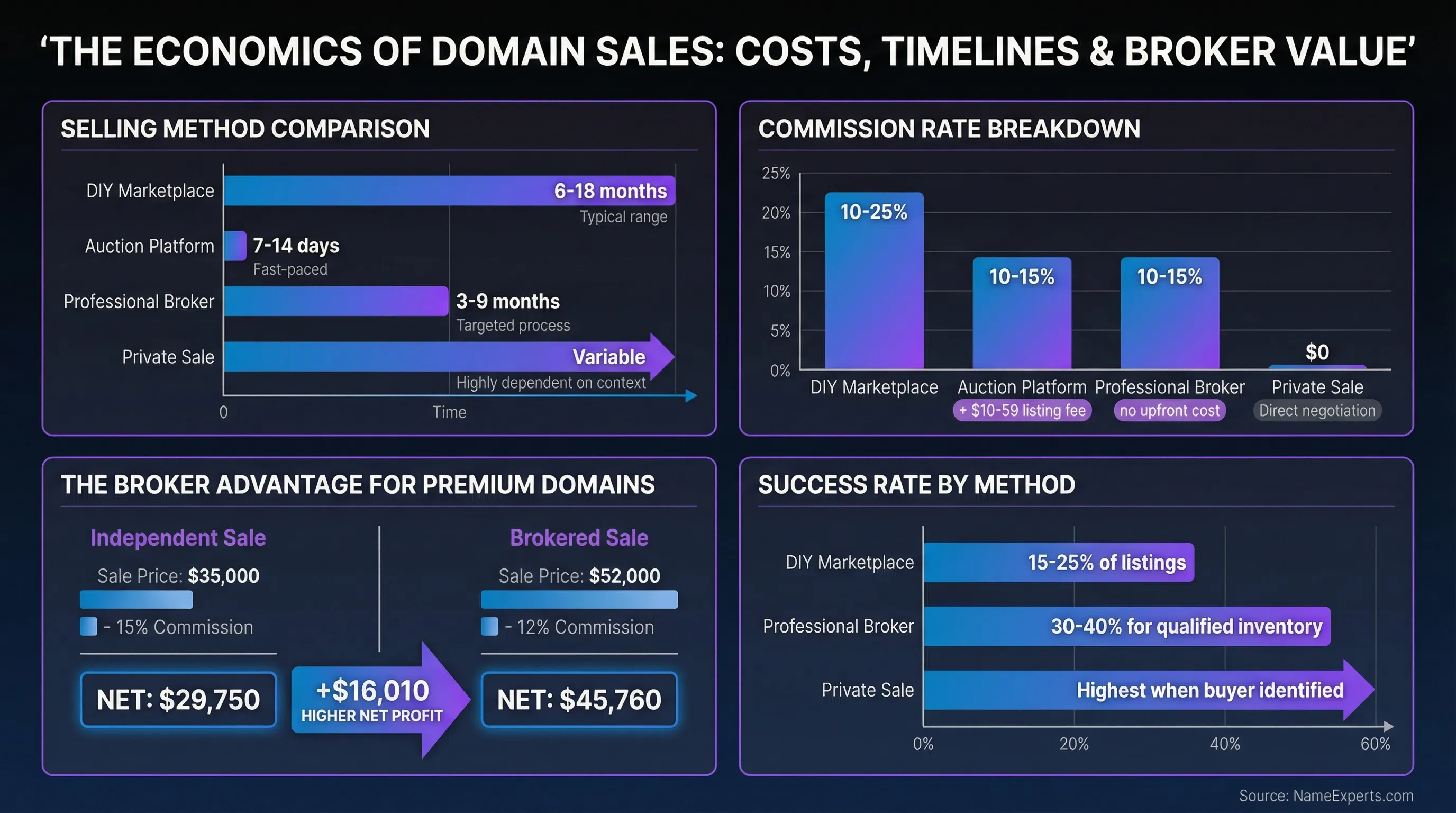
- Most domains take 6-18 months to sell through marketplaces, though premium names with broker representation often sell faster at higher prices.
- Commission rates vary widely: DIY marketplaces charge 10-25%, while professional brokers typically charge 10-15% but often secure significantly higher sale prices.
- Domains valued above $10,000 benefit substantially from professional brokerage services—the commission cost is typically offset by 20-40% higher negotiated prices.
- Always use escrow services for transactions to protect both parties—never accept direct wire transfers or alternative payment methods from unknown buyers.
Selling a domain name isn't as simple as posting it online and waiting for offers to roll in. The reality is more nuanced: most domains never sell, many sit listed for years, and pricing mistakes cost sellers thousands in lost revenue. But with the right approach, you can turn an unused digital asset into substantial profit.
Whether you're holding a premium name you registered years ago or testing the waters of domain investing, understanding the fundamentals of valuation, marketplace selection, and negotiation strategy makes the difference between a quick sale at fair value and watching your listing gather digital dust. In our experience working with domain transactions for over 16 years, we've seen firsthand how strategic positioning and expert guidance transform outcomes—often adding five or six figures to final sale prices.
This guide walks you through the complete process, from determining what your asset is actually worth to closing the deal securely. We'll cover when DIY approaches make sense, when professional representation pays for itself, and how to avoid the common pitfalls that trap inexperienced sellers.
Understanding What Your Domain Is Actually Worth
Before listing anything for sale, you need a realistic understanding of its market value. Domain valuation isn't an exact science, but it follows predictable patterns based on specific characteristics that buyers consistently value.
The Five Core Value Drivers
Five primary factors determine what buyers will pay. Length matters significantly—shorter names command premium prices because they're easier to remember, faster to type, and look cleaner on marketing materials. Single-word or two-word .com addresses, especially those using dictionary terms or commonly searched keywords, can be particularly valuable.
Keywords drive value when they align with commercial intent. Names containing terms people actively search for when looking to make purchases or hire services attract higher bids. A domain clearly related to finance, health, technology, or other lucrative industries typically outperforms generic combinations.
The extension makes an enormous difference. According to industry analysis, .com addresses generally hold the most value thanks to their global popularity and perceived credibility. While other extensions like .shop, .xyz, and .ai have carved out their own niches, .com remains the gold standard for resale value.
Brandability—how well the name works as a company identity—significantly impacts pricing. Memorable, pronounceable names that evoke positive associations or clearly communicate purpose sell faster and command higher prices than awkward combinations or confusing spellings.
Finally, existing traffic or revenue provides concrete justification for premium pricing. If your asset already attracts visitors or generates income through parking or a developed site, you have quantifiable metrics that reduce buyer risk and support higher valuations.
Free Valuation Tools vs. Professional Appraisal
Automated appraisal tools offered by major registrars provide quick baseline estimates. These algorithms analyze comparable sales, keyword search volume, extension popularity, and other factors to generate a price range. They're useful starting points, but they have significant limitations.
Automated tools can't assess brandability, they often undervalue premium names by 30-50%, and they miss market timing opportunities. A domain related to artificial intelligence, for example, might receive a generic valuation that completely misses its current market premium due to AI industry growth.
For assets you believe are worth $10,000 or more, professional appraisal provides substantially more accurate guidance. At NameExperts, we offer free valuation services that incorporate our 16+ years of market experience and access to real comparable sales data. Our appraisals consider factors automated tools miss: current buyer demand in specific industries, brandability assessment, and strategic timing recommendations.
Even if you ultimately decide to sell independently, getting an expert valuation helps you set realistic expectations and avoid the two most common pricing mistakes: asking far too much (which scares away serious buyers) or accepting far too little (leaving substantial money on the table).
Market Research That Matters
Beyond automated tools and professional appraisals, researching actual sales of comparable names provides invaluable context. NameBio maintains the industry's most comprehensive database of reported transactions, allowing you to search by keyword, extension, length, and sale date.
When researching comparables, look for recent sales (within the past 12-18 months) of names with similar characteristics. Pay attention to the marketplace where they sold—auction prices often differ from negotiated private sales. Note any patterns: do shorter versions consistently sell for more? Do certain keyword combinations command premiums?
This research helps you understand not just what to ask, but also what buyers in your niche actually pay. It's the difference between hoping for $50,000 because you saw one outlier sale and realistically expecting $8,000-$12,000 based on consistent market data.
The Premium Domain Threshold
There's a critical inflection point around $10,000 where selling strategy should fundamentally change. Below this threshold, DIY approaches through marketplaces make financial sense—the time investment is manageable and commission savings are meaningful relative to sale price.
Above $10,000, professional brokerage services typically pay for themselves through higher negotiated prices. In a recent transaction we brokered, the owner initially priced their fintech domain at $25,000 based on automated appraisals. Through strategic buyer identification and skilled negotiation, it sold for $67,000—a $42,000 difference that more than justified the brokerage commission.
Premium names require different marketing approaches, access to serious buyers who aren't browsing public marketplaces, and negotiation expertise that prevents leaving significant money on the table. Understanding where your asset falls on this spectrum guides every subsequent decision about how to proceed.
Not Sure What Your Domain Is Really Worth?
Automated valuation tools often undervalue premium domains by 30-50%, missing market timing opportunities and brandability factors that drive real buyer demand. If you believe your domain is worth $10,000 or more, get a free professional appraisal from our team that incorporates 16+ years of market experience and access to real comparable sales data.
Choosing Your Selling Method: A No-BS Comparison
You have three primary paths for selling: DIY through marketplaces, auction platforms, or professional brokerage services. Each has distinct advantages, costs, and ideal use cases. Choosing the wrong approach for your specific situation costs time and money.

| Method | Cost Structure | Typical Timeline | Best For | Success Rate |
|---|---|---|---|---|
| DIY Marketplace | 10-25% commission | 6-18 months | Domains under $10k, sellers with time | Moderate (15-25% of listings) |
| Auction Platform | $10-$59 listing fee + 10-15% commission | 7-14 days | High-demand names, creating urgency | Variable (depends on reserve) |
| Professional Broker | 10-15% commission (no upfront cost) | 3-9 months | Premium domains $10k+, complex negotiations | Higher (30-40% for qualified inventory) |
| Private Sale | $0 (direct negotiation) | Variable | Known interested buyers, established relationships | Highest (when buyer identified) |
The DIY Marketplace Path
Major marketplace platforms provide self-service listings where you post your asset and wait for buyer inquiries. Commission structures vary considerably across platforms, typically ranging from 10-25% of the final sale price.
The advantage is simplicity and broad exposure. Leading platforms distribute your listing across partner networks, potentially reaching hundreds of thousands of buyers. You maintain control over pricing and negotiation, and for straightforward transactions under $10,000, the process works reasonably well.
The disadvantages become apparent with higher-value assets. You're responsible for all marketing, responding to inquiries (many from tire-kickers), negotiating effectively, and managing the transfer process. Most sellers lack the market knowledge to recognize when they're being lowballed or the negotiation skills to extract maximum value. Time investment can be substantial, especially if you're managing multiple listings.
Marketplace success requires realistic pricing, compelling listing descriptions, and patience. Even with everything done correctly, most names take 12-18 months to sell, and many never attract serious offers.
When Professional Brokers Make Financial Sense
For premium assets valued above $10,000, professional brokerage services fundamentally change the equation. Yes, you'll pay a commission—typically 10-15%—but the math consistently favors this approach for high-value transactions.
Here's why: experienced brokers bring three critical advantages. First, they have direct relationships with serious buyers and investors who aren't browsing public marketplaces. These buyers often pay premiums for the right asset because they're making strategic business decisions, not bargain hunting.
Second, professional negotiation expertise prevents the single biggest mistake amateur sellers make: accepting the first reasonable offer. In our experience completing 200+ transactions over 16 years, skilled negotiation typically increases final sale prices by 20-40% compared to initial offers. On a $50,000 sale, that's $10,000-$20,000 in additional revenue—far more than the commission cost.
Third, brokers handle all the time-consuming work: buyer qualification, negotiation, escrow coordination, and transfer management. For busy professionals, this time savings alone justifies the service.
Consider the math on a domain you believe is worth $40,000. Selling independently through a marketplace at 15% commission, you might accept an offer of $35,000 (buyers often lowball on marketplaces), netting $29,750 after commission. With professional representation at 12% commission, a skilled broker might negotiate a $52,000 sale, netting you $45,760—a $16,010 difference that more than justifies the slightly higher commission rate.
At NameExperts, our sell-side representation leverages 16+ years of market expertise and relationships with serious buyers across industries. We've handled transactions for notable clients including HBO/Max.com, Monday.com, TripAdvisor, and HubSpot. Our approach combines accurate market pricing, strategic buyer identification, and skilled negotiation to maximize your return.
The Private Sale Option
Sometimes you know exactly who should buy your asset—perhaps a company already using a similar name, or a business whose brand would benefit from your exact match domain. In these cases, direct outreach bypasses marketplaces entirely.
Private sales work best when you've identified a specific buyer with clear motivation. Your outreach should be professional, concise, and focused on the value proposition: how this particular name solves their specific business need. Avoid appearing desperate or making unrealistic demands.
The challenge with private sales is that most sellers lack the negotiation experience to navigate these conversations effectively. Buyers often lowball initial offers to test your knowledge and resolve. Without market expertise, you may accept an offer that's 30-50% below fair value simply because you don't know better.
For high-value private sale opportunities, consider engaging a broker to handle the negotiation even if you've identified the buyer. The commission cost is typically offset by significantly better terms.
Pricing Strategy: Fixed, Negotiable, or Auction?
How you present your price dramatically affects buyer behavior and final sale amounts. The three primary models—fixed "Buy Now" pricing, "Make Offer" negotiation, and auction formats—each create different psychological dynamics and suit different situations.
The Three Pricing Models
Fixed "Buy Now" pricing provides certainty and speed. Buyers know exactly what they'll pay, eliminating negotiation friction. This approach works well for domains with clear market comparables, when you need to sell quickly, or when your price is already competitive. According to marketplace data, Buy Now listings sell up to three times faster than Make Offer alternatives.
The downside is that you might leave money on the table if a buyer would have paid more. Fixed pricing also requires accurate market knowledge—price too high and you'll get no interest; too low and you're giving away value.
"Make Offer" listings invite negotiation, allowing you to gauge buyer interest and potentially extract higher prices from motivated purchasers. This flexibility helps when market value is unclear or when you're willing to consider various price points. The challenge is managing negotiations effectively—many buyers will lowball initial offers to test your resolve.
Auction formats create urgency and competition, potentially driving prices above market value when multiple buyers compete. They work best for names with proven demand or unique characteristics that attract multiple interested parties. The risk is that without sufficient interest, your asset might sell below value or fail to meet reserve prices.
Pricing Psychology for Premium Domains
For high-value assets, pricing strategy becomes more sophisticated. Anchoring—setting an initial high price that shapes subsequent negotiations—can be effective when done correctly. A listing at $75,000 frames buyer expectations differently than one at $45,000, even if you're willing to negotiate both down to $50,000.
However, anchoring too high backfires by discouraging serious inquiries. The sweet spot is typically 20-30% above your realistic target, leaving room for negotiation while remaining within the realm of plausibility based on market comparables.
For premium names, consider omitting public pricing entirely and using "Contact for Price" or "Serious Inquiries Only." This approach pre-qualifies buyers—only those with genuine interest and budget will reach out—and allows you to tailor pricing based on each buyer's specific situation and motivation.
Common Pricing Mistakes
Three pricing errors consistently cost sellers money. First, emotional attachment leads to wildly unrealistic asking prices. Your domain might be worth $5,000 based on market data, but you're asking $50,000 because you "know it's valuable" or "put a lot of thought into it." Buyers don't care about your emotional investment—they care about market value and their business needs.
Second, desperation pricing—slashing prices dramatically because you need quick cash—signals weakness and attracts lowball offers. If you must sell quickly, work with a broker who can create urgency through strategic buyer outreach rather than broadcasting desperation through rock-bottom pricing.
Third, ignoring market comparables and pricing based on what you "feel" it's worth rather than what similar names actually sell for guarantees disappointment. The market determines value, not your opinions or needs.
The Negotiation Phase
When offers arrive, negotiation skill determines whether you maximize value or leave substantial money on the table. The most common amateur mistake is accepting the first reasonable offer out of fear that no other buyer will emerge. In reality, initial offers are almost always below what buyers are actually willing to pay—they're testing your knowledge and resolve.
Effective negotiation requires patience, market knowledge, and the confidence to counter strategically. When a buyer offers $15,000 for a domain worth $30,000, your response matters enormously. Accepting immediately signals you don't know the value. Countering at $29,000 shows you understand the market. Explaining why comparable names sold for $28,000-$32,000 provides justification that serious buyers respect.
This is where professional representation proves most valuable. In a recent transaction, a seller received a $25,000 offer for a domain they'd listed at $40,000. They were ready to accept, viewing it as "close enough." We countered at $38,000 with comparable sales data, and after three rounds of negotiation, closed at $36,500—an additional $11,500 that more than covered our commission.
For complex negotiations involving payment terms, installment plans, or contingencies, expert guidance prevents costly mistakes in contract structure that can haunt you later.
Creating Listings That Actually Convert
Your listing is your sales pitch. Most sellers treat it as an afterthought, typing a few generic sentences and wondering why they get no inquiries. Professional presentation signals that you're a serious seller with a valuable asset, while sloppy listings suggest the opposite.
The Essential Elements
Effective listings start with a compelling headline that goes beyond just the domain name. "Premium Finance Domain - Exact Match for Growing Fintech Market" works better than simply "FinanceApp.com for Sale." Your headline should immediately communicate value and relevance.
The description should focus on buyer benefits, not your personal story. Buyers don't care that you registered this five years ago or that you think it's valuable. They care about how it solves their business needs. Highlight specific use cases: "Perfect for financial advisory firms, investment platforms, or personal finance apps seeking a memorable, trustworthy brand identity."
Include relevant metrics when available. If the name receives organic traffic, mention monthly visitor counts. If it has existing backlinks, note the domain authority. If similar names sold recently, reference those comparables to justify your pricing. Concrete data builds credibility and reduces buyer skepticism.
Keep the tone professional but approachable. Avoid hype ("This will make you millions!") and desperation ("Must sell immediately!"). Instead, convey confidence: "Serious inquiries from qualified buyers are welcome."
Visibility Tactics
Creating a great listing means nothing if buyers never see it. Domain parking services provide "For Sale" landing pages that capture traffic from people typing your domain directly. These pages should clearly display your contact information or link to your marketplace listing.
Many marketplaces offer promotion options that increase visibility. Featured placement on high-traffic homepage areas can dramatically reduce time to sale for the right domains. While these promotions cost money, they multiply exposure without additional effort.
Distribution networks automatically list your domain across hundreds of partner sites, multiplying exposure. When evaluating marketplaces, consider their distribution reach—a platform with 100,000 monthly visitors but no partner network provides less exposure than one with 50,000 visitors and broad distribution.
Professional Presentation
For premium assets, polished presentation justifies premium pricing. Consider creating a dedicated landing page that showcases the name with professional design, clear value proposition, and easy contact options. This level of presentation signals that you're a sophisticated seller with a valuable asset.
Professional sellers often include mockups showing how the domain looks in use—as a logo, on business cards, or as a website header. These visuals help buyers envision the name as part of their brand identity, making abstract value concrete and compelling.
When working with a broker for high-value sales, you benefit from their professional marketing materials and established buyer relationships. Your asset gets presented to qualified buyers with context and credibility that individual sellers struggle to achieve independently.
Closing the Deal: Escrow, Transfer, and Getting Paid
You've found a buyer and agreed on price—congratulations! But the transaction isn't complete until money and domain ownership have safely exchanged hands. This final phase requires careful attention to security and process to avoid scams and complications.
Why Escrow Is Non-Negotiable
Never, under any circumstances, transfer a domain before receiving payment, and never accept payment before transferring ownership. This creates obvious risks for both parties. Escrow services solve this problem by acting as a trusted intermediary.
Here's how it works: The buyer deposits funds with the escrow service, confirming they have the money and are committed to the purchase. Once escrow confirms receipt of funds, you initiate the domain transfer. After the buyer confirms they've received the domain and it's functioning correctly, escrow releases payment to you.
Escrow.com is the industry standard, trusted for thousands of domain transactions. Many marketplaces include integrated escrow services as part of their platform, simplifying the process. The small fee (typically 2-3% of the transaction value, often split between buyer and seller) is insignificant compared to the protection it provides.
Beware of scammers who suggest alternative payment methods or fake escrow services. If a buyer insists on wire transfer, cryptocurrency, or an escrow service you've never heard of, walk away. Legitimate buyers understand and expect proper escrow procedures.
The Transfer Process Demystified
Domain transfers follow a standardized process governed by ICANN regulations, though specific steps vary slightly by registrar. The basic sequence is consistent: unlock the domain at your current registrar, obtain the authorization code (also called EPP code or transfer key), provide this code to the buyer, and approve the transfer request.
Most transfers complete within 5-7 days, though some registrars process them faster. During this period, maintain communication with the buyer so they know the transfer is progressing normally. Silence creates anxiety and can lead to disputes.
Some registrars charge transfer fees; others include one free year of registration with the transfer. Make sure you and the buyer understand who's responsible for any fees before initiating the transfer to avoid last-minute disputes.
For premium sales, consider using a broker who handles the entire transfer process. We manage all technical details, coordinate with both registrars, and ensure smooth completion. This eliminates stress and prevents the technical mistakes that can delay transfers or create complications.

Payment Structures
Most domain sales involve full payment at closing, but premium transactions sometimes use alternative structures. Installment plans allow buyers to pay over time—typically 12-24 months—while you retain ownership until final payment. This expands your buyer pool by making expensive domains accessible to buyers with limited immediate capital.
Installment sales require careful contract structure to protect your interests. You need clear terms covering payment schedule, interest rates, what happens if the buyer defaults, and how the domain is held during the payment period. Specialized escrow services can manage installment plans, holding the domain and releasing it only after final payment.
Seller financing makes sense for premium assets where expanding the buyer pool justifies the additional complexity and risk. For most transactions under $50,000, full payment at closing is simpler and preferable.
Post-Sale Considerations
After the sale completes, you have tax obligations to consider. Domain sales are typically treated as capital gains if you held the asset as an investment, or as ordinary income if you're in the business of buying and selling domains. Consult with a tax professional to understand your specific situation and obligations.
If you're an active domain investor, consider reinvestment strategies. Professional investors typically balance their portfolios across stable premium domains, niche-specific thesis plays, and speculative emerging opportunities. This balanced approach manages risk while positioning for growth.
For sellers who've completed their first successful transaction, the experience often reveals whether domain investing suits your interests and skills. Some discover they enjoy the research and negotiation aspects and expand their activities. Others decide one transaction was enough and move on to other ventures. Both outcomes are perfectly valid.
The domain aftermarket continues growing as online business becomes increasingly central to commerce. Quality domain names remain valuable digital real estate. Whether you're selling a single asset or building a portfolio, understanding the fundamentals of valuation, marketing, and negotiation positions you for success in this dynamic market.
Leaving Money on the Table in Negotiations?
The most common amateur mistake is accepting the first reasonable offer—but initial offers are almost always below what buyers will actually pay. In our experience, skilled negotiation typically increases final sale prices by 20-40% compared to initial offers. On a $50,000 sale, that's $10,000-$20,000 in additional revenue. If you're facing a negotiation on a premium domain, connect with our experienced brokers who've completed 200+ transactions and consistently secure higher prices through strategic buyer relationships and expert negotiation.
Ready to Maximize Your Domain Sale?
Selling a premium domain without expert guidance means navigating complex valuations, managing tire-kickers, and negotiating against experienced buyers who know exactly how to lowball sellers. For domains valued above $10,000, professional representation consistently pays for itself through 20-40% higher negotiated prices, access to serious buyers who aren't browsing public marketplaces, and complete management of the transfer process. We've handled transactions for HBO/Max.com, Monday.com, Trip
Schedule a free consultation to discuss your domain







Frequently Asked Questions
Values range from under $100 for basic names to $10,000-$50,000 for premium brandable domains, with exceptional single-word .com addresses occasionally reaching six or seven figures depending on length, keywords, extension, and market demand.
Selling makes financial sense for unused assets, especially premium names valued above $5,000 where professional representation typically increases final prices by 20-40%, easily offsetting commission costs and generating substantial returns on minimal initial investment.
Buying and selling domains for profit is completely legal, though registering trademarked names with intent to profit from someone else's brand (cybersquatting) violates the Anti-Cybersquatting Consumer Protection Act and can result in financial penalties and forced transfers.
GoDaddy's List for Sale service lets you list domains with automatic distribution across 100+ registrar networks and partner sites, charging a 15-20% commission on successful sales with integrated escrow handling the secure transfer and payment process.


