
Key Takeaways
- Expiring domains progress through five lifecycle stages—timing your acquisition strategy around these phases is critical
- Use domain databases and auction platforms to find candidates, then filter by age, backlinks, and historical content
- Always vet for spam history, toxic backlinks, and trademark conflicts before placing any bid
- Choose your acquisition method based on domain value and competition: backorder services, auctions, drop-catching, or broker representation
- Post-acquisition, restore historical content or implement proper redirects to preserve existing SEO value
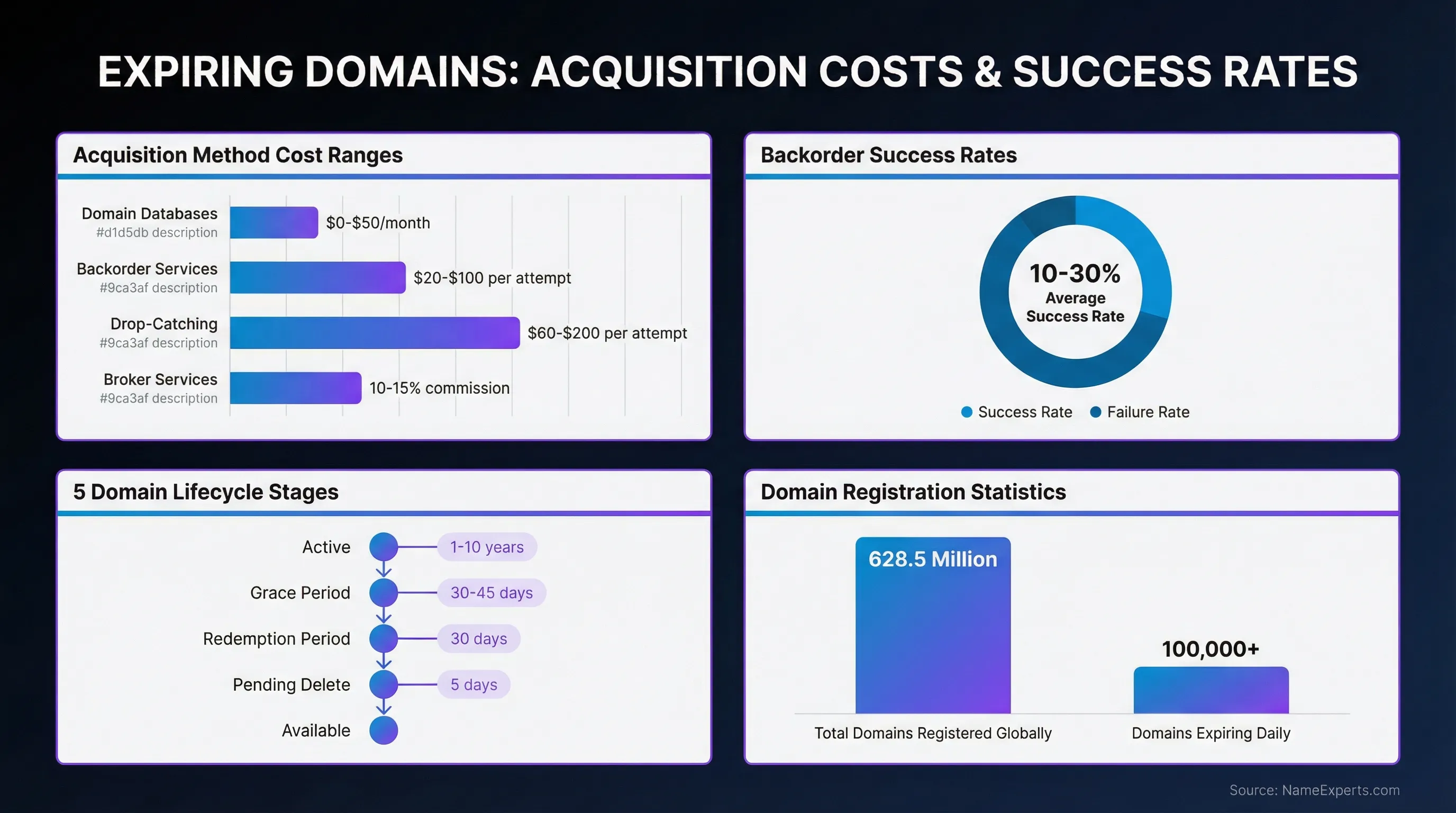
Acquiring an expiring domain can deliver instant SEO advantages—established backlinks, existing authority, and residual traffic—without the years-long wait that new domains require. Around 628.5 million domains are registered globally, and over 100,000 expire daily, creating a competitive marketplace where timing and evaluation determine success. This guide walks you through the complete process, from understanding domain lifecycle mechanics to securing ownership and maximizing inherited value.
Understanding the Domain Expiration Lifecycle
Before you can acquire an expiring domain, you need to understand when it actually becomes available. The process follows a regulated sequence governed by ICANN policies, and each stage presents different strategic opportunities.
The five lifecycle stages:
- Active (1-10 years): The domain is registered and owned by an individual or organization. You cannot register it during this phase.
- Grace Period (typically 30-45 days): After the expiration date passes, the original owner can still renew without extra fees. Domain registration costs vary by registrar—in 2026, you can typically register a .com domain for $10-20 per year, though renewals often cost more than initial registration.
- Redemption Period (30 days): If not renewed during the grace period, the domain enters redemption. The original owner can still reclaim it, but registrars typically charge substantial recovery fees.
- Pending Delete (5 days): After redemption expires, the domain enters a five-day countdown before release. This is when backorder services and drop-catching become relevant.
- Available: The registrar releases the domain back to the public market. Anyone can register it on a first-come, first-served basis—though competition for valuable names is fierce.

Why timing matters: Understanding these stages determines your acquisition strategy. If a domain is in the grace period, you'll need to wait or contact the owner directly. If it's in pending delete, backorder services give you the best chance. If it's already available, you can register it immediately—but you're likely competing with automated systems that monitor drop lists.
A common misconception: "expired" doesn't always mean "available." Many domains sit in grace or redemption for weeks before becoming registrable. Monitoring the lifecycle stage prevents wasted effort on domains you can't yet acquire.
Finding Expiring Domains Worth Buying
Locating quality candidates requires specialized tools that aggregate expiring names and provide filtering capabilities. Manual searching is impractical given the volume—you need databases that compile daily drop lists and provide essential SEO metrics upfront.
Primary discovery methods:
- Domain databases: Specialized platforms catalog millions of names entering the expiration cycle. These services pull data from registrar feeds and present sortable lists with backlink counts, domain age, and Archive.org history.
- Auction platforms: Registrars and aftermarket services host auctions for domains they've captured during the drop process. These typically feature higher-quality names that have already passed initial vetting.
- Backorder services: You can place advance orders for domains still in the pending delete phase. The service attempts to register the name the moment it becomes available.
- Manual monitoring: For specific high-value targets, you can track WHOIS expiration dates and set alerts. This approach works for individual domains but doesn't scale.
Essential filtering criteria:
- Domain age: Older domains generally carry more authority. Use Archive.org's Wayback Machine to verify the domain actually hosted content historically—not just that it was registered years ago.
- Backlink profile quality: Raw backlink counts mean little. You need links from relevant, authoritative sources. A domain with 50 links from reputable sites outperforms one with 5,000 spam links.
- Traffic potential: Some domains still receive visitors from old backlinks or search engine results. This residual traffic can jumpstart your new site's audience.
- Spam signals: Filter out domains with adult content history, pharmaceutical spam, or patterns indicating black-hat SEO. These red flags often disqualify otherwise attractive candidates.
| Method | Best For | Cost Range | Success Rate |
|---|---|---|---|
| Domain Databases | Broad discovery and research | Free to $50/month | High for available domains |
| Auction Platforms | Pre-vetted, competitive names | $10 to $10,000+ | Depends on budget |
| Backorder Services | Specific pending delete targets | $20 to $100 per attempt | 10-30% depending on competition |
| Manual Monitoring | Individual high-value domains | Time investment only | Low without automation |
When evaluating candidates, we've found that NameExperts' valuation tools provide comprehensive analysis of SEO metrics and backlink quality for high-stakes decisions. Our 16+ years of experience with 200+ transactions has taught us that thorough vetting prevents costly mistakes—spending an extra hour on due diligence can save thousands in wasted acquisition costs.
Competing for Premium Expiring Domains?
When multiple buyers target the same high-value domain, standard backorder services deliver success rates as low as 10-30%. If you're pursuing a domain worth $10,000 or more to your business, our stealth acquisition strategies and direct registrar relationships can capture names that would otherwise go to competitors with deeper pockets or better infrastructure.
Evaluating Domain Value Before You Buy
Discovery is only the first step. Before committing funds, you must conduct thorough due diligence to avoid inheriting problems that outweigh any SEO benefits. These domains carry their complete history—both positive and negative.
Critical vetting checklist:
1. Historical content analysis: Use Archive.org to review what the domain hosted previously. Look for:
- Spam content (pharmaceuticals, adult material, gambling)
- Trademark violations or brand impersonation
- Low-quality content farms or scraper sites
- Legitimate business use that aligns with your intended purpose
If the domain hosted questionable content, search engines may have applied penalties that persist even after ownership changes. Research indicates that approximately 25% of short-lived domains are reportedly malicious, demonstrating the prevalence of problematic histories in the expiring domain pool.
2. Backlink quality assessment: Examine the link profile using tools like Ahrefs, Moz, or Majestic. Evaluate:
- Link relevance: Do the linking sites relate to your intended use? Links from topically relevant sources carry more weight.
- Anchor text distribution: Natural profiles show varied anchor text. Over-optimized exact-match anchors suggest manipulation.
- Toxic links: Identify links from known spam networks, link farms, or penalized sites. These can transfer negative signals.
- Link decay rates: A slight rank loss can cut clicks in half, as position one averages about 27.6 percent CTR, while lower positions capture significantly less. Understanding how quickly backlink value erodes helps set realistic expectations.
3. Legal risks assessment: Trademark conflicts represent serious exposure. Check:
- Whether the domain name matches or closely resembles registered trademarks
- If previous content infringed on intellectual property rights
- UDRP (Uniform Domain-Name Dispute-Resolution Policy) case history—has this domain been involved in disputes?
Trademark owners can file UDRP complaints to reclaim domains that infringe on their rights. If you acquire a domain with trademark issues, you risk losing both the domain and your investment. WIPO administers thousands of UDRP cases annually, with trademark conflicts being a leading cause. For comprehensive guidance on avoiding these pitfalls, review our domain due diligence checklist before making any purchase.
4. Domain authority metrics: While metrics like Domain Authority (Moz) or Domain Rating (Ahrefs) provide useful benchmarks, don't rely on them exclusively. These are predictive scores, not guarantees. Focus on:
- Actual referring domains (not just total backlinks)
- Trust Flow vs. Citation Flow (Majestic)—balanced ratios indicate natural link profiles
- Organic search visibility history—did the domain actually rank for valuable keywords?
Red flags that should stop you from bidding:
- No Archive.org history despite claimed age (suggests the domain was parked or unused)
- Sudden spikes in backlinks followed by drops (indicates link scheme participation)
- Previous use for adult content, pharmaceuticals, or gambling (high penalty risk)
- Exact-match trademark conflicts with active brands
- Majority of backlinks from foreign-language sites unrelated to your target market
- Recent manual actions or penalties visible in historical data
The goal is to inherit SEO value, not problems. When in doubt, walk away—thousands of other domains expire daily.
Acquisition Methods: How to Actually Secure the Domain
Once you've identified and vetted a target, you need to choose the right acquisition method based on the domain's lifecycle stage, value, and competitive interest. Each approach has distinct mechanics, costs, and success rates.
Method 1: Backordering services
Backorder services monitor domains in the pending delete phase and attempt to register them the moment they become available. You place an order in advance, and the service uses automated systems to submit registration requests at the exact second of release.
How they work: Multiple customers can backorder the same domain. If the service successfully captures it and multiple customers ordered it, they typically run a private auction among those customers. If you're the only customer who ordered it, you get it at the base backorder price.
When to use: Backorder services work best for domains with moderate competition. If a domain has dozens of backorders across multiple services, your chances decrease significantly. They're ideal when you've identified a valuable name that hasn't attracted widespread attention.
Success rates: Industry data shows backorder success rates average 10-30% for competitive domains, depending on the service's infrastructure and the number of competing registrars attempting to capture the same name.
Method 2: Domain auctions
Registrars and aftermarket platforms host auctions for domains they've captured or that owners have listed for sale. These auctions follow standard bidding mechanics with set timeframes and incremental bid increases.
Bidding strategies:
- Set maximum bids early: Decide your ceiling before bidding begins. Auction fever causes overpaying.
- Watch closing mechanics: Some platforms extend auction time if bids arrive in the final minutes. Others have hard closes. Understand the rules.
- Research comparable sales: Check what similar domains have sold for recently. This prevents both underbidding and overpaying.
Competition levels: Auctions attract serious buyers, so expect competition for quality names. The advantage is transparency—you see competing bids and can adjust strategy accordingly.
Method 3: Drop-catching
Drop-catching involves using specialized services with direct registrar connections to capture domains the instant they're released. This is the most technical and competitive acquisition method.
Technical process: Drop-catching services maintain relationships with multiple registrars and use automated systems to submit registration requests across numerous channels simultaneously. The service with the fastest connection and best registrar relationships wins.
Competitive landscape: Drop-catching is dominated by professional domain investors with sophisticated infrastructure. Success rates for individual buyers using drop-catching services are typically lower than backorder services, but the method can capture extremely valuable names that would otherwise go to competitors.
Method 4: Broker-assisted acquisition
For high-value domains where competition is fierce and stakes are significant, professional brokerage provides strategic advantages that self-service methods cannot match.
When brokerage becomes essential:
- The domain is worth $10,000 or more to your business
- Multiple competitors are likely targeting the same name
- You need stealth acquisition to prevent price inflation
- The domain requires negotiation with the current owner (not yet expired)
- You're building a portfolio and need coordinated acquisition strategy
At NameExperts, our buy-side representation uses stealth acquisition tactics to prevent seller price inflation. We've saved clients substantial amounts—including a fintech startup that paid $42,000 for a domain with a $75,000 asking price, a $33,000 savings. Our 16+ years of experience and 200+ completed transactions give us market intelligence and negotiation leverage that individual buyers lack.
Cost expectations for each method:
- Backorder services: $20-$100 per attempt, plus registration fees if successful
- Domain auctions: Starting bids from $10, but competitive names regularly reach $1,000-$10,000+
- Drop-catching: $60-$200 per attempt, with no guarantee of success
- Broker services: Typically 10-15% commission on successful acquisitions, but savings often exceed fees
Post-Acquisition Strategy
Securing the domain is only half the battle. How you handle the transition determines whether you preserve inherited SEO value or squander it through poor implementation.
Immediate actions after acquisition:
1. Transfer process and registrar selection: If you acquired the domain through an auction or broker, you'll need to transfer it to your preferred registrar. Choose a registrar with:
- Reliable DNS management tools
- Strong security features (two-factor authentication, transfer locks)
- Responsive support for technical issues
- Competitive renewal pricing (registration costs have dropped significantly, but renewal rates vary)
2. Content restoration vs. redirect strategy: You face a critical decision: restore historical content or redirect to an existing site?
Restore historical content if:
- The domain hosted quality content relevant to your business
- You can recreate or improve upon the original site structure
- Backlinks point to specific internal pages (not just the homepage)
- You want to maintain the domain as a standalone property
Implement redirects if:
- You're consolidating the domain's authority into an existing site
- The historical content doesn't align with your current business
- You want to pass link equity to specific pages on your main site
- Maintaining separate content would create duplicate content issues
3. SEO considerations: Maintaining backlink value requires careful execution:
- Implement 301 redirects properly: Map old URLs to relevant new destinations. Generic homepage redirects waste link equity.
- Preserve URL structure when possible: If restoring content, maintain the original URL paths that backlinks point to.
- Monitor for Google penalties: Submit the domain to Google Search Console and watch for manual action notifications. If penalties exist, file reconsideration requests with documentation of ownership change.
- Update backlink anchor text gradually: If you control any of the linking sites, update anchor text slowly to avoid triggering algorithmic filters.
4. Portfolio management for multiple acquisitions: If you're acquiring several domains as part of a broader strategy, organization becomes critical. Track:
- Renewal dates across all domains
- Redirect mappings and their performance
- Traffic and ranking changes post-acquisition
- ROI for each domain investment
For clients managing multiple domain acquisitions, NameExperts offers portfolio management services that handle renewal coordination, redirect optimization, and performance tracking. This prevents valuable domains from accidentally expiring and ensures each acquisition delivers measurable returns.

Common post-acquisition mistakes to avoid:
- Letting the domain sit parked for months (backlinks decay over time)
- Implementing redirects to irrelevant content (wastes link equity and may trigger penalties)
- Ignoring existing penalties or spam associations
- Failing to set up renewal reminders (losing the domain after investing in acquisition)
- Not monitoring traffic and rankings to measure ROI
The most successful domain acquisitions follow a clear implementation plan from day one. Before you bid, know exactly how you'll use the domain and have the resources ready to execute immediately after purchase.
Avoid Costly Due Diligence Mistakes
Inheriting spam penalties, toxic backlinks, or trademark conflicts can turn a promising acquisition into a liability. With 25% of short-lived domains reportedly malicious and UDRP disputes costing thousands, thorough vetting is non-negotiable. Our team has evaluated hundreds of domains across 200+ transactions—request a professional domain evaluation before you commit funds to ensure you're inheriting SEO value, not problems.
Making Your First Acquisition
Acquiring expiring domains combines technical knowledge, market timing, and strategic evaluation. The process rewards patience and thorough vetting—rushing into purchases without proper due diligence leads to wasted investment and potential penalties.
Start with lower-value acquisitions to learn the mechanics before pursuing premium names. Use domain databases to identify candidates, apply strict filtering criteria, and conduct comprehensive historical analysis before committing funds. Choose your acquisition method based on competition level and domain value, and have a clear implementation plan ready before you bid.
For high-value acquisitions where competition is fierce or negotiation is required, professional representation can save multiples of the service cost. Our team at NameExperts has successfully acquired domains for clients including HBO/Max.com, Monday.com, TripAdvisor, and HubSpot. We use stealth acquisition tactics and market intelligence from 16+ years of experience to secure names that would otherwise be unattainable or overpriced.
The expiring domain market moves quickly—over 100,000 domains drop daily. With the right tools, evaluation framework, and acquisition strategy, you can capture names that deliver immediate SEO advantages and accelerate your online growth. Start your search today, and remember: thorough vetting prevents costly mistakes, timing determines success, and professional guidance pays for itself on high-stakes acquisitions.
Ready to Acquire Your Target Domain?
The expiring domain market moves fast—over 100,000 domains drop daily, and competition for quality names is fierce. Whether you're targeting a single high-value domain or building a strategic portfolio, timing and expertise determine success. Our 16+ years of experience and proven track record with clients like HBO/Max.com, Monday.com, and HubSpot means we know how to navigate competitive auctions, conduct thorough due diligence, and execute stealth acquisitions that prevent price inflation. Sch
Schedule a free consultation to discuss your domain acquisition strategy







Frequently Asked Questions
You cannot register a domain immediately upon expiration—it must complete the grace period (30-45 days) and redemption period (30 days) before entering the pending delete phase, where backorder services can attempt to capture it for you.
The primary risks include inheriting Google penalties from previous spam activity, acquiring toxic backlink profiles that harm rankings, facing trademark disputes that could result in losing the domain, and cybersecurity vulnerabilities if the name was previously used for malicious purposes.
For inactive names still owned, contact the registrant directly through WHOIS information or hire a broker for stealth negotiation; for truly expired names, use backorder services, participate in registrar auctions, or employ drop-catching platforms to capture them when they become available.
Yes, GoDaddy automatically enters expiring domains into their auction platform 26 days after expiration, allowing anyone to bid on names that weren't renewed by their original owners.


