
Key Takeaways
- First-year promotional prices mask true costs—renewal rates reveal what you'll actually pay long-term
- ICANN charges a standard $0.20/year fee; everything above that is registrar markup and registry pricing
- Hidden costs like privacy protection, DNS management, and transfer fees can double your actual expense
- Premium and aftermarket domains follow completely different pricing rules where expert valuation becomes essential
- Calculate 3-year total cost of ownership to compare registrars accurately and avoid promotional pricing traps
A .com domain advertised at $0.99 seems like a steal—until you discover it renews at $22.99 the following year. This dramatic price variation confuses buyers searching for straightforward cost information. The domain registration industry operates on promotional pricing models that obscure true long-term expenses, making direct comparisons difficult without understanding the underlying cost structure.
How Domain Pricing Actually Works
Costs flow through a three-tier system that determines what you ultimately pay. At the foundation, registry operators (like Verisign for .com) set wholesale prices based on ICANN agreements. Registrars then add their markup before selling to consumers. Finally, optional services like privacy protection and premium DNS create additional charges.
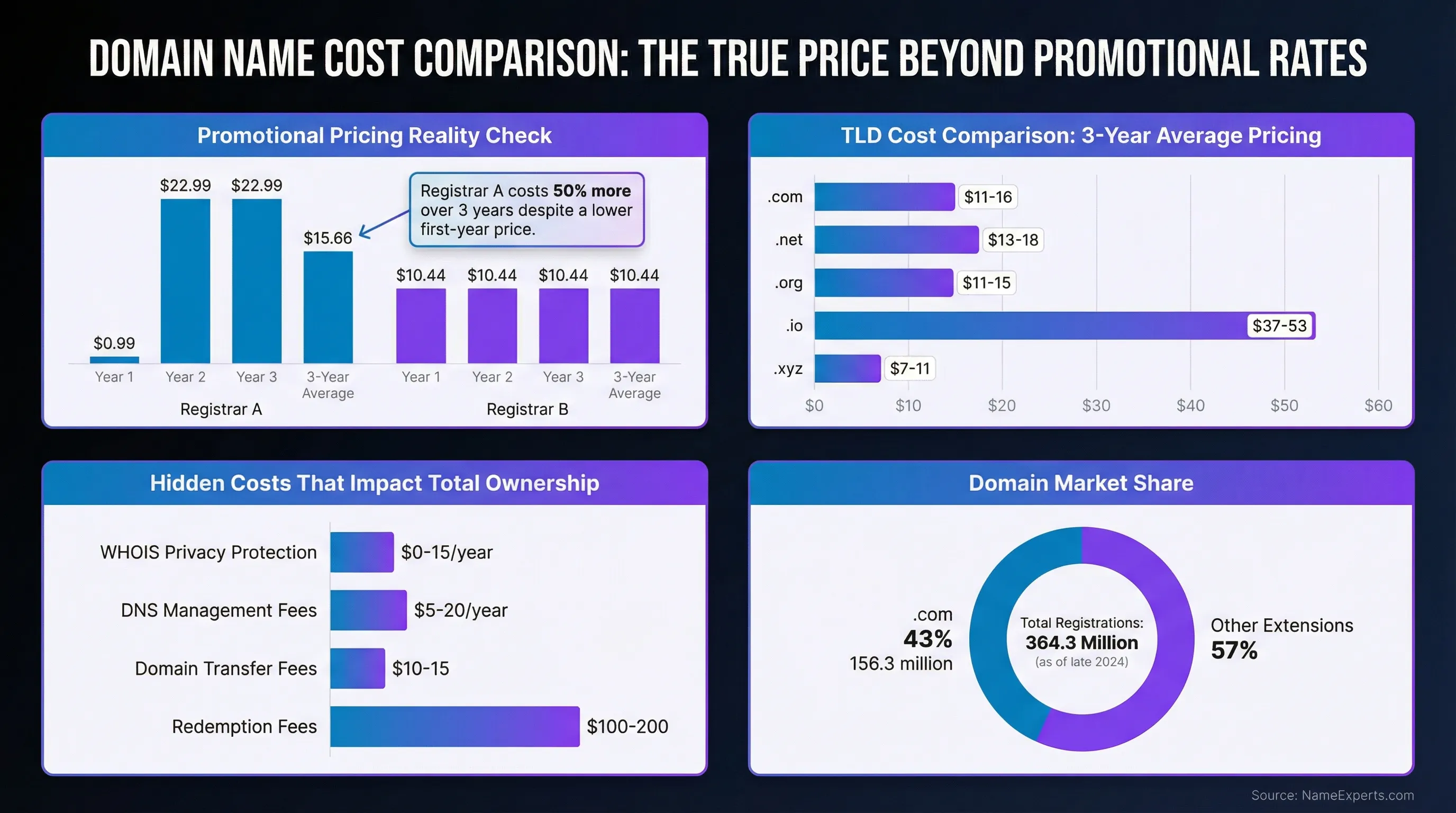
The ICANN fee structure includes a mandatory $0.20 annual charge for .com and .net domains. This fee supports the nonprofit's coordination of the global domain name system. Everything beyond this base amount represents either registry wholesale pricing or registrar profit margins. According to industry data, .com domains represent approximately 43% of all registered domains worldwide—about 156.3 million out of 364.3 million total registrations as of late 2024.
Registry-level pricing varies significantly by extension. Country-code domains like .io command premium rates ($40-60 annually) because the registry itself charges more. Generic extensions like .xyz remain inexpensive ($10-15) due to lower registry fees and high competition among registrars. This explains why certain extensions cost substantially more regardless of which registrar you choose.
Promotional pricing creates the most confusion. Registrars use first-year discounts as customer acquisition tools, then recoup costs through renewal rates. A domain advertised at $0.99 that renews at $20 actually costs an average of $13.66 annually over three years—more expensive than one priced at $10 with $12 renewals ($11.33 average). This promotional model makes comparing providers based solely on initial registration price misleading.
Calculating Total Cost of Ownership
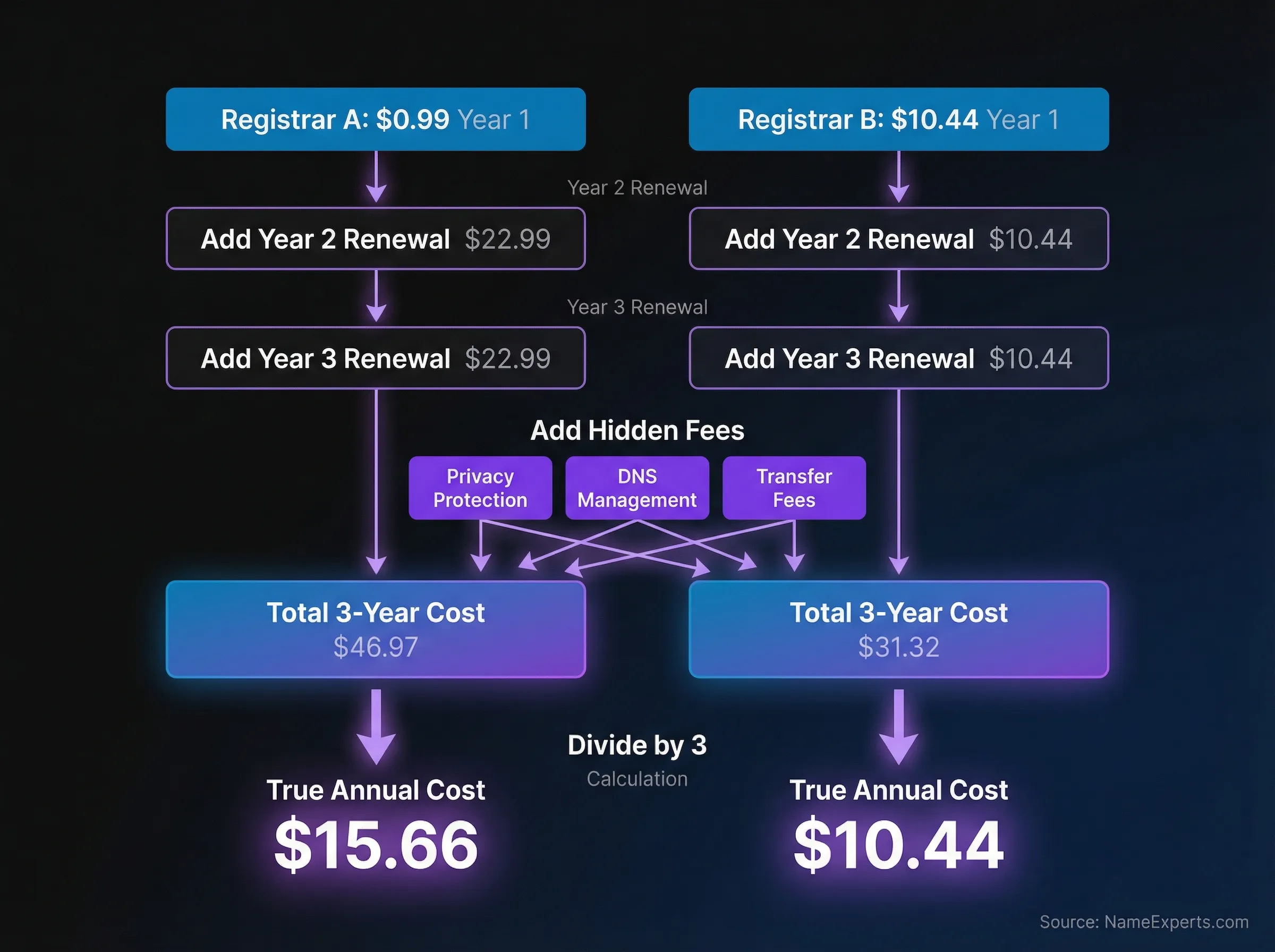
Smart buyers evaluate domains using a three-year total cost of ownership model. This timeframe balances promotional pricing against renewal reality while accounting for typical business planning horizons. The formula is straightforward: (First year + Year 2 renewal + Year 3 renewal + mandatory fees) ÷ 3 = true annual cost.
Consider a practical example. Registrar A offers .com domains at $0.99 for year one, then $22.99 for renewals. Registrar B charges $10.44 initially and $10.44 for renewals. Over three years, Registrar A costs $46.97 total ($15.66 average), while Registrar B costs $31.32 total ($10.44 average). The "cheap" option actually costs 50% more.
| TLD | Typical First Year | Renewal Rate | 3-Year Average | Best For |
|---|---|---|---|---|
| .com | $6-10 | $13-20 | $11-16 | Universal credibility |
| .net | $11-15 | $15-20 | $13-18 | Tech/network services |
| .org | $6-10 | $14-18 | $11-15 | Nonprofits/communities |
| .io | $30-40 | $40-60 | $37-53 | Startups/SaaS brands |
| .xyz | $1-3 | $10-15 | $7-11 | Budget/experimental |
Hidden costs significantly impact total ownership expenses. These often-overlooked charges include:
- WHOIS Privacy Protection: Ranges from free at some providers to $9.99-14.88 annually at others. This service masks your personal contact information in public WHOIS databases, preventing spam and protecting privacy.
- DNS Management Fees: Basic DNS is typically free, but premium DNS with advanced features costs $5-20 annually. Most small businesses don't need premium DNS initially.
- Domain Transfer Fees: Usually $10-15, which includes a one-year extension per ICANN transfer policy. Some registrars waive this fee during promotional periods.
- Redemption Fees: If your domain expires and enters the redemption grace period, recovery costs $100-200 on top of renewal fees. Auto-renewal prevents this expensive mistake.
Privacy protection deserves special attention. According to registrar comparison data, this service adds $0-15 annually depending on the provider. At registrars charging $9.99/year for privacy, a $10 domain effectively costs $20 annually. Providers offering free privacy protection deliver genuine savings for buyers who value this feature.
Navigating Premium Domain Acquisitions?
While standard registrar pricing works for available domains, premium and aftermarket domains require a different approach. If you're considering a domain priced above $1,000 or need to acquire a name that's already registered, get expert valuation and stealth acquisition guidance to prevent seller price inflation and avoid overpaying by hundreds or thousands of dollars.
When Standard Pricing Doesn't Apply
The aftermarket for premium domains operates under completely different economics than standard registration. These previously owned domains sell for $500 to $500,000+ based on perceived value rather than registry pricing. Factors driving premium valuations include domain length (shorter is better), keyword relevance, brandability, existing traffic, and backlink profiles.
Comparison tools fail in the premium domain market because pricing isn't transparent or standardized. A three-letter .com might sell for $50,000 while a similar four-letter version costs $5,000—or vice versa depending on the specific letters and their memorability. Negotiation skills and market knowledge become more important than finding the lowest registrar fees.
In our 16+ years facilitating domain transactions, we've seen businesses overpay by 200-300% on premium acquisitions due to lack of market knowledge. Expert valuation becomes essential when considering domains priced above $1,000. Our team recently helped a fintech startup acquire a premium domain for $42,000 that the seller initially listed at $75,000—a $33,000 savings achieved through comparable sales analysis and strategic negotiation.
When to Consult a Domain Expert
Standard registrar pricing works fine for available domains, but expert guidance adds value when:
- Your desired domain is already registered and you need acquisition strategy
- You're evaluating premium domains priced above $1,000
- You manage portfolios of 10+ domains requiring strategic oversight
- You're navigating domain transfer disputes or ownership conflicts
NameExperts provides expert valuation and stealth acquisition services that prevent seller price inflation. Learn about our buy-side representation.
Brandable domains occupy a middle ground between standard registration and ultra-premium names. These typically cost $500-5,000 and offer memorable, pronounceable names that work well for startups. The premium reflects their marketing value—a strong brandable domain can reduce customer acquisition costs and improve brand recall compared to generic alternatives.

Smart Comparison Strategy
Effective cost comparison requires a systematic approach that accounts for all pricing variables. Follow this process to identify genuine value:
- Calculate 3-year total cost rather than focusing on promotional first-year pricing. Add registration fee plus two renewal cycles, then divide by three for true annual cost.
- Verify included services before comparing prices. Free privacy protection, DNS management, and email forwarding add $15-30 in annual value when bundled at no charge.
- Check registrar reputation for renewal practices. Some providers dramatically increase renewal rates after year one, while others maintain consistent pricing. Review independent feedback on renewal transparency.
- Confirm transfer flexibility in the registrar's terms. Avoid providers that lock domains for extended periods or charge excessive transfer fees. ICANN requires a 60-day lock after initial registration, but additional restrictions vary.
- Consider bundled service value if you need hosting, email, or SSL certificates. Some registrars offer legitimate discounts when services are combined, though unbundled solutions often provide better individual value.
Red flags that indicate problematic pricing practices include opaque renewal rates not disclosed upfront, mandatory add-ons bundled into "discounted" packages, excessive transfer restrictions beyond ICANN's 60-day requirement, and poor customer support reputation based on independent reviews. According to market research, the global domain registrar market reached $1.64 billion in 2026 and continues growing at 4.95% annually, driven by increasing digitalization among small businesses.
For standard domain registration, use price comparison tools to find current best rates across registrars. These tools aggregate real-time pricing and highlight promotional offers. However, remember that the cheapest option isn't always the best value—factor in renewal rates, included services, and registrar reliability.
Making the Right Choice
Understanding total cost of ownership transforms domain shopping from confusing to straightforward. The framework is simple: calculate three-year costs including all fees, verify what's included free, and choose registrars with transparent renewal pricing. This approach reveals that promotional $0.99 domains often cost more than straightforward $10 options over time.
For standard available domains, comparison tools provide the data you need to make informed decisions. For premium domains, complex acquisitions, or portfolio strategy, expert guidance prevents costly mistakes. Our stealth acquisition approach has saved clients an average of 30-40% on premium domain purchases by preventing seller price inflation and leveraging market knowledge.
Whether you're registering your first domain or acquiring a premium name for a rebrand, understanding the true cost structure helps you invest wisely. Calculate beyond the promotional price, account for hidden fees, and recognize when expert valuation adds value. Contact NameExperts for guidance on premium acquisitions or request a domain appraisal to understand market value before negotiating.
Don't Navigate Premium Domain Pricing Alone
The aftermarket domain landscape operates without transparent pricing or standardization—making it easy to overpay without market knowledge. Our team has saved clients 30-40% on premium acquisitions through comparable sales analysis and strategic negotiation. When you're evaluating domains priced above $1,000 or need to acquire an already-registered name, schedule a consultation with our domain acquisition specialists to understand true market value before you negotiate.
Ready to Make a Smart Domain Investment?
Understanding total cost of ownership helps you avoid promotional pricing traps on standard registrations, but premium domain acquisitions require market expertise to prevent overpaying. Whether you're acquiring a brandable domain for your startup or negotiating a premium name for your rebrand, our no-bullshit approach to domain brokerage has saved clients an average of 30-40% through stealth acquisition strategies that prevent seller price inflation. If you're considering a domain investment ab
connect with our team for expert valuation and acquisition strategy







Frequently Asked Questions
Cloudflare Registrar offers the lowest prices by selling domains at cost with zero markup, while Namecheap and Porkbun provide competitive rates with transparent renewal pricing—but always calculate the 3-year total cost rather than comparing promotional first-year rates alone.
Standard .com domains typically cost $10-16 annually when averaging registration and renewal rates over three years, while extensions like .io run $37-53 and budget options like .xyz average $7-11 depending on the registrar.
ICANN rules prevent permanent ownership to maintain fairness in the domain system, but you can register for up to 10 years at once and set up auto-renewal to maintain long-term control indefinitely.
Expect .com renewals between $13-20 annually at most registrars—significantly higher than promotional first-year rates—which is why calculating total cost of ownership over three years reveals the true expense and helps avoid pricing traps.


