
Key Takeaways
- Domain disputes typically involve cybersquatting, typosquatting, or trademark conflicts over domain name registrations
- UDRP offers fast resolution (60 days average) at lower cost ($1,300+) compared to federal court litigation ($50,000+, 18+ months)
- Success in dispute resolution requires proving three elements: trademark similarity, lack of legitimate interest, and bad faith registration
- Prevention through trademark screening and professional due diligence is more effective than reactive dispute resolution
- Professional domain acquisition services help avoid purchasing domains with hidden legal issues or pending disputes
When Nissan Computer Corporation registered nissan.com in 1994, they had no idea they'd face a decades-long legal battle with Nissan Motor Company. This famous case illustrates how conflicts over internet addresses can escalate into costly, protracted disputes that damage brands and drain resources.
What Are Domain Disputes? (Common Types Explained)
A domain name dispute occurs when conflicting parties claim rights to the same internet address. These conflicts typically arise when someone registers a domain that infringes on existing trademark rights, creates consumer confusion, or diverts legitimate traffic to competing sites.
Understanding the specific types helps identify potential problems before they escalate:
Cybersquatting involves registering domains identical or confusingly similar to established trademarks with intent to profit. Cybersquatters typically register brand names, then demand payment from legitimate trademark holders. Research analyzing 370 prominent brands reveals that this practice remains a persistent threat requiring defensive registration strategies.
Typosquatting targets common misspellings of popular domains. Someone might register "gooogle.com" or "amazone.com" to capture misdirected traffic. This practice causes significant revenue loss for affected brands by diverting users who make typing errors.
Reverse domain hijacking occurs when trademark holders improperly attempt to seize domains from legitimate owners. This happens when companies use dispute resolution processes to claim domains that were registered in good faith, often by individuals or businesses with legitimate rights to the name.
Trademark infringement disputes involve genuine conflicts between parties with competing claims. These cases are more complex because both parties may have legitimate business interests in the domain, making resolution through standard processes difficult.

How Domain Disputes Are Resolved (UDRP, ICANN, and Legal Options)
When disputes arise, trademark owners have several resolution paths. The choice depends on the specific circumstances, urgency, and desired outcomes.
Uniform Domain-Name Dispute-Resolution Policy (UDRP)
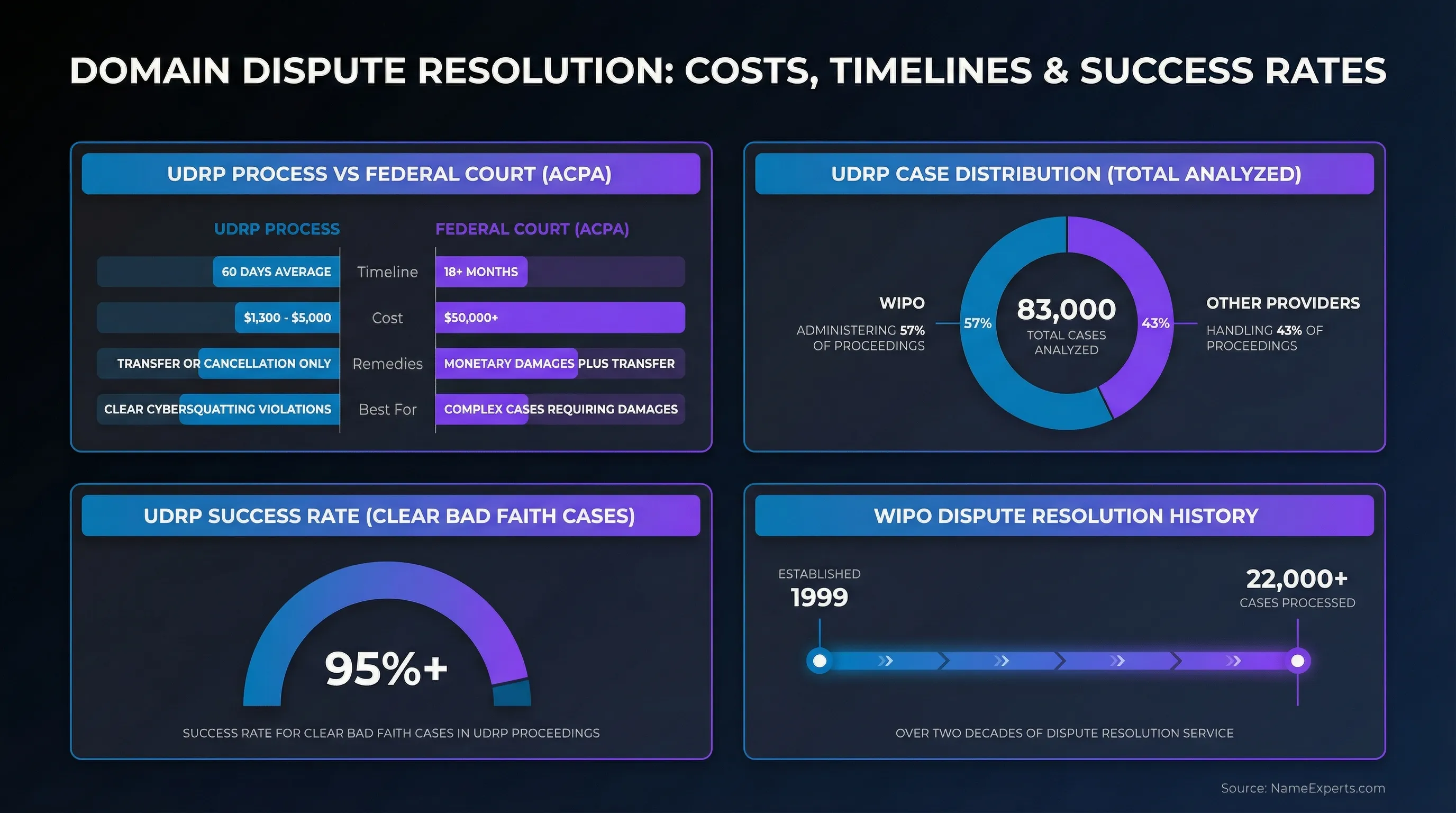
The UDRP provides the most common resolution mechanism for clear-cut cases. WIPO has processed well over 22,000 cases since establishing its dispute resolution service in 1999, making it the leading authority in this space.
To succeed under this policy, complainants must prove three specific requirements:
- The disputed domain is identical or confusingly similar to a trademark in which the complainant has rights
- The registrant has no legitimate rights or interests in the domain
- The domain was registered and is being used in bad faith
The process typically concludes within 60 days from complaint filing. Analysis of 83,000 individual cases shows WIPO administers 57% of proceedings, with other providers handling the remainder. Starting costs begin around $1,300 for single-domain disputes with one panelist.
Success rates favor complainants in clear cybersquatting cases, with 95%+ of complaints resulting in domain transfer or cancellation when bad faith is evident. However, the system works best for straightforward trademark violations rather than complex business disputes.
| Factor | UDRP Process | Federal Court (ACPA) |
|---|---|---|
| Timeline | 60 days average | 18+ months |
| Cost | $1,300-$5,000 | $50,000+ |
| Remedies | Transfer or cancellation only | Monetary damages plus transfer |
| Success Rate | 95%+ for clear bad faith cases | Varies widely by circumstances |
| Best For | Clear cybersquatting violations | Complex cases requiring damages |
When Standard Dispute Resolution Doesn't Work
Several situations fall outside the scope of typical resolution mechanisms. Broken business relationships where domains were registered during legitimate partnerships rarely succeed through UDRP because the original registration occurred in good faith. The policy requires proving bad faith at the time of registration, not just current misuse.
Genuine trademark conflicts between competing businesses need court resolution. When both parties have legitimate claims or when the dispute involves complex factual issues, administrative proceedings cannot provide adequate remedies.
Free speech domains created for criticism or commentary present constitutional considerations beyond the scope of administrative dispute resolution. Attempting to seize these domains often backfires, generating negative publicity and reinforcing perceptions of censorship.
Alternative Resolution Approaches
Direct negotiation often provides the fastest, most cost-effective resolution. Many disputes settle when parties communicate directly about their respective interests and find mutually acceptable solutions.
Professional domain acquisition services can facilitate transfers when legal action seems premature or disproportionate. With our 16+ years of experience facilitating domain transactions, we've helped clients navigate sensitive negotiations that preserve business relationships while securing necessary domain assets.
Avoid Costly Legal Battles Before They Start
Before purchasing any premium domain, comprehensive trademark screening and ownership verification can save you from inheriting expensive disputes. Our team will conduct thorough pre-acquisition due diligence on your target domain to identify potential trademark conflicts and hidden legal risks that could jeopardize your investment.
Famous Domain Dispute Cases (What We Can Learn)
Real-world cases illustrate how disputes unfold and what factors determine outcomes.
The nissan.com case remains one of the most instructive examples. Nissan Computer Corporation registered the domain in 1994 using the founder's surname. When Nissan Motor Company later demanded the domain, courts sided with the computer company because they had legitimate rights to the name and registered it before the automotive company sought it. The case demonstrates that trademark rights don't automatically override legitimate prior registrations.
Microsoft successfully recovered numerous domains through UDRP proceedings when registrants clearly targeted the Microsoft trademark with no legitimate business purpose. These cases succeeded because bad faith was obvious—domains like "microsoftdownloads.com" registered by parties with no Microsoft affiliation and used to confuse consumers.
A technology startup lost a dispute when they attempted to claim a domain from a long-time registrant who operated a legitimate business under that name. The panel found the startup guilty of reverse domain hijacking, demonstrating that trademark registration alone doesn't justify seizing domains from established users.

These cases teach several critical lessons. Timing matters enormously—rights established before trademark registration carry significant weight. Documentation of legitimate use provides crucial defense against claims. Bad faith must be clear and provable, not merely inferred from circumstances. Finally, aggressive pursuit of domains can backfire when registrants have legitimate claims.
How to Prevent Domain Disputes (Proactive Protection Strategies)
Prevention proves far more effective and economical than dispute resolution. Strategic approaches protect brands while avoiding costly conflicts.
For Domain Buyers and Businesses
Conduct comprehensive trademark screening before purchase. We perform thorough trademark database searches as part of our pre-acquisition consultation services, identifying potential conflicts before clients commit to purchases. This due diligence prevents acquiring domains that carry hidden legal risks.
Register defensive domains proactively. Securing common misspellings, alternative extensions, and related variations prevents typosquatters from exploiting your brand. While this requires upfront investment, it costs far less than resolving disputes or losing traffic to confusingly similar domains.
Monitor brand-related registrations continuously. Automated monitoring services alert you when someone registers domains similar to your trademarks, enabling rapid response before problems escalate. Early intervention often resolves issues through simple communication rather than formal proceedings.
Obtain professional domain valuation. Understanding fair market value prevents overpaying for disputed domains and provides leverage in negotiations. Our appraisal services help clients make informed decisions about whether to pursue disputes or negotiate acquisitions.
For Domain Investors and Owners
Research trademark databases before registration. Investing a few minutes in trademark searches prevents registering domains that will inevitably face challenges. Focus on generic terms, geographic names, or descriptive phrases rather than established brand names.
Document legitimate business use. If you register a domain for genuine business purposes, maintain clear records of your intent and use. This documentation provides crucial defense if trademark holders later challenge your registration.
Avoid obvious brand names and typos. Registering slight variations of famous trademarks invites disputes you'll likely lose. The short-term profit potential isn't worth the legal risk and potential liability.
Due Diligence During Acquisition
Professional due diligence during domain acquisition prevents inheriting problems from previous owners. We verify clean ownership history, checking for pending disputes or UDRP proceedings that could jeopardize your investment.
In our 200+ completed transactions, we've encountered numerous situations where thorough investigation revealed issues that would have caused significant problems for buyers. One client nearly purchased a premium domain before our research uncovered a pending trademark dispute. Avoiding that acquisition saved them from inheriting an expensive legal battle.
Domain acquisition involves more than simply purchasing an address. It requires understanding trademark law, researching ownership history, and anticipating potential conflicts. Professional brokerage services provide this expertise, positioning domain purchases as strategic assets rather than legal liabilities.
The preventative approach extends beyond individual transactions. We help clients develop comprehensive domain strategies that align with their brand protection goals, identifying which domains require defensive registration and which disputes merit pursuit versus negotiated resolution.
By treating domain acquisition as a strategic business decision rather than a simple transaction, companies avoid disputes before they start. This proactive stance proves far more effective than reactive dispute resolution, protecting both brand integrity and financial resources while securing the digital assets that drive modern business success.
Navigate Domain Conflicts With Expert Guidance
When disputes arise or you're unsure whether a domain carries legal risks, professional expertise makes the difference between costly litigation and strategic resolution. With 16+ years of experience and 200+ completed transactions, we'll help you assess trademark conflicts and negotiate fair resolutions that protect your business interests without unnecessary legal expenses.
Secure Your Domain Assets Without the Legal Headaches
Domain disputes drain resources, damage brands, and create uncertainty that threatens your digital presence. Whether you're acquiring a premium domain, protecting your trademark, or navigating a potential conflict, professional guidance prevents costly mistakes and positions your domain portfolio as a strategic asset rather than a legal liability. Our no-bullshit approach to domain acquisition includes comprehensive trademark screening, ownership verification, and strategic negotiation that keep
Get your free domain consultation today







Frequently Asked Questions
A domain dispute occurs when two or more parties claim rights to the same internet address, typically involving trademark infringement, cybersquatting, or conflicts between legitimate business interests over who should control the registration.
Under UDRP proceedings, complainants must prove three elements: the disputed name is identical or confusingly similar to their trademark, the registrant lacks legitimate rights or interests in it, and it was registered and used in bad faith.
Most disputes are resolved through ICANN's UDRP process (60 days, $1,300+ cost) for clear cybersquatting cases, while complex trademark conflicts or cases requiring monetary damages need federal court litigation under the Anticybersquatting Consumer Protection Act.
A domain violation occurs when someone registers or uses an internet address that infringes on trademark rights, creates consumer confusion through typosquatting, or engages in cybersquatting by targeting established brand names for profit.


