
Key Takeaways
- Expired domains offer instant SEO value through existing backlinks and established domain authority
- Quality evaluation requires checking 6 critical metrics: backlink profile, spam scores, traffic history, domain age, penalty status, and anchor text diversity
- Public marketplaces list 500K+ domains daily but miss the highest-value inventory acquired through private channels
- Professional appraisal services identify red flags that automated tools overlook
- Premium domains are often secured through brokerage before they reach public auction platforms
The expired domain market represents a significant opportunity for businesses seeking instant SEO advantages, but most buyers either overpay or unknowingly acquire penalized domains. When a domain owner fails to renew their registration, that domain enters a deletion cycle that eventually makes it available for purchase. These assets carry valuable digital properties—backlinks, traffic, and authority—that new registrations simply cannot match. This guide teaches you how to evaluate quality, avoid toxic domains, and access premium inventory before it hits public marketplaces.
What Are Expired Domains and Why Buy Them?
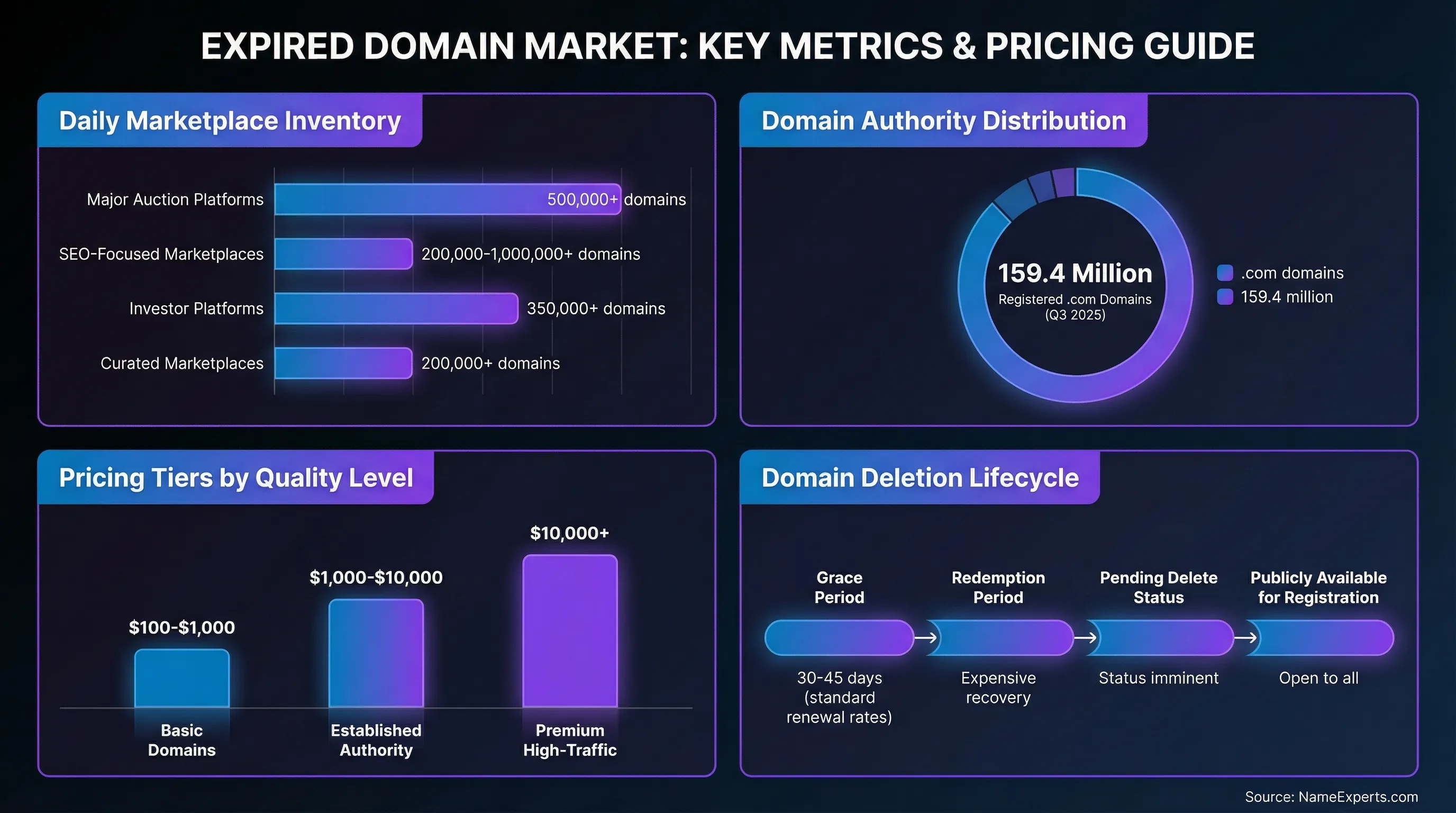
When domain registrations reach their expiration date without renewal, they enter a predictable lifecycle. The grace period allows original owners to renew at standard rates, typically lasting 30-45 days. If renewal doesn't occur, the domain moves into a redemption period where recovery becomes more expensive. After redemption, it enters pending delete status before becoming publicly available for registration.
This lifecycle creates opportunities for savvy buyers. According to industry data, while .com continues to dominate with 159.4 million registered domains as of Q3 2025, the aftermarket for these assets remains highly active. Buyers pursue them for three primary benefits:
Inherited backlink equity provides the most compelling advantage. When you acquire a domain with existing inbound links from authoritative websites, you inherit the trust signals those links represent. Search engines view these established connections as indicators of credibility, giving your content a ranking advantage that new domains require months or years to build.
Existing traffic from referral sources delivers immediate visitors. Domains that previously hosted active websites often continue receiving clicks from old bookmarks, directory listings, and referral links across the web. This residual traffic provides an instant audience for your new project.
Established domain authority accelerates search engine rankings. Older domains with clean histories signal trustworthiness to search algorithms. As SEO research indicates, domain authority encompasses indexed pages, backlink quality, niche trustworthiness, and technical soundness—all factors that influence how quickly your content ranks.
Common use cases include launching new sites with an SEO head start, building private blog networks (though this carries risks), implementing 301 redirects to boost main site authority, and domain investing for resale. The key is understanding that not all expired domains offer equal value—quality evaluation separates profitable acquisitions from costly mistakes.
The 6 Essential Quality Metrics for Evaluating Domains
Automated metrics provide baseline data, but comprehensive evaluation requires examining multiple factors that indicate genuine authority versus artificial manipulation.
Backlink Profile Analysis forms the foundation of quality assessment. Total backlink count matters less than the number of unique referring domains. A domain with 500 backlinks from 50 different websites demonstrates stronger authority than one with 5,000 links from 100 domains—the 10:1 ratio indicates natural link diversity rather than spam patterns. Examine the domain authority or rating of linking sites; connections from high-authority sources carry more weight. Check the dofollow versus nofollow ratio, as dofollow links pass more SEO value. Finally, analyze link velocity patterns to identify natural growth versus sudden spikes that suggest manipulation.
Spam Score Assessment helps identify domains with toxic link profiles. Tools like Majestic provide spam scores that flag suspicious patterns. Look for indicators like links from known private blog networks, identical footer links across multiple sites, or connections to adult, pharmaceutical, or gambling content unrelated to the domain's niche. According to penalty prevention guidelines, spam detection requires checking for link schemes, manipulative practices, and trust issues that could trigger ranking losses.
Traffic History Verification reveals whether a domain genuinely attracted visitors. Services like SimilarWeb or Ahrefs provide historical traffic estimates. Identify sudden traffic drops that may signal penalties or deindexing. Distinguish between organic search traffic (valuable) and referral traffic (which may disappear if source sites remove links). Domains with consistent organic traffic history demonstrate sustained search engine trust.
Domain Age and Archive History offer insights into legitimacy. Domains aged 10+ years typically carry more inherent authority, though age alone doesn't guarantee quality. Use the Wayback Machine to verify the domain hosted legitimate content throughout its history. Red flags include previous use for adult content, pharmaceutical spam, gambling unrelated to current intent, or frequent topic changes suggesting manipulation.

Penalty Status Verification prevents inheriting search engine punishments. Search for "[domain name] penalty" or "[domain name] banned" to uncover public discussions of issues. Check the domain against Google Safe Browsing to ensure it's not flagged for malware or phishing. Review Search Console data if accessible to identify manual actions. Penalties can take months to recover from, making this check critical.
Anchor Text Diversity indicates natural versus manipulative link building. Healthy profiles show varied anchor text with brand names, URLs, and natural phrases. Suspicious patterns include excessive exact-match keywords (over 30% of total anchors), repetitive commercial terms, or unnatural phrase distributions that suggest deliberate manipulation.
While automated tools provide these baseline metrics, our domain appraisal service at NameExperts offers professional vetting that examines trademark conflicts, brand safety issues, and nuanced penalty indicators that standard software cannot detect. With 16+ years of experience evaluating domains across 200+ transactions, we identify risks that could derail your investment.
Don't Risk Buying a Penalized Domain
Automated metrics reveal baseline data, but they miss critical issues like trademark conflicts, subtle penalty signals, and brand safety problems that could cost you thousands. Before you commit to any expired domain purchase, get a professional domain evaluation from our team to identify the red flags that standard tools overlook.
Where to Buy: Marketplace Comparison
The public marketplace landscape offers over 500,000 domains listed daily across multiple platforms, but quality and features vary dramatically. Understanding each platform's strengths helps you target your search effectively.
| Platform Type | Inventory Size | Key Features | Filtering Tools | Best For |
|---|---|---|---|---|
| Major Auction Platforms | 500K+ domains | Beginner-friendly interface, closeout deals, integrated registrar | Basic filters for age, traffic, bids | General buyers seeking convenience |
| SEO-Focused Marketplaces | 200K-1M+ domains | Advanced SEO metrics, multiple TLDs, backlink data | 70+ filters including spam scores, archive data | SEO professionals needing detailed analysis |
| Investor Platforms | 350K+ domains | Bulk search tools, export capabilities, competitive pricing | Import lists, watchlist alerts | Domain investors managing portfolios |
| Curated Marketplaces | 200K+ curated | Pre-vetted inventory, quality screening, established platforms | Pre-filtered quality, niche categories | Serious buyers seeking premium options |
Each platform offers different purchasing methods. Auction formats create competitive bidding environments where prices rise based on demand—ideal for high-value domains but requiring strategic timing. Buy-now options provide instant acquisition at fixed prices, typically 20-40% higher than auction starting bids but eliminating competition risk. Backorder services attempt to register domains the moment they become available, useful for pending delete domains but with no guarantee of success.
According to domain valuation research, pricing follows order-of-magnitude ranges rather than precise values. Basic domains with minimal metrics sell for $100-$1,000, while those with established authority and clean backlinks range from $1,000-$10,000. Premium options with significant traffic and high domain ratings can exceed $10,000, though prices depend heavily on niche relevance and buyer circumstances.
Public marketplaces have inherent limitations. The best domains never reach public listings because brokers and investors acquire them during grace or redemption periods. Automated metrics miss critical quality issues like trademark conflicts or subtle penalty signals. Competitive bidding inflates prices beyond fair market value. Buyers have no negotiation leverage in auction formats.
These constraints explain why serious buyers often supplement marketplace searches with professional brokerage services that access pre-market inventory.
Step-by-Step Process to Buy Your First Domain
A systematic approach reduces risk and increases the likelihood of acquiring valuable assets rather than problematic ones.
Step 1: Define Your Criteria before searching. Establish niche relevance requirements—domains should relate to your intended content or business. Set minimum authority thresholds (Domain Authority 20+ or Domain Rating 30+ for meaningful SEO value). Determine budget parameters including maximum bid limits. Clarify your intended use case, as requirements differ for new site launches versus 301 redirects versus private blog networks.
Step 2: Search and Filter Strategically using advanced options. Filter for domain age of 5+ years to ensure established history. Set spam score maximums below 5% to avoid toxic profiles. Require minimum referring domains (50+ for modest authority, 100+ for stronger profiles). Create watchlists for domains meeting your criteria and set up email alerts for new additions matching your parameters.
Step 3: Conduct Deep Quality Audits on shortlisted candidates. Perform manual backlink reviews in Ahrefs or Majestic, examining the top 100 links for quality and relevance. Use the Wayback Machine to verify historical content aligns with your intended use. Search for "[domain] penalty" or "[domain] banned" to uncover potential issues. Check the domain against Google Safe Browsing to ensure it's not flagged for security threats.
Step 4: Valuation and Bidding Strategy prevents overpaying. Use automated appraisal tools as baseline estimates, but recognize these often miss niche-specific value. Factor in premium pricing for highly relevant domains in competitive industries. Set maximum bid limits before auctions begin to avoid emotional overspending. Time your bids strategically—early bids attract attention, while last-minute entries reduce competition visibility.
Step 5: Post-Purchase Verification and Setup ensures you received what you paid for. Transfer the domain to your preferred registrar immediately. Add it to Google Search Console to monitor indexing status and check for existing manual actions. Monitor for negative SEO or inherited penalties in the first 30 days. If using the domain for redirects, implement 301 redirects following best practices to preserve link equity, as proper redirect implementation determines whether you successfully transfer authority or lose it entirely.

Accessing Premium Inventory Through Brokerage
The highest-value domains—those with Domain Rating 60+, clean backlink profiles, and brandable names—rarely appear on public auction platforms. Experienced brokers and investors monitor pending deletions and negotiate directly with current owners during grace and redemption periods, securing premium assets before they reach the open market.
Professional brokerage services maintain private inventory networks and conduct stealth acquisitions that avoid competitive bidding. This approach benefits buyers in several scenarios: when seeking domains in competitive niches like finance, health, or legal where quality inventory disappears quickly; when requiring specific brandable names with verified clean histories; when needing domains with Domain Rating 50+ and confirmed traffic; or when wanting pre-vetted inventory without investing hours in manual research.
At NameExperts, our 16+ years of experience identifying premium domains before public listing provides clients with early access to inventory unavailable elsewhere. We maintain direct relationships with domain investors and registrars, enabling acquisition during grace periods when owners are most motivated to sell. Our comprehensive due diligence eliminates penalty risks that plague marketplace purchases, and our negotiation expertise often secures below-market pricing despite private acquisition channels.
The cost-benefit analysis favors brokerage for serious acquisitions. While brokerage fees typically range from 10-15% of purchase price, this investment saves dozens of research hours, dramatically reduces the risk of acquiring penalized domains, and provides access to inventory that never appears on public marketplaces. For businesses where domain quality directly impacts revenue, professional representation delivers returns that far exceed the service fee.
Access Premium Domains Before Public Listing
The highest-value expired domains with Domain Rating 60+, clean backlinks, and brandable names never appear on public auction platforms—brokers secure them during grace periods before competitive bidding begins. If you're serious about acquiring premium inventory with verified SEO value, connect with our brokerage team to explore pre-market acquisition opportunities that give you first access to domains that would otherwise disappear before you ever see them.
Red Flags and Risks to Avoid
Understanding common pitfalls prevents costly mistakes that can derail your SEO strategy or create legal complications.
Google penalties and manual actions represent the most significant risk. According to penalty recovery guidelines, these punishments occur when domains violate search quality guidelines through spam, manipulation, or trust issues. Check penalty history by searching for the domain name combined with terms like "penalty," "banned," or "deindexed." Common penalty types include Penguin (link-based penalties for unnatural backlink patterns) and Panda (content-based penalties for thin or duplicate content). Penalties can persist even after ownership changes, requiring extensive cleanup efforts.
Toxic backlink patterns indicate manipulation that search engines penalize. Warning signs include spammy anchor text ratios where exact-match commercial keywords exceed 30% of total anchors, links from adult, gambling, or pharmaceutical sites unrelated to the domain's niche, sudden link velocity spikes suggesting purchased links rather than organic growth, and PBN footprints like identical IP ranges, matching footer links, or similar site structures across linking domains.
Trademark and legal risks create potential liability. Conduct USPTO trademark searches to identify conflicts with registered marks. Avoid domains that create brand confusion with established companies, even if not trademarked. Research whether the domain has existing legal disputes or cease-and-desist history. Trademark infringement claims can force you to surrender the domain and pay damages, making this due diligence essential.
Fake metrics and inflated valuations mislead buyers. Some domains show artificially inflated Domain Authority through temporary link schemes that collapse after purchase. Traffic may come from bot networks rather than legitimate visitors, disappearing immediately after acquisition. Sellers sometimes misrepresent archive.org data, claiming historical content that never existed or exaggerating the site's previous prominence. Always verify metrics through multiple independent sources before committing to purchase.
Making Your First Acquisition
Expired domains offer legitimate SEO value when properly evaluated. The backlink equity, residual traffic, and established authority they provide can accelerate new projects significantly faster than starting from scratch. However, success requires expertise that goes beyond automated metrics.
Public marketplaces provide access to extensive inventory but demand significant knowledge to separate quality assets from toxic liabilities. The six-metric evaluation framework—backlink profile, spam scores, traffic history, domain age, penalty status, and anchor text diversity—forms the foundation of sound decision-making, but nuanced risks require professional assessment.
Whether you choose to search marketplaces independently or pursue premium pre-vetted inventory, professional evaluation eliminates costly mistakes. Found a potential domain that meets your criteria? Get a free professional evaluation from NameExperts. Our 16+ years of domain expertise identifies red flags that automated tools miss—trademark conflicts, subtle penalty indicators, and brand safety issues that could undermine your investment.
If you're seeking premium domains with verified SEO value, our brokerage service accesses inventory that never reaches public marketplaces. We've completed 200+ successful transactions for clients including HBO/Max.com, Monday.com, TripAdvisor, and HubSpot, securing high-value domains while protecting buyers from the risks that plague marketplace purchases. Contact us to discuss your domain acquisition needs and discover how professional representation transforms the buying process.
Ready to Acquire Your Domain with Confidence?
Expired domains offer legitimate SEO advantages, but success requires expertise that goes beyond automated metrics. Whether you've found a potential domain that needs professional vetting or you're seeking premium pre-market inventory with verified authority, our 16+ years of domain expertise protects you from the costly mistakes that plague marketplace purchases. We've completed 200+ successful transactions for clients including HBO/Max.com, Monday.com, and HubSpot, identifying red flags that c
Schedule a free consultation with our domain acquisition team







Frequently Asked Questions
SEO-focused marketplaces with advanced filtering tools (70+ metrics including spam scores and archive data) provide the most comprehensive public inventory, while professional brokerage services access premium domains with Domain Rating 50+ before they reach public listings.
Basic domains with minimal authority sell for $100-$1,000, those with established backlink profiles range from $1,000-$10,000, and premium options with significant traffic and high domain ratings exceed $10,000 depending on niche relevance.
Yes, major auction platforms including GoDaddy list 500K+ domains daily with beginner-friendly interfaces and closeout deals, though they lack the advanced SEO filtering tools and pre-vetted inventory found on specialized marketplaces.
Google penalties that persist after ownership changes, toxic backlink patterns from link schemes or PBNs, trademark conflicts that can force domain surrender, and fake metrics from temporary manipulation that disappear post-purchase represent the most critical risks requiring professional vetting.


