
Key Takeaways
- Brandable domains create unique identity rather than describing services—think Shopify vs. OnlineStoreSoftware.com
- Quality names share four traits: memorability, brevity (under 12 characters), clear pronunciation, and timeless appeal
- Professional evaluation prevents trademark conflicts and pronunciation failures that cost thousands in rebranding
- Acquisition channels range from $10 hand registration to $25,000+ premium marketplaces and brokerage services
- The .com extension remains essential—new generic TLDs grew 13.5% year-over-year but .com dominates trust and recall
The difference between NewYorkCafe.com and Starbucks.com illustrates why brandable domains matter for businesses launching or rebranding. One describes a location and product. The other creates an identity that scales globally. This distinction determines whether your domain becomes a forgettable address or a valuable business asset.
What Makes a Domain Name Brandable?
A brandable domain establishes unique identity rather than describing what you do. Generic descriptions like ProjectManagementSoftware.com tell visitors exactly what they'll find, but they create zero emotional connection. Memorable names like Asana spark curiosity and stick in memory after a single encounter.
Four essential characteristics define quality options:
Memorability: The name should lodge in someone's mind after hearing it once. Research on brand recall shows that distinctive names outperform descriptive alternatives in customer retention. When someone mentions your business at a networking event, listeners should remember how to find you online.
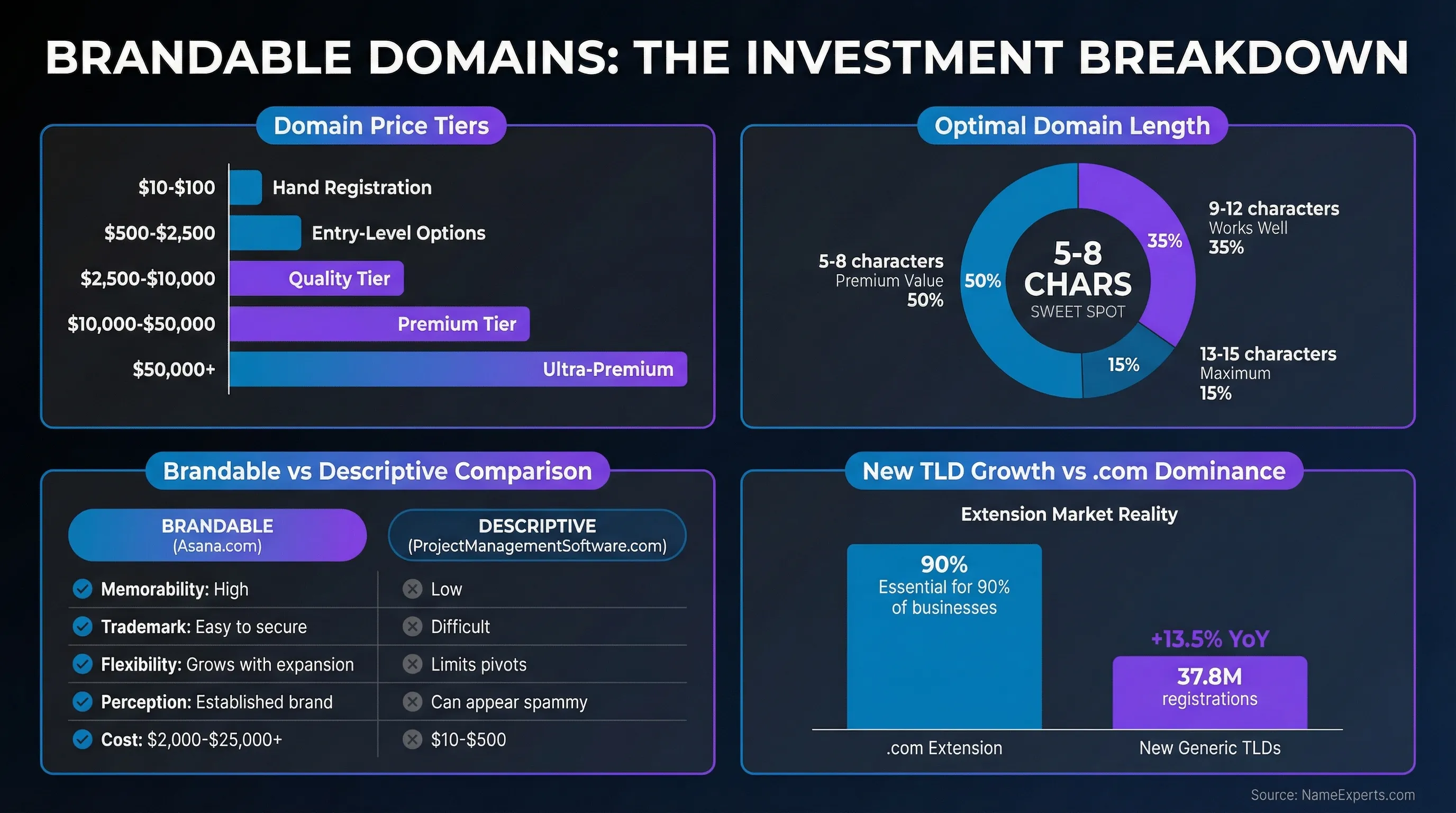
Length: Shorter names win. Five to eight characters hit the sweet spot for premium value. Nine to twelve characters work well for most businesses. Beyond fifteen characters, you're asking customers to work too hard. Every extra letter increases the chance they'll mistype your address or give up entirely.
Pronunciation: Clear spelling matters when customers hear your name spoken. If you need to explain "it's spelled with a Y not an I," you've created friction. The phone test reveals this immediately—say the name to someone and see if they can find your site without help.
Timelessness: Trends fade. Your domain should feel relevant in five or ten years. Names tied to current slang or technology buzzwords age poorly. Classic construction techniques create lasting value.
Real Examples That Work
Invented words: Shopify, Spotify, and Hulu demonstrate how made-up terms become household names. These creations carry no baggage from existing meanings. They're blank canvases for building brand associations.
Dictionary words used uniquely: Apple, Amazon, and Nest took common words and gave them new context. The familiarity makes them easy to remember while the unexpected application creates interest.
Compound brandables: Facebook, Pinterest, and PayPal combine two concepts into something greater than the sum of parts. This approach hints at functionality while maintaining distinctiveness.
Modified spellings: Lyft and Fiverr show when creative spelling works—the modification is intuitive and the name remains pronounceable. This technique fails when it creates confusion about the correct spelling.
Expert evaluation identifies these qualities before purchase. We've helped clients avoid names that seemed clever in brainstorming but failed basic pronunciation tests. A professional assessment catches issues that cost thousands to fix later.

Strategic Differences: Brandable vs. Descriptive
The choice between these approaches shapes your business trajectory. Descriptive options like ProjectManagementSoftware.com explain exactly what visitors will find. They're literal and functional. Brandable alternatives like Asana create identity that transcends any single product or service.
| Factor | Brandable Domain | Descriptive Domain |
|---|---|---|
| Example | Asana.com | ProjectManagementSoftware.com |
| Memorability | High—unique and catchy | Low—generic and forgettable |
| Trademark Protection | Easy to secure | Difficult—often generic terms |
| Business Flexibility | Grows with expansion | Limits future pivots |
| Professional Perception | Established brand feel | Can appear spammy |
| Typical Cost | $2,000-$25,000+ | $10-$500 |
Why businesses choose brandable: Long-term value outweighs initial cost. Marketing flexibility allows you to evolve offerings without changing your identity. When Asana expanded beyond project management into workflow automation, the name still fit perfectly. ProjectManagementSoftware.com would have become a liability.
When descriptive might work: Local businesses serving specific geographic areas sometimes benefit from literal names. PlumberSanDiego.com tells exactly what and where. Niche service providers in established categories can leverage descriptive clarity. But these situations are exceptions, not the rule.
The SEO reality: Many assume descriptive names boost search rankings through keyword matching. Modern search algorithms prioritize content quality and user signals over exact-match domains. Brandable names build authority through exceptional content and customer experience. The initial SEO advantage of descriptive names has largely disappeared.
Companies that rebranded from descriptive to brandable names consistently report improved market perception. The investment signals commitment to building something lasting rather than chasing quick traffic.
Don't Risk an Expensive Naming Mistake
Trademark conflicts, spam history, and pronunciation failures cost thousands in rebranding. Our 8-point professional evaluation catches these issues before you invest—protecting your budget and brand reputation from day one.
Identifying Quality Options: The Expert Framework
Professional evaluation separates memorable names from expensive mistakes. This eight-point checklist reveals what we examine when assessing potential acquisitions:
The 8-Point Evaluation Checklist
- Pronunciation Test: Can you say it clearly over the phone? Would someone spell it correctly after hearing it once? Call a friend and say the name. If they can't find your site without additional spelling help, it fails this test.
- Length Assessment: Five to eight characters command premium prices. Nine to twelve characters work well for most businesses. Thirteen to fifteen characters represent the maximum before usability suffers. Each additional character reduces memorability and increases typo risk.
- Extension Priority: The .com extension remains essential for 90% of businesses. According to industry data, new generic TLDs recorded 37.8 million registrations with 13.5% year-over-year growth, but .com still dominates trust and automatic typing behavior. Alternative extensions work for specific niches—.io for tech startups, .ai for artificial intelligence companies—but most businesses need .com.
- Spelling Clarity: Avoid double letters that create confusion (is it one T or two?). Skip hyphens entirely—they look unprofessional and users forget them. Numbers create ambiguity: is it "4" or "four" or "for"? Clean, obvious spelling eliminates friction.
- Trademark Clearance: USPTO searches are non-negotiable. International trademark databases matter for global brands. Comprehensive trademark research prevents cease-and-desist letters that force expensive rebrands. We search USPTO, WIPO, and EU databases plus Google the name with "lawsuit" and "trademark dispute."
- Domain History Check: Wayback Machine reveals previous site content. Spam or adult content history can mean Google penalties that persist for years. Tools like Ahrefs historical data and spam database checks verify clean records. Previous use damages brand perception even if penalties don't apply.
- Phonetic Appeal: Does it sound pleasant when spoken? Harsh consonant clusters feel aggressive. Smooth vowel-consonant flow creates positive associations. Say the name aloud repeatedly—if it feels awkward, customers will avoid saying it, killing word-of-mouth marketing.
- Cultural Sensitivity: Check meanings in other languages if you plan global expansion. What sounds great in English might be offensive or ridiculous elsewhere. International market considerations prevent embarrassing mistakes that limit growth.
Red Flags That Diminish Value
Hyphens: They appear unprofessional and create typo traffic loss. Users forget whether the hyphen exists and where it goes. BestCoffee-Shop.com loses visitors to BestCoffeeShop.com.
Numbers: The confusion between "4" versus "four" versus "for" fragments your traffic. Some users type the numeral, others spell it out. You're splitting your audience before they arrive.
Common misspellings: Intentional misspellings rarely work. Flickr succeeded despite the missing vowel, but for every Flickr there are thousands of failed attempts. The cognitive load of remembering the "clever" spelling outweighs any perceived benefit.
Overly trendy suffixes: The -ly, -ify, and -io suffixes saturated the market between 2020-2026. What felt fresh in 2020 now signals "trying too hard." Timeless construction outlasts trends.
Acronyms without meaning: Unless you're IBM or GE with decades of brand equity, acronyms confuse more than clarify. ACME works because it's a word. XYZQ doesn't work because it's random letters.
Professional Insight
Expert evaluation prevents costly mistakes. We've seen businesses invest thousands in branding a name only to discover trademark conflicts or pronunciation issues that kill word-of-mouth marketing. A consultation saves significant rebranding costs down the line.
One client came to us after spending $8,000 on branding a name with trademark conflicts. The cease-and-desist letter arrived six months after launch. Rebranding required new materials, updated marketing, and customer communication about the change. Professional evaluation before purchase would have identified the conflict immediately.
Where to Find Quality Options
Four primary acquisition channels serve different needs and budgets. Understanding the pros and cons of each helps you choose the right approach.
Curated Marketplaces
Specialized platforms offer pre-vetted selections with logos included. These marketplaces employ naming experts who screen submissions for quality. Only 3-5% of submitted names pass their curation standards.
Pros: Pre-vetted quality saves evaluation time. Logo inclusion provides turnkey branding. Immediate purchase enables fast launches. Trademark pre-screening reduces legal risk.
Cons: Premium pricing reflects the curation service. Expect $2,000-$10,000 for quality options. Selection is limited to current inventory. You're choosing from existing names rather than creating custom options.
Best for: Businesses wanting turnkey solutions. Entrepreneurs who value speed over cost optimization. Companies that need professional design included.
Expired Domain Auctions
GoDaddy Auctions, NameJet, and SnapNames list domains that previous owners let expire. These platforms auction names to the highest bidder. Established age and existing backlinks can provide SEO value.
Pros: Lower entry prices than curated marketplaces. Domain age benefits search rankings. Existing backlink profiles provide immediate authority. Competitive bidding reveals market value.
Cons: Requires expertise to evaluate quality and history. Competitive bidding can drive prices up. History checking is essential—previous spam use creates penalties. Time investment in research and bidding.
Best for: Investors and experienced buyers. Those with time to research thoroughly. Buyers seeking aged domains for SEO benefits.
Hand Registration
AI generators and creative brainstorming can identify available names for standard registration fees. Tools like OneWord.Domains database help discover unregistered options. This approach offers the lowest cost but requires the most creativity.
Pros: Registration costs only $10-20. Complete creative control over the name. No competition for unregistered options. Satisfaction of creating something original.
Cons: Most premium short names are already registered. Requires significant creativity and time. No guarantee you'll find suitable options. Easy to settle for mediocre choices.
Best for: Unique invented words. Specific niche applications. Bootstrapped startups minimizing costs. Creative founders who enjoy the naming process.
Domain Brokerage Services
Professional brokers like NameExperts pursue specific unavailable names through stealth acquisition and expert negotiation. When you've identified the perfect name but someone else owns it, domain brokerage services make acquisition possible.
Pros: Access to unlisted inventory. Professional negotiation prevents inflated prices. Confidential approach protects your identity. Expertise in transfer processes. Handles entire transaction from contact through transfer.
Cons: Brokerage fees typically run 10-15% of purchase price. Longer timeline than marketplace purchases. Success depends on current owner's willingness to sell. No guarantee of acquisition.
Best for: Pursuing specific unavailable names. High-value acquisitions where negotiation expertise matters. Businesses that need confidential transactions. Companies lacking internal domain expertise.
NameExperts Acquisition Services
When you've identified the perfect name but it's already registered, professional brokerage makes the difference. Our stealth acquisition approach contacts owners confidentially, negotiates fair pricing, and handles the entire transfer process. With 16+ years of experience and 200+ successful transactions, we know how to acquire names without triggering inflated asking prices.
Our transaction history includes high-profile acquisitions for major brands. This experience provides real market pricing data that goes beyond algorithmic estimates. We understand what names actually sell for, not what automated appraisals suggest.
Common Mistakes to Avoid
Five costly errors derail naming projects. Learning from others' mistakes saves time and money.
Skipping Trademark Research
Real consequence: Cease-and-desist letters force expensive rebrands. One client invested $30,000 in branding before discovering trademark conflicts. The legal threat required complete rebrand including new marketing materials, updated packaging, and customer communication about the change.
Solution: USPTO searches are mandatory. International trademark databases matter for global businesses. Legal consultation provides definitive answers. NameExperts includes trademark screening in evaluation services, catching conflicts before you invest in branding.
Choosing Memorability Over Clarity
Example: Xyzr.com might be unique but it's impossible to remember or spell. The balance between distinctive and intuitive determines success. Names that are too clever create friction that kills word-of-mouth marketing.
Balance needed: Distinctive yet intuitive. Memorable but pronounceable. Unique without being bizarre. The sweet spot combines originality with accessibility.
Ignoring Domain History
Previous spam use: Google penalties persist for years. Sites that hosted spam, malware, or black-hat SEO tactics carry baggage that affects your rankings. The domain might be available because the previous owner destroyed its value.
Adult content history: Brand perception suffers when customers discover previous use. Even if penalties don't apply, the association damages credibility. Professional clients won't take you seriously if your domain previously hosted inappropriate content.
Tools: Wayback Machine shows historical content. Domain history checkers reveal previous use. Ahrefs historical data exposes spam patterns. Comprehensive checking prevents inheriting someone else's problems.
Settling for Non-.com Extensions
User behavior: A significant portion of users automatically type .com regardless of what extension you promote. This creates traffic leakage to whoever owns the .com version. You're essentially marketing for your competitor.
When alternatives work: Tech startups successfully use .io extensions. Artificial intelligence companies leverage .ai domains. Specific industries have adopted alternative extensions. But these are exceptions requiring strong branding to overcome .com bias.
Risk: Traffic leakage to .com version owned by others. Reduced trust from customers unfamiliar with alternative extensions. Constant explanation of your extension. Lost word-of-mouth traffic from people who assume .com.
Buying Without Professional Valuation
Overpaying: Emotional attachment clouds judgment. Sellers exploit buyer enthusiasm to inflate prices. Without market data, you can't distinguish fair pricing from gouging. One client paid $15,000 for a name worth $3,000 because they fell in love with it.
Underpaying: Missing hidden value in aged domains. Existing backlinks and authority justify premium prices. Walking away from good deals because you don't recognize value. Market knowledge reveals opportunities others miss.
Expert appraisal: Professional domain appraisal provides negotiation leverage. Real comparable sales data grounds discussions in reality. Our 200+ transactions give us pricing knowledge that algorithmic tools can't match. We've saved clients 20-40% through expert negotiation, more than covering consultation fees.
Stop Overpaying for Premium Domains
Without real market data from actual transactions, you're negotiating blind. Our 16+ years of experience and 200+ successful acquisitions give you pricing knowledge that saves 20-40% through expert negotiation—more than covering our consultation fees.
Financial Reality: Investment Perspective
Understanding pricing tiers helps set realistic expectations and budget appropriately.
Price Tiers and What They Mean
$10-100: Hand Registration
New, creative invented words you register yourself. This tier requires the most creativity but offers complete cost control. Success depends entirely on your naming skills.
$500-2,500: Entry-Level Options
Seven to nine character names from newer marketplaces. Some compromises on length or extension. Decent starting points for bootstrapped ventures. Quality varies significantly in this range.
$2,500-10,000: Quality Tier
Five to seven characters with clear pronunciation. .com extension from established marketplaces. This range offers the best balance of quality and affordability for most businesses. Professional curation ensures solid fundamentals.
$10,000-50,000: Premium Tier
Four to six characters with exceptional memorability. Aged domains with established authority. Names in this tier provide immediate credibility and SEO benefits. Investment justified for well-funded ventures.
$50,000+: Ultra-Premium
Three to five characters. Dictionary words with massive brand potential. These names are business assets that can appreciate over time. Reserved for established companies or well-capitalized startups.
Investment Perspective
Quality domains represent one-time marketing investments that provide lasting value. A $5,000 acquisition:
- Eliminates future rebranding costs: Complete rebrands require new materials, updated marketing, and customer communication. Getting it right initially saves this entire expense.
- Builds immediate credibility: Professional names signal established business versus weak alternatives that suggest amateur operation. First impressions matter in customer acquisition.
- Provides trademark protection: Unique names are easier to protect legally. Generic descriptive terms face challenges in trademark registration. Distinctive options secure your brand identity.
- Remains a saleable asset: If business pivots or closes, quality names retain value. They're liquid assets that can be sold to recover investment. Poor names have zero resale value.
NameExperts Consultation Value: Professional evaluation and acquisition services typically cost 10-15% of total value but prevent overpaying by 20-40% through expert negotiation. The net result is savings plus strategic guidance. Our real market knowledge from 200+ transactions provides pricing data that algorithmic tools can't match. For more insights on domain pricing, see our guide on how to value a domain name and our comprehensive resource on buying a premium domain name.

Making Your Final Decision
A structured selection process prevents expensive mistakes and builds confidence in your choice.
Step-by-Step Decision Framework
- Create Your Shortlist: Identify 5-10 candidates that pass the 8-point evaluation checklist. Don't settle for one option—comparison reveals strengths and weaknesses. Multiple choices provide fallback options if your first choice has issues.
- Test With Real People: Say each name aloud to 10 people. Ask them to spell it without seeing it written. Check if they remember it 24 hours later. Real-world testing reveals problems that internal teams miss. Friends and family provide honest feedback.
- Check Social Media Availability: Matching handles on Instagram, Twitter, and Facebook add significant value. Consistent naming across platforms strengthens brand recognition. Fragmented social presence confuses customers and dilutes marketing impact.
- Run the Phone Test: Call a friend and say the name. See if they can find your site without additional help. This simulates word-of-mouth marketing scenarios. If they can't locate you easily, the name fails practical use.
- Evaluate Long-Term Fit: Will this work if you expand services? Does it support entry into new markets? Names that limit growth become liabilities. Flexibility matters more than perfect current fit.
- Get Expert Validation: Professional evaluation catches issues you'll miss. Outside perspective identifies problems that internal teams overlook. Investment in consultation prevents expensive mistakes.
When to Consult Domain Experts
Professional guidance makes sense in specific situations:
- Investing over $5,000: At this price point, evaluation fees are small insurance against major mistakes. Expert negotiation often saves more than consultation costs.
- Pursuing unavailable names: Stealth acquisition requires professional expertise. DIY approaches often inflate prices by revealing buyer interest. Experienced brokers know how to approach owners effectively.
- Launching with significant capital: When substantial funding backs your venture, getting the foundation right matters. Cheap mistakes become expensive problems at scale.
- Rebranding established companies: Existing customer base and market presence raise the stakes. Professional guidance prevents alienating current customers while attracting new ones.
- Needing trademark strategy: Complex legal considerations require expert navigation. International expansion adds layers of complexity. Professional guidance prevents legal problems.
For expert assistance with your domain acquisition, consider working with the best domain brokers in the industry.
Your Next Steps
Brandable domains are investments in identity, not just web addresses. The characteristics that matter—memorable, short, clear, unique, .com—separate lasting brands from forgettable addresses. Acquisition channels from marketplaces to auctions to brokerage serve different needs and budgets. Avoiding mistakes through trademark checks, history review, and professional evaluation protects your investment.
The decision framework of testing, validation, and expert consultation builds confidence in your choice. Whether you're evaluating options you've found, need help acquiring a specific unavailable name, or want strategic guidance on your naming approach, professional expertise protects your investment.
NameExperts brings 16+ years of domain expertise and 200+ successful transactions to your decision. Our no-nonsense approach means honest evaluation, transparent pricing, and strategic advice that protects your investment. We've helped major brands including HBO Max, Monday.com, TripAdvisor, and HubSpot with their domain strategies.
Contact NameExperts for a domain strategy consultation and ensure your brandable domain becomes a powerful business asset, not an expensive mistake.
Work With a Domain Expert
Whether you're evaluating options, pursuing an unavailable name, or need strategic guidance on trademark protection and fair pricing—professional expertise turns your domain into a powerful asset, not an expensive mistake. With 16+ years of experience, 200+ successful transactions, and clients including HBO Max, Monday.com, and HubSpot, we bring no-nonsense domain expertise to your decision. Get Your Free Domain Consultation
Get Your Free Domain Consultation







Frequently Asked Questions
Quality options typically range from $2,500-$10,000 for five to seven character .com names with clear pronunciation and professional appeal, while premium four to six character names with exceptional memorability cost $10,000-$50,000.
A brandable name creates unique identity that grows with your business (like Asana or Shopify), while descriptive options literally explain what you do (like ProjectManagementSoftware.com), limiting flexibility and making trademark protection difficult.
Alternative extensions like .io or .ai work for specific tech niches, but most users automatically type .com regardless of your marketing, creating traffic leakage to whoever owns that version and reducing overall trust and memorability.
Search the USPTO database for U.S. trademarks, check WIPO and EU databases for international conflicts, and Google the name with terms like "lawsuit" and "trademark dispute" to uncover potential legal issues before purchase.


