
Key Takeaways
- .xyz domains offer excellent availability and low cost, making them attractive for startups and side projects
- Email deliverability challenges and trust perception issues can significantly impact business communications
- Tech companies, Web3 brands, and creative professionals often succeed with this extension
- Traditional businesses and email-dependent operations should carefully weigh the trade-offs
- Domain choice affects long-term brand value—professional consultation helps avoid costly migrations
The .xyz domain extension presents a modern dilemma for businesses and individuals building their online presence. While Google's parent company Alphabet famously chose abc.xyz for its corporate identity, many organizations have encountered unexpected challenges with this newer top-level domain. Understanding when this extension works—and when it doesn't—can save you from costly rebranding down the road.
What is .xyz? Understanding the Extension
Launched in 2014 as part of ICANN's new generic top-level domain program, the .xyz extension was designed as a "true generic" option without inherent industry or geographic associations. The registry, managed by XYZ.COM LLC with technical operations by CentralNic, positioned it as a domain "for every website, everywhere."
The extension references the final three letters of the Latin alphabet, creating a memorable and universally recognizable pattern. This deliberate ambiguity allows the domain to serve any purpose, from personal portfolios to enterprise applications. For those understanding domain extensions and how they impact brand perception, .xyz represents a departure from traditional TLD conventions.
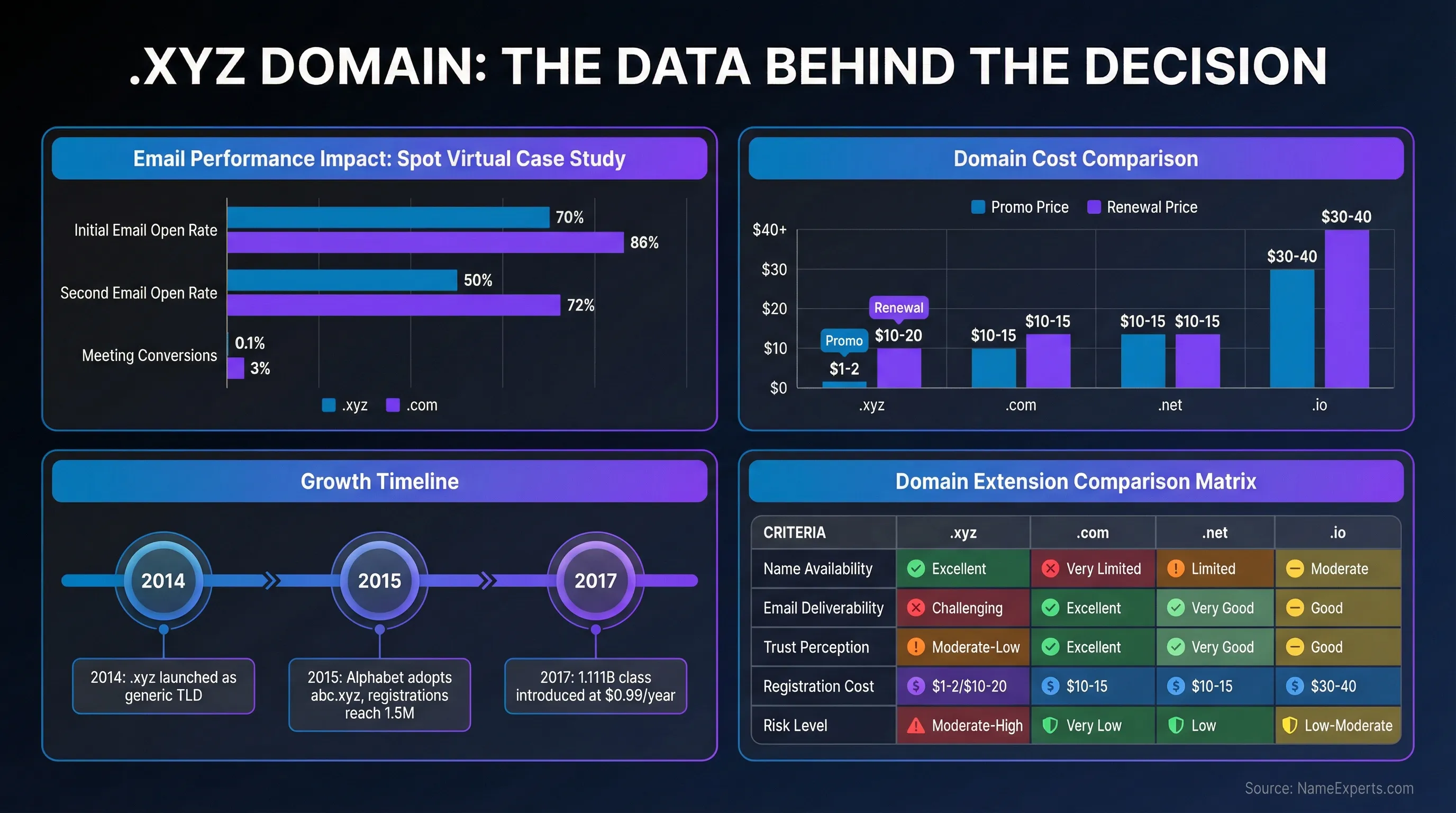
According to the Domain Name Industry Brief Q3 2025, this extension ranks among the top 10 largest TLDs by registration volume globally. The extension reached 1.5 million registrations shortly after Alphabet's adoption in 2015, though some of this growth came from controversial promotional tactics by certain registrars.

In 2017, the registry introduced the "1.111B class"—numeric domains ranging from six to nine digits, priced at just $0.99 annually. This initiative aimed to bring competition and choice to the market, though it also contributed to concerns about spam and malicious use.
The Real-World Benefits of This Extension
Availability and Cost Advantages
The most immediate advantage is availability. While premium .com domains often cost thousands or require lengthy negotiations, comparable names with this extension remain accessible. Registration typically starts around $1-2 for the first year, with renewals ranging from $10-20 annually depending on your registrar.
This pricing structure makes it feasible to secure your ideal brand name rather than settling for a compromised .com alternative with added hyphens, numbers, or awkward modifiers. For bootstrapped startups and individual creators, these savings matter.
When This Extension Makes Strategic Sense
Certain industries and use cases align naturally with this modern extension. Tech startups, particularly those in emerging sectors, often embrace it as a signal of innovation. The Web3 ecosystem has particularly adopted this domain, with blockchain companies, NFT platforms, and decentralized applications using it to reinforce their forward-thinking positioning.
Creative professionals—designers, photographers, developers—frequently choose this extension for portfolio sites. The modern aesthetic complements their work, and the lower stakes of personal branding make potential trust issues less concerning than they would be for e-commerce operations.
Side projects and experimental ventures represent another ideal use case. When testing a business concept or building a minimum viable product, the combination of low cost and good availability makes this extension practical. If the project succeeds and requires migration to .com later, the initial investment remains minimal.
International audiences present an interesting advantage. Unlike extensions with English-language connotations (.biz, .shop), this three-letter pattern carries no inherent meaning, making it equally accessible across languages and cultures. In Mandarin Chinese, the characters even translate to "little universe," creating an unexpected positive association in that market.
The "Generation XYZ" Brand Appeal
The extension deliberately targets Generations X, Y, and Z—demographics that grew up alongside internet technology. For brands seeking to connect with younger, digitally native audiences, this extension can reinforce that positioning. The novelty signals that your organization embraces change rather than clinging to traditional approaches.
The Hidden Risks: What Registrars Won't Tell You
Email Deliverability Challenges
The most significant practical concern involves email deliverability. Spam filters treat newer generic top-level domains with heightened scrutiny, and this extension has developed particular associations with suspicious activity.
One documented case study provides quantified evidence: Spot Virtual, a virtual office platform, tracked their email performance before and after switching from their original extension to .com. Their initial email open rates increased from 70% to 86%, second email open rates jumped from 50% to 72%, and overall meeting conversions rose from 0.1% to 3%. These improvements occurred despite maintaining identical email authentication (SPF, DKIM) and content.
The deliverability issues extend beyond marketing emails. Transactional messages—password resets, account confirmations, purchase receipts—frequently land in spam folders when sent from these domains. For businesses dependent on reliable email communications, this represents a critical operational risk.
Trust and Credibility Perception
Consumer perception studies consistently show that unfamiliar domain extensions trigger skepticism. While tech-savvy audiences may not hesitate, mainstream consumers often associate non-traditional extensions with less established or less trustworthy businesses.
This perception gap matters more in certain contexts. B2B sales, professional services, financial products, and healthcare applications all face higher trust requirements. When prospects are evaluating vendors for significant purchases or sensitive services, domain choice becomes part of their credibility assessment.
Industry-specific considerations also apply. Legal firms, accounting practices, and medical offices benefit from traditional extensions that reinforce their established professional status. Conversely, creative agencies, tech consultancies, and innovation-focused brands may find that a modern extension actually enhances their positioning.
Technical and Security Concerns
Several technical challenges affect these domains disproportionately. Corporate firewalls sometimes block entire top-level domains that have been associated with malicious activity. Some organizations have blacklisted all sites using this extension, making your website entirely inaccessible to those networks.
SMS delivery presents another unexpected obstacle. Many mobile carriers silently filter text messages containing links to certain extensions. Users attempting to share your website via text may find their messages never arrive, creating invisible barriers to word-of-mouth marketing.
Social media platforms occasionally flag links to these domains as spam or malicious content. While this typically resolves after review, the friction discourages sharing and reduces viral potential.
The security concerns have factual basis. The Anti-Phishing Working Group identified this extension among the top five for malicious domain registrations in 2023. Multiple anti-malware vendors have implemented broad blocking of these domains due to the volume of scams and phishing attempts. While your specific site may be entirely legitimate, you inherit the reputation of the broader extension.
Unsure If .xyz Is Right for Your Brand?
Domain choice impacts everything from email deliverability to customer trust. With 15+ years guiding brands like HBO Max and Monday.com through domain strategy, we help you avoid costly mistakes before you build your brand around the wrong extension.
Case Studies: Success Stories and Cautionary Tales
Success: Alphabet (abc.xyz)
When Google restructured under parent company Alphabet in 2015, choosing abc.xyz generated significant attention. The decision worked because Alphabet possessed overwhelming brand strength that transcended domain concerns. Their existing reputation and massive marketing reach ensured that any initial skepticism quickly dissipated.
The key lesson: established brands with substantial resources can successfully adopt unconventional extensions. Their existing trust and visibility overcome the domain's limitations. Startups and smaller organizations lack this advantage.
Success: Web3 and Crypto Companies
Blockchain companies, NFT platforms, and decentralized applications have found genuine success with this extension. Brands like Mirror, Dune, and numerous crypto projects use it effectively because their target audience—crypto enthusiasts and early adopters—actively values innovation signals over traditional trust markers.
The alignment between audience expectations and domain choice creates authenticity. When your customers expect and appreciate unconventional approaches, a modern extension reinforces rather than undermines your positioning.
Cautionary Tale: Spot Virtual's Migration
Spot Virtual's experience provides the most detailed documentation of real-world challenges. Beyond the email deliverability issues mentioned earlier, the company encountered SMS blocking, corporate firewall restrictions, and user feedback indicating the domain felt unprofessional.

The cumulative impact forced a complete rebrand to spotvirtual.com. While the company documented improvements across every metric after switching, the migration itself required significant resources: updating marketing materials, notifying customers, implementing redirects, and rebuilding SEO authority.
The founder noted that even on the University of Washington campus, the institution's wifi network entirely blocked access to their original domain. These invisible barriers created constant friction in user acquisition and retention.
When Domain Authority Matters
Search engines officially treat all top-level domains equally in their algorithms. Google has stated that domain extension doesn't directly impact rankings. However, user behavior signals—bounce rates, time on site, click-through rates—do affect SEO, and these metrics suffer when visitors distrust or question your domain.
Professional services firms, established industries, and businesses targeting mainstream consumers should carefully consider whether the cost savings justify the potential credibility gap. In our experience brokering 200+ domain transactions over 16 years, we've observed that domain choice significantly impacts brand value and customer confidence.
Complete Comparison: Evaluating Your Options
| Criteria | .xyz | .com | .net | .io |
|---|---|---|---|---|
| Registration Cost | $1-2 (promo) $10-20 (regular) | $10-15 | $10-15 | $30-40 |
| Renewal Cost | $10-20 | $10-15 | $10-15 | $30-40 |
| Name Availability | Excellent | Very Limited | Limited | Moderate |
| Email Deliverability | Challenging | Excellent | Very Good | Good |
| Trust Perception | Moderate-Low | Excellent | Very Good | Good (Tech) |
| SEO Treatment | Neutral | Neutral | Neutral | Neutral |
| Best Use Cases | Tech startups, Web3, creative portfolios, side projects | All business types, e-commerce, professional services | Technology, networking, infrastructure | Tech startups, SaaS, developer tools |
| Risk Level | Moderate-High | Very Low | Low | Low-Moderate |
Can't Secure Your Ideal .com Domain?
Before settling for a .xyz compromise, explore professional domain acquisition. We specialize in stealth negotiations that secure premium domains at fair market prices—often making that "unavailable" .com accessible without the risks of alternative extensions.
Your Domain Decision Framework
Making the right choice requires evaluating your specific situation against several key criteria:
- Assess your audience expectations: Tech-savvy early adopters tolerate or even prefer modern extensions. Mainstream consumers, B2B buyers, and traditional industries expect conventional domains. Match your extension to your audience's comfort level.
- Evaluate email marketing dependency: If email represents a primary customer acquisition or retention channel, deliverability challenges pose serious risks. Businesses relying heavily on transactional emails, newsletters, or cold outreach should prioritize extensions with proven inbox performance.
- Consider your industry's trust requirements: Financial services, healthcare, legal, and professional services face higher credibility thresholds. E-commerce operations converting first-time visitors need maximum trust signals. Creative services, tech products, and community platforms have more flexibility.
- Weigh budget versus perception trade-offs: The cost savings are real but temporary. Calculate not just the registration difference but the potential cost of future migration if your business outgrows the extension. Include rebranding expenses, redirect implementation, and SEO recovery time.
- Plan for potential migration costs: If you choose this extension, establish clear metrics for success and triggers for reconsidering. Define what would constitute sufficient evidence that migration makes sense, and budget accordingly.
Red flags suggesting you should avoid this extension:
- Your business depends heavily on email marketing or transactional emails
- You operate in a traditional or trust-sensitive industry
- Your target customers are mainstream consumers rather than early adopters
- You're building a long-term brand rather than testing a concept
- You need maximum credibility for B2B sales or professional services
Green lights indicating this extension could work:
- You're targeting tech-savvy, innovation-focused audiences
- Your brand positioning emphasizes being modern and unconventional
- You're building in the Web3, crypto, or blockchain space
- This is a side project, portfolio, or experimental venture
- Your ideal .com is prohibitively expensive or unavailable
- You're a creative professional building a personal brand
At NameExperts, we've guided clients through domain strategy decisions for over 16 years, helping brands like HBO Max and Monday.com choose optimal domains. Our experience across 200+ transactions has shown that domain choice significantly impacts brand value, customer acquisition costs, and long-term business success. When the stakes are high, professional domain consultation helps you avoid expensive mistakes and choose extensions that support rather than hinder your growth.
The right domain choice depends on your specific circumstances, audience, and business model. While this extension offers genuine advantages for certain use cases, understanding its limitations helps you make an informed decision rather than discovering problems after you've built your brand around it.
Domain strategy extends beyond choosing an extension—it encompasses availability, brandability, memorability, and long-term value. Whether you ultimately select this modern option or pursue a traditional alternative, aligning your domain with your business goals and audience expectations sets the foundation for sustainable growth. If you're uncertain about which path serves your specific situation, professional domain consultation can provide clarity and prevent costly missteps. For those considering the traditional route, understanding why .com domains remain the gold standard can inform your decision-making process.
Work With a Domain Expert
Whether you're weighing .xyz against .com, concerned about email deliverability, or wondering if that premium domain is truly unavailable, your domain choice shapes your brand's future. With our no-bullshit approach and 15+ years navigating the domain marketplace, we provide the clarity you need to avoid expensive migrations and credibility issues down the road. Get a free domain consultation to evaluate your options, explore acquisition possibilities for your ideal domain, or receive profession
Get Started Free







Frequently Asked Questions
A .xyz domain is a generic top-level domain extension launched in 2014 that references the final three letters of the Latin alphabet, designed as a universal option for any website without industry or geographic associations.
Yes, this extension ranks among the most affordable options with promotional first-year registrations starting at $1-2, though standard renewals typically range from $10-20 annually depending on your registrar.
While many legitimate businesses use this extension (including Google's parent company Alphabet), it faces trust perception challenges due to high volumes of spam and phishing sites, resulting in email deliverability issues and occasional blocking by corporate firewalls.
Tech startups, Web3 companies, blockchain platforms, creative professionals, and side projects commonly adopt this extension because their audiences value innovation signals and the low cost makes securing ideal brand names feasible.