
Key Takeaways
- .io is the country code top-level domain (ccTLD) for the British Indian Ocean Territory, but has evolved into the tech industry's favorite extension
- The extension resonates with developers because "io" mirrors input/output terminology in computer science
- Google treats .io as a generic TLD, meaning no geographic targeting penalties in search results
- Registration typically costs $35-$80 annually, significantly higher than .com but with better availability
- Despite sovereignty concerns, the extension is likely to remain stable due to its economic value and widespread adoption
The .io extension has become synonymous with innovation in the technology sector. Originally designated as the country code top-level domain for the British Indian Ocean Territory, it has transcended its geographic origins to become the calling card of startups, SaaS platforms, and tech companies worldwide. Understanding what makes this domain special—and whether it's the right choice for your business—requires looking at both its technical foundations and its cultural significance in the developer community.
What Is a .io Domain? History and Technical Background
The .io extension was officially delegated by the Internet Assigned Numbers Authority (IANA) in 1997 to represent the British Indian Ocean Territory. This ccTLD was initially managed by entrepreneur Paul Kane through Internet Computer Bureau Limited, who operated it alongside several other territory domains. Unlike most country code extensions that remain tightly controlled by their respective governments, this particular domain was managed for commercial purposes from the beginning.
What transformed this geographic identifier into a tech phenomenon was the happy coincidence of its letters. In computer science, "I/O" serves as the universal abbreviation for input/output—the fundamental concept describing how systems receive and transmit data. This semantic connection wasn't lost on developers and entrepreneurs seeking memorable, meaningful domain names for their projects.

The technical infrastructure supporting these domains has evolved significantly since 1997. Internet Computer Bureau Limited continues to manage the registry, with registrar services distributed through major providers worldwide. The extension supports modern DNS security features including DNSSEC, ensuring that domain owners can implement robust security measures for their websites and email systems.
By 2026, it has grown from a niche choice to a mainstream option, with hundreds of thousands of registrations spanning startups, established tech companies, and even gaming platforms. This growth reflects both the technical community's embrace of the extension and its proven track record for branding and memorability.
Why Tech Startups and SaaS Companies Choose These Domains
The appeal within the technology sector goes far beyond simple wordplay. When a startup chooses this extension, they're making an immediate statement about their identity and values. It serves as a signal to potential customers, investors, and partners that the company operates in the technology space and understands its culture.
Several factors drive this popularity among tech companies:
- Community recognition: The extension has become a badge of belonging within tech circles, instantly communicating that a company is part of the startup ecosystem
- Availability advantage: With .com domains heavily saturated after decades of registrations, finding a short, memorable name has become nearly impossible—this alternative offers significantly better availability
- Brandability: The two-letter extension creates punchy, memorable URLs that work well in marketing materials and are easy to communicate verbally
- Search engine treatment: Google explicitly treats this extension as a generic TLD rather than geo-targeting it to the British Indian Ocean Territory, meaning websites perform well in global search results
- Domain hacks: The letters enable creative naming strategies where the extension becomes part of the brand name itself (like "portfol.io" or "aud.io")
Real-world adoption demonstrates these advantages. GitHub uses the extension for its GitHub Pages service (username.github.io), introducing millions of developers to the domain. Gaming platforms like Itch.io have built entire businesses around names that incorporate it. Numerous successful SaaS companies have launched with these domains and maintained them even after achieving significant scale, validating long-term viability for serious businesses.
From our experience working with tech startups over 16+ years, we've observed that companies using this extension often receive more immediate recognition from technical audiences. The domain choice communicates technical credibility before a visitor even loads the website. For companies targeting developers, IT professionals, or tech-savvy consumers, this instant recognition provides measurable value.
Can't Find the Perfect .io Domain for Your Tech Brand?
The best .io names are already taken or priced beyond reason. Our stealth acquisition strategies help tech startups secure premium domains at fair market prices—without tipping off sellers that you're interested. With 200+ successful transactions, we navigate the Wild West of domain negotiations so you don't overpay.
Benefits and Drawbacks: A Balanced Comparison
Like any domain extension, this option comes with distinct advantages and limitations that businesses should carefully evaluate before committing.
| Benefits | Drawbacks |
|---|---|
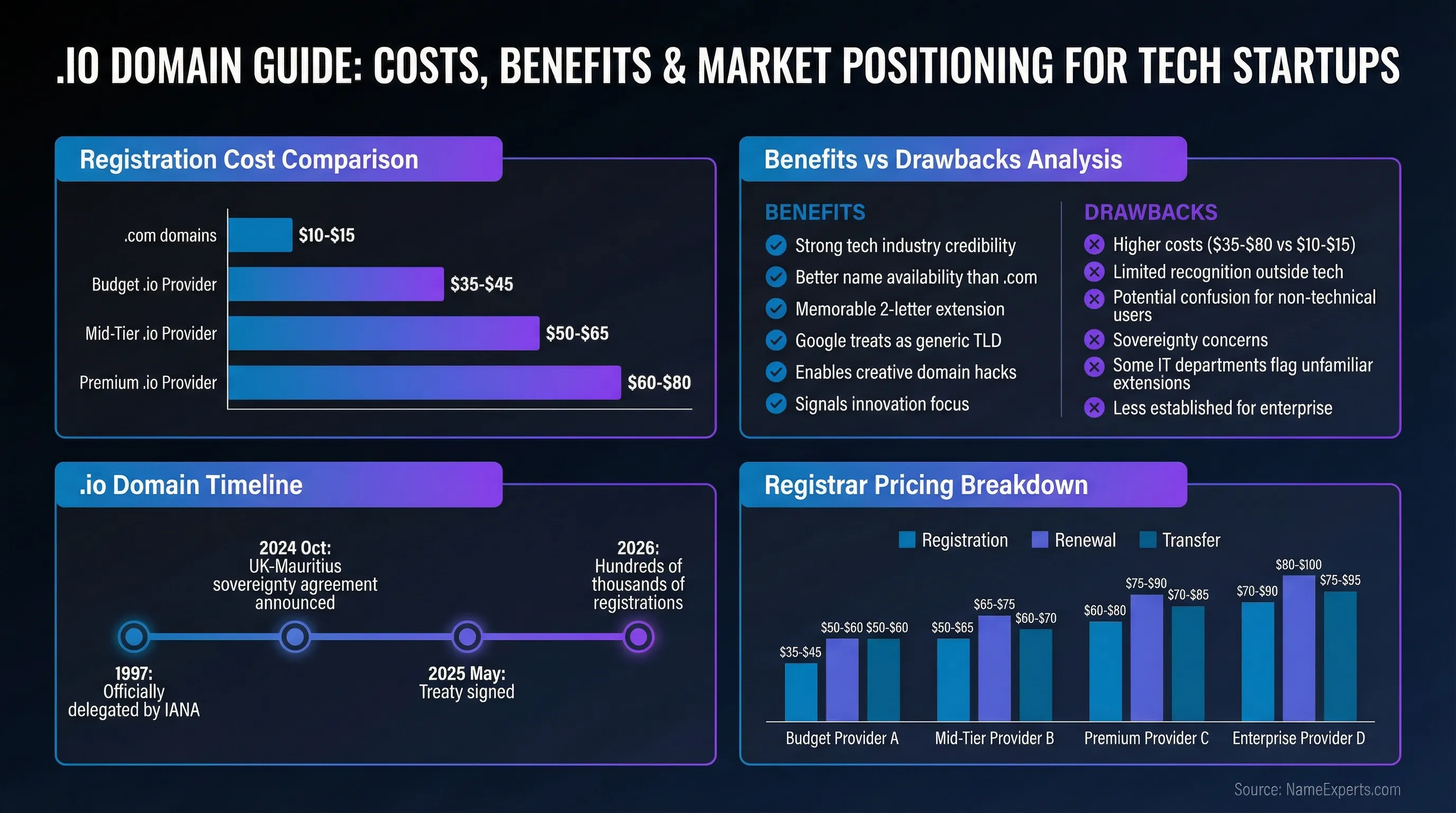
| Strong tech industry association and credibility | Higher registration and renewal costs ($35-$80 vs. $10-$15 for .com) |
| Better name availability than saturated .com space | Limited recognition outside technology and gaming sectors |
| Memorable two-letter extension ideal for branding | Potential confusion for non-technical audiences unfamiliar with the extension |
| Google treats as generic TLD (no geo-targeting penalty) | Sovereignty concerns regarding British Indian Ocean Territory's future |
| Enables creative domain hacks and naming strategies | Some corporate IT departments may initially flag unfamiliar extensions |
| Signals innovation and modern technology focus | Less established track record than traditional extensions for enterprise buyers |
The cost consideration deserves particular attention. While the extension costs significantly more than .com domains, this price difference reflects both supply dynamics and positioning. The higher cost also means less speculative registration, potentially improving overall domain quality and availability for legitimate businesses.
Recognition limitations matter primarily for businesses targeting mainstream consumers or traditional industries. A fintech startup targeting developers will benefit from the tech association, while a local restaurant or retail business would likely confuse customers with an unfamiliar extension. Understanding your audience's technical sophistication is crucial for making the right choice.
Choosing the Right Domain Name
Selecting an effective domain requires more than simply checking availability. The best names balance memorability, brandability, and practical considerations that affect long-term success.
When evaluating potential names, consider these key factors:
- Length and simplicity: Shorter names are easier to remember, type, and communicate verbally—aim for 15 characters or fewer including the extension
- Pronunciation clarity: The name should be easy to say and spell when heard—avoid ambiguous spellings or unusual letter combinations
- Trademark availability: Before falling in love with a name, conduct thorough trademark searches to avoid legal conflicts
- Brand alignment: The name should reflect your company's mission, values, or product offering in a meaningful way
- Future flexibility: Avoid names that are too specific to your current product if you plan to expand offerings
Domain hacks—where the extension becomes part of the word—offer creative possibilities but require careful evaluation. Names like "aud.io" or "repl.io" are clever and memorable, but they only work if the resulting word is pronounceable and relevant to your business. Forced or awkward domain hacks often create more confusion than value.
Trademark evaluation is particularly critical in the crowded tech space. Our team at NameExperts has helped numerous clients navigate trademark conflicts during domain selection, and we've seen how early trademark research prevents costly problems later. Professional trademark searches go beyond simple USPTO database queries to examine common law usage, international registrations, and potential conflicts with established brands.
For companies acquiring premium domains in competitive spaces, stealth acquisition strategies can prevent price inflation. When sellers know a well-funded company wants a specific domain, prices often increase dramatically. Working with experienced domain brokers who can negotiate on your behalf while maintaining confidentiality often results in better outcomes and lower acquisition costs.
Pricing and Registration Guide
Understanding the true cost of ownership requires looking beyond initial registration fees to include renewals, transfers, and potential premium pricing for desirable names.
Current market pricing for standard registrations varies significantly across registrars:
| Registrar | Registration Price | Renewal Price | Transfer Price |
|---|---|---|---|
| Budget Provider A | $35-$45 | $50-$60 | $50-$60 |
| Mid-Tier Provider B | $50-$65 | $65-$75 | $60-$70 |
| Premium Provider C | $60-$80 | $75-$90 | $70-$85 |
| Enterprise Provider D | $70-$90 | $80-$100 | $75-$95 |
These prices reflect 2026 market rates and represent standard registrations. Premium domains—short names, dictionary words, or highly desirable combinations—command significantly higher prices, often ranging from hundreds to hundreds of thousands of dollars depending on the name's value.

The higher cost compared to .com domains stems from several factors. The registry wholesale price is higher, reflecting the extension's positioning and limited supply compared to the massive .com namespace. Additionally, its popularity in the well-funded startup sector supports premium pricing that the market has proven willing to pay.
Hidden costs and considerations include:
- Renewal price increases: Many registrars offer discounted first-year pricing but charge full price for renewals—always check renewal rates before registering
- Privacy protection fees: Some registrars charge extra for WHOIS privacy, though many now include it free
- DNS hosting quality: Budget registrars may provide slower or less reliable DNS infrastructure, affecting website performance
- Transfer restrictions: Most domains cannot be transferred for 60 days after registration, locking you to your initial registrar temporarily
- Auto-renewal policies: Understand cancellation procedures to avoid unwanted renewals and charges
At NameExperts, we take a transparent approach to domain pricing, providing clients with honest market assessments rather than inflated valuations. Our 200+ transactions have given us deep insight into what domains are actually worth versus what sellers initially ask. For businesses evaluating significant domain investments, professional appraisal and negotiation services often pay for themselves through better acquisition terms.
Considering a Premium .io Domain Investment?
Don't guess at what a domain is actually worth. Our honest, no-bullshit appraisals are based on real market data from 200+ transactions—not inflated seller asking prices. We'll tell you what it's truly worth and negotiate on your behalf while maintaining complete anonymity to prevent price inflation.
The Future: What You Need to Know
The most significant question surrounding these domains involves the British Indian Ocean Territory's political future and what that means for the extension's stability.
In October 2024, the United Kingdom and Mauritius announced an agreement to transfer sovereignty of the Chagos Archipelago (which comprises the British Indian Ocean Territory) to Mauritius. The treaty was signed in May 2025. This development raised concerns among domain owners about whether the extension might be retired, as ICANN policy generally calls for retiring country code TLDs when the corresponding country ceases to exist.
However, several factors suggest the extension will likely remain stable:
- Economic significance: The extension generates substantial revenue and supports hundreds of thousands of websites—retiring it would cause massive disruption
- Historical precedents: The .su extension (Soviet Union) has continued operating for decades after the USSR dissolved, though ICANN announced plans in March 2025 to retire it by 2030, demonstrating both ICANN's pragmatic approach and eventual policy enforcement
- Technical independence: The extension's management and infrastructure operate independently of the territory's government, reducing political dependencies
- Widespread adoption: Major companies and platforms have built significant infrastructure around the extension, creating strong incentives for continuity
- ICANN flexibility: ICANN has shown willingness to maintain ccTLDs when retirement would cause disproportionate harm to internet users
The .su precedent is instructive but not entirely reassuring. Despite the Soviet Union's dissolution in 1991, the extension remained active for over three decades. However, ICANN's 2025 announcement of retirement plans by 2030 shows that even long-standing exceptions eventually face policy enforcement. This suggests that while .io may receive a grace period, its long-term future remains uncertain if the British Indian Ocean Territory designation is removed from international standards.
For businesses concerned about long-term stability, risk mitigation strategies include:
- Registering equivalent .com domains as backups, even if you primarily use the .io version
- Building brand recognition around your company name rather than relying solely on the domain extension
- Monitoring ICANN policy discussions and sovereignty developments that might affect domain status
- Maintaining flexibility in your technical infrastructure to enable domain changes if necessary
From our perspective working with domain portfolios over 16+ years, we've observed that well-established extensions rarely disappear suddenly. The transition periods for domain retirements typically span years and include extensive notice periods, giving businesses ample time to adapt if necessary. The extension's economic importance and technical community's investment make abrupt retirement highly unlikely.
Is This Extension Right for Your Tech Brand?
The decision ultimately depends on your specific business context, target audience, and branding strategy. This extension excels for certain use cases while presenting challenges for others.
Strong fit scenarios include:
- Technology startups targeting developer or technical audiences
- SaaS platforms and cloud services
- API providers and developer tools
- Gaming platforms and browser-based games
- Open source projects and technical communities
- Tech-focused media and content platforms
Consider alternatives if:
- Your target audience is primarily non-technical consumers
- You operate in traditional industries where the extension might confuse customers
- Budget constraints make the higher pricing prohibitive
- You need maximum mainstream credibility for enterprise sales
- Your business model requires absolute domain stability with zero political risk
For businesses on the fence, a hybrid approach often works well. Register both versions—using the .io for your primary web presence while securing the .com as a redirect or for email addresses. This strategy provides the branding benefits of the tech-focused extension while maintaining a fallback option.
The extension has proven its staying power over nearly three decades, evolving from an obscure country code to a recognized symbol of innovation and technical expertise. For companies that align with its positioning, it offers genuine branding value that extends beyond the domain itself.
If you're building a tech brand and evaluating domain options, NameExperts can help you navigate the decision with expertise drawn from 200+ domain transactions. We provide honest assessments of domain value, help identify trademark conflicts before they become problems, and can assist with acquisition strategies for premium names. Our domain portfolio consultation service examines your specific business needs and recommends the optimal domain strategy for your brand. Contact us to discuss how the right domain choice can strengthen your market position and support your growth objectives.
Work With a Domain Expert
Choosing between .io and .com, evaluating premium domain investments, and navigating trademark conflicts shouldn't be guesswork. With 16+ years of experience and 200+ successful transactions, NameExperts provides the honest guidance and stealth acquisition expertise that tech startups need—without the corporate distance of large brokerages. Whether you're securing your ideal .io domain, getting a realistic appraisal, or developing a complete domain strategy, we bring transparency and personalize
Get Started Free







Frequently Asked Questions
The extension is primarily used by tech startups, SaaS companies, developer tools, gaming platforms, and API providers because "io" mirrors the input/output terminology in computer science, creating instant recognition within technical communities.
For tech startups targeting developers, the .io extension offers better name availability and stronger industry credibility, while .com provides broader mainstream recognition and lower costs—many successful companies use .io as their primary domain with .com as a backup.
Registration costs $35-$80 annually (versus $10-$15 for .com) due to higher registry wholesale pricing, limited supply compared to the massive .com namespace, and strong demand from well-funded startups willing to pay premium rates for tech-credible domains.
Yes, Google explicitly treats this extension as a generic top-level domain rather than geo-targeting it to the British Indian Ocean Territory, meaning websites using it perform equally well in global search results without geographic penalties.


