
Key Takeaways
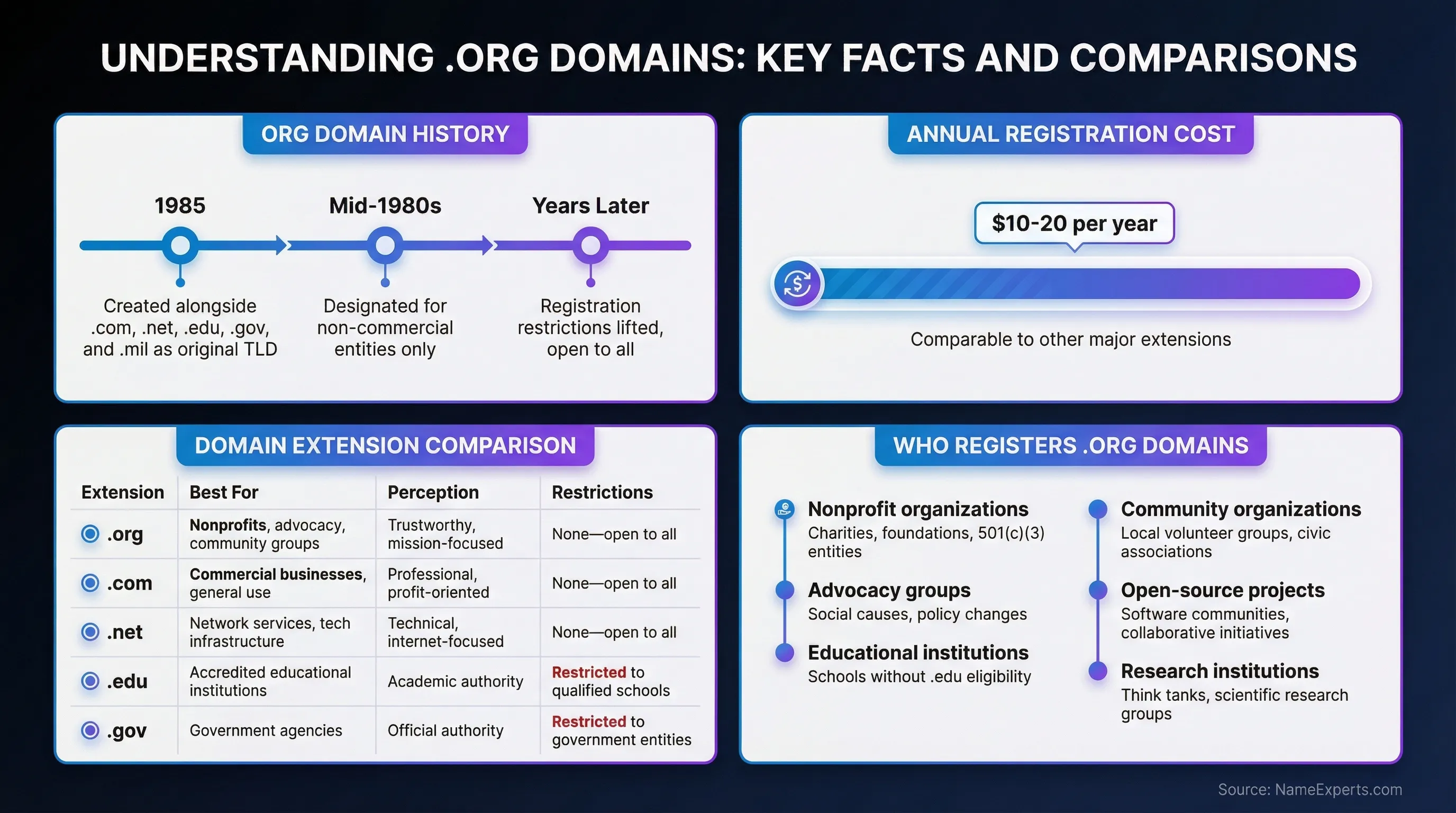
- .org stands for "organization" and was originally created in 1985 for non-profit entities
- Anyone can register this extension today—no restrictions on entity type or location
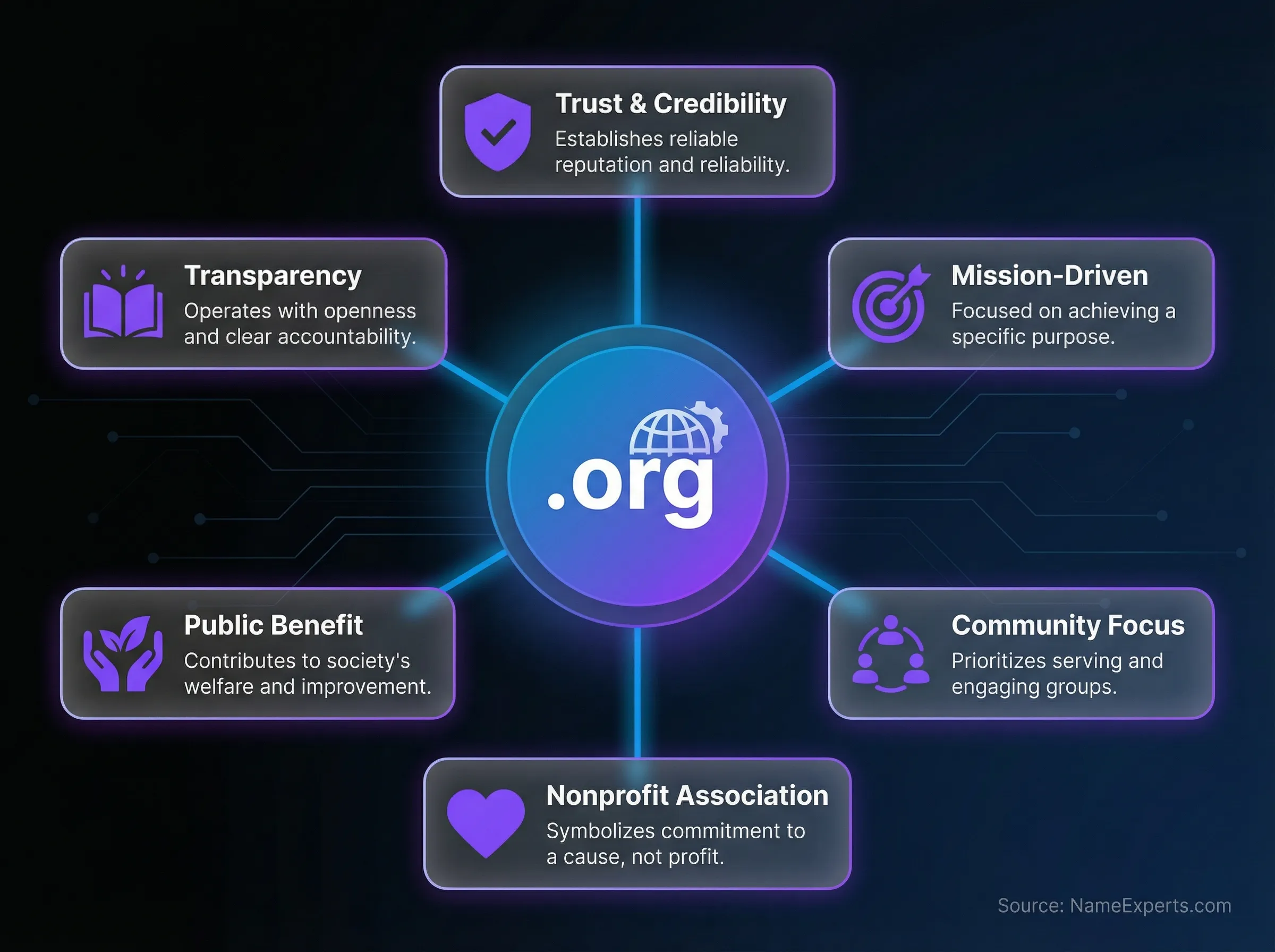
- These domains signal credibility and mission-driven purpose, making them ideal for nonprofits, charities, and advocacy groups
- Google treats the extension as generic, not geo-targeted to any specific region
- Registration costs typically range from $10-20 per year, comparable to other major extensions
When you see a website ending in .org, you're looking at one of the internet's original domain extensions. Created in 1985 alongside .com, .net, .edu, .gov, and .mil, this top-level domain was specifically designed to serve organizations focused on public benefit rather than commercial profit. While the extension has evolved beyond its original restrictions, it continues to carry strong associations with credibility, transparency, and service-oriented missions.
Understanding what this domain extension represents—and whether it's the right choice for your website—requires looking at both its technical definition and its practical perception in today's digital landscape.
What Does .org Stand For?
The extension is short for "organization." When the Internet Assigned Numbers Authority (IANA) established the first top-level domains in the mid-1980s, this particular extension was designated for non-commercial entities. The original intent was to create a clear distinction between commercial businesses using .com and organizations serving public interests.
Today, the Public Interest Registry (PIR) manages the extension. PIR operates as a nonprofit organization itself, which reinforces the domain's mission-driven identity. Unlike country-code domains that represent specific geographic regions, this extension functions as a generic top-level domain available to registrants worldwide.
The technical definition is straightforward: it's a gTLD (generic top-level domain) in the Domain Name System. But its practical meaning extends far beyond technical specifications—it signals purpose, credibility, and a focus on community impact rather than profit maximization.
Who Can Register These Domains?
Contrary to common belief, there are no restrictions on who can register this extension. When it was first introduced, registrations were limited to non-profit organizations, educational institutions, and similar entities. Those restrictions were lifted years ago, opening registration to anyone—individuals, businesses, nonprofits, or government agencies.
That said, most registrants fall into specific categories:
- Nonprofit organizations – Charities, foundations, and 501(c)(3) entities
- Advocacy groups – Organizations promoting social causes or policy changes
- Educational institutions – Schools and educational programs without .edu eligibility
- Community organizations – Local volunteer groups and civic associations
- Open-source projects – Software communities and collaborative initiatives
- Research institutions – Think tanks and scientific research groups
While commercial businesses can technically register these domains, doing so may create confusion. Visitors typically associate the extension with nonprofit status, which could lead to mismatched expectations if you're selling products or services.
Comparing Domain Extensions
Choosing between different extensions depends on your organization's purpose, audience, and branding goals. Each major extension serves a distinct role in the digital ecosystem.
| Extension | Best For | Perception | Registration Restrictions |
|---|---|---|---|
| .org | Nonprofits, advocacy, community groups | Trustworthy, mission-focused | None—open to all |
| .com | Commercial businesses, general use | Professional, profit-oriented | None—open to all |
| .net | Network services, tech infrastructure | Technical, internet-focused | None—open to all |
| .edu | Accredited educational institutions | Academic authority | Restricted to qualified schools |
| .gov | Government agencies | Official authority | Restricted to government entities |
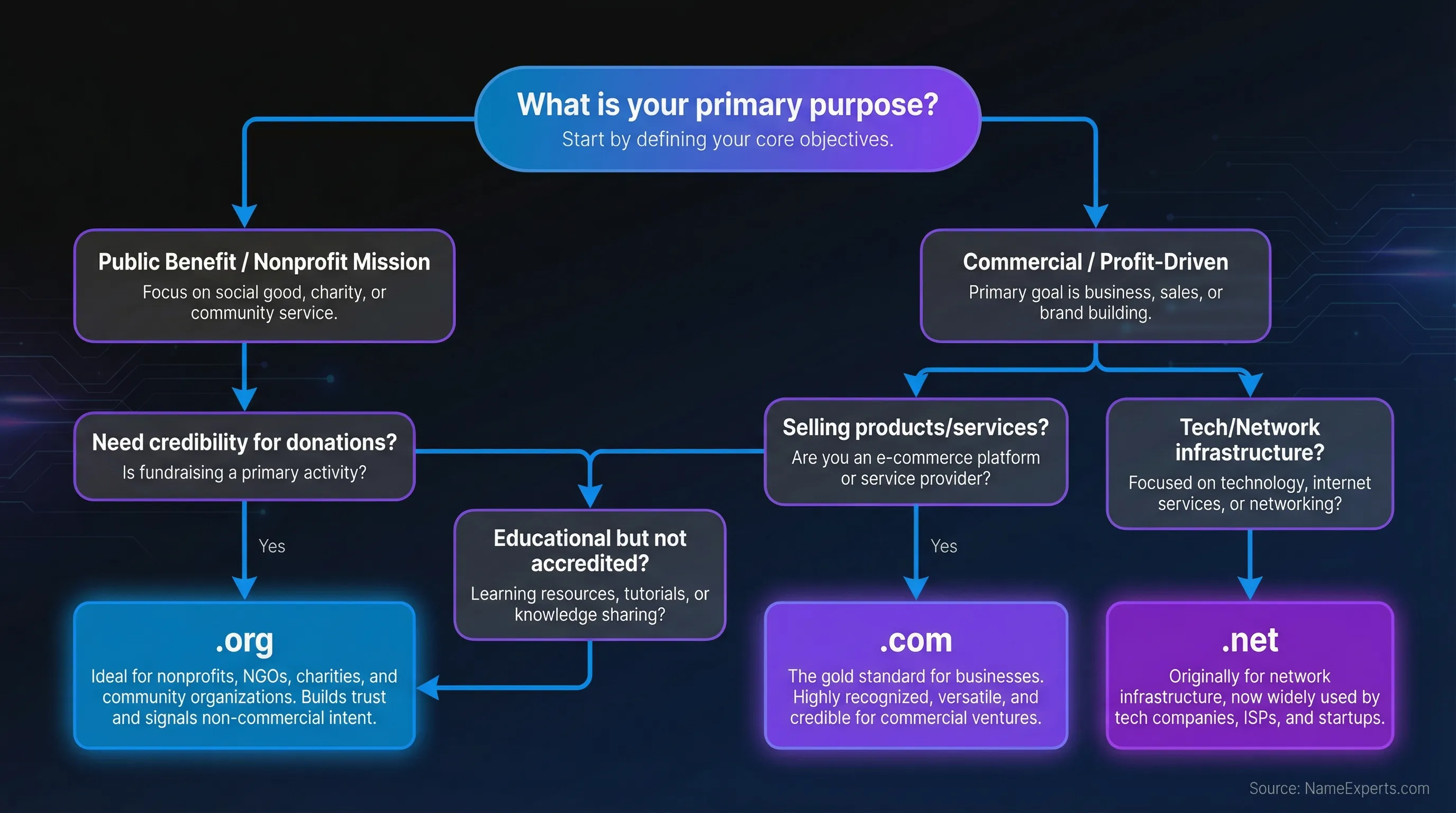
The choice between .org and .com often comes down to mission versus commerce. If your primary goal involves serving a public interest, advancing a cause, or building community, the nonprofit-associated extension signals that purpose immediately. If you're selling products or services for profit, .com remains the standard choice.
Search engines don't favor one extension over another in rankings. Google treats this extension as generic rather than geo-targeted, meaning your site can rank globally regardless of your physical location. The extension itself won't boost or harm your SEO—content quality, technical optimization, and user experience matter far more.
Is Your Perfect .org Domain Already Taken?
Finding the right domain that signals credibility and aligns with your mission can be challenging—especially when your ideal name is already registered. With 16+ years of experience in domain acquisitions, we help mission-driven organizations secure the domains they need through strategic negotiation and stealth acquisitions.
Advantages of Using This Extension
Organizations that align with the extension's mission-driven identity gain several benefits:
Built-in credibility: Visitors immediately recognize the extension as signaling nonprofit or public-interest work. This instant association can increase trust, especially for organizations asking for donations, volunteer commitments, or community engagement.
Greater availability: While .com domains face intense competition with millions of registrations, this extension offers more options. You're more likely to secure your exact organization name or preferred domain without resorting to hyphens, numbers, or awkward variations.
Appropriate positioning: The extension clearly communicates that your mission prioritizes impact over profit. For advocacy groups, charities, and community organizations, this positioning aligns perfectly with organizational values and public perception.
Global recognition: As one of the original top-level domains, the extension enjoys worldwide recognition. International audiences understand its purpose, making it suitable for organizations with global reach or cross-border missions.
Reasonable pricing: Registration costs remain competitive with other major extensions, typically ranging from $10-20 annually depending on your registrar. Some registrars even offer discounted rates for verified nonprofit organizations.
Potential Drawbacks to Consider
While the extension offers clear advantages for mission-driven organizations, it's not without limitations:
Perception mismatch for commercial entities: If you operate a for-profit business, using this extension may confuse potential customers. They might assume you're a nonprofit and question your business model or pricing structure.
Lower memorability for some audiences: Despite being one of the original extensions, .com still dominates public consciousness. Some users automatically assume websites end in .com, which could lead to lost traffic if they mistype your address.
Potential credibility concerns if misused: Organizations that register this extension but operate primarily for profit may face skepticism. The extension carries expectations of transparency and public benefit—failing to meet those expectations can damage trust.
Limited commercial appeal: Investors, partners, and commercial stakeholders sometimes view the extension as less "serious" for business ventures. Tech startups, for example, often prefer .com or .io to signal commercial ambition.
Registration Requirements and Process
Registering a domain with this extension follows the same straightforward process as other top-level domains:
- Choose a domain registrar: Select a reputable provider that offers competitive pricing and reliable service. We specialize in helping organizations secure the right domain for their mission.
- Search for availability: Use the registrar's search tool to check if your desired name is available. If your first choice is taken, consider variations or alternative phrasing that still captures your organization's identity.
- Complete registration: Provide contact information, select a registration term (typically 1-10 years), and complete payment. Most registrars process registrations instantly.
- Configure DNS settings: Point your domain to your web hosting provider by updating nameserver records. Your registrar and hosting provider can guide you through this technical step.
- Enable privacy protection: Consider adding WHOIS privacy to keep your contact information private and reduce spam.
Technical requirements are minimal. Your domain name must be 3-63 characters long, use only letters, numbers, and hyphens (not at the beginning or end), and avoid special characters. Internationalized domain names (IDNs) are supported, allowing non-Latin characters in many languages.
Not Sure Which Domain Extension Fits Your Organization?
Choosing between .org, .com, and other extensions is a strategic branding decision that affects credibility and audience perception. Our domain experts provide honest, no-bullshit guidance to help you select and secure the domain that best supports your mission and long-term goals.
Real-World Examples of Successful Usage
Some of the world's most recognized organizations use this extension to reinforce their mission-driven identity:
Wikipedia.org operates as the world's largest free encyclopedia, relying entirely on donations and volunteer contributions. The extension perfectly signals its nonprofit status and community-driven mission.
RedCross.org serves as the digital home for the American Red Cross, one of the most trusted humanitarian organizations globally. The extension reinforces credibility and public service.
UNICEF.org represents the United Nations Children's Fund, using the extension to emphasize its focus on global children's welfare rather than commercial interests.
These organizations demonstrate how the extension can support brand identity, build trust, and clearly communicate organizational purpose. Their success shows that choosing the right extension isn't just a technical decision—it's a strategic branding choice.
Making Your Decision
Choosing the right domain extension requires evaluating your organization's purpose, audience expectations, and long-term goals. Consider these factors:
Mission alignment: If your organization exists primarily to serve public interests, advance a cause, or build community, this extension signals that mission clearly. The immediate association with nonprofit work can strengthen your brand identity.
Audience expectations: Consider what your target audience expects. Donors, volunteers, and community members often look for the extension when seeking organizations to support. Commercial customers, however, may default to .com.
Brand protection: Even if you choose this extension as your primary domain, consider registering the .com variant to prevent confusion and protect your brand. You can redirect the .com to your main site.
Long-term flexibility: Think about your organization's future. If you might expand into commercial activities or revenue-generating services, the extension could create complications. Conversely, if your nonprofit mission is central to your identity, the extension reinforces that commitment.
When selecting and securing the perfect domain for your mission-driven organization, working with domain experts can streamline the process. At NameExperts, we bring 16+ years of experience helping organizations find domains that align with their brand strategy and organizational goals. Whether you're launching a new nonprofit, rebranding an existing organization, or securing a domain that's already registered, our team understands how extension choice affects credibility, trust, and long-term success.
The extension remains one of the most trusted and recognizable domain choices for organizations focused on public benefit. Its history, perception, and continued association with nonprofit work make it an excellent choice for charities, advocacy groups, educational initiatives, and community organizations. While anyone can register these domains, they work best when they accurately reflect an organization's mission-driven purpose. Choose wisely, and your domain extension becomes a powerful signal of credibility and commitment to making a positive impact.
Work With a Domain Expert
Securing the right domain is more than a technical decision—it's a strategic choice that signals your organization's credibility, mission, and values. Whether you need help acquiring a domain that's already registered, choosing the extension that best fits your purpose, or protecting your brand across multiple domains, NameExperts brings 16+ years of personalized, boutique service to guide you through the Wild West of the domain marketplace. We specialize in stealth acquisitions, fair market val
Get Started Free







Frequently Asked Questions
Anyone can register a .org domain—there are no restrictions on entity type, location, or nonprofit status, though the extension works best for mission-driven organizations due to public perception.
Google treats .org as a generic top-level domain without ranking preference—content quality, technical optimization, and user experience determine search performance regardless of whether you use this extension or alternatives like .com.
For-profit businesses should generally avoid this extension because visitors associate it with nonprofit status, which can create confusion about your business model and pricing structure.
Registration typically costs $10-20 per year depending on your registrar, with some providers offering discounted rates for verified nonprofit organizations.


