
The domain name market is evolving rapidly in 2026, driven by ICANN’s anticipated new top-level domain approval window, the continued rise of AI-related extensions, and an increasingly sophisticated aftermarket for expired premium domains. While .com remains the gold standard, new opportunities are emerging across industry-specific TLDs, creative country-code repurposing, and city-level domain extensions that didn’t exist five years ago. This guide identifies six specific domain investment strategies that forward-thinking businesses and investors should be executing now — before mainstream awareness drives prices up. Written by Joe Uddeme, who has navigated domain market cycles for 16+ years.
Are you looking for hidden domain opportunities for 2026? You’ve come to the right place. In this post, domain name expert broker Joe Uddeme delves into the many possibilities that await the canny investor.
Introduction: why 2026 is a big year for domain names
I often think of the global domain name market as being a bit like an ocean-bound oil tanker. Not only is it bigger than many people can imagine (annual global sales are more than $2 billion), but it can seem to take an age to change course.
That’s not to say it does not change course. Like everything, the domain name market evolves with time – although the fundamentals of domain name investing rarely alter.
In this post, we’ll take a look at the trends for 2026 that look set to shape the market.
The biggest of them is likely to be a shake-up of TLDs (the bit at the end of a domain name such as .com or .org). We will get into this fully in the post, but in simple terms, ICANN (the Internet Corporation for Assigned Names and Numbers) is set to allow a whole slew of new domain name extensions in 2026.
Exciting times – and if you are looking to acquire a premium domain name for your business, there has perhaps never been a better moment. Unless you can invent a flux capacitor and go back to 1993, of course!
Key takeaways
- Why 2026 could be a pivotal year for domain investing
- Industry-specific TLDs make their mark
- New short keyword opportunities in tech
- The.com TLD remains strong, but faces stiff competition (and may be overpriced)
- Expired domains for sale – a hidden goldmine?
What are hidden domain opportunities?
Virtually every business today has a website. A large part of the success of their website is the domain name. Ideally, it needs to match your brand name.
Tesla realized this at their peril when they had to spend millions to acquire tesla.com. There is nothing ‘hidden’ about Tesla’s strategy: they simply needed to match the domain name to their business name to avoid confusion and ensure that customers find them easily.
So what is a hidden opportunity?
A hidden opportunity in the domain name market is anything that requires inside knowledge or a little lateral thinking. Timing can be important, too.
Hidden opportunities include:
- Securing undervalued off-market names with the help of a domain name broker.
- Registering under-the-radar domain names that the wider marketplace hasn’t yet cottoned onto.
- Getting in there early with new TLDs.
We’ll look at all these – and more – in this post.
Why 2026 could be a pivotal year for global domain name investors
Let’s say you have a trucking business called Heavy Duty. The perfect URL for your business – heavyduty.com – was probably snapped up decades ago (it is currently used by a roadside services company).
Because heavyduty.com has already been acquired, you might be tempted to try and launch something like heavyduty.truck.
Problem is, you can’t. That’s because .truck is not an official TLD – so you can’t register it as a domain name.
The last time a whole batch of TLDs was agreed upon was back in 2012. This was all handled by ICANN (the Internet Corporation for Assigned Names and Numbers), and the decisions they made back then are the reason that TLDs such as .xyz and .tech have slowly rolled out in the years that followed.
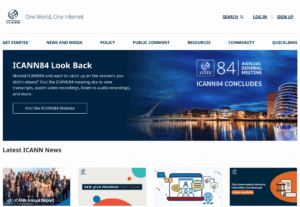
The ICANN homepage – a rich source of domain name information.
Buy a premium brand name – at a great price?
2026 is set to be the year that ICANN opens another application window. This means they are accepting suggestions for new TLDs to launch in the coming years.
The decisions they make will affect domain names for the next decade or more. While it is unlikely that anything would ever eclipse .com, who’s to say that a new TLD won’t change the face of URLs as we know it?
These changes are potentially transformational. And they provide the bulk of our hidden domain name opportunities for 2026.
Here are NameExperts.com’s six top picks for anybody looking for hidden domain opportunities.
1. Emerging industry-specific TLDs
We’ve already had .ai (actually borrowed from the Anguilla TLD) and .tech, but the doors are wide open for a smorgasbord of new industry-specific TLDs.
While there are already hundreds of TLDs already available, some of those that are sure to be under consideration include:
- .climate
- .mentalhealth
- .fintech
- .pay
- .wellness
- .agent
These emerging domain extensions represent a wealth of new opportunities for investors and businesses alike.
Pro tip: competition for the best new names will be fierce. Build up a wish-list long in advance of any new TLD announcements.
2. Creative TLD repurposing
We’ve already seen evidence of this over the past few years with the likes of .io (British Indian Ocean Territory) and .tv (Tuvalu) gaining ground.
Niche country TLD domains like these provide businesses in relevant sectors with a snappy way to challenge the supremacy of .com.
A good example of a country code with potential clout is .vc (Saint Vincent and the Grenadines), which works well with venture capitalist businesses. Another one ripe for repurposing is .sc (The Seychelles), which is potentially of interest to scientific organisations.
Thinking laterally can be helpful, too. Take Iceland’s .is TLD. It lends itself well to the likes of cris.is or life.is – though hack gems like these have long since been taken.

Iceland: source of some seriously creative URLs
3. Localized, city-level domains
Many of these already exist, but are they potentially underused? Some say the strongest are seriously undervalued domain names – and in some cases, they’re right.
For a hyper-localized business with a large presence in a major city, the likes of .berlin or .paris could be worth its weight in gold.
There are new opportunities, too. Among the TLDs not yet approved are .shanghai, .seattle, .toronto and .doha. These could appear in ICANN’s next batch release.
Pro tip: Think of where demand may be tomorrow. The 2032 Olympics, for example, is in Brisbane – which is currently not designated as a TLD.

Would a .seattle TLD help your business?
4. Niche vertical domains in generic TLDs
As mentioned, if you’re prepared to look past the .com TLD, the world is already your oyster. Commercially attractive TLDs such as .store, .digital, .live and .online are available today and hold potential value for the right business.
A quick aside: as a premium domain name broker, we are often asked what constitutes a premium domain. Many people think that because they have been able to secure a single-word domain name with one of the new generic TLD’s, they are sitting on a goldmine.
While this may be true in some cases, in most instances it isn’t.
In NameExperts.com’s world, a premium domain name is usually something along the lines of haru.com (a catchy, short brand) or smarthome.com – two strong words that make sense together and collectively have commercial appeal.
Of course, the likes of gold.com or flowers.com would be considered premium, too.
By comparison, smarthome.xyz or haru.digital are significantly less attractive. The numbers speak for themselves – at the time of writing, haru.digital was all yours for a couple of bucks a year. Smarthome.com, meanwhile, was up for close to seven figures.
5. Expired and soon-to-expire premium domains
This is where an experienced domain broker can really help you when choosing a brand name for your business. Most companies today don’t launch until they can match their proposed business name with a domain they know they can secure.
Basically, there’s little point having a superb brand name if you can’t get the domain to go with it!
Here’s the thing, though: just because a great name is taken doesn’t mean you’ll never be able to use it. That’s where stealth acquisition comes in. Our bread and butter is persuading people who own a domain name to sell it to you at the right price.
There’s another thing we do: peek in all the right places in search of attractive domain names that are approaching expiration or have dropped and are in an auction. (Check out our blog post: Can you own a domain name forever?).
People sometimes don’t fully appreciate what they are sitting on – and they forget to renew. As a result, bargains sometimes come up.
Let’s be clear: this doesn’t happen an awful lot, especially when the name is a good one. But let’s say somebody has registered a snappy made-up name such as chivalia.com and left it parked for several years.
If they are managing a large portfolio, it’s conceivable that they’ve written it off as a dead loss. It’s perhaps been for sale for a few thousand, but there’s been zero interest.
Now let’s imagine that you’re launching a business that is connected to the world of heritage, horses or chivalry – or maybe it’s a fantasy/medieval themed game.
You can see where this is going. And yes – at the time of writing, chivalia.com was available for peanuts.
Name Experts are experts in this field (it’s also known as domain drop-catching). We know which expired domain buy sites are the ones to watch and take expired domain hunting very seriously.
Pro tip: before investing in expired domain names that seem too good to be true, check out their history. They may be associated with an adult site or something equally problematic.
6. Domains aligning with AI, Web3 and emerging tech trends
As of right now, you cannot use the .crypto domain name. But we’d expect that TLD to become available in the next round of ICANN releases.
If you’re smart enough to get in early, you may be able to acquire a fantastic domain name with this TLD and profit from it – either by aligning it to an existing business or selling it to a high bidder. Let’s be honest, buy.crypto is a beauty.
Some other TLDs that may soon appear and could be worth considering:
- .metaverse
- .quantum
- .neuro
- .devops
- .mesh
As with all non- .com TLDs, snapping these up is something of a gamble. It usually all comes back to the name itself. If you’re the first person in the queue for something like core.quantum or grid.mesh, you may have a name with potential.

Would a .metaverse TLD propel your tech business to greatness?
Is the reign of the .com domain name over?
Since the earliest days of the internet, the .com domain name has been the most universally popular. However, it would be foolish to underestimate the power of country codes such as .co.uk in the United Kingdom and .cn in China.
That said, the .com TLD adds a lot of weight – it comes with a suggestion of trust. It’s still our #1 recommendation for a business TLD most of the time, but it’s certainly not the only choice.
Additionally, some investors feel the value of super-premium .coms is often too high. If somebody is sitting on smarthomes.com and wants $1 million for it, what’s to say that your business couldn’t be successful with a different TLD – at a fraction of the price?
Historically, many new TLDs have been seen as inferior to the .com. But perhaps the juggernaut is starting to turn? And when ICANN releases its next batch of names, there will be more choices than ever.
Investing in a portfolio of sensible, high-potential non-.com domain names may be a strategy well worth pursuing.
Summing up: domain investing 2026 – why short domains still prevail
Whatever happens in the world of domain names in 2026 and beyond, one thing that won’t change is the fact that the shorter the name, the better.
Even if a brand-new TLD suddenly dominates, the bit that precedes it will always have to be super-easy to type (or say). The future domain market won’t change in that respect – you can bet your entire domain portfolio strategy on it.
That “trend” is carved in stone.
Investing in a premium domain name can be one of the most important things your business will ever do. It is a complex process with many moving parts.
Working with a seasoned domain name broker can help you fast-track everything from research to first contact to negotiation and sealing the deal.
Our goal is not only to secure the best name for your business at the right price, but to save you the headache of having to go through a challenging process that is best approached with years of experience and nerves of steel.
It’s why clients all over the world are happy to pay us a small percentage of the purchase price as compensation for the hours we put in.
Our services are especially useful when you’re interested in acquiring off-market domain names, but that’s not all we do. If you’re just looking to spot domain name opportunities for 2026 and the years ahead, we’re definitely well worth having onside.
About the author
Joe Uddeme is Director and Principal of Name Experts, one of the world’s leading domain name brokerage services. He has overseen domain name sales and acquisitions totaling more than $150 million and is renowned worldwide as a go-to expert in buying and selling premium domains. Contact us at: [email protected]
Don't Miss the 2026 Domain Window
Name Experts helps businesses and investors identify and acquire high-value domain names before the market catches up. From premium .coms to emerging TLDs, our brokers have the market intelligence to find your next winning domain.
Explore Opportunities







Frequently Asked Questions
The strongest domain investment opportunities in 2026 include acquiring expiring premium .com domains through auction and drop-catching services, securing early positions in ICANN's newly approved TLDs (particularly industry-specific extensions), and buying short .ai domains while the AI market continues expanding. For businesses, the biggest opportunity is acquiring a premium .com domain before aftermarket prices increase further. For investors, monitoring expired domain auctions provides the best risk-adjusted returns.
Some new domain extensions offer excellent investment potential, while most do not. Extensions tied to growing industries (.ai, .io, .tech) have shown strong appreciation. ICANN's upcoming releases (.climate, .fintech) may offer early-mover advantages. However, history shows that the majority of new gTLDs fail to gain meaningful adoption -- many extensions launched in 2012-2014 remain underused. Focus on extensions with clear industry alignment and growing demand rather than speculative bets on obscure TLDs.
The .ai domain extension has significant investment potential given the explosive growth of the artificial intelligence industry. Major companies including OpenAI, Meta, and Google have adopted .ai domains, lending credibility to the extension. With only ~533,000 registrations compared to .com's 160+ million, short and keyword-rich .ai domains remain relatively affordable. However, .ai is technically Anguilla's country-code TLD, meaning registration policies could change. Diversify your portfolio rather than concentrating entirely on any single extension.
Monitor expired domain auction platforms including GoDaddy Auctions, NameJet, DropCatch, and SnapNames for premium names as they become available. Services like ExpiredDomains.net aggregate listings across multiple platforms. Set up alerts for domains matching your target criteria (length, TLD, keyword). For the most valuable expiring domains, competition is intense -- automated drop-catching services and professional domain investors monitor these closely. Working with a domain broker who maintains relationships across the industry can provide early access to opportunities before they hit public auctions.
Three factors make 2026 particularly significant for domain investors. First, ICANN's anticipated new TLD approval window will introduce fresh extensions creating new market opportunities. Second, the AI industry's continued expansion is driving unprecedented demand for .ai domains and AI-related .com names. Third, the maturation of the aftermarket has made domain valuation, trading, and investing more accessible and data-driven than ever before. These converging trends create opportunities for both strategic business acquisitions and pure investment plays.


