
Key Takeaways
- .com offers universal recognition and trust, but faces significant availability challenges for exact-match names
- .store provides clear ecommerce intent and better domain availability for retail businesses
- Domain choice affects SEO, brand perception, and marketing effectiveness across all channels
- Consider business scale, target audience, and long-term expansion plans when selecting your extension
- Domain portfolio strategy matters for growing businesses with multiple product lines or markets
Your domain extension shapes how customers perceive your business before they ever visit your site. For online retailers, the choice between .store and .com domains carries real implications for brand clarity, marketing costs, and customer trust. While .com remains the default choice for many, the .store extension offers distinct advantages for ecommerce businesses—particularly when your ideal .com name is already registered or prohibitively expensive.
Understanding Domain Extensions for Online Stores
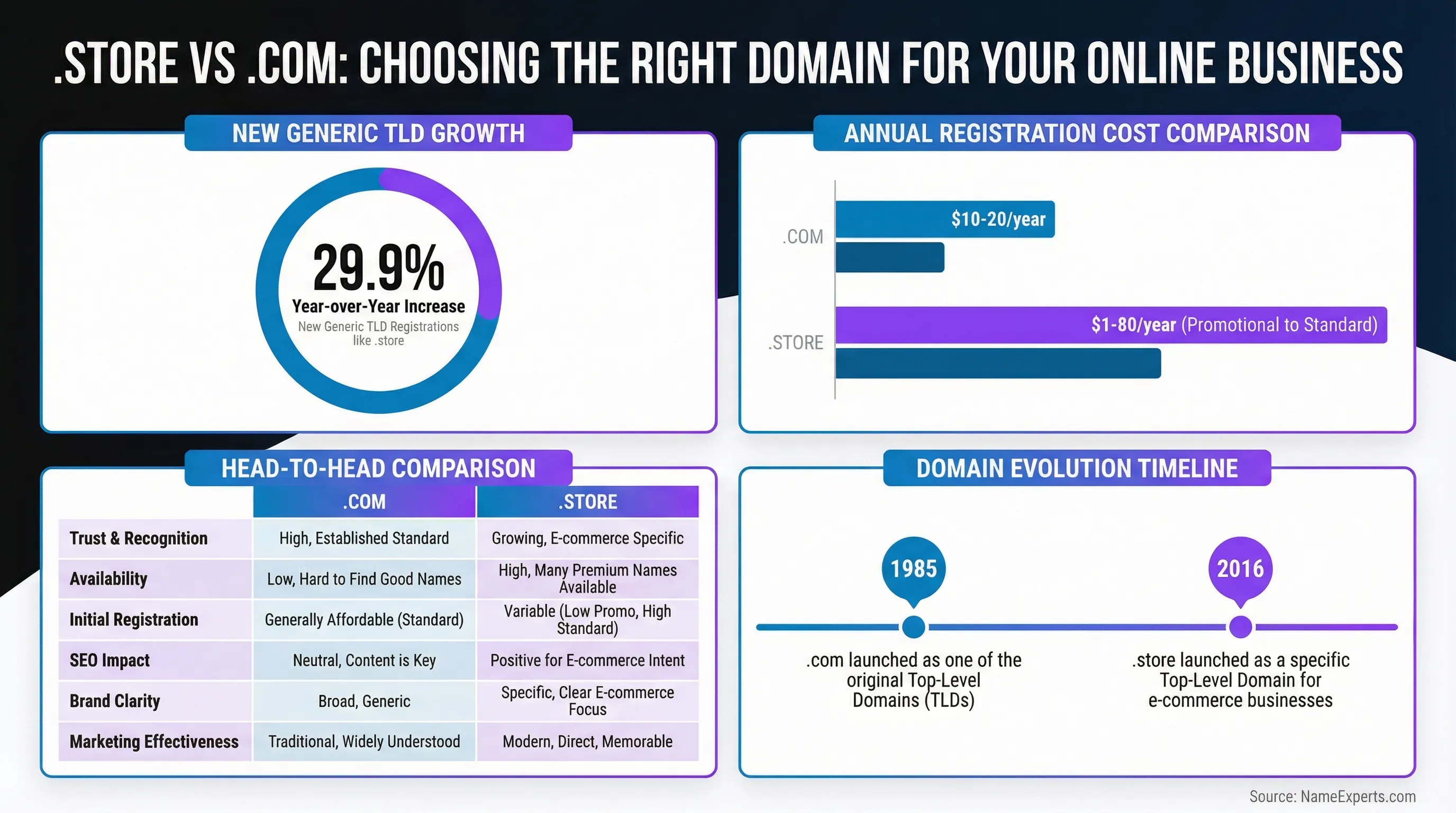
A domain extension, or top-level domain (TLD), is the suffix that follows your business name in a web address. The .com extension launched in 1985 as one of the original TLDs, initially designated for commercial entities. Over decades, it evolved into the universal standard for businesses across all industries.
The .store extension launched in 2016 as an ecommerce-specific TLD designed exclusively for retail businesses. According to industry registration data, new generic TLDs like .store have grown significantly, with total registrations increasing 29.9% year over year. This growth reflects broader acceptance of alternative extensions among both businesses and consumers.
Your domain extension matters beyond the web address itself. It signals your business purpose, influences customer expectations, and affects how easily people remember and find your site. For retailers, this choice becomes particularly important as ecommerce continues expanding globally.
Head-to-Head Comparison
| Factor | .com | .store |
|---|---|---|
| Trust & Recognition | Universal, established credibility | Growing acceptance, clear retail focus |
| Availability | Limited for exact-match names | Better availability for desired names |
| Initial Registration | $10-20/year | $1-80/year (promotional to standard) |
| SEO Impact | No inherent advantage | No inherent disadvantage |
| Brand Clarity | Generic, requires context | Immediate retail identification |
| Marketing Effectiveness | Broad appeal | Targeted ecommerce messaging |

The .com Advantage
The .com extension carries universal recognition built over four decades. Customers instinctively type .com when remembering a business name, making it the path of least resistance for brand recall. This familiarity translates to trust—consumers perceive .com sites as more established and legitimate, particularly for businesses mixing online and offline presence.
Initial registration costs remain competitive for .com domains, typically ranging from $10-20 annually. This extension works well for businesses planning diverse content beyond pure ecommerce, such as blogs, resources, or community features. The broad appeal makes it suitable for companies targeting global audiences requiring maximum recognition.
However, availability presents the primary challenge. Most short, memorable .com names were registered years ago. Premium domains—already registered and available for purchase—often cost thousands or tens of thousands of dollars. This scarcity forces businesses to compromise on their ideal name or consider alternatives.
The .store Advantage
The .store extension immediately signals your business purpose. When customers see a .store domain, they know exactly what to expect: a place to shop. This clarity eliminates confusion and sets appropriate expectations before the first click.
Availability represents a significant advantage. Because this extension launched recently, exact-match names remain available that would be impossible or expensive to secure as .com domains. If "PremiumKitchen.com" costs $25,000, "PremiumKitchen.store" might be available for standard registration fees.
The extension also provides better availability for exact-match names that strengthen your brand identity. You can secure the precise name you want rather than settling for variations like "PremiumKitchenShop.com" or "ThePremiumKitchen.com" that dilute your brand.
The primary consideration is renewal costs, which typically range from $15-80 annually depending on your registrar and promotional offers. Some customers, particularly older demographics, may default to typing .com when trying to remember your address. This requires stronger marketing to establish the correct extension in customer minds.
Your Perfect Domain Name Is Already Taken?
Don't settle for a compromised brand name. NameExperts specializes in stealth acquisitions of premium domains, negotiating fair prices while protecting your identity. With 200+ successful transactions, we've helped businesses secure their ideal domains without overpaying.
Making the Right Choice for Your Business
When .com Makes Sense
Established brands seeking maximum credibility benefit most from .com domains. If you've operated for years and customers already associate your name with .com, changing extensions creates unnecessary confusion. Similarly, businesses with mixed online and offline presence—retail stores, restaurants, service providers—find .com's broad recognition valuable across all touchpoints.
Companies planning diverse content beyond pure ecommerce should consider .com. If your site will include extensive blogs, educational resources, community forums, or other non-transactional content, the generic extension provides more flexibility. Global businesses requiring universal recognition across markets and languages also benefit from .com's worldwide familiarity.
If your ideal .com name is available at standard registration costs, securing it makes sense. The combination of availability and recognition creates a strong foundation for long-term brand building.
When .store Outperforms Alternatives
Pure-play online retailers and ecommerce startups gain the most from .store domains. If your business exists primarily to sell products online, the extension reinforces this focus immediately. Businesses needing exact-match domain names find better availability with .store, avoiding awkward compromises that weaken brand identity.
Brands wanting immediate purpose clarity benefit from the specificity. When marketing campaigns drive traffic to your site, the .store extension eliminates any question about what customers will find. This clarity can improve conversion rates by setting accurate expectations.
Product launch pages and seasonal stores work particularly well with .store domains. If you're launching a new product line or creating a temporary seasonal shop, the extension provides clear context. The targeted nature helps marketing campaigns perform more efficiently by immediately identifying the destination as a shopping experience.
Choosing the Right Domain Strategy
Your domain decision extends beyond simply choosing an available extension. Consider how the domain fits your overall brand positioning, competitive landscape, and growth plans. The right choice depends on your specific business context rather than universal rules.
At NameExperts, we help clients evaluate brand positioning beyond just TLD selection. With 16+ years of experience and 200+ transactions, we've seen how domain strategy affects long-term business success. Our team analyzes your competitive landscape, target audience expectations, and expansion plans to recommend domain approaches that support your goals for years to come.
Strategic Domain Considerations
Premium vs Standard Domain Acquisition
When your ideal domain is already registered, you face a choice: compromise on the name or acquire the premium domain. Premium domains—those already registered and offered for resale—often carry significant price tags, but they can justify the investment for the right business.
Premium domain pricing reflects factors like length, memorability, keyword relevance, and existing traffic. A short, exact-match domain in a competitive industry might cost $10,000-$100,000 or more. However, this investment can pay dividends through improved brand recall, reduced marketing costs, and stronger customer trust.
NameExperts specializes in negotiating and acquiring already-registered premium domains for clients. We employ stealth acquisition strategies for competitive situations where revealing the buyer's identity might inflate prices. Our experience with 200+ transactions helps clients secure valuable domains at fair market prices, often saving thousands compared to direct negotiations.
SEO and Search Visibility Reality
Google has consistently stated that domain extensions do not directly impact search rankings. According to search engine guidance, the algorithm treats most TLDs equally, focusing instead on content quality, user experience, and technical factors.
However, domain choice indirectly affects SEO through user behavior. A domain that matches search intent may achieve higher click-through rates in search results. If someone searches for "organic coffee store," they might be more likely to click "OrganicCoffee.store" than a less descriptive alternative. These behavioral signals can influence rankings over time.
Keyword-rich domains provide some benefit through anchor text when other sites link to you. If your domain is "HandmadeJewelry.store," natural links often use your domain as anchor text, sending relevance signals to search engines. This effect is modest but measurable.
Voice search optimization presents another consideration. As voice queries become more conversational, domains that match natural language patterns may gain advantages. A .store domain clearly answers the implicit question "where can I buy this?" in voice search results.

Brand Recall and Customer Psychology
Domain memorability directly impacts marketing effectiveness. Customers who can't remember your exact web address must search for your business name, adding friction to the customer journey. According to domain research, shorter domains with clear meaning achieve better recall rates than longer, complex alternatives.
Customer expectations based on domain extensions influence behavior. When someone sees a .store domain, they expect a transactional experience optimized for shopping. This expectation can improve conversion rates by attracting visitors with purchase intent while filtering out those seeking information only.
Cross-channel marketing integration matters significantly. Your domain appears in offline advertising, social media profiles, email signatures, and packaging. A clear, memorable domain works better across these touchpoints than a complex compromise. Consider how your domain sounds when spoken aloud in radio ads or mentioned in conversations.
Building a Domain Portfolio Strategy
Growing businesses should consider defensive domain registration—securing both .com and .store versions of their brand name. This prevents competitors from capitalizing on customer confusion and protects your brand as it expands. The modest annual cost of multiple registrations is worthwhile insurance against future complications.
Geographic expansion introduces additional considerations. If you plan to enter international markets, research country-code TLDs (ccTLDs) and local domain preferences. Some markets strongly prefer local extensions, while others accept .com universally. Your domain strategy should account for these regional differences.
Product line and subsidiary domain planning becomes important as businesses grow. Multiple product lines might warrant separate domains for clarity and targeted marketing. Acquisitions and new ventures require domain strategies that balance brand architecture with practical considerations.
NameExperts provides domain portfolio strategy consultation for businesses with expansion plans, multiple product lines, or complex brand architecture needs. We help clients develop comprehensive domain strategies that support growth while protecting brand equity. Our experience with major brands like HBO Max and Monday.com demonstrates how strategic domain planning enables business success. Contact our team to discuss your domain portfolio needs.
The choice between .store and .com domains depends on your specific business context, available options, and long-term goals. Evaluate your needs against the comparison criteria outlined above, considering factors like domain availability, budget, target audience, and brand positioning. For complex domain decisions involving premium acquisitions or portfolio strategy, professional guidance can help you make choices that support your business for years to come.
Building a Domain Strategy That Grows With Your Business?
From defensive registrations to multi-market expansion, domain portfolio decisions get complex fast. With 16+ years of experience helping brands like HBO Max and Monday.com, we'll develop a comprehensive domain strategy that protects your brand and supports your growth plans.
Work With a Domain Expert
Whether you're navigating the Wild West of premium domain negotiations, deciding between .store and .com, or building a portfolio strategy for expansion, the right domain decision shapes your business for years to come. NameExperts brings a no-bullshit approach to domain acquisition and strategy—combining 16+ years of expertise with personalized service that large corporate brokerages can't match. We'll help you secure your ideal domain at fair market prices, maintain complete anonymity during n
Get Started Free







Frequently Asked Questions
Choose .com if your exact-match name is available at standard pricing and you need maximum universal recognition; opt for .store when you want immediate retail clarity and better availability for your ideal brand name.
.store domain registration typically ranges from $1-80 annually depending on registrar promotions and standard pricing, with renewal costs generally settling at $15-80 per year.
Google treats .store and .com equally in search algorithms, but your extension can indirectly influence rankings through click-through rates when users perceive stronger relevance to their search intent.
Defensive registration of both extensions protects your brand from competitor confusion and costs only modest annual fees, making it worthwhile insurance as your ecommerce business grows.


