
Key Takeaways
- Strategic naming matters more than founders realize—your name shapes first impressions, funding opportunities, and global scalability from day one
- Three proven approaches work best: descriptive names (clear value), phrase-based names (cultural resonance), and memorable names (emotional connection)
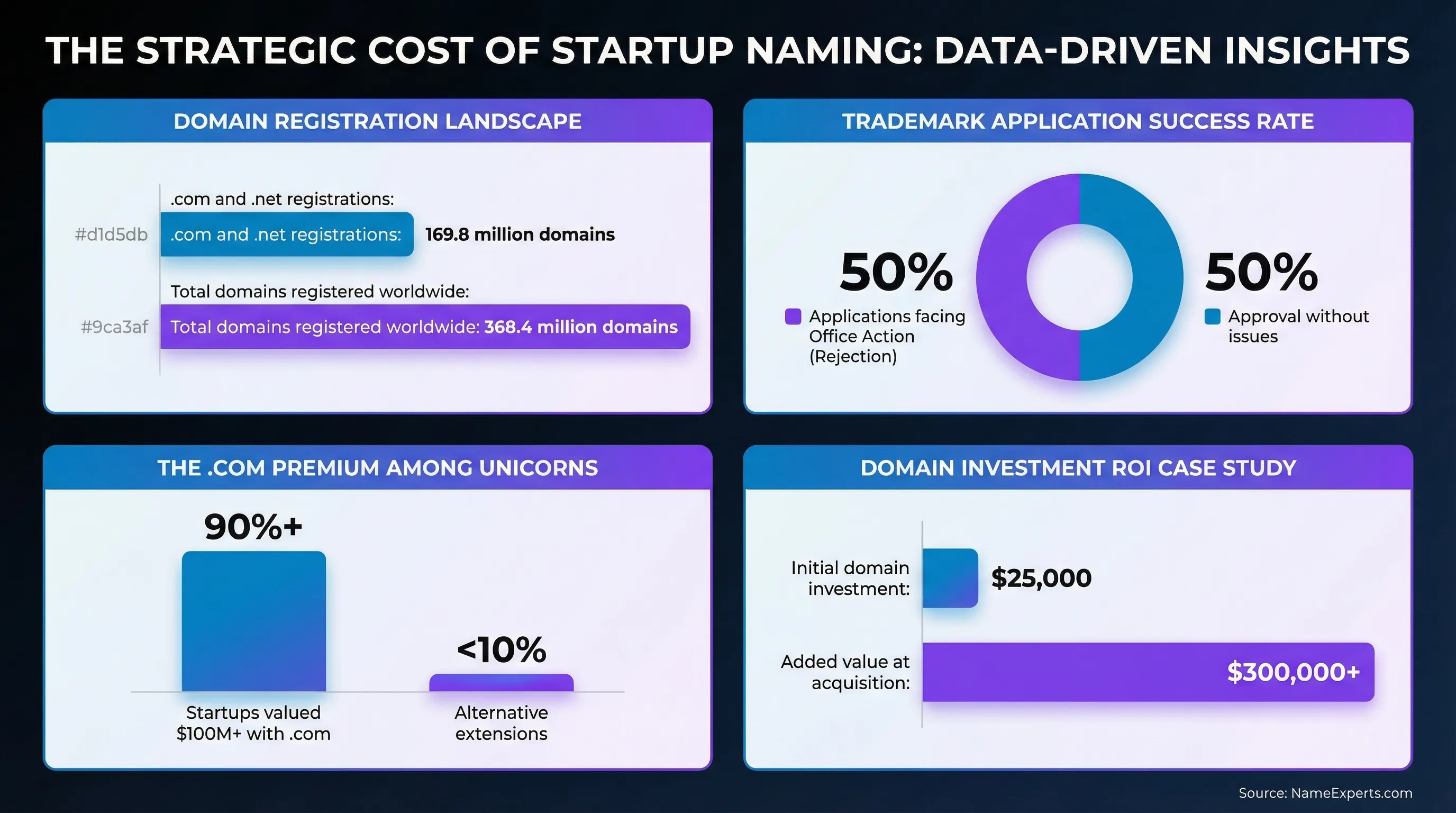
- Domain availability and trademark clearance present major hurdles—over 368 million domains are registered worldwide, making early professional vetting essential
- The .com extension remains the gold standard, with over 90% of successful startups valued at $100M+ launching with one
- Professional naming consultation bridges the gap between DIY tools and full agency engagements, offering strategic guidance at critical decision points
The shift from quirky startup names like Coinburp and MortgageHippo to serious-sounding brands like OpenAI and Anthropic reflects a fundamental change in how investors and customers perceive startups. Your company's name isn't just a label—it's the foundation of your brand identity, your first impression on potential customers, and a signal to investors about your ambitions. In our 16+ years advising businesses on domain strategy through over 200 transactions, we've seen how the right name can accelerate growth while the wrong one creates friction at every turn.
The Current Naming Landscape
The startup world has undergone a dramatic evolution in how companies choose their names. According to Crunchbase, there was a time when reading through the names of the last 1,000 funded startups was entertaining—founders named companies after badgers, hippopotamuses, and vegetables. Then someone hit the boring switch.
This transformation isn't random. The falling share of financing going to consumer-facing startups, combined with the rise of B2B software and enterprise solutions, has pushed founders toward more serious-sounding names. When the most valuable unicorns today have names like OpenAI and Anthropic, imitation becomes a factor. Investors and enterprise customers expect gravitas, not gimmicks.
The "weird era" of 2016-2017 featured misspellings as a workaround for domain availability. Startups adapted to finding their dream name taken by deleting the "i" and replacing it with a "y," or changing a "c" to a "k." Standouts from this period include Mylestone, Shyft Technologies, and Kustomer. These techniques made names hard to spell but solved the availability problem—until they didn't.
Today's patterns favor clarity over cleverness. Successful recent launches prioritize descriptive accuracy, professional tone, and global scalability. The challenge isn't creating something memorable anymore—it's creating something memorable that also passes trademark screening, secures a quality domain, and positions your company for international expansion.
The 5-Step Strategic Framework
Effective naming requires a systematic approach that balances creativity with practical constraints. This framework has guided hundreds of our clients through the process, from initial brainstorming to final trademark filing.
Step 1: Define Your Naming Strategy Type
Before generating options, you need to understand which strategic approach aligns with your business model and growth plans. Three primary strategies dominate the landscape, each with distinct advantages and limitations.
Descriptive names communicate exactly what you do. Think "Somewhere I Would Live" (an Instagram account with 838,000 followers showcasing beautiful homes) or "Design Scientist" (our previous agency name that combined design with strategic thinking). These work exceptionally well when your value proposition is clear and your market is established. The downside? They can limit pivots and feel generic in crowded markets.
Invented or brandable names create entirely new words or combine existing ones in novel ways. Facebook, Pinterest, and Perplexity fall into this category. They offer maximum flexibility as your business evolves and can become powerful brand assets. The tradeoff is the initial investment required to build meaning—when you launch, nobody knows what your name means.
Compound names blend familiarity with uniqueness by combining two recognizable words. GitHub, Dropbox, and Firebase demonstrate this approach. They balance immediate comprehension with distinctive branding, though finding available combinations grows harder each year.
| Strategy Type | Best For | Scalability | Example |
|---|---|---|---|
| Descriptive | Clear value props, established markets | Limited by specificity | American Airlines |
| Invented/Brandable | Long-term brand building, flexibility | High—grows with you | Perplexity |
| Compound | Balance of clarity and uniqueness | Medium—some constraints | GitHub |
| Phrase-Based | Cultural resonance, viral potential | Variable by phrase | Boss Babe |
Step 2: Generate Names Using Proven Techniques
Once you've selected your strategic direction, specific techniques can help generate quality options. The most effective approaches combine linguistic creativity with practical constraints.
Word blending and portmanteaus merge two words into one cohesive unit. Facebook combined "face" and "book," while Pinterest merged "pin" and "interest." This technique works best when both root words relate to your core offering and the combination sounds natural when spoken aloud.
Prefix and suffix additions modify existing words to create something familiar yet distinct. Optimizely added "-ly" to "optimize," while Delighten added "-en" to "delight." This approach maintains recognition while establishing uniqueness, though it can feel formulaic if overused.
Creative misspellings dominated the 2016 era but require caution today. While Flickr and Tumblr succeeded by dropping vowels, this technique now signals amateur hour to many investors and enterprise customers. Use sparingly and only when the misspelling is intuitive.
Mixing core words with neutral nouns combines your category with colors, elements, or objects. Stripe (payment processing), Linear (project management), and Notion (productivity) demonstrate how simple nouns can become powerful brands when paired with excellent execution.

Step 3: Apply Critical Filters
Your initial brainstorming should produce dozens of options. Now comes the ruthless filtering process that separates viable candidates from creative dead ends.
The length rule matters. Aim for nine letters or fewer and three syllables maximum. Research from Stanford Graduate School of Business demonstrates that certain words stick in our minds more readily than others, with shorter, phonetically simple words showing higher recall rates. When people are forced to use longer names, they shorten them anyway—"television" became "TV," "electronic mail" became "email."
Pronunciation and cultural checks prevent embarrassing mistakes. Your name needs to work across languages and cultures if you plan to expand globally. Test pronunciation with native speakers of your target markets. Check for unintended meanings in major languages. A name that works perfectly in English might be offensive or ridiculous in Mandarin, Spanish, or Arabic.
Negative association screening protects your brand from day one. Search each candidate thoroughly for existing associations, slang meanings, and historical references. Urban Dictionary, Google Trends, and social media searches reveal how people actually use words in context. One founder nearly named their productivity app after a term that had recently become slang for something entirely inappropriate.
Competitive landscape analysis determines whether you'll stand out or blend in. Study your direct competitors' names. Are they all descriptive? All invented? If everyone in your space uses compound words, a single invented word might help you differentiate. Conversely, if everyone has abstract names, a clear descriptive option might cut through the noise.
Step 4: Validate Availability and Legal Safety
This step kills more naming dreams than any other. The harsh reality: 368.4 million domain names are registered worldwide as of Q1 2025, with .com and .net registrations reaching 169.8 million. Finding an available, affordable domain for your perfect name is increasingly difficult.
Domain availability reality check should happen early in your process. Check domain availability for every name on your shortlist before falling in love with any option. The .com extension remains the gold standard—over 90% of successful startups valued at $100M+ launched with one. Alternative extensions like .tech, .ai, or .io can work for specific use cases, but they carry tradeoffs in credibility and recall.
Trademark prescreening prevents costly legal battles down the road. According to trademark attorneys, less than 50% of trademark applications are approved without issuing an Office Action—more than one in every two applications faces initial rejection. The most common issue? Likelihood of confusion with existing registered trademarks.
Start with the USPTO's free TESS database to search existing trademarks in your category. Look for exact matches and similar names that could cause confusion. Pay special attention to marks in your specific industry classification. A name that's available in one category might be blocked in another.
When to engage professional vetting depends on your risk tolerance and budget. If you're planning significant investment in brand building, operating in a crowded market, or targeting enterprise customers, professional trademark screening is worth the cost. Before committing to a name, consider conducting thorough domain due diligence to identify potential conflicts early. At NameExperts, we've helped clients avoid expensive mistakes by identifying potential conflicts before they committed to a name. Our 16+ years of experience means we spot issues that founders miss.
Step 5: Test for Long-Term Viability
Your name needs to work not just for your current product but for where you're headed. This final validation step ensures you're building a brand that can grow with your ambitions.
Will it grow with your business? Avoid product-specific limitations that could force a costly rebrand later. "iPhone Repair Shop" works fine for a local business but becomes a problem when you expand to Android repairs, then computer services, then general tech support. Similarly, geographic names limit perceived scope—"Brooklyn Coffee" suggests local operations even if you ship nationwide.
Investor perception matters more than founders often realize. Your name signals whether you're building a lifestyle business or aiming for venture scale. Names that sound like hobbyist projects struggle to attract serious capital. Test your shortlist with advisors, mentors, and potential investors. Do they take it seriously? Can they imagine it on a billboard or in a press release announcing your Series A?
Memorability and word-of-mouth testing reveals how your name performs in real conversations. Tell people your name once, then ask them to repeat it back. Can they spell it correctly? Would they remember it tomorrow? The "bar test" works well: imagine telling someone your company name in a crowded bar with loud music. If they can't understand or remember it, keep searching.
Struggling to Find an Available Domain for Your Perfect Name?
With over 368 million domains already registered, securing the right .com for your startup often requires strategic negotiation and market expertise. If you're facing inflated asking prices or complex ownership situations, our stealth acquisition service protects your identity during negotiations to prevent sellers from price-gouging when they discover a funded startup is interested.
Domain Acquisition Strategy
Securing the right domain often determines whether you can use your preferred name at all. The domain market has become increasingly competitive, with premium short domains commanding six or seven-figure prices. Understanding your options helps you make smart tradeoffs between cost, brand strength, and long-term value.
The .com Premium
The .com extension remains the most trusted and recognizable choice globally. Domain statistics show that .com hosts over 160 million registrations, and 46% of small businesses report that a custom domain increases credibility. Mobile users are twice as likely to trust sites with a branded domain versus generic subdomains.
When is the .com premium worth paying? Consider the lifetime value of customer trust and reduced friction. Every time someone types your domain incorrectly or defaults to adding ".com" to your .io address, you lose traffic. Every time an investor or enterprise customer sees a non-.com extension, you face an unconscious credibility penalty. For venture-backed startups planning significant growth, the .com investment often pays for itself in reduced customer acquisition costs and improved conversion rates.
We helped Monday.com through their rebrand from Dapulse.com, understanding firsthand how the right domain supports a complete brand transformation. The .com extension wasn't just about credibility—it was about signaling their evolution from a niche tool to a global platform.
Alternative Domain Strategies
When your ideal .com is unavailable or prohibitively expensive, alternative extensions offer viable paths forward. The key is understanding which alternatives work for which business models.
.tech, .ai, and .io extensions have gained acceptance in the startup world, particularly for technology companies. The .ai extension saw 400%+ growth in demand over the past three years, driven by the AI boom. These extensions can work well when they align naturally with your business (an AI company using .ai makes sense), but they still carry tradeoffs in memorability and trust.
Creative .com alternatives include adding prefixes or suffixes to your core name. "Get," "try," "use," or "app" before your name, or "hq," "app," or "io" after it can secure a .com when the exact match isn't available. The downside? You're training customers to remember a longer, less elegant domain.
Invented spellings represent another workaround, though they require careful consideration. Dropping vowels (Flickr, Tumblr) or creative respellings can secure available domains, but they increase the cognitive load on customers and create spelling confusion in verbal conversations.
Negotiating Domain Purchases
When your perfect domain is registered but not actively used, negotiation becomes necessary. Understanding realistic pricing expectations and effective tactics improves your chances of securing the domain at a fair price.
Realistic pricing expectations vary widely based on domain quality. Short, dictionary-word .com domains in competitive categories can command $25,000 to $250,000 or more. Longer, compound, or niche-specific domains might range from $2,000 to $25,000. The average domain length is 11-13 characters, and domains under 10 characters are significantly more memorable—and more expensive.
One founder we advised spent $25,000 on their ideal domain early in their journey. When their company was acquired years later, that domain investment added over $300,000 to the cash consideration in the deal. The lesson? If you succeed, the domain price becomes irrelevant. If you fail, it won't matter anyway. But operating with a suboptimal domain while trying to succeed creates unnecessary friction.
Negotiation tactics require patience and strategy. Never reveal your budget or urgency. Research the domain owner through WHOIS records and understand their position—are they a domain investor looking for profit, or a business owner who might have emotional attachment? Make a reasonable initial offer (typically 30-50% of your target price) and be prepared for counteroffers. For detailed guidance on effective negotiation approaches, review our domain negotiation scripts and strategies.
When to use domain brokerage services depends on the domain value and your negotiation comfort. For premium domains or competitive situations, professional brokers provide valuable services. At NameExperts, our stealth acquisition service prevents sellers from inflating prices when they discover a funded startup is interested. We've completed over 200 transactions and understand how to navigate complex negotiations while protecting your interests.
All our transactions use escrow protection through Escrow.com, ensuring both buyer and seller are protected throughout the transfer process. This eliminates the risk of paying for a domain that never transfers or transferring a domain before receiving payment.
DIY vs Professional Naming
Founders face a crucial decision: tackle naming independently or engage professional help. Understanding when each approach makes sense prevents wasted time and costly mistakes.
When DIY Naming Works
Independent naming succeeds in specific scenarios. If you're early-stage with limited budget, operating in a niche market with less competition, and have clear positioning, DIY can work well. The key indicators that DIY is appropriate:
- Available domains exist in your target category at reasonable prices
- Your market isn't crowded with similar names creating trademark conflicts
- You have time to iterate through multiple options without deadline pressure
- Your team includes someone with branding or marketing experience
- You're comfortable conducting trademark searches and understanding legal risks
Free tools can support DIY efforts. AI-powered name generators provide starting points for brainstorming. The USPTO's TESS database offers free trademark searching. Domain registrars show availability across extensions. These resources help founders generate and validate options independently.
Red Flags That Suggest Professional Help
Certain situations warrant professional guidance from the start. We've seen founders waste months on efforts that professional consultation could have resolved in weeks. Watch for these warning signs:
- Trademark conflicts keep appearing in your searches across multiple name candidates
- Competitive markets mean similar names already exist, making differentiation crucial
- Premium domain needs require negotiation with domain owners or investors
- International expansion plans demand cultural and linguistic validation across markets
- Enterprise customers in your target market expect polished, professional branding
- Significant brand investment is planned, making the name a critical foundation
The cost of getting it wrong compounds over time. Rebranding after you've built awareness, printed materials, and established customer relationships is exponentially more expensive than investing in professional guidance upfront. One agency we worked with operated as "Dispatch" before rebranding to "Design Scientist." Revenue and conversion rates improved immediately after the change—but the transition cost time, money, and momentum.
The Middle-Ground Option
Professional naming consultation bridges the gap between free DIY tools and full-service agency engagements costing $50,000 or more. This middle path offers strategic guidance at critical decision points without the full agency price tag.
What consultation provides: Expert review of your shortlist, trademark risk assessment, domain acquisition strategy, and guidance on legal protection steps. You maintain control of the creative process while gaining professional validation of your direction.
At NameExperts, our domain consulting service helps startups navigate the process strategically. With 16+ years of experience and over 200 completed transactions, we've seen every challenge and know how to avoid common pitfalls. Our clients include HBO/Max.com, Monday.com, TripAdvisor, and HubSpot—companies that understood the strategic importance of getting their domain right. If you're evaluating different service providers, our comprehensive guide to the best domain brokers of 2026 can help you understand what to look for in a professional partner.
Cost-benefit analysis reveals when consultation makes financial sense. If you're planning to raise venture capital, the credibility boost from a strong name and domain can influence investor perception. If you're targeting enterprise customers, professional branding signals that you're serious. If you're entering a competitive market, differentiation through naming can provide early advantage.

Practical Next Steps
Naming your startup doesn't have to be overwhelming when you follow a systematic approach. Start by defining your strategic direction—descriptive, invented, or compound. Generate dozens of options using proven linguistic techniques. Filter ruthlessly through length, pronunciation, and cultural checks. Validate availability through trademark and domain searches. Test finalists for long-term viability and memorability.
Remember that your name is a long-term asset. The right choice supports growth, builds credibility, and creates customer confidence. The wrong choice creates friction at every stage—from investor pitches to customer acquisition to international expansion. Invest the time and resources to get it right from the start.
If you're facing trademark conflicts, struggling with domain availability, or operating in a competitive market, professional guidance can accelerate your path to the right name. Our team at NameExperts has helped hundreds of companies navigate this process, from early-stage startups to established enterprises undergoing rebrands. We understand the full lifecycle of strategy and can help you avoid costly mistakes while securing the domain assets you need. Learn more about how to rebrand your business if you're considering a name change for an existing company.
The startups that succeed don't just build great products—they build great brands. And great brands start with great names. Take the strategic approach, validate thoroughly, and don't settle for a name that will limit your potential. Your future customers, investors, and team members will thank you.
Don't Navigate Trademark Risks and Domain Negotiations Alone
With less than 50% of trademark applications approved without issues and premium domains requiring sophisticated negotiation tactics, the cost of mistakes compounds quickly. Our 16+ years of experience across 200+ transactions means we spot conflicts early and secure fair pricing. Get expert guidance on trademark screening and domain acquisition strategy without paying full-agency prices.
Ready to Secure the Perfect Domain for Your Startup?
Your company name is a long-term asset that shapes investor perception, customer trust, and global scalability from day one. Whether you're facing trademark conflicts, negotiating with domain owners, or simply need strategic validation of your shortlist, professional guidance prevents costly mistakes and accelerates your path to the right name. We've helped companies like Monday.com, HBO/Max.com, and HubSpot navigate complex domain acquisitions with our no-bullshit approach to the Wild West of t
Schedule a free consultation to discuss your naming strategy and domain needs







Frequently Asked Questions
Choose a strategic approach (descriptive, invented, or compound), generate 50+ options using proven linguistic techniques, filter through length and pronunciation checks, validate trademark and domain availability, then test finalists for memorability and long-term scalability.
The seven primary types are descriptive (American Airlines), invented (Perplexity), compound (GitHub), founder-based (Ford), acronym (IBM), geographic (Bank of America), and metaphorical (Apple)—each offering different tradeoffs between clarity, flexibility, and trademark protection.
Each state requires unique entity names that don't conflict with existing registrations, proper use of legal suffixes (LLC, Inc., Corp.), and compliance with trademark laws—most states prohibit names that imply government affiliation or use restricted words without proper licensing.
Startup owners are called "founders" (or "solo founders" for single-person launches and "co-founders" when multiple people launch together), though titles like CEO, managing director, or entrepreneur are also commonly used depending on company structure and stage.


