
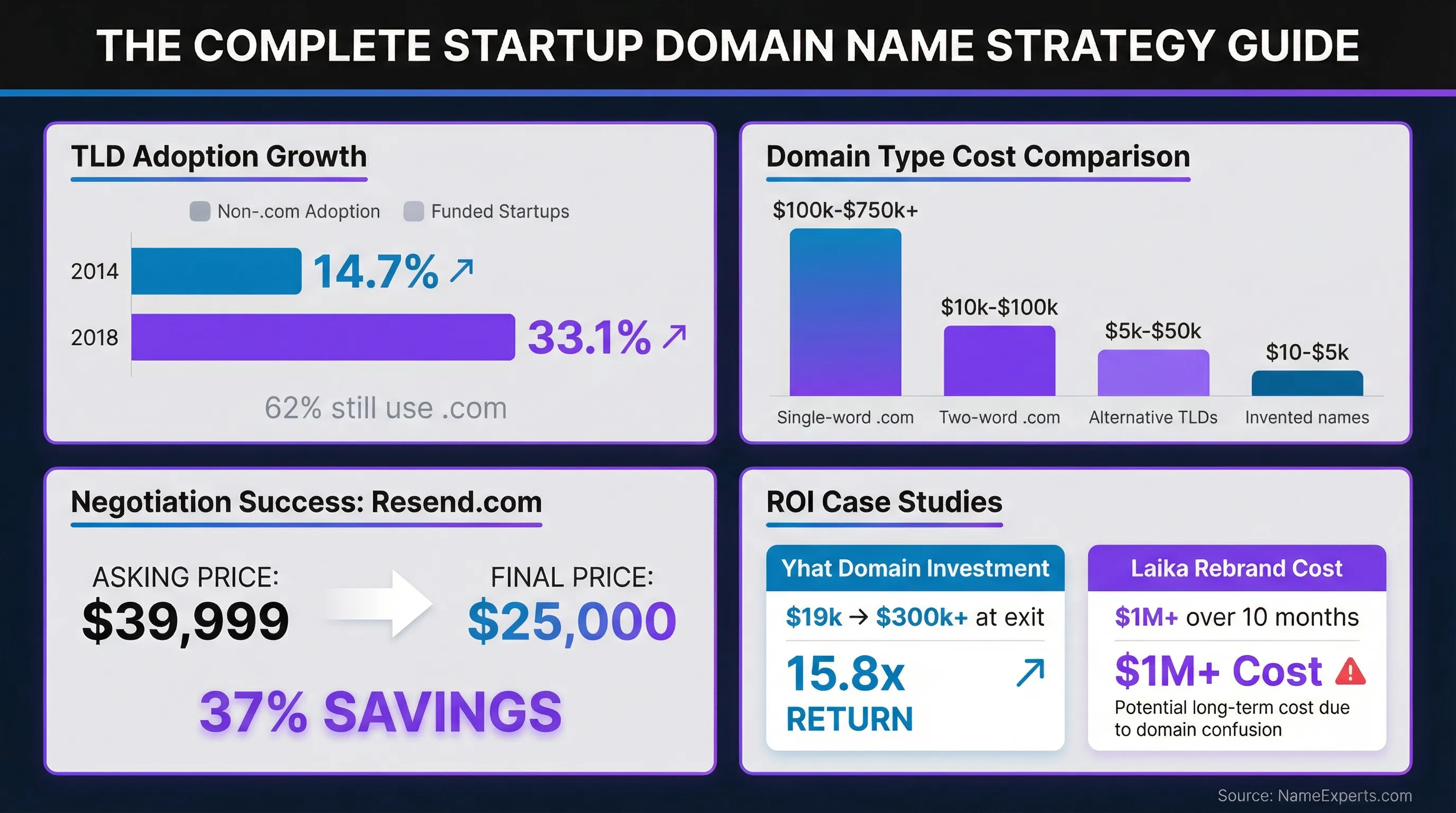
Ring's transformation from Doorbot included a $1M domain investment that contributed to a $1B Amazon acquisition. The dilemma facing founders is real: premium domains command price tags ranging from $100k to $750k, yet they remain critical brand assets. This guide provides a strategic framework for choosing, evaluating, and acquiring domains without overpaying.
Key Takeaways
- Five non-negotiables for domain evaluation: .com preference (with .co/.ai exceptions), memorability, under 10 characters, brandability, and trademark clearance
- Domain Type Evaluation Matrix comparing single-word, two-word, alternative TLDs, and invented names across cost and perception
- Negotiation tactics that secured Resend.com for $25,000 (down from $39,999 asking price)
- ROI analysis: Yhat's $19k domain investment added $300k+ to acquisition value
- When to use professional brokers for domains over $50k (typical savings: 30-40% vs direct purchase)
The Strategic Framework: Evaluating Startup Domain Names
Choosing the right domain requires balancing multiple factors. The most successful founders apply systematic evaluation criteria rather than relying on gut instinct alone.
The Five Non-Negotiables
Every startup domain should meet these fundamental requirements:
- .com preference with strategic exceptions - While .com remains the gold standard, 62% of funded startups use .com, but alternative TLD adoption grew from 14.7% in 2014 to 33.1% in 2018. Industry-specific extensions like .ai or .co work when they strengthen rather than confuse your positioning.
- Memorability through the radio test - If someone hears your domain on a podcast with background noise, can they spell it correctly? Avoid hyphens, numbers, and ambiguous spellings that create friction.
- Length under 10 characters - Shorter domains reduce typing errors and improve recall. Single-word dictionary domains command premium prices for good reason.
- Brandability vs descriptiveness - Stripe.com exemplifies perfect brandability: six characters, pleasant word shape, easy to say. Descriptive options like Booking.com trade memorability for immediate clarity about function.
- Trademark clearance - Registering your domain name or incorporating your business does not give you any trademark rights. Conduct thorough searches before committing to prevent costly legal disputes.
Domain Type Evaluation Matrix
| Domain Type | Memorability | Availability | Typical Cost | VC Perception | SEO Impact |
|---|---|---|---|---|---|
| Single-word .com | Excellent | Very limited | $100k-$750k+ | Strong credibility | High brand signal |
| Two-word .com | Good | Limited | $10k-$100k | Professional | Moderate keyword value |
| Alternative TLDs (.ai/.co) | Good if industry-aligned | Better | $5k-$50k | Acceptable for tech | Neutral in search |
| Invented names | Variable | Excellent | $10-$5k | Requires brand building | Depends on execution |
The timing question matters significantly. Rebranding costs escalate dramatically after launch. Laika's transition to Thoropass required 10 months and approximately $1M in agency fees, marketing materials, and opportunity costs. Getting it right initially prevents this expensive disruption.

Domain Acquisition Tactics: From $7,999 to $25,000
Once you've identified target domains, acquisition strategy determines whether you overpay or secure a fair deal. The Resend.com negotiation provides a tactical blueprint.
The Negotiation Playbook
When Resend's founder encountered a $39,999 asking price, he didn't accept immediately. Instead, he followed this sequence:
- Initial lowball offer - Countered at $7,999 (approximately 20% of asking price) to test willingness to negotiate
- Received counteroffer - Seller dropped to $35,000, confirming flexibility
- Multiple rounds of incremental increases - Moved from $7,999 toward middle ground over several days
- Final settlement - Closed at $25,000, saving $14,999 from original ask (37% discount)
This patient approach works because domain owners often set inflated asking prices expecting negotiation. The key is demonstrating serious interest while establishing a lower price anchor. For more detailed strategies, see our comprehensive guide on how to negotiate a premium domain name purchase.
Four Acquisition Channels Ranked by Cost-Effectiveness
Direct owner outreach (cheapest) - Use WHOIS lookup to find contact information and reach out personally. Many owners haven't thought about selling until approached. This channel offers maximum negotiation leverage since you're not competing with other buyers.
Domain marketplaces (moderate cost) - Various platforms list available domains with transparent pricing. Expect to pay 10-20% above direct outreach prices due to marketplace fees, but benefit from escrow protection and streamlined transfers.
Backorder services (timing-dependent) - If your target domain is expiring soon, backorder services attempt to register it the moment it becomes available. Average domain registration costs around $10-20/year, making this the cheapest option when successful, but success rates vary.
Professional brokers (premium channel) - When domains exceed $50k or negotiations stall, brokers justify their fees through stealth acquisition tactics and market intelligence. Professional brokers can negotiate 30-40% below asking prices by approaching owners without revealing the end buyer's identity, preventing price inflation based on your startup's funding status or urgency.
Red Flags and Overpaying Indicators
Not every domain justifies its asking price. Watch for these warning signs:
- Prices exceeding comparable sales by 3x+ - Check recent sales of similar domains through industry resources. If a two-word .com typically sells for $15k-$30k, a $150k ask suggests domain squatting rather than fair market value.
- Aggressive urgency tactics - Claims of "other interested buyers" or "price increasing soon" often indicate negotiation manipulation rather than genuine scarcity.
- Refusal to use escrow - Legitimate sellers accept escrow services that protect both parties. Resistance suggests potential fraud.
- Inconsistent pricing across platforms - The same domain listed at wildly different prices on multiple marketplaces indicates the owner is testing what buyers will pay rather than pricing based on value.
Avoid Overpaying on Your Premium Domain
Negotiating domain acquisitions requires market intelligence and stealth tactics that prevent price inflation. When you're evaluating domains over $50k, connect with an experienced domain broker who can approach owners anonymously and leverage comparable sales data to secure fair pricing—typically saving 30-40% compared to direct negotiations.
Real Startup Domain Decisions: What Worked and What Failed
Examining actual acquisition outcomes reveals patterns that help founders make informed investment decisions.
Case Study 1: Yhat's $19k Investment Adds $300k+ to Exit Value
During Y Combinator office hours, Yhat's founders used yhathq.com. Paul Graham advised: "Your product is great, but your URL is yhathq.com. You need yhat.com. It's $19k right now - a big expense, I know. But if you succeed, the price will skyrocket. And if you fail, the cost won't matter anyway."
They purchased yhat.com for $19,000. When Alteryx acquired Yhat in 2017, that investment added over $300,000 to the cash consideration in the deal - a 15.8x return on the domain investment alone. The premium domain signaled professionalism to enterprise customers and simplified marketing across all channels.
Case Study 2: Agree.com Acquired Early at Low Six Figures
After hearing the Yhat story, Agree's founders moved quickly from agree.xyz to secure agree.com in low six figures before raising significant funding. Co-founder Will Hubbard explained: "The domain has been a force multiplier for our brand and customer trust. Negotiating before financing was key to getting a fair price."
By acquiring early, they avoided the price inflation that occurs when domain owners discover a startup has fresh venture capital. The timing strategy saved an estimated 40-60% compared to post-funding acquisition.
Case Study 3: Laika → Thoropass Rebrand Costs $1M+ and 10 Months
Originally named Laika with HeyLaika.com, the company faced multiple problems:
- Name collisions - Customers confused them with Laika the space dog and Leica cameras
- Competitor similarity - Competitors Drata and Vanta sounded similar to Laika, creating market confusion
- Limited brandability - The name didn't communicate the company's compliance automation focus
The rebrand to Thoropass and acquisition of thoropass.com required 10 months of work, costing approximately $1M when including agency fees, internal team time, updated marketing materials, customer communication, and lost momentum during the transition period.
Pattern Analysis: What These Decisions Reveal
Three clear patterns emerge from successful domain strategies:
Early acquisition prevents price inflation - Both Yhat and Agree secured domains before or immediately after funding announcements. Domain owners who discover a startup just raised $5M often increase asking prices by 2-5x.
Premium domains accelerate trust-building - Enterprise customers and investors use domain quality as a credibility signal. A strong domain reduces the explanation burden in every sales conversation and investor pitch.
Rebranding costs exceed initial domain investment - Laika's $1M+ rebrand cost 50-100x more than simply acquiring the right domain initially. The opportunity cost of 10 months spent on rebranding rather than product development compounds these direct expenses.
The 2026 Domain Landscape: .COM vs The Alternatives
The domain extension debate has evolved significantly as alternative TLDs gain legitimacy in specific contexts.
Statistical Reality Check
While .com still represents 62% of funded startups, the trend toward alternatives is unmistakable. The 33.1% using non-.com domains in 2018 represents more than a doubling from 14.7% in 2014. This shift reflects both .com scarcity and changing user behavior.
When Alternative TLDs Work
.ai for AI startups - The artificial intelligence sector has embraced .ai domains so thoroughly that they now signal category leadership. The extension grew 160.77% from July 2022 to July 2023, demonstrating explosive adoption. For AI-focused companies, .ai often outperforms .com in conveying technical credibility.
.tech for developer tools - With 1.1 million registrations and steady 0.7% quarterly growth, .tech has achieved critical mass among technical audiences. Developer-focused products benefit from the immediate category association.
.co as legitimate .com alternative - Originally Colombia's country code, .co has successfully repositioned as a global alternative to .com. Consumer trust metrics show minimal differentiation between .co and .com for younger demographics (18-34), though older users still prefer traditional extensions.
The key consideration is audience sophistication. Technical buyers and younger consumers readily accept alternative TLDs, while traditional enterprise buyers and older demographics maintain stronger .com preferences.

The PG Doctrine Evolving
Paul Graham's famous advice that "you must have a .com" reflected the internet landscape of the 2000s and early 2010s. In 2026, this guidance requires nuance. Search behavior has shifted from direct URL entry to Google searches and social media discovery. Users increasingly reach websites through links rather than typing domains directly.
This doesn't mean .com is irrelevant - it remains the safest choice for maximum credibility across all audiences. But the penalty for alternative TLDs has decreased substantially, particularly when the extension reinforces rather than contradicts your positioning.
Making Your Domain Decision
Your domain strategy should align with your startup's stage, budget, and target market. Early-stage bootstrapped companies can succeed with strong alternative TLDs while planning future .com acquisition. Well-funded startups targeting enterprise customers should prioritize premium .com domains as credibility investments.
The negotiation tactics, evaluation frameworks, and case studies in this guide provide the foundation for making informed domain decisions. Whether you're spending $25 on initial registration or $25,000 on acquisition, approach the decision systematically rather than impulsively. Understanding how to properly value a domain name is essential to avoid overpaying while ensuring you secure the right asset for your brand.
Remember that domain strategy extends beyond the initial purchase. Protect your investment through proper security measures, trademark registration, and defensive registrations of common misspellings. The domain you choose today becomes inseparable from your brand identity - make it count.
Protect Your Funding from Domain Price Inflation
Domain owners routinely increase asking prices by 2-5x when they discover a startup just raised capital. The difference between Agree.com's early acquisition strategy and waiting until post-funding could have cost them 40-60% more. If you're planning to raise funding soon, schedule a confidential domain acquisition consultation to secure your target domain before your funding announcement goes public.
Get Your Domain Strategy Right the First Time
Whether you're evaluating a $25k domain like Resend or a six-figure premium acquisition like Agree.com, the difference between a smart investment and overpaying often comes down to market expertise and negotiation strategy. Rebranding later costs 50-100x more than acquiring the right domain initially, as Laika's $1M+ rebrand demonstrates. Our no-bullshit approach to domain brokerage means you'll get honest market valuations, stealth acquisition tactics that prevent price inflation, and direct ac
Request a free domain consultation and valuation







Frequently Asked Questions
The .com extension remains the gold standard with 62% of funded startups using it, though .ai works exceptionally well for artificial intelligence companies (160.77% growth in 2022-2023), .io suits tech and SaaS businesses, and .co serves as a legitimate alternative when your preferred .com is unavailable or prohibitively expensive.
Alternative TLD adoption has more than doubled from 14.7% in 2014 to 33.1% in 2018 and continues growing, with total domain registrations reaching 368.4 million by early 2025, driven by .com scarcity and increasing acceptance of industry-specific extensions like .ai and .tech among younger demographics.
The .com extension provides maximum credibility across all audiences and age groups, while .io has gained strong acceptance specifically within tech and SaaS communities—choose .com for broad enterprise appeal or .io when targeting developer-focused audiences who view it as a category signal rather than a compromise.
No, you can register a domain as an individual without forming an LLC, though registering your domain name or incorporating your business does not automatically grant trademark rights—conduct separate trademark searches and registration to protect your brand legally.


