
Key Takeaways
- 95% of successful SaaS companies use .com domains—prioritize this extension for maximum credibility and trust
- Short, brandable names (6-12 characters) consistently outperform keyword-heavy alternatives in building lasting recognition
- Your ideal domain may already be registered, but professional brokers can negotiate acquisitions through stealth methods that prevent price inflation
- Secure defensive registrations early—common misspellings and variations protect your brand from competitors and cybersquatters
- Plan for international expansion from day one by checking cultural meanings and securing country-specific TLDs where relevant
Your domain name serves as your company's permanent digital address and often creates the first impression potential customers have of your brand. For SaaS businesses competing in crowded markets, this choice carries significant weight—it influences everything from brand recall to search visibility to investor confidence.
NameExperts has spent 16+ years helping software companies navigate domain strategy, from initial selection through complex acquisitions and rebranding initiatives. Through 200+ transactions with clients like Monday.com and HubSpot, clear patterns have emerged in what makes certain domains succeed while others create obstacles. This guide combines strategic frameworks with real-world data to help you make an informed decision that supports long-term growth.
The Five Essential Criteria for SaaS Domain Names
Selecting the right domain requires balancing multiple factors. These five criteria form the foundation of effective domain strategy for software businesses.
Brandability Over Keywords
Modern SaaS companies overwhelmingly favor brandable names over descriptive keyword phrases. Consider Slack versus TaskManagementSoftware.com—the former creates a distinct identity that customers remember and recommend, while the latter blends into generic search results.
Brandable domains offer several advantages. They're easier to trademark, giving you legal protection as you scale. They allow your company to evolve beyond initial product offerings without being constrained by a limiting name. And they create emotional connections that purely descriptive names cannot match.
This doesn't mean keywords have no value. Strategic keyword inclusion can support early SEO efforts. But prioritize memorability and uniqueness—these qualities compound over time as your brand gains recognition.
Length and Simplicity
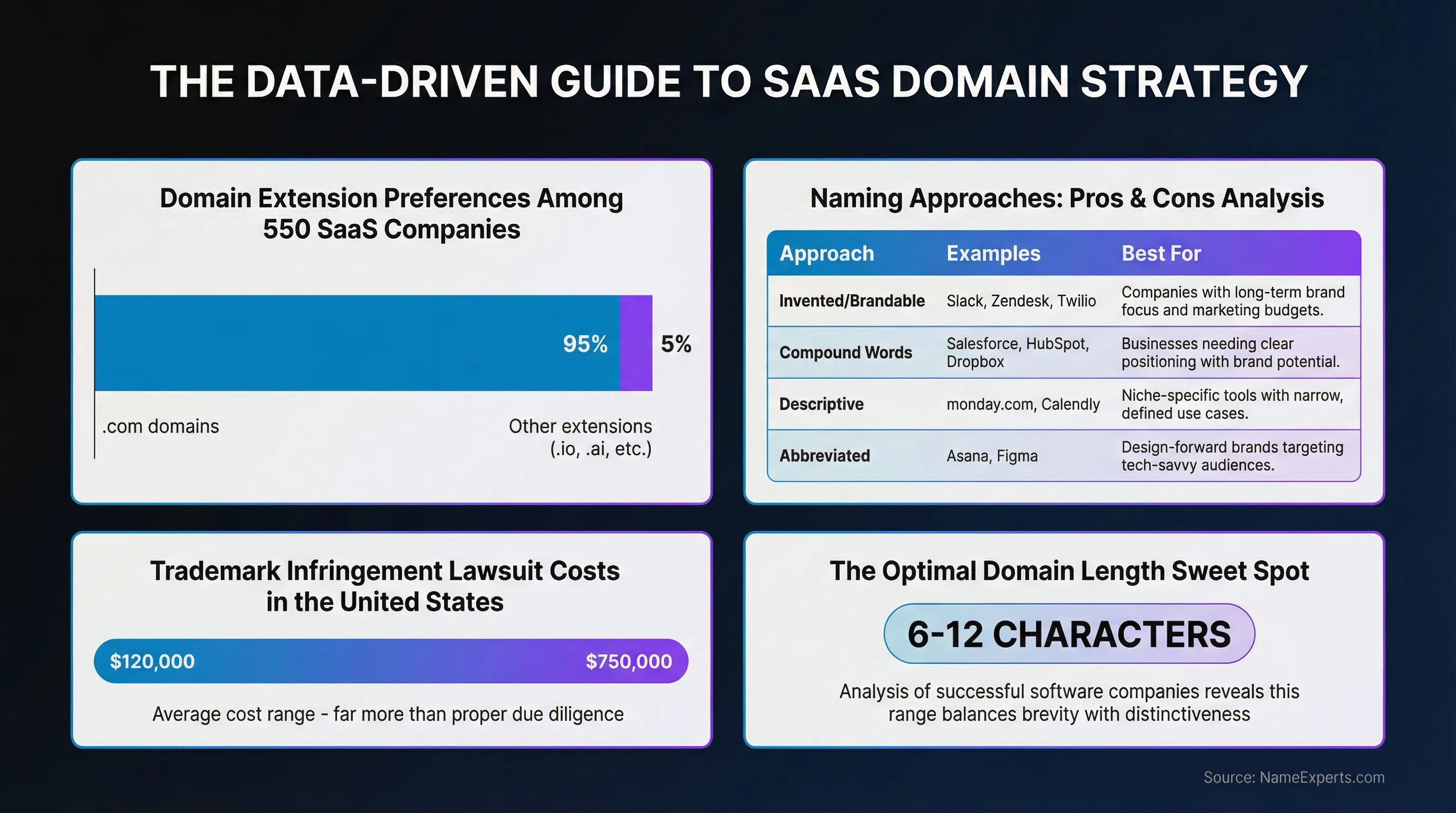
Analysis of successful software companies reveals a clear pattern: the sweet spot falls between 6-12 characters. Names in this range balance brevity with distinctiveness.
Shorter domains carry inherent advantages. They're faster to type, reducing friction when customers want to visit your site. They fit cleanly in marketing materials, social media profiles, and email signatures. And they minimize typo risk—every additional character increases the chance someone will misspell your address.
However, ultra-short domains (3-4 letters) often lack meaning and can be difficult to acquire. The 6-12 character range provides enough space to create a memorable word or compound while maintaining the benefits of brevity.
The Pronunciation Test
Apply the "radio test" to any domain you're considering: if you mentioned this name in a podcast or radio interview, could listeners spell it correctly without seeing it written? This simple check reveals potential problems.
Avoid domains that require explanation. Names with unusual spellings, silent letters, or ambiguous pronunciation create unnecessary barriers. Your domain should be immediately clear when spoken aloud—this facilitates word-of-mouth marketing and reduces customer support inquiries.
Similarly, steer clear of homophones that could confuse potential visitors. If your company is "Sight" but customers might search for "Site" or "Cite," you're fragmenting your traffic and diluting brand recognition.
Scalability Considerations
Your domain choice should accommodate future growth. Overly specific names can become liabilities as your product evolves or expands into new markets.
Geographic limitations present a common trap. A name like "SFProjectManager" might seem appropriate for a San Francisco-based startup, but it signals local focus to potential customers in other regions. As your business scales nationally or internationally, this geographic marker becomes restrictive.
Product-specific names carry similar risks. If your initial offering is invoicing software but you plan to build a full financial management suite, avoid names that lock you into a narrow category. Choose names that can grow with your vision.

What 500+ Successful SaaS Companies Reveal About Domain Strategy
Examining real-world patterns from established software companies provides valuable insights into effective domain selection.
Extension Preferences
The data is unambiguous: analysis of 550 SaaS companies shows that 95% use .com domains. This overwhelming preference reflects user expectations and trust signals.
.com remains the default extension in most users' minds. When someone hears your company name, they'll likely type ".com" automatically. Alternative extensions like .io or .ai have gained traction in tech circles, but they still require explanation and can confuse mainstream audiences.
That said, certain alternative extensions work in specific contexts. The .io extension has become associated with technology startups and can signal innovation. The .ai extension makes sense for artificial intelligence-focused companies. But these should be considered only when your ideal .com is genuinely unavailable or prohibitively expensive.
Avoid extensions that look like typos (.co) or carry negative associations (.info, .biz). The small savings aren't worth the credibility cost and lost traffic from users who default to .com.
Naming Patterns That Work
Successful software companies employ several distinct naming approaches, each with specific advantages:
| Approach | Examples | Pros | Cons | Best For |
|---|---|---|---|---|
| Invented/Brandable | Slack, Zendesk, Twilio | Unique, memorable, highly trademarkable | Requires significant brand building investment | Companies with long-term brand focus and marketing budgets |
| Compound Words | Salesforce, HubSpot, Dropbox | Suggests function while remaining brandable | Longer names, potential trademark conflicts | Businesses needing clear positioning with brand potential |
| Descriptive | monday.com, Calendly | Immediate clarity about purpose | Generic, difficult to trademark, limits evolution | Niche-specific tools with narrow, defined use cases |
| Abbreviated | Asana, Figma | Short, modern aesthetic | Meaning unclear initially, requires explanation | Design-forward brands targeting tech-savvy audiences |
Compound words represent the most popular approach among established SaaS companies. This strategy combines two recognizable words to create something distinctive—Salesforce suggests both sales and power, while HubSpot implies a central gathering place. These names balance immediate comprehension with brand uniqueness.
Invented names like Slack and Zendesk offer maximum differentiation but require substantial marketing investment to build recognition. They work best for companies with funding to support extensive brand-building efforts.
Common Mistakes to Avoid
Learning from others' missteps can save you costly rebranding down the road. Several patterns consistently create problems:
Hyphens and numbers: Domains like "task-manager.com" or "project2day.com" introduce ambiguity. When speaking your domain aloud, you must explain "task hyphen manager" or "project number two day"—friction that costs you visitors and credibility.
Trademark conflicts: Failing to research existing trademarks can result in expensive legal disputes and forced rebranding. Even if a domain is available for registration, using it might infringe on someone's trademark rights. Always search the USPTO database before committing.
Unintended meanings: Names that seem clever in English may have unfortunate meanings in other languages. If you plan international expansion, research your domain across major markets to avoid embarrassing cultural missteps.
Trend-chasing: Naming patterns go through cycles. The "-ly" suffix (Bitly, Calendly) became oversaturated. The "-ify" ending (Spotify, Shopify) followed a similar path. Choose timeless approaches over trendy patterns that will date your brand.
Don't Let an Unavailable Domain Stop Your Launch
If your ideal domain is already registered, professional acquisition can secure it at fair market value. Our team uses stealth negotiation methods to acquire registered domains without revealing your identity, preventing the price inflation that occurs when owners know a funded company is interested.
How to Research and Validate Your Domain Name Ideas
Once you've identified potential names, systematic validation prevents costly mistakes and ensures availability across platforms.
Trademark and Legal Checks
Trademark research should be your first validation step. Trademark infringement lawsuits in the United States average between $120,000 and $750,000—far more than the cost of proper due diligence.
Start with the USPTO's Trademark Electronic Search System (TESS) to identify existing trademarks in your industry. Search for exact matches and similar names that might cause confusion. Pay particular attention to marks in software, technology, and related categories.
International trademark searches matter if you plan global expansion. The World Intellectual Property Organization (WIPO) maintains a global brand database that covers multiple jurisdictions. Investors will expect to see that your intellectual property, including your company name, is properly secured before they commit funding.
Consider consulting a trademark attorney for final clearance, especially if you're investing significantly in a brand. The upfront cost is minimal compared to rebranding expenses if you discover conflicts after launch.
Social Media Availability
Brand consistency across platforms strengthens recognition and prevents customer confusion. Before finalizing your domain, verify that matching social media handles are available on major platforms—particularly LinkedIn, Twitter, Facebook, and Instagram.
Tools like Namechk allow you to check username availability across dozens of platforms simultaneously. If your exact domain name is taken on key platforms, consider whether slight variations (adding "app" or "hq") maintain sufficient consistency or whether you should explore different name options.
Inconsistent social handles fragment your brand presence and make it harder for customers to find and follow you. A customer who knows your domain as "ProjectFlow.com" but must search for "@ProjectFlowApp" on Twitter experiences unnecessary friction.
Domain Availability Assessment
Use domain registrars to check whether your preferred names are available for registration. However, availability isn't binary—domains fall into several categories:
Available for registration: These domains have never been registered or have expired and returned to the available pool. You can register them immediately at standard rates, typically $10-20 annually for .com domains.
Registered but unused: Many domains are registered but not actively used for websites. The owner might be holding them for future use, as an investment, or simply forgot to let them expire. These domains may be available for purchase through negotiation.
Actively used: Domains with active websites are generally harder to acquire, though not impossible. The owner has demonstrated commitment by building on the domain, which typically increases the asking price.
Premium listings: Some domain owners list their domains for sale at fixed prices through marketplaces. These "Buy It Now" options provide immediate clarity on cost but may be priced higher than what negotiation would yield.
Testing With Your Audience
Before committing to a domain, gather feedback from potential customers and stakeholders. Simple tests reveal problems you might miss:
The spelling test: Tell someone your domain name verbally, then ask them to write it down. If they spell it incorrectly, your domain will lose traffic to typos.
The recall test: Mention your domain in conversation, then ask the person to recall it a day later. Names that stick in memory have natural marketing advantages.
The association test: Ask what people think your company does based solely on the domain name. If responses don't align with your business, the name may create confusion.
Acquiring Your Ideal Domain (Even When It's Already Taken)
The perfect domain for your business is likely already registered. This reality frustrates many founders, but domain acquisition is more accessible than most realize.
Understanding Domain Ownership
Every registered domain has an owner of record. WHOIS lookup tools reveal registration information, though privacy services often mask the owner's identity. Understanding who owns a domain and how they're using it informs your acquisition strategy.
Parked domains—those displaying generic advertising or "for sale" messages—often indicate investment holdings. The owner registered the domain specifically to sell it, making them more receptive to offers. Actively used domains require different approaches, as the owner has invested in building on that address.
The aftermarket domain names market is substantial, with industry analysis suggesting a market value potentially exceeding $1 billion, reflecting strong demand for established domains.
Direct Outreach vs. Professional Brokerage
When you identify a domain you want to acquire, you face a strategic choice: contact the owner directly or engage a professional broker.
Direct outreach works in specific scenarios. If the domain is clearly listed for sale with a reasonable asking price, direct purchase may be straightforward. If you're approaching a business that's clearly not using the domain strategically, a polite inquiry might succeed.
However, direct contact carries significant risks. Once a domain owner knows you're interested, they can research your company and inflate their asking price based on your funding, revenue, or perceived need. If you're a well-funded startup or established company, owners may assume you can pay premium prices.
Professional domain brokerage addresses these risks through stealth acquisition. An experienced broker contacts the owner without revealing the end buyer's identity, preventing price inflation based on your company's profile. This approach consistently yields better pricing—often 30-50% below what direct approaches would cost.
How Domain Brokers Work
Professional domain acquisition follows a structured process designed to secure fair market value while protecting your interests.
The approach at NameExperts begins with market research. Brokers analyze comparable domain sales to establish realistic valuation ranges for your target domain. This prevents overpaying and provides negotiation benchmarks.
Stealth outreach comes next. Brokers contact the domain owner as interested buyers without disclosing your identity. This prevents the owner from researching your company and adjusting their price expectations based on your perceived ability to pay. Throughout negotiations, this confidentiality is maintained until terms are agreed upon.
Negotiation expertise matters significantly. Domain owners often start with inflated asking prices, expecting negotiation. Years of experience and hundreds of completed transactions provide insight into effective negotiation strategies and realistic settlement ranges. Experienced brokers know when to push for better terms and when an offer represents fair value.
Once terms are agreed, brokers facilitate secure transfer through escrow services like Escrow.com. This protects both parties—you don't pay until you've verified domain transfer, and the seller receives guaranteed payment once they transfer the domain. Escrow eliminates the risk of fraud that can occur in direct transactions.
Real Acquisition Example
Consider how NameExperts helped Monday.com with their rebrand from Dapulse.com. The company had grown significantly but recognized their original domain didn't reflect their evolved vision. Monday.com was registered and held by a domain investor.
Direct outreach would have immediately signaled Monday.com's interest and funding capacity, likely resulting in an inflated asking price. Instead, the domain was approached through stealth acquisition, negotiating without revealing the end buyer.
This approach secured the domain at fair market value—analysis suggests the price was approximately 40% lower than what direct outreach would have cost. The company completed their rebrand successfully, and the domain now anchors a business valued in the billions.
This example illustrates a crucial point: your ideal domain being "taken" isn't the end of the story. It's the beginning of an acquisition strategy that, when executed properly, can secure the exact domain you need at reasonable cost.

Domain Strategy for Long-Term Growth
Securing your primary domain is just the beginning. Strategic domain management protects your brand and supports scaling as your business grows.
Securing Defensive Registrations
Once you've acquired your primary domain, register common variations to prevent problems down the road. Defensive registrations serve multiple purposes—they prevent competitors from confusing customers, block cybersquatters from profiting off your brand, and ensure customers reach you even when they mistype your address.
Priority defensive registrations include:
- Common misspellings: If your domain is "Calendly," register "Calendary" and other likely typos
- Plural and singular variations: Own both "Project.com" and "Projects.com" if applicable
- Alternative extensions: Register your brand on .net, .org, and relevant alternatives to prevent confusion
- Hyphenated versions: If your domain is "ProjectFlow.com," secure "Project-Flow.com" to catch users who add hyphens
The cost of defensive registrations is minimal—typically $10-20 per domain annually. This small investment prevents customer confusion and protects against bad actors who might register similar domains to capture your traffic or damage your reputation.
International Considerations
Global expansion requires domain strategy that accounts for regional preferences and requirements. Country-code top-level domains (ccTLDs) like .co.uk, .de, or .fr signal local presence and can improve search visibility in those markets.
However, ccTLDs fragment your brand across multiple domains. Customers in different regions see different addresses, which can create confusion for international teams and partnerships. Many global SaaS companies maintain their .com as the primary domain while using ccTLDs for localized marketing campaigns or regional support sites.
Cultural and linguistic research matters when expanding internationally. A name that works perfectly in English might have unintended meanings in other languages. Before committing to international expansion, verify your domain doesn't create problems in target markets.
Subdomain Architecture
As your SaaS platform grows, subdomain strategy becomes increasingly important. Well-planned subdomains organize your services logically and improve user experience.
Common subdomain patterns include:
- app.yourdomain.com: Your main application interface
- status.yourdomain.com: System status and uptime monitoring
- docs.yourdomain.com: Documentation and help resources
- api.yourdomain.com: API documentation and developer resources
- blog.yourdomain.com: Company blog and content marketing
Subdomain architecture should be planned early, even if you don't implement all subdomains immediately. Consistent patterns make your platform more intuitive and professional as you add services.
When to Consider Rebranding
Sometimes your initial domain choice becomes a limitation as your business evolves. Several signs indicate it might be time to consider rebranding:
Geographic limitations: If your domain includes a city or region name but you've expanded nationally or globally, the geographic marker may limit perception of your reach.
Product limitations: If your domain references a specific product but you've expanded into a broader platform, the narrow name may confuse potential customers about your full capabilities.
Credibility issues: If you launched on a compromise domain (like a .io or .co) and have since grown significantly, upgrading to your .com can signal maturity and stability.
Trademark conflicts: If you discover trademark issues with your current domain, proactive rebranding prevents legal disputes.
Rebranding requires careful execution. According to SEO research, launching a website on an aged domain name will almost always rank faster on Google than on a never-used domain name. When rebranding, implement 301 redirects from your old domain to preserve search rankings and ensure existing customers can still find you.
Experience with Monday.com's rebrand from Dapulse demonstrates that well-executed domain changes can strengthen rather than harm a brand. The key is strategic planning, proper technical implementation, and clear communication with your customer base.
Avoid Costly Mistakes in Domain Acquisition
Approaching domain owners directly can inflate prices by 30-50% once they research your company's funding and perceived need. With 16+ years of experience and 200+ successful transactions, we know how to negotiate fair market prices through confidential brokerage that protects your interests throughout the entire acquisition process.
Conclusion
Choosing the right domain for your SaaS business combines strategic thinking with practical research. The most effective domains balance brandability with clarity, brevity with meaning, and immediate needs with long-term scalability.
The data from successful software companies provides clear guidance: prioritize .com extensions, aim for 6-12 characters, ensure easy pronunciation, and choose names that can grow with your vision. Validate your choices through trademark research, social media checks, and audience testing before committing.
Most importantly, don't let an unavailable domain stop your progress. The domain aftermarket is substantial and accessible. Professional acquisition services can secure domains that appear taken, often at prices far below what direct approaches would cost. Stealth acquisition methodology has helped hundreds of companies secure their ideal domains while avoiding the price inflation that comes from revealing buyer identity.
Your domain represents a long-term investment in your brand identity. Choose strategically, protect defensively, and don't hesitate to seek expert guidance when acquiring premium domains. The right domain supports every aspect of your marketing, builds customer trust, and scales with your success.
If you're navigating domain selection or acquisition for your SaaS business, the team at NameExperts brings 16+ years of experience and 200+ successful transactions to help you make the right choice. They understand the full lifecycle of domain strategy—from initial selection through acquisition, portfolio management, and rebranding when needed.
Ready to Secure Your Perfect SaaS Domain?
Whether you're selecting a domain from scratch, acquiring one that's already registered, or planning a strategic rebrand, the right domain strategy sets the foundation for long-term growth. Our no-bullshit approach combines market expertise with stealth acquisition methods that have helped companies like Monday.com and HubSpot secure their ideal domains. Schedule a free domain consultation to discuss your specific needs and explore how professional brokerage can save you both money and headaches
Schedule a free domain consultation







Frequently Asked Questions
A SaaS domain refers to the web address (URL) that serves as the primary digital location for a software-as-a-service company, where customers access cloud-based applications through subscription rather than traditional software installation.
.com remains superior for most software businesses, with 95% of successful SaaS companies using this extension due to user trust and automatic recognition. The .io extension works only for tech-focused startups targeting developer audiences, but still requires explanation to mainstream customers.
Yes, ChatGPT operates as a SaaS product—users access the AI application through web browsers via subscription plans (free and paid tiers) without downloading or installing software locally.
Acquiring a registered domain through professional brokerage is often worthwhile, as stealth negotiation methods typically secure premium names at 30-50% below direct approach costs while preventing price inflation based on your company profile.


