Key Takeaways
- Domains can only be registered for 1-10 years due to ICANN regulations—permanent ownership isn't possible
- You're leasing exclusive usage rights, not owning property, but can maintain control indefinitely through renewals
- Maximum 10-year registration + auto-renewal creates the closest thing to "permanent" domain security
- High-value domains require professional monitoring to prevent costly loss from missed renewals
- Missing a renewal gives you only 65 days to recover before your domain becomes publicly available
The idea of buying a domain name permanently is appealing—register once, own forever, never worry about renewals again. Unfortunately, that's not how the domain system works. You cannot purchase a domain name permanently under current ICANN regulations. However, you can secure long-term control and maintain your domain indefinitely with the right strategies. Here's how to get as close to permanent ownership as possible.
Why You Can't Buy a Domain Name Permanently (And Why That's Actually Good)
The Internet Corporation for Assigned Names and Numbers (ICANN) sets global policies for domain registration, and they've established a maximum registration period of 10 years for any single registration term. This isn't arbitrary—it serves important purposes for the health of the internet ecosystem.
ICANN's 10-Year Maximum Registration Policy Explained
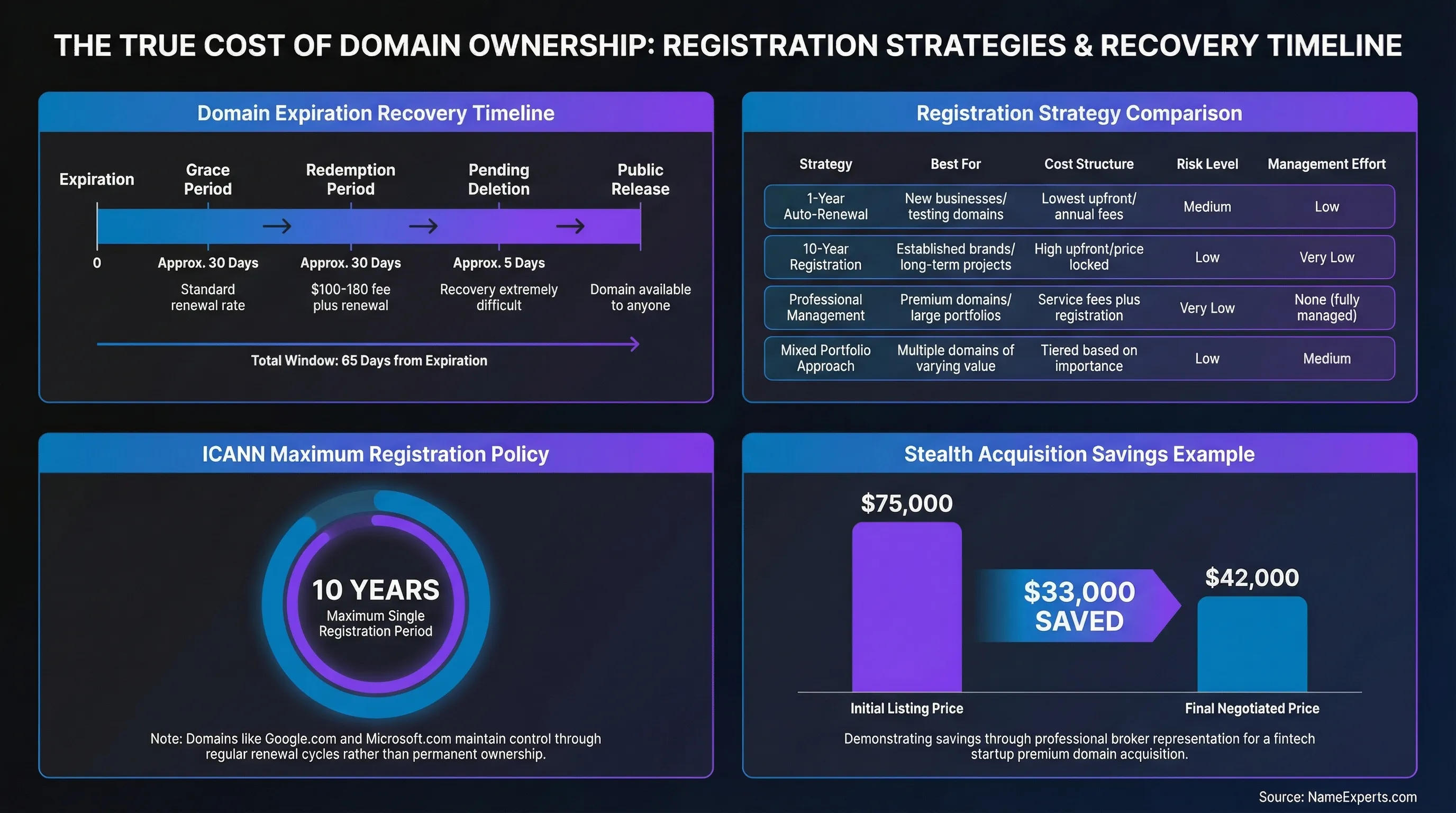
ICANN's regulations prevent anyone from locking up domain names indefinitely. According to ICANN policies, the maximum registration period is 10 years at a time. This doesn't mean you lose your domain after 10 years—it simply means each registration period cannot exceed that limit. At the end of your term, you can renew for another period up to 10 years.
Major domains like Google.com, Microsoft.com, and thousands of others have existed far longer than 10 years. They maintain continuous control through regular renewal cycles rather than permanent ownership.
The Economics of Domain Infrastructure
The domain name system requires ongoing operational costs. Registries maintain databases, ensure security, process updates, and coordinate with registrars worldwide. These infrastructure costs are funded through recurring registration and renewal fees. A one-time permanent purchase model would create funding gaps that could compromise the stability of the entire system.
Additionally, the renewal model prevents domain hoarding. Without periodic renewals, individuals or organizations could accumulate thousands of valuable names and hold them indefinitely, removing them from the market permanently. The current system ensures that abandoned or unused domains eventually become available to others who will actively use them.
What You Actually Get When You "Buy" a Domain
When you register a domain, you're acquiring exclusive usage rights for a specified period. During your registration term, you have complete control to:
- Point it to your website and configure DNS settings
- Create email addresses using your domain name
- Transfer it to another registrar if you choose
- Sell or transfer control to another party
- Renew your registration before it expires
These rights are exclusive—no one else can use your registered domain during your term. You're not renting in the traditional sense where a landlord could refuse to renew your lease. As long as you renew on time and comply with registration policies, you maintain uninterrupted control.
The Domain Expiration Lifecycle
Understanding what happens when a registration expires is crucial for maintaining long-term control. The expiration process follows a structured timeline:
Grace Period (approximately 30 days): After your expiration date, most registrars provide a grace period where you can renew at the standard rate without penalty. Your website and email may stop functioning during this time, but you retain the right to renew.
Redemption Period (approximately 30 days): If you don't renew during the grace period, the domain enters redemption status. You can still recover it, but registrars typically charge a redemption fee (often $100-180) in addition to the renewal cost.
Pending Deletion (approximately 5 days): After redemption ends, the domain enters a pending deletion status. During this brief window, recovery becomes extremely difficult or impossible.
Public Release: Once deletion completes, the domain becomes available for anyone to register on a first-come, first-served basis.
This 65-day window from expiration to public release represents your total opportunity to recover a lapsed domain. According to CSC Digital Brand Services, domains can expire due to neglect, rationalization of portfolios, or oversights during registrar transfers. Without proper tracking systems, businesses can easily lose control over valuable digital assets.

How to Secure Long-Term Domain Control: The Maximum Registration Strategy
While permanent ownership isn't possible, you can implement strategies that minimize renewal frequency and maximize security for your domain assets.
Register for the Full 10-Year Period Upfront
Most registrars allow you to register a new domain or extend an existing one for up to 10 years in a single transaction. This approach offers several advantages:
Price lock protection: Many registrars honor the price you pay at registration for the entire term. If renewal prices increase over the next decade, you're protected from those increases for your current registration period.
Reduced renewal frequency: Instead of remembering to renew annually, you only need to address renewal once per decade. This dramatically reduces the risk of forgetting a renewal deadline.
SEO stability signal: Search engines consider registration length as a minor trust signal. A 10-year registration suggests you're committed to your domain long-term, not running a temporary spam site.
When it makes sense: The 10-year approach is ideal for established businesses, primary brand domains, and any domain you're certain you'll need long-term. For experimental projects or domains you're testing, shorter terms may be more appropriate.
Set Up Bulletproof Auto-Renewal Systems
Auto-renewal is your primary defense against accidental domain loss. However, auto-renewal alone isn't foolproof—you need redundant systems:
Primary and backup payment methods: Configure both a primary credit card and a backup payment method with your registrar. If your primary card expires or has insufficient funds, the backup prevents renewal failure.
Multiple notification timelines: Set up renewal notifications at 90, 60, and 30 days before expiration. Don't rely solely on your registrar's notifications—create independent calendar reminders.
Dedicated domain management email: Use a dedicated email address for domain notifications rather than a personal email that might change or get overlooked. Forward this email to multiple team members for redundancy.
Annual verification: Even with auto-renewal enabled, manually verify your payment methods and contact information at least once per year. Credit cards expire, email addresses change, and billing addresses update.
Choose Registrars With Strong Renewal Protection
Not all registrars offer the same level of protection for your domains. When selecting where to register or transfer your domains, evaluate:
Grace period policies: Some registrars offer longer grace periods than others. A 45-day grace period gives you more breathing room than a 30-day window.
Redemption fee structures: Redemption fees vary significantly. Some registrars charge $100, others $180 or more. Knowing these costs in advance helps you budget for worst-case scenarios.
Domain lock features: Registrar lock and transfer lock prevent unauthorized transfers. These security features ensure that even if someone gains access to your account, they cannot transfer your domain away without additional verification steps.
Account security options: Two-factor authentication, registry lock, and WHOIS privacy protection add layers of security that protect your long-term control.
Calculate Your Break-Even Point
Is a 10-year registration financially sensible compared to annual renewals? The calculation is straightforward:
Break-even formula: (10-year registration cost) ÷ (annual renewal cost) = years to break even
For example, if a 10-year registration costs $120 and annual renewals cost $15, you break even at 8 years ($120 ÷ $15 = 8). Any time you keep the domain beyond 8 years represents savings.
However, this calculation doesn't account for price increases. If annual renewal prices increase by even $2-3 per year over the decade, your break-even point moves earlier, and your total savings increase substantially.
Worried About Losing Your Domain Investment?
For high-value domains, professional oversight isn't optional—it's insurance against catastrophic loss. If you're managing premium domains or planning a significant acquisition, talk to our domain brokers about bulletproof management strategies that protect your digital assets from day one.
Domain Portfolio Management for High-Value Assets
For businesses managing multiple domains or high-value premium domains, basic registration strategies aren't sufficient. Professional portfolio management becomes essential.
When Professional Domain Management Becomes Essential
Consider professional management services when:
You own premium domains: If you've invested thousands or tens of thousands in a premium domain acquisition, the cost of professional management is negligible compared to the catastrophic loss of letting it expire.
You manage multiple domains: Once your portfolio exceeds 10-20 domains, especially across multiple registrars, centralized tracking becomes critical. Missing a renewal on even one domain can damage your brand or business operations.
Your domain is business-critical: If your domain powers your primary revenue stream, downtime from an expired domain translates directly to lost revenue. For e-commerce sites, SaaS platforms, or service businesses, even 24 hours of downtime can cost thousands.
You lack internal resources: Small businesses without dedicated IT staff often struggle to maintain proper domain oversight. Professional management ensures nothing falls through the cracks.
Domain Monitoring and Tracking Systems
Professional domain management relies on centralized systems that provide:
Centralized dashboards: View all your domains across multiple registrars in a single interface. See expiration dates, renewal status, DNS configuration, and security settings at a glance.
Expiration tracking across registrars: If you have domains at multiple registrars, tracking renewals manually becomes complex. Centralized tracking consolidates all deadlines regardless of where domains are registered.
Automated alerts for status changes: Receive immediate notifications when domain status changes—whether it's an upcoming expiration, a failed renewal attempt, or an unauthorized modification.
Historical documentation: Maintain records of all domain transactions, renewals, transfers, and configuration changes. This documentation proves invaluable for audits, disputes, or recovery situations.
The Role of Domain Brokers in Long-Term Security
When acquiring premium domains or managing high-stakes portfolios, professional brokerage services provide value beyond simple registration. With our 16+ years of experience and 200+ completed transactions, we've seen firsthand how proper acquisition and management prevents costly mistakes.
Professional brokers like NameExperts provide white-glove management for premium acquisitions, ensuring:
Proper registration setup from day one: Premium domains require immediate security implementation. Professional brokers configure registry lock, WHOIS privacy, and transfer protection before the domain even reaches your account.
Renewal strategy configuration: Rather than leaving renewal settings at defaults, brokers establish multi-year registration periods, redundant payment methods, and monitoring systems tailored to your domain's value.
Ongoing portfolio oversight: For clients with multiple premium domains, brokers provide quarterly audits, renewal coordination across registrars, and proactive security updates as new threats emerge.
Stealth acquisition advantages: When acquiring valuable domains, using a broker prevents price inflation. Sellers often increase asking prices when they know a well-funded company wants their domain. Broker representation keeps your identity confidential during negotiations, often saving tens of thousands on acquisition costs.
Protection Against Domain Hijacking and Theft
Long-term domain security isn't just about renewals—it's about preventing unauthorized access and transfers:
Registry lock: This registrar-level lock prevents any changes to your domain without manual verification. Even if someone compromises your account, they cannot transfer, modify, or delete a registry-locked domain.
Two-factor authentication: Enable 2FA on your registrar account. Password breaches are common, but 2FA adds a critical second layer that prevents unauthorized access even if your password is compromised.
WHOIS privacy protection: Public WHOIS data exposes your contact information, making you a target for social engineering attacks. Privacy protection shields your personal details while maintaining your legal rights to the domain.
Transfer lock: Most registrars offer transfer lock features that prevent domain transfers without explicit authorization. Enable this feature on all valuable domains.
| Strategy | Best For | Cost Structure | Risk Level | Management Effort |
|---|---|---|---|---|
| 1-Year Auto-Renewal | New businesses, testing domains | Lowest upfront, annual fees | Medium (annual payment risk) | Low (set and forget) |
| 10-Year Registration | Established brands, long-term projects | High upfront, price locked | Low (infrequent renewals) | Very Low (renew once/decade) |
| Professional Management | Premium domains, large portfolios | Service fees + registration | Very Low (expert oversight) | None (fully managed) |
| Mixed Portfolio Approach | Multiple domains of varying value | Tiered based on importance | Low (strategic protection) | Medium (selective attention) |
Critical Mistakes That Cost You Your Domain (And How to Avoid Them)
Even with the best intentions, domain owners lose valuable domains every year. Understanding common failure points helps you avoid them.
Payment Method Failures
The most common cause of accidental domain loss is payment failure. Credit cards expire, accounts close, and billing addresses change. When your registrar attempts to process renewal and the payment fails, your domain enters the expiration lifecycle.
Prevention strategies:
- Maintain two payment methods on file with your registrar
- Set calendar reminders to verify payment methods quarterly
- Use a credit card with a distant expiration date for domain renewals
- Consider using a business credit card rather than personal cards that might be cancelled
- Enable email notifications for failed payment attempts
Email Address Changes and Missed Notifications
Registrars send renewal notices to the email address on file. If that email address becomes inactive, changes, or gets overwhelmed with spam, you'll miss critical notifications.
Prevention strategies:
- Create a dedicated email address specifically for domain management ([email protected])
- Forward domain management emails to multiple team members
- Set up email filtering rules to ensure domain notifications never go to spam
- Conduct quarterly audits of contact information across all registrars
- Use a company email address rather than personal email that might change if you leave the company
Registrar Account Security Vulnerabilities
Weak account security doesn't just risk hijacking—it can lead to accidental changes that trigger domain loss. If someone gains unauthorized access to your registrar account, they might disable auto-renewal, change contact information, or initiate transfers.
Prevention strategies:
- Use unique, complex passwords for registrar accounts (never reuse passwords from other services)
- Enable two-factor authentication on all registrar accounts
- Avoid sharing registrar account credentials across multiple team members
- Review account access logs quarterly for suspicious activity
- Enable registry lock on high-value domains
Assuming "Set It and Forget It" Is Safe
Auto-renewal creates a false sense of security. While it's an essential safeguard, it's not infallible. Payment methods fail, registrar systems have glitches, and account settings can change unexpectedly.
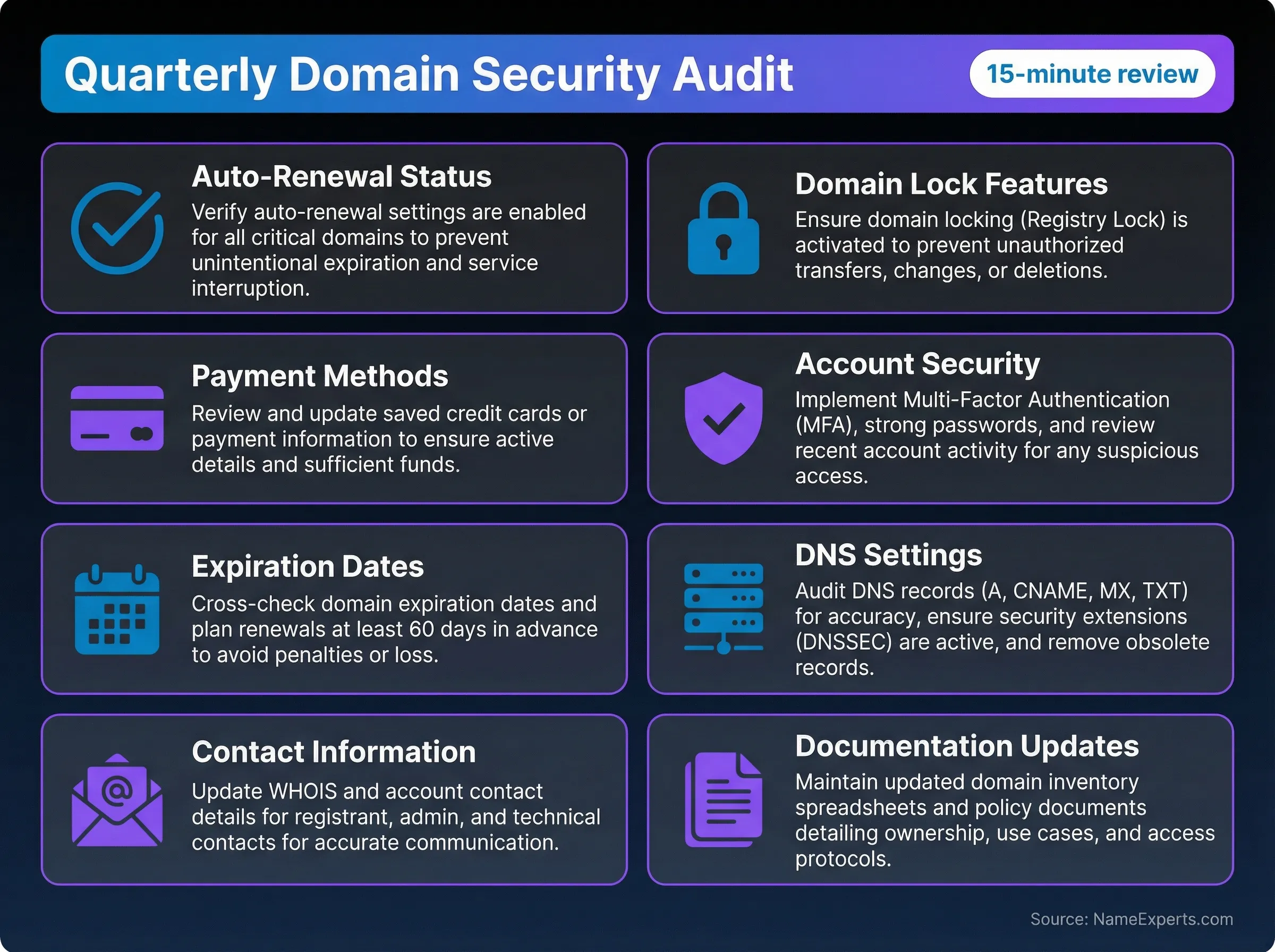
Quarterly domain audit checklist:
- Verify auto-renewal is enabled on all domains
- Confirm payment methods are current and valid
- Check that contact email addresses are active and monitored
- Review expiration dates and upcoming renewals
- Test that domain lock and transfer lock features are enabled
- Verify WHOIS information is accurate (or properly privacy-protected)
- Check DNS settings haven't been modified unexpectedly
- Document any changes or upcoming actions needed
This 15-minute quarterly review can prevent catastrophic domain loss that would cost thousands in recovery fees, lost traffic, and brand damage.
Premium Domain Acquisitions: When Expert Guidance Prevents Costly Mistakes
Acquiring a premium domain—whether for $5,000, $50,000, or $500,000—represents a significant investment. The acquisition process itself introduces risks that can undermine your long-term security.
The Risks of Acquiring High-Value Domains Independently
When purchasing premium domains without professional guidance, several pitfalls commonly occur:
Overpaying without market knowledge: Domain pricing is opaque. Without access to comparable sales data, buyers often pay 2-3x fair market value. We've saved clients tens of thousands by leveraging our database of actual transaction prices to negotiate from a position of knowledge.
Legal complications: Premium domains sometimes have trademark issues, disputed ownership, or liens that aren't immediately apparent. Professional brokers conduct due diligence to identify these issues before you commit to purchase.
Escrow failures: High-value domain transfers require secure escrow services. Using unvetted escrow providers or attempting direct transfers exposes you to fraud risk. Professional brokers use established escrow services and verify transfer completion before releasing funds.
Ownership transfer issues: The technical process of transferring a premium domain involves authorization codes, registrar coordination, and timing considerations. Errors during transfer can result in domain loss or extended limbo periods where neither party has clear control.
How Professional Brokers Secure Long-Term Domain Control From Day One
Professional brokerage services don't end when the transaction completes. The real value lies in proper setup and ongoing protection:
Proper registration setup: Before the domain even reaches your account, brokers configure optimal registration settings—10-year terms, auto-renewal with backup payment methods, and security features appropriate to the domain's value.
Immediate security implementation: Registry lock, transfer lock, WHOIS privacy, and two-factor authentication are configured during the transfer process, not left for you to set up later.
Renewal strategy configuration: Rather than defaulting to annual renewals, brokers establish multi-year registration periods that minimize renewal frequency and lock in current pricing.
Ongoing monitoring: For premium acquisitions, brokers often provide ongoing monitoring services—quarterly audits, renewal coordination, and proactive security updates as new threats emerge.
Case for Stealth Acquisitions Through Professional Services
One of the most valuable aspects of broker representation is confidentiality. When a seller knows a well-funded company wants their domain, asking prices often double or triple. Stealth acquisition through broker representation prevents this price inflation.
For example, we recently helped a fintech startup acquire a premium domain. The seller initially listed it at $75,000. Through stealth acquisition—where our team approached the seller without revealing the end buyer—we negotiated a final price of $42,000. The client saved $33,000 simply by using broker representation rather than approaching the seller directly.
This approach works because sellers perceive broker inquiries as speculative rather than urgent. When a company directly contacts a seller, it signals strong intent and often desperation, driving prices upward.
The True Cost of Domain Loss vs. Professional Management
Consider the financial impact of losing a business-critical domain:
Redemption fees: $100-180 to recover during the redemption period
Traffic loss: Days or weeks of downtime while recovering the domain means lost visitors, lost sales, and damaged SEO rankings
Email disruption: Business email stops working, disrupting customer communication, sales processes, and internal operations
Brand damage: Customers who encounter a dead website lose trust in your business
Rebranding costs: If you can't recover the domain and must rebrand, costs include new domain acquisition, website updates, marketing material changes, and customer re-education
Legal battles: If someone else registers your expired domain, legal recovery can cost tens of thousands in attorney fees with no guarantee of success
Against these potential costs, professional domain management—whether through dedicated software, internal processes, or broker services—represents a minimal investment with substantial risk mitigation.
For high-value domains, the question isn't whether you can afford professional management, but whether you can afford the consequences of not having it. A $500/year management fee is negligible compared to the $50,000+ cost of losing and attempting to recover a premium domain.
While you cannot buy a domain name permanently, you can establish systems and strategies that provide long-term security approaching permanence. Maximum registration periods, bulletproof renewal systems, professional management for valuable assets, and proactive security measures combine to ensure your domain remains under your control for as long as you need it. The key is treating domain security as an ongoing process rather than a one-time purchase—because in the domain world, vigilance is the price of long-term control.
Don't Overpay for Your Premium Domain
Acquiring a premium domain without market expertise often means paying 2-3x fair value. With our database of actual transaction prices and 16+ years of negotiation experience, we consistently save clients tens of thousands on premium acquisitions. Get a professional domain appraisal and stealth acquisition strategy before you approach sellers directly.
Secure Your Domain for the Long Haul
You can't buy a domain permanently, but you can establish systems that provide security approaching permanence. Whether you're acquiring a premium domain, managing a valuable portfolio, or simply want to ensure your business-critical domain never expires, professional guidance prevents costly mistakes. Our no-bullshit approach to domain brokerage means transparent pricing, honest market assessments, and white-glove management that protects your investment. Contact us for a free domain consultati
Contact us for a free domain consultation







Frequently Asked Questions
No, ICANN regulations prevent permanent domain ownership, limiting registration to a maximum 10-year term per transaction. However, you can maintain indefinite control through timely renewals and auto-renewal systems, effectively securing the domain for as long as you need it.
You don't own it forever—you're leasing exclusive usage rights for a specified period (1-10 years). As long as you renew before expiration and comply with registration policies, you maintain uninterrupted control indefinitely, similar to how Google.com and Microsoft.com have been controlled for decades through regular renewals.
Register common variations and misspellings of your primary domain, enable registry lock and transfer lock features at your registrar, implement two-factor authentication, and maintain current payment methods with auto-renewal to prevent expiration that could allow squatters to claim your domain.
Domain flipping is legal when you register available domains and resell them at market value. It becomes illegal only when you register trademarked names in bad faith (cybersquatting) with intent to profit from someone else's brand, which violates the Anticybersquatting Consumer Protection Act.