
Key Takeaways
- Standard domain registration costs $10-50/year for common TLDs like .com, .net, and .org
- Premium domains from registries range from $500-$50,000+ as one-time fees plus annual renewal
- Aftermarket domains (buying from private owners) typically cost $1,000-$1,000,000+ depending on negotiation and market value
- Hidden costs include renewal fees (often 2-3x first-year promotional rates), privacy protection ($5-15/year), and premium DNS services
- Professional brokers become cost-effective for domains over $5,000, complex negotiations, or competitive acquisitions where their fees (10-15%) prevent overpayment of 30-50%
Domain pricing can feel like navigating the Wild West—you'll see names available for $10 per year, while others command seven-figure price tags. Understanding these pricing tiers helps you avoid overpaying and identify when expert assistance adds genuine value to your acquisition strategy.
The cost to secure a domain depends primarily on three factors: whether you're registering an available name, purchasing a premium option from a registry, or negotiating with a private owner who already controls it. Each path carries different price points, hidden fees, and strategic considerations that directly impact your total investment over time.
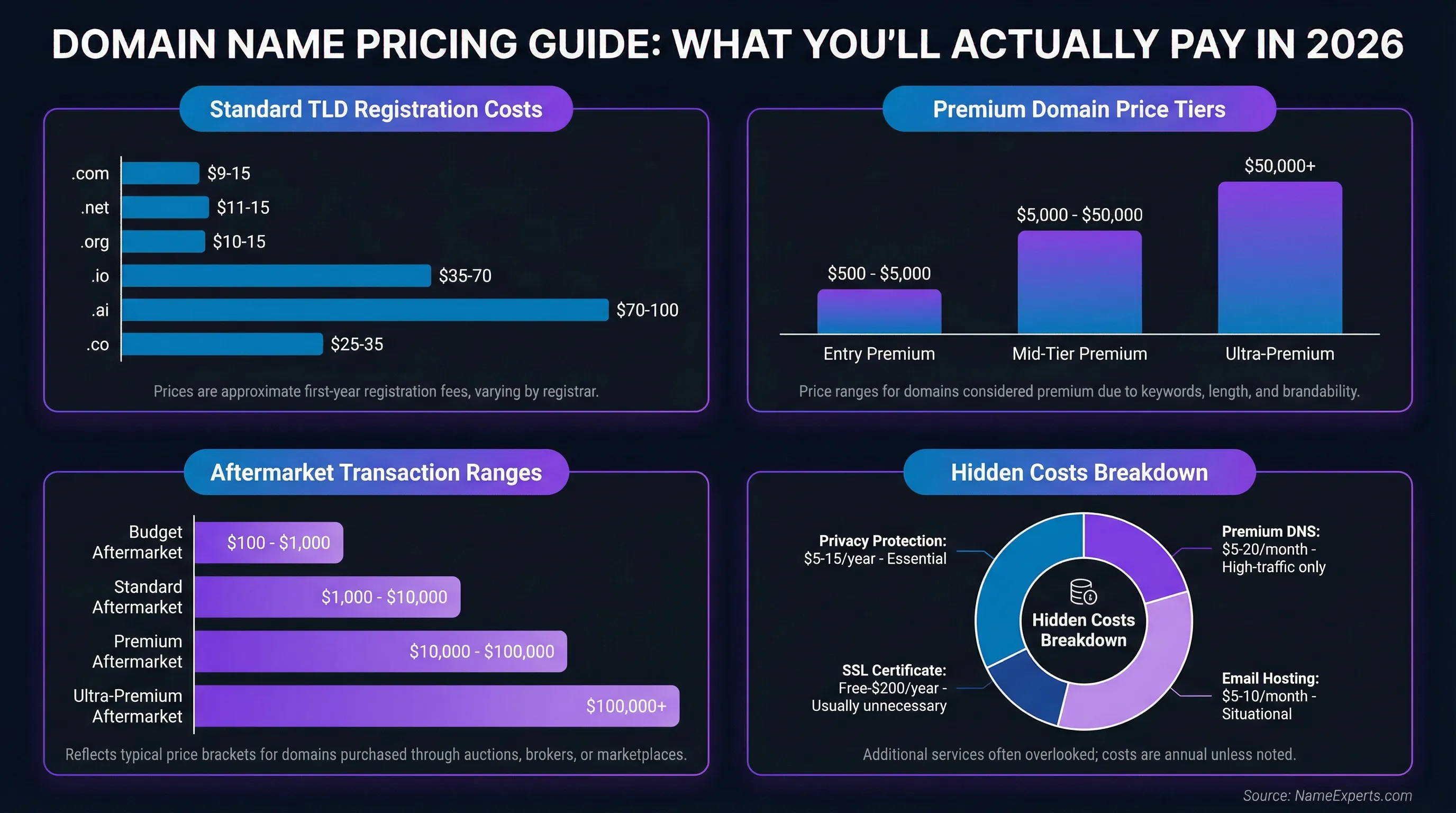
Standard Domain Registration Costs ($10-50/Year)
When a domain name is available for registration, you'll pay the most straightforward pricing structure in the industry. Standard registration through ICANN-accredited registrars typically ranges from $10-50 annually, depending on the top-level domain (TLD) extension you select.
The .com extension remains the most recognized and trusted option, with registration costs typically ranging from $8.99 to $14.99 per year for standard registrations through most major registrars. Some budget registrars offer introductory rates as low as $6.99 for the first year, though these promotional prices often jump to regular rates upon renewal.
Different TLDs carry varying price points based on registry policies and market demand. Country-code TLDs like .uk or .de often cost less than generic TLDs, while newer extensions like .io or .ai command premium pricing due to their popularity in tech sectors.
| TLD Extension | Typical First-Year Cost | Standard Renewal Cost | Best Use Case |
|---|---|---|---|
| .com | $9-15 | $12-18 | General business, maximum trust |
| .net | $11-15 | $13-18 | Network services, tech companies |
| .org | $10-15 | $12-16 | Nonprofits, community organizations |
| .io | $35-70 | $60-90 | Tech startups, SaaS platforms |
| .ai | $70-100 | $80-100 | AI companies, tech innovation |
| .co | $25-35 | $30-40 | Startups, .com alternatives |
The price you see advertised is rarely the complete picture. ICANN charges a mandatory annual fee of $0.20 for each domain registration, renewal, or transfer for certain TLDs. This gets added to the listed price at purchase time, though many registrars now include this in their advertised rates.
Hidden Costs in Standard Registration
Beyond the base registration fee, several additional costs can significantly increase your total ownership expenses. Privacy protection services typically add $5-15 per year to shield your personal information from public WHOIS databases. While some registrars include this feature at no charge, others treat it as a premium add-on.
SSL certificates, once a common upsell costing $50-200 annually, are now frequently provided free through services like Let's Encrypt. However, premium DNS services offering faster resolution times and advanced features may cost an additional $5-20 per month depending on your performance requirements.
The most significant hidden cost comes from renewal rate surprises. Promotional first-year pricing often masks renewal rates that are 2-3 times higher. A name advertised at $6.99 for the first year might renew at $18.99 annually, fundamentally changing your long-term cost calculation.

Expert Tip: Calculate True Ownership Costs
Before committing to any registrar, calculate your five-year total cost rather than focusing solely on first-year promotional rates. Multiply the annual renewal rate by five, add the first-year cost, and include any mandatory add-ons like privacy protection. This reveals the true investment and often shows that registrars with slightly higher first-year rates but consistent renewal pricing offer better long-term value.
In our experience brokering domains for over 16 years, we've seen clients save thousands by avoiding promotional pricing traps and selecting registrars with transparent, stable renewal policies from the outset.
Premium Domain Pricing (Registry-Owned)
Premium domains represent a distinct category where registries themselves designate certain names as high-value and price them accordingly. These aren't domains being resold by private owners—they're names the registry has never released at standard pricing.
What makes a domain "premium" in registry terms? Short length (typically 3-4 characters), dictionary words with high commercial value, industry-specific keywords with substantial search volume, and brandable phrases that companies would pay to own. The registry identifies these characteristics before the name ever reaches the open market.
Registry premium pricing operates differently than aftermarket sales. Some registries use fixed premium pricing where the cost remains constant, while others employ auction-based models where interested parties bid for the right to register the name. Premium domains are priced significantly higher than standard registration—ranging from hundreds to millions of dollars, with most quality brandable or keyword-rich names falling in the $500-50,000 range.
Premium Pricing Tiers
Registry premium domains typically fall into three value tiers based on their commercial potential and market demand:
- Entry Premium ($500-$5,000): Good keywords with moderate search volume, industry-specific terms, or brandable phrases with clear commercial application. Examples might include terms like "CloudBackup.io" or "LocalPlumber.com"
- Mid-Tier Premium ($5,000-$50,000): Exceptional names with high search volume, short memorable phrases, or powerful brand potential. These offer immediate recognition and substantial SEO value in competitive markets
- Ultra-Premium ($50,000+): Single dictionary words, two-letter combinations, or phrases with massive commercial value across multiple industries. These represent the pinnacle of digital real estate
One critical distinction: aftermarket premiums are one-time purchases with standard renewals, while registry premiums may carry elevated renewal costs. Always verify whether the premium pricing applies only to initial registration or continues through renewals. Some registry premiums require you to pay hundreds or thousands annually just to maintain ownership.
When Registry Premiums Make Sense
Registry premium domains offer advantages over aftermarket alternatives in specific scenarios. If you need immediate availability without negotiation delays, registry premiums provide instant acquisition. The pricing is transparent and non-negotiable, eliminating the uncertainty of aftermarket negotiations.
However, comparable aftermarket options often provide better value. A private owner selling a similar name may accept significantly less than a registry's fixed premium price, especially if they've held it for years without generating revenue. Before purchasing a registry premium, always search aftermarket platforms for similar alternatives that might meet your needs at lower cost.
Aftermarket & Private Owner Domain Costs
The aftermarket represents the largest and most complex pricing environment. When someone already owns your desired domain, you're entering a negotiation-based marketplace where prices reflect perceived value rather than fixed registry rates.
Understanding the aftermarket requires recognizing its key players: domain investors who hold portfolios of hundreds or thousands of names, businesses selling assets during rebrands or closures, and individuals who registered names years ago without developing them. Each seller type brings different motivations and pricing expectations to negotiations.
According to market analysis, secondary market transaction volume grew from 0.99M domains in 2017 to 1.25M domains in 2020, with average prices in the secondary market ranging 150-200 times higher than primary market prices. However, this average masks enormous variation—some domains sell for a few hundred dollars while others command millions.
Price Determination Factors
Aftermarket pricing depends on multiple valuation factors that sellers and buyers assess differently. Comparable sales data from platforms like NameBio provides the most reliable pricing foundation, showing what similar domains actually sold for rather than asking prices.
Traffic and revenue metrics dramatically impact valuation. Domains generating organic traffic or revenue command multiples of their annual earnings. A name producing $10,000 annually in parking revenue might reasonably sell for $30,000-50,000 based on standard valuation multiples.
Brand value and commercial potential drive pricing for non-revenue domains. Short, memorable names with clear commercial applications in high-value industries justify premium pricing even without existing traffic. A domain like "CyberInsurance.com" carries obvious value to multiple potential buyers, strengthening the seller's negotiating position.
Buyer urgency significantly affects final pricing. When multiple parties compete for the same name, prices escalate quickly. Conversely, patient buyers willing to wait months or years for motivated sellers often secure substantial discounts.
Typical Transaction Ranges by Domain Quality
Aftermarket transactions cluster around predictable price ranges based on characteristics:
- Budget Aftermarket ($100-$1,000): Longer domains with moderate keywords, newer TLD extensions, or names with limited commercial application. These often come from individual sellers willing to accept modest returns
- Standard Aftermarket ($1,000-$10,000): Quality .com domains with good keywords, brandable phrases, or established traffic. This range represents the majority of aftermarket transactions
- Premium Aftermarket ($10,000-$100,000): Exceptional .com domains with powerful keywords, existing revenue, or strong brand potential across multiple industries
- Ultra-Premium Aftermarket ($100,000+): Single-word .com domains, category-defining names, or those with substantial existing traffic and revenue
The challenge in aftermarket acquisitions isn't just identifying fair pricing—it's executing negotiations that secure domains without overpaying. This is where professional brokers provide measurable value, particularly for transactions exceeding $5,000.
Avoid Overpaying on Premium Acquisitions
Navigating aftermarket negotiations without market expertise often results in overpayment of 30-50%. If you're considering a domain over $5,000, talk to our domain acquisition specialists to get access to real comparable sales data and stealth negotiation tactics that prevent price inflation.
When Domain Brokers Save You Money
Professional brokerage becomes cost-effective when the complexity, value, or competitive dynamics of an acquisition justify expert intervention. While broker fees typically range from 10-15% of the purchase price, the overpayment they prevent often exceeds their commission multiple times over.
At NameExperts, we've brokered over 200 transactions in our 16+ years of operation, and we've identified specific scenarios where professional representation delivers clear ROI for buyers.
Scenarios Where Brokers Provide Value
Competitive acquisitions represent the highest-value broker scenario. When multiple parties pursue the same domain, prices can inflate dramatically through direct negotiation. Brokers employ stealth acquisition tactics, approaching sellers without revealing the end buyer's identity or urgency. This prevents the price inflation that occurs when sellers recognize a well-funded company's interest.
We recently saved a fintech startup $33,000 on an acquisition through stealth negotiation. The seller initially asked $75,000 after researching our client's recent funding round. By approaching the seller as an intermediary representing an undisclosed buyer, we negotiated a $42,000 final price—a savings that far exceeded our broker fee.
Valuation uncertainty justifies professional assistance when you lack market data to assess fair pricing. Inexperienced buyers often overpay by 30-50% because they don't understand comparable sales or recognize inflated asking prices. Brokers provide access to comprehensive transaction databases and market intelligence that reveal true market value.
Seller anonymity needs create another high-value scenario. If you're a recognizable brand or public figure, direct contact with owners immediately weakens your negotiating position. Sellers adjust pricing expectations upward when they identify the buyer, sometimes doubling or tripling their asking price. Broker representation maintains anonymity throughout negotiations, preventing this price inflation.
Payment plan negotiations benefit from broker expertise. Many transactions over $10,000 involve structured payment terms rather than lump-sum transfers. Brokers structure these arrangements to protect both parties while facilitating deals that might otherwise fail due to cash flow constraints.
Cost-Benefit Analysis: DIY vs. Professional Representation
For domains under $5,000, direct negotiation typically makes financial sense. The potential savings from broker representation rarely justify the 10-15% commission on lower-value transactions. Most sellers at this price point respond to reasonable offers without complex negotiations.
Between $5,000-$20,000, the decision depends on your negotiation experience and competitive dynamics. If you're comfortable negotiating and the seller is responsive, direct acquisition may work well. However, if you encounter resistance, recognize competitive interest, or lack confidence in valuation, broker assistance becomes worthwhile.
Above $20,000, professional domain acquisition services almost always deliver positive ROI. The complexity of high-value negotiations, the importance of proper due diligence, and the significant financial risk of overpayment justify expert involvement. The 10-15% broker fee becomes insurance against overpaying by 30-50%, which is common in unassisted high-value acquisitions.
Red Flags Indicating You Need Professional Help
Several warning signs suggest you should engage a broker rather than proceeding independently:
- The owner won't respond to direct contact or provides vague, evasive responses
- The asking price seems arbitrary or dramatically exceeds comparable sales data
- You've identified multiple interested parties competing for the same name
- Trademark concerns exist that require careful navigation
- The seller demands unusual payment terms or refuses standard escrow services
- You're a recognizable brand whose identity would inflate pricing
- The transaction value exceeds your comfort level for independent negotiation
At NameExperts, we've represented notable clients including HBO/Max.com, Monday.com, TripAdvisor, and HubSpot in acquisitions. Our stealth acquisition approach and access to real comparable sales data consistently deliver outcomes that justify our involvement, particularly where competitive dynamics or seller sophistication create negotiation challenges.
Hidden Costs & Ongoing Expenses
Domain ownership extends far beyond the initial purchase price. Understanding the full cost structure prevents budget surprises and helps you plan for long-term ownership expenses that can significantly exceed your initial investment.
Annual Renewal Rate Surprises
The most common hidden cost comes from renewal rate increases that catch owners off guard. Renewal rates for .com domains typically match or slightly exceed initial registration prices, with most registrars charging between $8.99 and $14.99 per year for renewal. However, renewal rates are often higher than the promotional first-year rates that registrars advertise.
Premium domains purchased from registries may carry elevated renewal costs that persist indefinitely. A name purchased for $5,000 might require $500 annual renewals rather than standard $15 rates. Always verify renewal pricing before purchasing premium options, as these ongoing costs fundamentally change the total ownership calculation.
Promotional pricing traps represent a deliberate strategy where registrars advertise aggressive first-year discounts to acquire customers, then recover margins through higher renewal rates. A domain advertised at $0.99 for the first year might renew at $39.99 annually—a 40x increase that transforms an apparent bargain into an expensive long-term commitment.
Ownership Duration and Long-Term Planning
Ownership duration varies significantly based on business needs and strategic planning. For commercial use, typical ownership periods range from 2 to 10 years, with many businesses renewing annually or in multi-year blocks. Individual investors often hold names for 3 to 7 years before attempting to sell or flip them.
Multi-year registration offers two strategic advantages: price protection against future increases and improved search engine trust signals. Registering for 3-5 years locks in current renewal rates and demonstrates long-term commitment to search engines, potentially providing minor SEO benefits.
However, business pivots and rebrands occur frequently. The average ownership before a company changes direction or rebrands is approximately 3-5 years. This reality suggests that extremely long registration periods (8-10 years) may not provide value if your business strategy evolves before the registration expires.
Add-On Services: Essential vs. Marketing Fluff
Registrars offer numerous add-on services, but only a few provide genuine value for most owners. Privacy protection (WHOIS privacy) is essential for preventing spam, identity theft, and unwanted solicitation. This service masks your personal information in public WHOIS databases, replacing it with the registrar's contact details. At $5-15 annually, it's worthwhile for virtually all owners.
SSL certificates, once a significant expense at $50-200 per year, are now typically free through Let's Encrypt and similar services. Most hosting providers include free SSL certificates automatically, making paid SSL certificates unnecessary for standard websites. Only specialized applications requiring extended validation (EV) certificates justify paying for premium SSL services.
Email hosting represents a legitimate additional cost if you want professional email addresses using your domain. However, comparing standalone email hosting ($5-10/month per user) against comprehensive business email solutions like Google Workspace ($6-18/month per user) often reveals better value in the full-featured platforms that include storage, collaboration tools, and advanced security features.
Premium DNS services offer faster resolution times and advanced features like traffic routing and DDoS protection. For most small businesses, standard DNS included with registration provides adequate performance. Premium DNS becomes worthwhile for high-traffic websites where milliseconds of resolution time impact user experience and conversion rates.
| Add-On Service | Typical Cost | Value Assessment | Recommendation |
|---|---|---|---|
| Privacy Protection | $5-15/year | Essential | Always purchase |
| SSL Certificate | Free-$200/year | Usually unnecessary | Use free options |
| Email Hosting | $5-10/month | Situational | Compare with full platforms |
| Premium DNS | $5-20/month | High-traffic only | Skip for most sites |
| Domain Monitoring | $10-30/year | Low value | Skip unless high-risk |
| SEO Services | $20-100/month | Marketing fluff | Avoid registrar SEO |
Total Cost of Ownership Calculator Approach
To accurately assess costs, calculate your five-year total ownership expense including all mandatory and optional services. Start with the first-year registration cost, add four years of renewal fees at the standard (non-promotional) rate, include privacy protection for all five years, and factor in any premium DNS or email hosting you'll actually use.
This calculation reveals the true investment and often shows that names with higher first-year costs but lower renewal rates provide better long-term value than promotional offers with aggressive renewal pricing. It also highlights the significant impact of premium renewal fees, which can add thousands to your total ownership cost over five years.
Domain Valuation & Negotiation Strategies
Successful acquisition depends on accurate valuation and effective negotiation. Understanding how to value a domain name and structure offers prevents overpayment while increasing your success rate in competitive situations.
Researching Comparable Sales
Comparable sales data provides the most reliable foundation for valuation. Public auction data and reported private sales reveal what buyers actually paid rather than inflated asking prices that never result in transactions.
NameBio maintains the most comprehensive database of reported sales, with hundreds of thousands of transactions searchable by keyword, TLD, sale date, and price range. When valuing a name, search for sales of similar options—matching keyword themes, comparable length, and the same TLD extension.
Focus on recent transactions (within the past 12-24 months) rather than historical sales from 5-10 years ago. Values fluctuate with market conditions, industry trends, and search volume changes. A name that sold for $50,000 in 2015 might command $20,000 or $100,000 today depending on how market dynamics have evolved.
Weight your comparable sales analysis toward actual reported sales rather than asking prices on marketplace listings. Asking prices often exceed realistic market value by 50-200%, representing seller aspirations rather than achievable transaction prices. Completed sales reflect what buyers actually paid after negotiations.
Valuation Multiples for Revenue-Generating Domains
Domains generating revenue through parking, affiliate programs, or developed websites command valuations based on earnings multiples. Industry standards typically apply 24-36 month revenue multiples for valuations, meaning a name generating $1,000 monthly ($12,000 annually) might reasonably sell for $24,000-$36,000.
These multiples vary based on revenue stability, traffic quality, and monetization method. Those with consistent organic traffic and diversified revenue streams justify higher multiples than those dependent on paid traffic or single affiliate relationships. Buyer confidence in revenue sustainability directly impacts the multiple they'll accept.
Traffic metrics without revenue also influence valuation, though less dramatically than actual earnings. Names receiving substantial organic traffic demonstrate SEO value and audience interest, even without current monetization. These typically sell for $5-15 per monthly unique visitor, depending on traffic quality and commercial intent.

Negotiation Tactics for Aftermarket Acquisitions
Effective domain negotiation strategies balance assertiveness with flexibility, demonstrating serious interest while avoiding desperation signals that strengthen the seller's position. Your opening offer should reflect market data rather than arbitrary discounting from the asking price.
Starting offer positioning matters significantly. Offers below 40% of asking price often offend sellers and terminate negotiations before they begin. Conversely, offers above 70% of asking price leave little negotiating room and may signal willingness to pay full price. Initial offers between 50-65% of asking price typically open productive negotiations while preserving room for compromise.
Payment plan structuring can facilitate deals that exceed your available cash while providing sellers with acceptable terms. Many transactions over $10,000 involve structured payments—typically 30-50% upfront with the remainder paid over 6-24 months. Offering slightly higher total consideration in exchange for payment terms often proves acceptable to sellers who prefer guaranteed future payments over lower lump-sum offers.
Escrow services protect both parties in transactions, holding funds until the name transfers successfully to the buyer. Escrow.com dominates these transactions, charging fees of 1-3% of the purchase price depending on transaction value. Always insist on escrow for transactions over $500, and never agree to payment methods that lack buyer protection.
Expert Tips from NameExperts: Identifying Overpriced Domains
In our 16+ years brokering acquisitions, we've developed reliable methods for identifying overpriced options and finding better alternatives. Several red flags indicate asking prices that significantly exceed realistic market value:
- Asking prices more than 3x the highest comparable sale in the past 24 months
- Sellers who refuse to provide traffic data or revenue documentation for names claiming high value
- Names priced identically across an investor's entire portfolio regardless of individual characteristics
- Asking prices that haven't adjusted downward despite months or years without buyer interest
- Sellers who cite "appraisals" from automated tools rather than comparable sales data
When you encounter overpriced options, finding comparable alternatives often provides better value. If "CloudBackup.com" asks $75,000, investigate whether "CloudBackups.com" (plural), "BackupCloud.com" (reversed), or "CloudBackupPro.com" (modified) might be available at significantly lower prices while serving your branding needs equally well.
Timing offers strategically can yield substantial savings. Names listed for extended periods without sales often have motivated sellers willing to accept lower offers. Approaching sellers during end-of-year tax planning or after they've received their annual renewal invoice sometimes produces better negotiating outcomes than reaching out immediately after a listing appears.
Competitive Acquisition? Protect Your Negotiating Position
When multiple parties pursue the same domain or you're a recognizable brand, direct contact immediately weakens your position and inflates pricing. Our stealth acquisition approach has saved clients tens of thousands by maintaining buyer anonymity throughout negotiations—request a confidential acquisition strategy consultation to learn how we can secure your target domain without revealing your identity.
Legal & Risk Considerations That Affect Cost
Domain acquisitions carry legal and financial risks that can dramatically increase total costs if not properly addressed during due diligence. Understanding these risks and implementing appropriate protections prevents expensive problems after purchase.
Trademark Disputes and UDRP Costs
Trademark conflicts represent the most significant legal risk in ownership. Registering a domain that infringes on someone's trademark can cost you thousands of dollars in legal fees, force you to surrender the domain with zero compensation, and potentially result in statutory damages of up to $100,000 per domain under the Anti-Cybersquatting Consumer Protection Act (ACPA).
The Uniform Domain-Name Dispute-Resolution Policy (UDRP) provides trademark holders with a streamlined process for challenging registrations they believe infringe their marks. UDRP filing fees start at $1,500, with legal representation adding $2,000-5,000 to your defense costs. Even if you prevail, you've invested substantial time and money defending ownership.
Federal lawsuits under ACPA carry far higher costs. Litigation defense typically runs $15,000-50,000, with settlement payments ranging from $10,000-100,000 depending on the trademark holder's damages claims and your perceived bad faith. These costs far exceed the value of most names, making trademark due diligence essential before purchase.
Preventing trademark disputes requires thorough pre-purchase research. Search the USPTO database for US trademarks, the WIPO Global Brand Database for international marks, and conduct comprehensive Google searches for the exact name. Avoid exact brand matches, famous brands combined with generic keywords (like "NikeShoes.com"), and deliberate misspellings of known brands.
For domains over $5,000, consulting a trademark attorney for $200-500 provides valuable risk assessment that can prevent far more expensive problems later. At NameExperts, we include trademark risk assessment in our acquisition due diligence, helping clients avoid names with legal exposure that could result in forced surrender or costly litigation.
Escrow Service Fees for High-Value Transactions
Escrow services charge fees ranging from 1-3% of the purchase price, with minimum fees typically around $50-100. For a $10,000 transaction, expect to pay $100-300 in escrow fees. These costs are typically split between buyer and seller or paid entirely by one party as negotiated.
While escrow fees add to transaction costs, they provide essential protection for both parties. The escrow service verifies that funds are available before the seller transfers the name, then confirms successful transfer before releasing payment. This prevents common fraud scenarios where buyers pay but never receive domains, or sellers transfer names but never receive payment.
For transactions under $500, some buyers and sellers skip escrow to avoid fees. This significantly increases risk and should only be considered with sellers who have extensive positive transaction history and verified reputation in the community.
Due Diligence Costs
Comprehensive due diligence for acquisitions includes several cost components beyond trademark searches. History checks reveal previous ownership, past website content, and any historical issues that might affect current value or create future problems.
Traffic verification services confirm that claimed traffic metrics are accurate rather than artificially inflated through bot traffic or temporary paid campaigns. For names valued based on traffic, spending $50-200 on independent traffic verification prevents overpaying for inflated metrics.
Backlink analysis examines the link profile to identify quality backlinks that contribute to SEO value versus spammy links that might trigger search engine penalties. Professional SEO audits cost $200-500 but provide valuable insight into whether claimed SEO value is legitimate.
For high-value acquisitions over $50,000, comprehensive due diligence including legal review, traffic verification, SEO analysis, and trademark clearance typically costs $1,000-3,000. While this seems expensive, it represents 2-6% of the purchase price and provides essential protection against acquiring problematic assets.
How NameExperts Includes Risk Assessment
Our acquisition service includes comprehensive risk assessment as standard practice. Before recommending any purchase to clients, we conduct trademark searches, review history for potential issues, verify traffic claims when applicable, and assess legal exposure from previous use.
This due diligence has prevented clients from purchasing names with hidden trademark conflicts, inflated traffic claims, or problematic content history that would have created expensive problems after acquisition. The cost of this risk assessment is included in our broker fee, providing clients with professional protection without additional charges.
For names with identified risks, we advise clients on mitigation strategies or recommend alternative options that achieve their branding goals without legal exposure. This approach has saved clients from costly mistakes while helping them secure strong assets that support rather than threaten their business objectives.
If you're considering an acquisition over $5,000, particularly in competitive situations or where trademark concerns exist, professional representation provides measurable value. Visit nameexperts.com to discuss your needs with our team and learn how our stealth acquisition approach and market expertise can help you secure the right domain at the right price.
Ready to Secure Your Domain Without Overpaying?
Whether you're navigating competitive acquisitions, uncertain about fair market value, or need to maintain anonymity during negotiations, professional representation delivers measurable ROI on transactions over $5,000. With 16+ years of experience and over 200 successful acquisitions for clients like HBO, Monday.com, and HubSpot, we bring the market intelligence and negotiation expertise that prevents costly mistakes. Schedule a free consultation with our acquisition team to discuss your domain
Schedule a free consultation with our acquisition team







Frequently Asked Questions
Standard registration costs $10-50 annually for common extensions, while aftermarket purchases from private owners typically range from $1,000-$100,000+ depending on the name's commercial value and negotiation.
You cannot permanently own a domain—all registrations require annual renewal fees to maintain ownership, though you can register for up to 10 years at once to lock in current rates and reduce administrative burden.
Yes, a quality domain provides essential brand credibility, improves customer trust, and delivers long-term SEO value that far exceeds the modest $10-50 annual investment for standard registrations or justified premium costs for strategic acquisitions.
For available names, $10-50 annually is standard, while aftermarket purchases should align with comparable sales data—typically $1,000-$10,000 for quality brandable options and $10,000-$100,000 for premium keywords with strong commercial potential.


