
A domain name typically costs between $10 and $20 per year for standard extensions like .com, .net, and .org. However, the actual amount you'll pay depends on several factors: the extension you choose, whether it's a first-year promotional rate or renewal pricing, and which registrar you select. Hidden costs like privacy protection, transfer fees, and auto-renewal traps can push your total annual investment to $25-$50 or higher. Premium domains—short, memorable names with high commercial value—range from $500 to over $1 million depending on brandability and market demand.
Key Takeaways
- Standard domains cost $10-$20 initially, but renewal rates often jump to $15-$30 annually
- Hidden costs (privacy protection, transfer fees, SSL certificates) add 30-100% to advertised prices
- Premium domains require expert negotiation to avoid overpaying by 30-50% on high-value acquisitions
- Multi-year registration locks in first-year pricing and protects against future rate increases
- Independent registrar comparison reveals total 3-year costs vary by $50-$150 for identical domains
The Real Cost of Domain Ownership: Beyond the Sticker Price
When evaluating what you'll actually spend on a web address, the advertised registration fee represents only part of the equation. The domain registration market reached $10.1 billion in 2025, growing 2.9% from the previous year. This expansion reflects both increased online business activity and the pricing strategies registrars use to maximize revenue per customer.
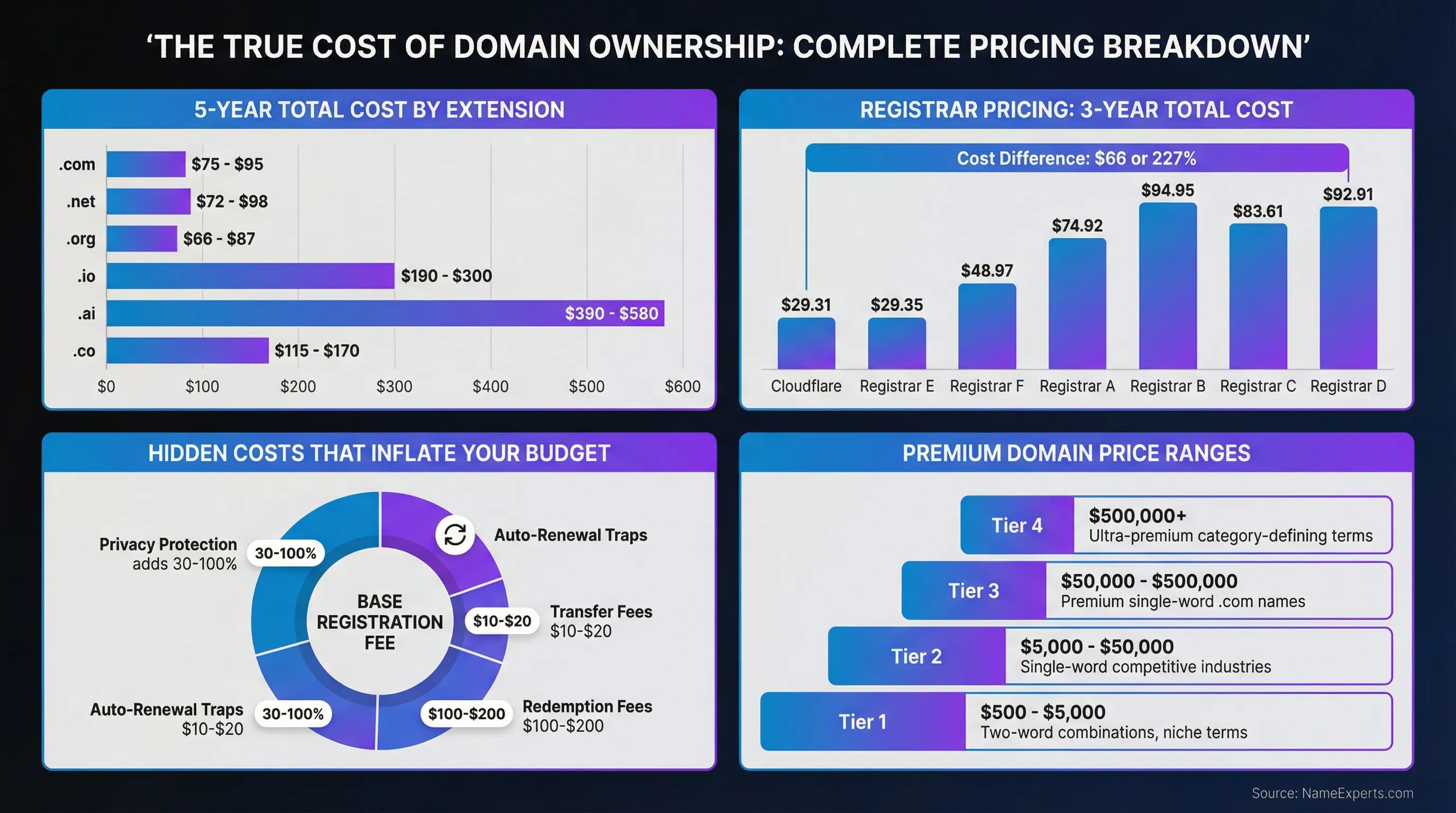
Standard pricing varies significantly by extension. A .com typically runs $10-$20 for the first year, while newer extensions like .io command $30-$60 annually. The .ai extension—popular among artificial intelligence companies—costs $70-$100+ per year due to high demand and registry pricing policies.
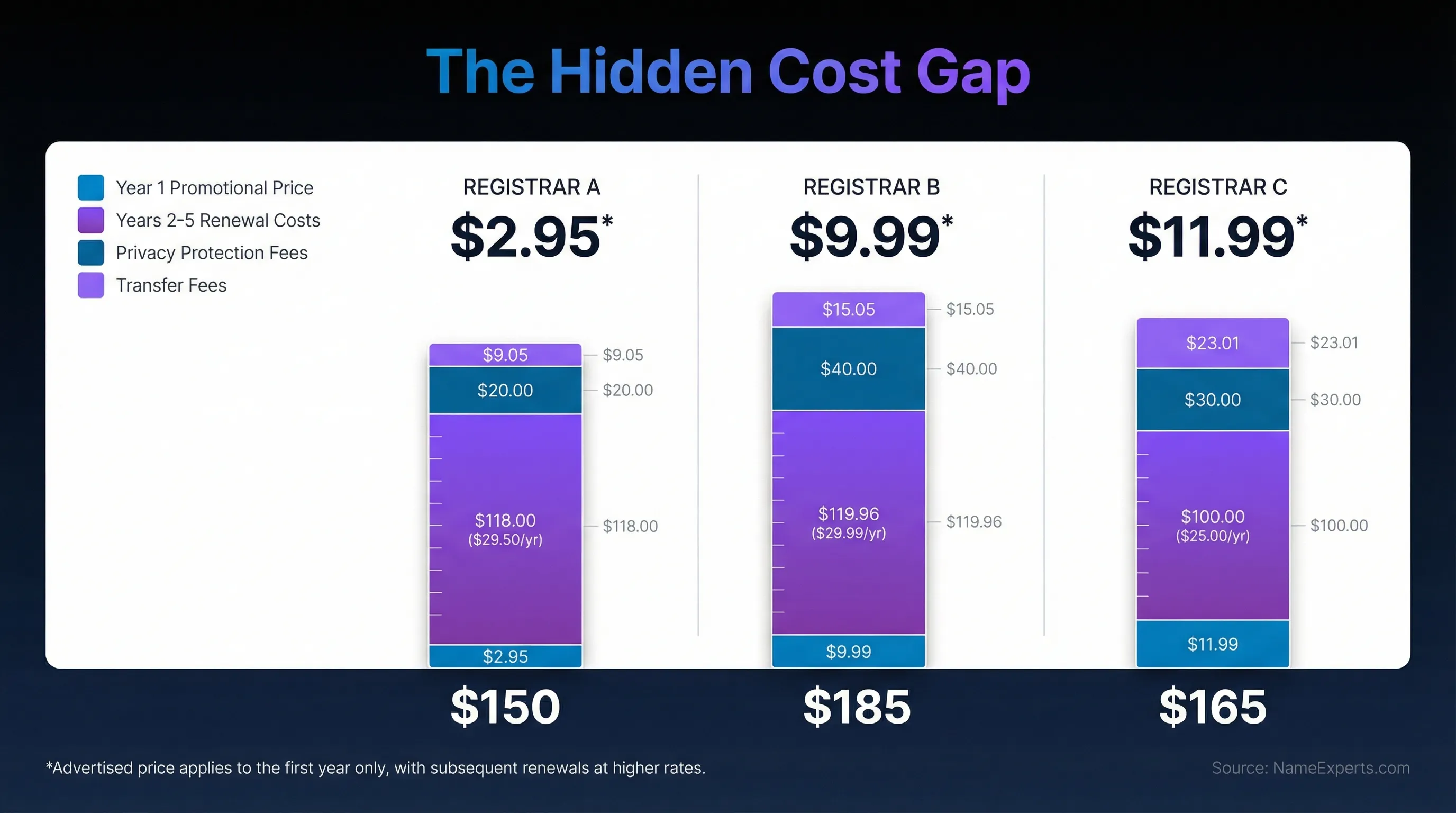
The gap between first-year and renewal pricing creates the most common cost surprise. Many registrars use promotional rates to attract customers, then increase prices substantially at renewal. Over 35% of new top-level domains have renewal prices 2x to 10x higher than their first-year rate. A name that costs $1.99 initially but renews at $49 annually will total over $200 across five years—before adding privacy protection or other services.
| Extension | Typical First-Year Cost | Average Renewal Rate | 5-Year Total Cost |
|---|---|---|---|
| .com | $10-$15 | $15-$20 | $75-$95 |
| .net | $12-$18 | $15-$20 | $72-$98 |
| .org | $10-$15 | $14-$18 | $66-$87 |
| .io | $30-$60 | $40-$60 | $190-$300 |
| .ai | $70-$100 | $80-$120 | $390-$580 |
| .co | $15-$30 | $25-$35 | $115-$170 |
ICANN—the nonprofit organization that coordinates the domain name system—charges a mandatory fee of $0.20 per year for most extensions. This fee supports the technical infrastructure that keeps the internet's addressing system functional. While small, it applies to registration, renewal, and transfer transactions, adding to your total cost of ownership.
Calculating true ownership costs requires looking at a 3-5 year timeline. If you register a promotional .xyz extension for $2 in year one, then pay $19.48 annually for renewals, your three-year total reaches $40.96—more than twenty times the advertised price. This calculation becomes even more important when managing multiple addresses for brand protection or different business divisions.
Independent Registrar Pricing Comparison
Pricing transparency varies dramatically across the industry. Some providers clearly display renewal rates upfront, while others bury this information in terms of service documents or reveal it only at checkout. We've compiled pricing data from major registrars to help you understand the complete cost picture before committing to a provider.
| Registrar | First-Year .com | Renewal .com | Privacy Protection | Transfer Fee | 3-Year Total | Transparency Rating |
|---|---|---|---|---|---|---|
| Cloudflare | $9.77 | $9.77 | Free | $9.77 | $29.31 | Excellent |
| Registrar E | $9.13 | $10.11 | Free | $10.11 | $29.35 | Excellent |
| Registrar F | $12.99 | $17.99 | Free | $17.99 | $48.97 | Good |
| Registrar A | $11.28 | $18.48 | $8.88/year | $11.48 | $74.92 | Fair |
| Registrar B | $9.99 | $19.99 | $14.99/year | $19.99 | $94.95 | Poor |
| Registrar C | $11.99 | $17.99 | $11.88/year | $17.99 | $83.61 | Fair |
| Registrar D | $2.95 | $19.99 | $9.99/year | $19.99 | $92.91 | Poor |
Note: Google Domains was acquired by Squarespace and shut down in 2023; the service is no longer available as an independent registrar option.
The data reveals significant cost variation for identical services. Over three years, the same .com extension costs between $29 and $95 depending on your registrar choice—a difference of $66 or 227%. This gap widens further when you manage portfolios of 10, 50, or 100 addresses for brand protection.
Cloudflare leads in value by offering at-cost pricing with no markup above registry wholesale rates. It includes privacy protection at no charge, eliminating a common $9-$15 annual fee. Its transparent renewal pricing means you won't face surprise rate increases when your initial term expires.
Several providers use aggressive first-year discounts to acquire customers, then impose substantial renewal increases. One registrar advertises .com addresses at $2.95 initially but charges $19.99 for renewals—a 577% increase. When combined with mandatory privacy protection fees, the true annual cost reaches $30, making it one of the most expensive options despite the promotional headline.
For business domains where professional credibility matters, consider registrars that bundle essential services. Free privacy protection prevents your contact information from appearing in public WHOIS databases, reducing spam and protecting against hijacking attempts. Free SSL certificates—offered by some hosting providers but not all registrars—encrypt data transmission and display the padlock icon browsers use to indicate secure connections.
Best Value Picks by Use Case
- Hobby sites and personal projects: At-cost providers offer the lowest total cost with no compromises on essential features like privacy protection
- Small business websites: Registrars with excellent customer support and clean management interfaces justify slightly higher costs for less technical users
- Enterprise portfolios: At-cost providers deliver maximum savings when managing dozens or hundreds of addresses
- International buyers: Check for local currency pricing and whether VAT or other taxes apply to avoid conversion fees and unexpected charges
Hidden Costs That Inflate Your Domain Budget
Beyond the base registration fee, several additional charges can significantly increase your annual expenditure. Understanding these costs upfront helps you budget accurately and avoid surprises when your credit card statement arrives.
WHOIS privacy protection typically costs $5-$15 per year when not included free. This service replaces your personal contact information in the public WHOIS database with proxy details from the registrar. Without it, your name, email address, phone number, and physical address become publicly searchable, leading to spam, unsolicited sales calls, and potential security risks. Some registrars include this feature at no charge, while others treat it as a profit center.
Auto-renewal traps catch many website owners off guard. Most registrars enable automatic renewal by default, charging your payment method when the registration period ends. While convenient for preventing accidental expiration, this system can lead to unexpected charges if you've forgotten about a test domain or changed payment methods. More problematic are registrars that make disabling auto-renewal difficult, burying the setting in account menus or requiring customer service contact.
Transfer fees apply when moving your address from one registrar to another. The Internet Corporation for Assigned Names and Numbers (ICANN) allows registrars to charge for transfers, with fees typically ranging from $10-$20. Most transfers include a one-year extension of your registration, effectively making the transfer cost equivalent to a renewal fee. However, some extensions have transfer restrictions or lock periods that prevent movement for 60 days after initial registration or recent transfers.
Redemption fees represent the most expensive hidden cost. If your address expires and you don't renew within the grace period (typically 30 days), it enters redemption status. Recovering it during this phase costs $100-$200 in addition to the standard renewal fee. After redemption, the name enters a pending deletion phase where you can no longer reclaim it, and it becomes available for anyone to register.
Bundled Services Markup
Registrars often bundle additional services at checkout, some valuable and others unnecessary. Email hosting lets you create professional addresses using your domain (like [email protected] rather than [email protected]). Prices range from $1-$5 per mailbox monthly for basic service to $6-$12 for business-grade email with larger storage and advanced features.
SSL certificates encrypt data transmitted between visitors and your website. While essential for sites collecting personal information or processing payments, many hosting providers now include basic SSL certificates free through Let's Encrypt. Paying $50-$200 annually for an SSL certificate through your registrar often duplicates protection your hosting service already provides.
DNS management services control how your address connects to your hosting server. Basic DNS is included with all registrations, but some registrars charge extra for advanced features like DNSSEC (security extensions that prevent DNS spoofing) or premium DNS with faster propagation and higher uptime guarantees. For most small business websites, standard DNS suffices, making premium DNS an unnecessary expense.
Navigating Premium Domain Costs Without Overpaying
When you're evaluating premium domains in the $10,000+ range, the difference between fair market value and an inflated asking price can cost your business tens of thousands of dollars. Our team can provide a professional domain valuation and acquisition strategy that leverages 16+ years of market intelligence and comparable sales data to ensure you invest wisely.
Premium and Aftermarket Domain Pricing
Not all web addresses cost the same. Premium names—those that are short, memorable, or contain valuable keywords—command significantly higher prices due to their branding potential and marketing value. Understanding what makes an address premium and how to value a domain name becomes essential when your business requires a specific name for brand identity.
Several factors determine premium status. Length matters: single-word .com addresses are extremely rare and valuable, while two-word combinations offer more availability at lower prices. Generic terms with high search volume—like "insurance," "loans," or "travel"—carry premium pricing because they attract type-in traffic from users who guess common web addresses. Brandability, the quality that makes a name memorable and distinctive, adds value even when search volume is modest.
Aftermarket pricing data provides benchmarks for valuation. Historical industry analysis from 2020 showed average secondary market sales prices ranging from $1,700 to $2,500, though more recent 2024-2025 market data indicates average prices around $2,345 with median prices of $549, reflecting significant variation based on extension, length, and keyword strength. The secondary market handled 1.25 million transactions in 2020, representing a small fraction of the 39 million new registrations in the primary market that year.
Price ranges break down into distinct tiers based on commercial potential:
- $500-$5,000: Two-word combinations, niche industry terms, alternative extensions (.io, .co, .net) with good brandability
- $5,000-$50,000: Single-word .com addresses in competitive industries, exact-match keywords with moderate search volume, established addresses with existing traffic
- $50,000-$500,000: Premium single-word .com names, category-defining terms, addresses with significant existing traffic and backlink profiles
- $500,000+: Ultra-premium names like single-letter combinations, major city names, industry-defining terms with massive search volume
Valuation factors extend beyond the name itself. An address's age influences value, as older registrations carry more authority in search engine algorithms and demonstrate stability. Existing traffic—visitors who type the address directly or find it through old links—provides immediate marketing value. A clean history matters: addresses previously used for spam or malicious content carry penalties that reduce their worth despite appearing attractive.
When you're investing $10,000 or more in a premium web address, expert negotiation becomes crucial. At NameExperts, we've completed over 200 transactions during our 16+ years in the domain brokerage industry. Our stealth acquisition service keeps your identity anonymous during negotiations—critical for preventing price inflation when sellers discover a large company or well-funded startup is the buyer. We've saved clients 30-50% on premium acquisitions by leveraging market intelligence and comparable sales data.
For a fintech startup seeking a competitive .io address, our team negotiated a final price of $42,000 after the seller initially requested $75,000—a savings of $33,000 through strategic positioning and market analysis. This approach works because we maintain relationships throughout the industry and access to comparable sales data that establishes fair market value.
Due diligence protects your investment. Before completing a premium acquisition, verify the address's history through archive services, check for existing trademark conflicts, and review traffic analytics if available. Escrow services like Escrow.com protect both parties by holding payment until the transfer completes successfully, preventing fraud that occasionally occurs in high-value transactions.

Strategic Domain Buying: How to Minimize Costs
Smart purchasing strategies can significantly reduce your total investment while securing the web address your business needs. These approaches work whether you're registering your first name or building a portfolio for brand protection.
Multi-year registration locks in first-year promotional pricing and protects against future rate increases. When you find a registrar offering .com addresses at $10 annually, registering for five years costs $50 upfront but guarantees that rate through 2031. This strategy works best with extensions that have stable pricing and when you're certain about long-term use. Avoid multi-year commitments for experimental projects or names you might not need beyond the initial year.
Alternative extension selection expands your options when .com versions are unavailable or prohibitively expensive. A premium .com might cost $50,000, while the .io version of the same name costs $60 annually. For technology startups, .io carries credibility and brand recognition that justifies the choice. Similarly, .co has gained acceptance as a .com alternative, particularly for companies emphasizing their collaborative or community aspects.
Consider these extension alternatives based on your business type:
- Technology companies: .io, .ai, .dev, .tech offer industry recognition at lower cost than premium .com names
- E-commerce businesses: .shop, .store provide clear purpose indication and strong availability
- Creative professionals: .design, .studio, .art, .photography immediately communicate your focus
- Local businesses: Country-code extensions (.us, .uk, .ca) signal regional presence and often cost less than .com
- Nonprofits: .org remains the standard, with good availability and reasonable pricing
Timing your purchase around promotional periods can yield significant savings. Many registrars run sales during major shopping events (Black Friday, Cyber Monday) or at quarter-end when they're pushing to meet sales targets. First-time customer discounts often provide the best rates, though they apply only to initial registration, not renewals. Subscribe to registrar newsletters or use price tracking tools to identify optimal purchase windows.
Negotiation tactics for aftermarket purchases require patience and market knowledge. When contacting a current owner, start with a lowball offer 40-50% below your actual budget. Many owners have unrealistic price expectations based on what they paid or emotional attachment rather than market value. Providing comparable sales data—recent transactions for similar names—establishes a factual basis for negotiation.
Walking away demonstrates you're not desperate and often prompts sellers to reconsider their asking price. Set a maximum budget before beginning negotiations and stick to it. The aftermarket contains millions of alternatives, and holding out for reasonable pricing usually succeeds better than overpaying for a specific name.
Escrow services protect both parties in aftermarket transactions. Escrow.com, the most established provider, holds your payment until the seller successfully transfers the address to your account. The service costs 3.25% of the transaction value (minimum $25), split between buyer and seller by agreement. This fee is worthwhile for purchases above $1,000 where fraud risk increases.
Protect Your Budget with Stealth Acquisition Services
When sellers discover a well-funded company is interested in their domain, prices often inflate by 30-50% or more. Our stealth acquisition approach keeps your identity confidential throughout negotiations, preventing the price manipulation that costs businesses thousands in unnecessary premiums. If you're pursuing a premium domain for your rebrand or new venture, connect with our domain brokerage team to discuss how anonymity protection and expert negotiation can secure your target domain at fair market value.
Red Flags and Registrar Practices to Avoid
Not all providers operate with customer interests as their priority. Recognizing problematic practices helps you avoid registrars that will cost you more money, create transfer difficulties, or provide poor service when you need support.
Deceptive pricing represents the most common red flag. Some registrars advertise eye-catching promotional rates ($0.99 or $1.99 for the first year) but bury renewal fees in terms of service documents or reveal them only after you've completed registration. Legitimate providers display both registration and renewal pricing clearly on their main pricing pages. Before committing, always verify the renewal rate and calculate your total cost over three years.
Transfer restrictions create lock-in that prevents you from moving to better providers. ICANN regulations require a 60-day lock period after initial registration or transfer to prevent hijacking. However, some registrars impose additional restrictions: requiring phone verification for transfer authorization, charging excessive transfer-out fees, or making the authorization code difficult to obtain. Check reviews and documentation about transfer processes before choosing the right registrar.
Excessive transfer-out fees signal a registrar more interested in trapping customers than providing value. While charging the standard renewal fee ($10-$20) for transfers is acceptable since transfers include a one-year extension, fees above $25 or additional "processing charges" indicate problematic practices. The best registrars make transfers straightforward with clear documentation and responsive support.
Upsell bombardment at checkout adds unnecessary services that provide minimal value. Be wary of pre-checked boxes for services like:
- Website builders you don't need if you already have hosting
- Email services when you use Google Workspace or Microsoft 365
- SEO submission services that promise to "submit your site to 100 search engines" (Google and Bing represent 95%+ of search traffic)
- Premium DNS when standard DNS meets your needs
- Extended validation SSL certificates for simple business websites
Domain front-running allegations have plagued certain registrars. This practice involves registering addresses that users search for in the registrar's availability checker, then offering them at premium prices. While difficult to prove definitively, patterns of searched names becoming "suddenly unavailable" then appearing at inflated prices suggest problematic behavior. Use WHOIS privacy when searching for names, and consider checking availability through multiple sources before registering.
Poor customer support becomes critical when you face technical issues, need to disable auto-renewal, or require transfer assistance. Before committing to a registrar, check their support options: Do they offer phone support or only email tickets? What are their response times? Read recent reviews on independent platforms to gauge current service quality, as support standards can decline over time.
Unclear ownership terms occasionally appear in registrar agreements. Your registration should clearly establish you as the registrant (owner) with the registrar acting as your agent. Some providers use confusing language that suggests they retain ownership rights or can reclaim addresses under vague circumstances. Read the registration agreement's ownership section before completing your purchase.
Conclusion: Making Smart Domain Investment Decisions
Understanding the complete cost picture empowers you to make informed decisions about this essential business asset. Standard web addresses cost $10-$20 annually, but renewal rates, privacy protection, and transfer fees can double or triple that amount over time. Premium names require significantly higher investment, justified only when the branding value and traffic potential support the cost.
Independent registrar comparison reveals substantial price variation for identical services. Choosing providers with transparent pricing, included privacy protection, and straightforward transfer policies saves money while avoiding future complications. Calculate total three-year costs rather than focusing solely on promotional first-year rates to understand true ownership expenses.
For standard business domains, select a reputable registrar offering clear renewal pricing and essential features at no extra charge. For premium acquisitions where you're investing $10,000 or more, professional domain brokerage services provide market intelligence, negotiation expertise, and stealth acquisition that prevent overpaying by 30-50%.
At NameExperts, our 16+ years of experience and 200+ completed transactions give us the market knowledge and industry relationships to secure premium addresses at fair prices. Our stealth acquisition approach keeps your identity confidential during negotiations, preventing the price inflation that occurs when sellers discover a well-funded buyer's interest. We've helped clients ranging from HBO and Monday.com to fintech startups acquire the web addresses that define their brands.
Whether you're registering your first business domain or acquiring a premium address to establish market leadership, the right strategy minimizes costs while securing the online identity your business deserves. For premium acquisitions where expert negotiation and market intelligence provide substantial value, contact NameExperts for a confidential consultation about your domain needs.
Ready to Secure Your Premium Domain at the Right Price?
Understanding annual domain costs is just the beginning—when you're investing in a premium web address that will define your brand for years to come, expert guidance makes the difference between overpaying and securing a smart investment. Our no-bullshit approach combines market intelligence from 200+ completed transactions with stealth acquisition tactics that have saved clients like HBO and Monday.com substantial amounts on their domain acquisitions. Whether you're navigating the Wild West of
schedule a confidential consultation with NameExperts







Frequently Asked Questions
Standard web addresses typically run $10-$20 annually for common extensions like .com, .net, and .org, though renewal rates often increase to $15-$30 after the first year. Specialized extensions like .io ($40-$60) and .ai ($80-$120) command higher prices due to industry demand and registry policies.
No, ICANN rules prevent permanent ownership—you register a web address for a specific term (typically 1-10 years) and must renew it to maintain control. However, you can retain continuous control indefinitely through timely renewals or multi-year registration periods.
A paid web address is essential for business credibility and brand control, providing professional email addresses, improved SEO performance, and ownership of your online identity. The $10-$20 annual investment delivers substantial value compared to free subdomain alternatives that limit branding and customer trust.
Yes, registrations operate on annual billing cycles, though you can prepay for multiple years (typically up to 10) to lock in current rates and avoid renewal price increases. Most registrars enable auto-renewal by default to prevent accidental expiration.


