
You've heard about domains selling for thousands—sometimes millions—of dollars, and you're curious about what yours might be worth. Free domain appraisal tools promise instant valuations powered by machine learning and decades of sales data. But here's the question nobody's asking: Are they actually accurate enough to make important financial decisions?
Most online content about domain valuation is dominated by promotional material from the companies offering these tools, with zero independent analysis of whether they deliver reliable valuations. We're filling that gap with an honest assessment based on our 15+ years of domain brokerage experience and millions in transactions for brands like Max.com, Monday.com, and TripAdvisor.
Key Takeaways
- Free automated tools provide instant estimates useful for standard domains under $5,000 in estimated value
- Algorithmic valuations have significant limitations for premium domains, brandable names, and developed websites
- Automated systems cannot assess traffic value, backlink profiles, revenue potential, or nuanced brandability factors
- Expert appraisals become essential for domains valued over $10,000 or involving serious negotiations
- Combining multiple valuation methods—including professional assessment—yields the most accurate pricing
What Are Automated Domain Appraisal Tools?
Automated domain valuation services estimate what a domain name might sell for on the secondary market. These tools are typically accessible to anyone—you don't need to own the domain or even have an account to get an appraisal.
According to industry documentation, these systems use proprietary machine learning algorithms trained on databases of domain sales accumulated over 20+ years. Major domain registrars managing tens of millions of domains have access to substantial transaction data.
The appraisal process typically analyzes several factors:
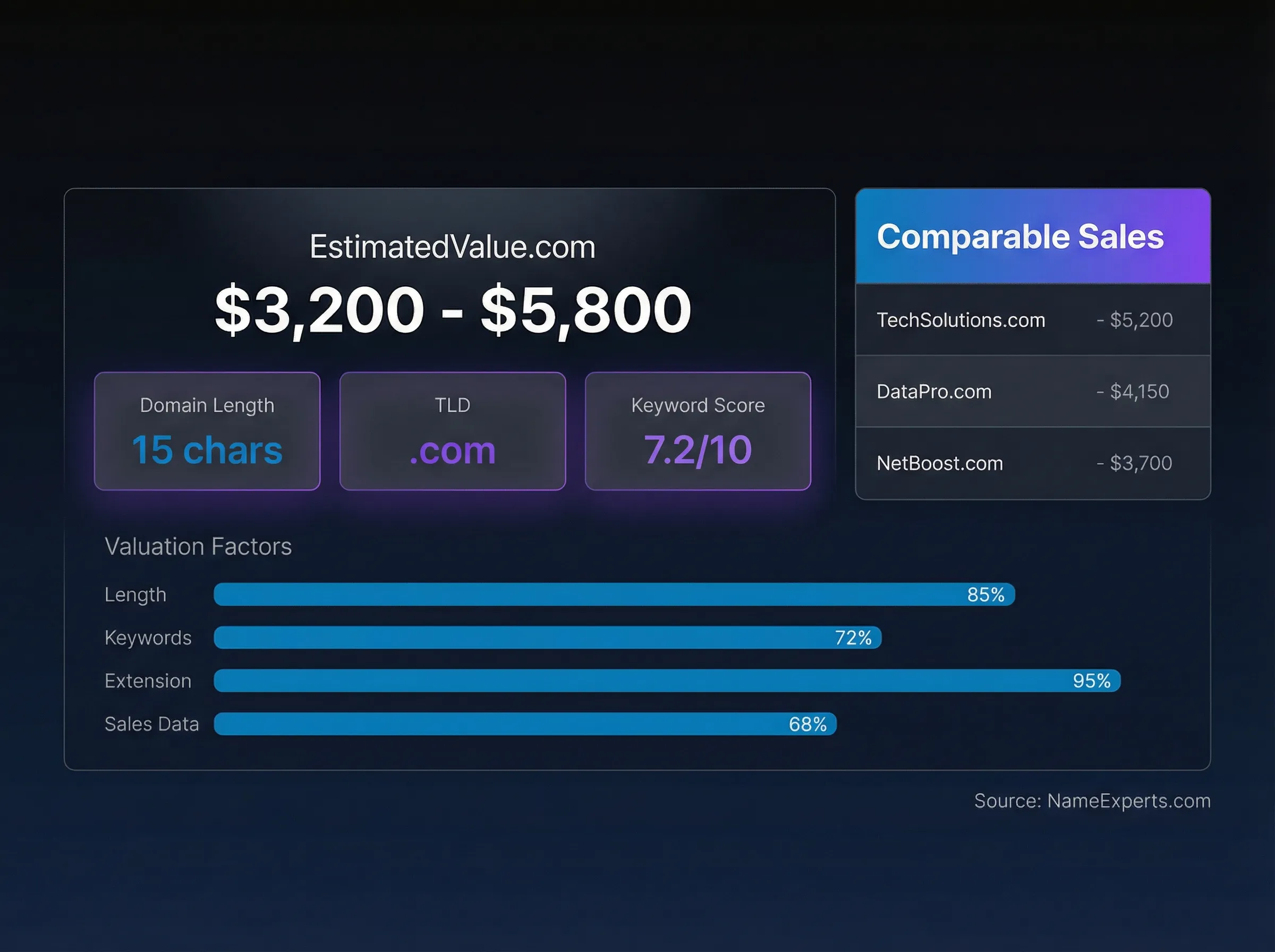
- Domain length: Shorter domains (under 15 characters) typically command higher values
- Keyword relevance: Popular search terms and commercial keywords increase estimated worth
- TLD extension: .com domains generally appraise higher than alternative extensions
- Comparable sales: Historical sales of similar domains inform the valuation range
- Character composition: Pronounceable words and memorable combinations score better than random strings
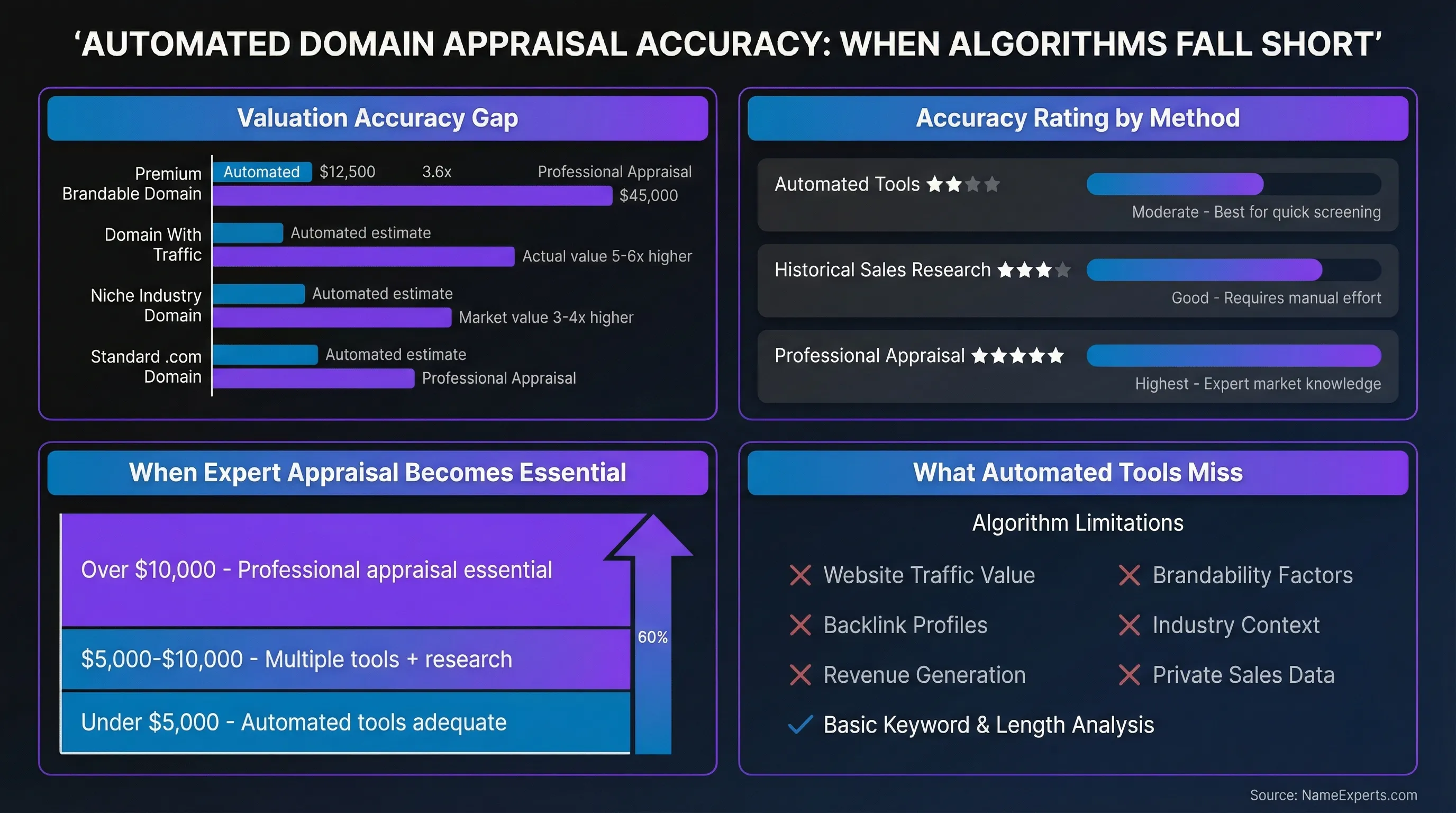
What these tools don't consider is equally important. They cannot evaluate existing website traffic, backlink authority, revenue generation, trademark value, or the subtle brandability factors that human experts immediately recognize. These limitations become critical when appraising premium domains where context matters enormously.
Understanding Automated Valuation Accuracy
To evaluate real-world performance, domain professionals regularly compare automated valuations against actual market outcomes and professional appraisals across different categories and price ranges.
Standard .com Domain (Tools Perform Reasonably)
For straightforward seven-character .com domains with common English words and no existing traffic or development, automated tools often estimate within reasonable ranges. When these domains have no special characteristics, algorithmic approaches can work adequately well.
Premium Brandable Domain (Significant Undervaluation)
Highly brandable six-letter .com domains with excellent phonetics and no trademark conflicts frequently receive automated estimates that fall far short of their true market value. Professional appraisals considering brandability, market timing, and comparable premium sales often value these domains at three to four times the automated estimate.
This discrepancy illustrates a fundamental limitation: algorithms struggle to quantify the intangible qualities that make certain domains exceptionally valuable to the right buyer.
Domain With Existing Traffic (Tools Miss Entirely)
Developed domains receiving thousands of monthly visitors and generating advertising revenue receive estimates that ignore the existing traffic and revenue stream entirely. Automated tools have no mechanism to detect or value these assets. Proper valuations accounting for traffic monetization potential often exceed automated estimates by five to six times.
Niche Industry Domain (Context Gap)
For domains highly relevant to specific professional industries but with moderate search volume, automated systems often undervalue significantly. Within specialized markets, comparable domains frequently sell for three to four times the automated estimate. The algorithms lack the industry-specific knowledge to recognize specialized value.
These patterns reveal a consistent trend: accuracy decreases substantially as domains become more unique, valuable, or contextually dependent.
Strengths of Automated Appraisal Tools
Despite limitations, automated valuation services offer genuine benefits for certain use cases:
Completely free with instant results: There's no cost barrier, and you receive estimates in seconds rather than waiting days for professional appraisals. This makes it practical for quickly screening large portfolios or researching potential purchases.
Extensive data foundation: With access to millions of domains and decades of sales history, the underlying datasets are genuinely comprehensive. For common domain patterns, this data provides reasonable baseline estimates.
Effective for standard domains: When evaluating typical .com, .net, or .org domains without special characteristics, automated tools perform adequately. If you're assessing a straightforward dictionary word or common phrase domain, the estimate will likely fall within a reasonable range.
Useful starting point: Even when not perfectly accurate, automated valuations provide a reference point for further research. They're valuable as one data point among several when forming your own assessment.
Comparable sales context: Many tools display similar domains that have sold, giving you market context beyond just a number. This transparency helps you understand how the estimate was derived.
User-friendly interface: These systems are genuinely easy to use, even for complete beginners. You simply enter a domain name and receive a formatted report you can download or share.
For domain investors managing hundreds of names or businesses conducting preliminary research, these advantages make automated tools a practical resource—provided you understand their limitations.
Don't Leave Money on the Table With Algorithmic Guesswork
Automated tools can't assess the brandability, traffic value, or revenue potential that often determine a domain's true worth. If your domain has special characteristics or estimated value over $10,000, you need human expertise that recognizes what algorithms miss entirely.
Critical Limitations You Need to Know
Understanding where automated valuations fall short is essential for making informed decisions:
Algorithm bias toward marketplace data: These systems naturally favor their own marketplace sales data, which may not represent the full spectrum of private transactions and premium deals that occur outside public platforms.
Missing brandability assessment: Algorithms cannot evaluate phonetic appeal, cultural relevance, or the emotional resonance that makes certain names exceptionally valuable. A human expert immediately recognizes when a domain has that intangible "it factor"—machines simply can't.
No traffic analysis: If your domain receives visitors, that traffic has real monetary value. Automated tools completely ignore this, potentially undervaluing developed domains by tens of thousands of dollars.
Backlink blindness: Domains with strong backlink profiles carry SEO value that can significantly impact worth. This factor isn't considered in algorithmic estimates.
Revenue ignorance: Domains generating income through parking, affiliate programs, or e-commerce have demonstrable value beyond the name itself. Automated systems cannot assess this revenue potential.
Industry expertise gap: Specialized domains serving specific professional markets often command premium prices within those niches. Without industry knowledge, algorithms miss this context entirely.
Limited private sales data: Many high-value transactions occur privately with non-disclosure agreements. Automated tools cannot access this data, creating blind spots in premium domain valuation.
New TLD challenges: For newer extensions like .ai, .io, or .app, there's less historical data available, making estimates less reliable than for established extensions.
In professional experience, domains valued by automated tools at $2,500 have ultimately sold for $45,000 through expert negotiation and targeted buyer outreach. The difference? Human understanding of market timing, buyer psychology, and strategic positioning that no algorithm can replicate.
Comparing Valuation Approaches
Different valuation methods serve different purposes and offer varying levels of accuracy:
Automated tools: Free, instant estimates work well for quick screening and standard domains under $5,000. Accuracy is moderate (approximately 3/5) and best suited for preliminary research.
Historical sales research: Manual research through sales databases provides valuable comparable data but requires time and interpretation. Accuracy improves (approximately 4/5) when you invest effort in finding truly comparable sales.
Professional appraisal: Expert assessment delivers the highest accuracy (5/5) by incorporating market knowledge, buyer identification, and strategic positioning that algorithms cannot replicate. Best for premium domains and serious transactions.
Each approach has distinct advantages. Automated tools excel at speed and convenience for standard domains. Historical sales databases provide valuable comparable data but require manual research and interpretation. Professional appraisals deliver the highest accuracy by incorporating market knowledge, buyer identification, and strategic positioning that algorithms cannot replicate.
When You Actually Need Expert Appraisal
Certain situations demand human expertise rather than algorithmic estimates:
Premium domains over $10,000: When significant money is involved, the cost of professional appraisal becomes negligible compared to the risk of mispricing. A $500 expert appraisal that helps you price a domain $15,000 higher pays for itself many times over.
Highly brandable names: Domains with exceptional memorability, phonetic appeal, or trademark potential require human assessment. These intangible qualities dramatically affect value but elude algorithmic detection.
Developed domains with traffic: If your domain receives visitors, has established backlinks, or generates revenue, you need valuation that accounts for these assets. Automated tools will systematically undervalue these properties.
Niche market domains: Industry-specific domains serving specialized professional markets require expertise in those sectors. A domain worth $5,000 in general markets might command $50,000 within the right niche.
Legal considerations: When trademark concerns, dispute potential, or intellectual property issues exist, professional guidance becomes essential to avoid costly mistakes.
Serious negotiations: If you're entering negotiations where tens of thousands of dollars hang in the balance, expert support provides strategic advantage. Professional brokers understand buyer psychology, negotiation timing, and deal structuring that maximizes outcomes.
Portfolio management: Managing valuable domain collections requires strategic oversight that considers market trends, renewal priorities, and disposition timing—factors beyond algorithmic capability.
At NameExperts, our professional appraisals include elements that automated tools cannot provide: identification of likely buyer categories, negotiation strategy recommendations, market timing analysis, and introductions to potential purchasers from our network. With millions in transactions for major brands, we understand the nuances that separate adequate valuations from truly accurate assessments.
The cost-benefit analysis is straightforward: when a domain's potential value exceeds $10,000, investing in expert appraisal typically returns many multiples of the fee through better pricing and negotiation outcomes.
Entering Serious Negotiations? Get Expert Backing.
When tens of thousands of dollars hang in the balance, professional appraisal provides strategic advantage through buyer identification, negotiation timing, and deal structuring that maximizes outcomes. Our 15+ years of experience and millions in transactions mean we understand the nuances automated tools cannot detect.
How to Use Automated Tools Effectively
If you choose to use automated valuation, follow these best practices:
Step 1: Visit a reputable appraisal tool and enter your domain name exactly as registered, including the extension.
Step 2: Review the estimated value range, but focus equally on the comparable sales data provided. These comparables often reveal more than the algorithmic estimate itself.
Step 3: Look for red flags indicating you need a second opinion: estimates that seem surprisingly low for brandable names, valuations that ignore obvious traffic or development, or assessments that don't account for industry-specific relevance.
Step 4: Cross-reference with historical sales data from industry databases. Search for similar domains that have actually sold and compare those real transaction prices to the automated estimate.
Step 5: Understand any "probability of sale" metric as a general indicator, not a precise prediction. This percentage reflects how quickly similar domains have sold historically, but your specific domain's appeal to buyers may differ substantially.
Step 6: Use the valuation as one data point among several. Combine it with historical research, keyword search volume analysis, and—for valuable domains—professional appraisal.
Step 7: Download the report for your records, but don't treat it as definitive pricing guidance for premium domains or serious transactions.
Automated tools work best when you understand their role: a quick screening mechanism and starting point for research, not a comprehensive valuation for important decisions.
What Professional Domain Investors Actually Use
Experienced domain investors rarely rely on single automated appraisals. Instead, they employ a multi-faceted approach:
Comparable sales analysis: Professionals spend significant time researching actual sales of similar domains through industry sales databases and reports. This real transaction data provides the most reliable pricing foundation.
Market knowledge and pattern recognition: Years of experience develop intuition about what makes domains valuable. Seasoned investors recognize patterns in buyer behavior, emerging trends, and market cycles that algorithms miss entirely.
Keyword and traffic research: Investors analyze search volume, cost-per-click data, and traffic potential to assess commercial viability. Keyword research tools inform these assessments.
Industry networking: Professional investors maintain relationships with buyers, brokers, and other investors. These connections provide market intelligence and transaction opportunities unavailable through automated channels.
Portfolio strategy: Rather than evaluating domains in isolation, experienced investors consider portfolio composition, renewal costs versus potential returns, and strategic holding periods.
The consensus among professionals is clear: automated tools serve as convenient screening mechanisms, but serious valuation requires human expertise, market knowledge, and strategic thinking that no algorithm can replicate.
Alternative Valuation Approaches
Beyond automated tools, several methodologies provide additional perspective:
Comparable sales method: Research recent sales of similar domains through industry databases and publications. This approach provides real market data rather than algorithmic estimates. Look for domains with similar length, extension, keyword relevance, and brandability.
Income approach: For revenue-generating domains, calculate value based on current income and projected future earnings. A domain generating $500 monthly might reasonably be valued at 24-36 months of revenue, or $12,000-$18,000.
Cost approach: Consider the investment required to build equivalent brand recognition and traffic through marketing. If establishing a brand on an alternative domain would cost $50,000 in marketing, a premium domain that provides instant brand credibility has comparable value.
Market demand analysis: Examine keyword search volume and commercial intent. Domains containing high-volume, high-CPC keywords serve markets with demonstrated buyer demand, increasing their value.
Brandability assessment: Evaluate phonetic appeal, memorability, spelling simplicity, and trademark availability. Domains that score highly across these factors command premium prices regardless of keyword metrics.
SEO value calculation: For domains with existing backlink profiles, assess domain authority and referring domain quality. Strong SEO foundations add substantial value beyond the domain name itself.
Combining multiple approaches yields more accurate valuations than any single method. For domains valued over $10,000, we recommend incorporating professional appraisal that synthesizes these various methodologies with market expertise.

The Bottom Line on Automated Appraisal
Automated domain appraisal tools serve a legitimate purpose: providing quick, free estimates for standard domains where algorithmic analysis works reasonably well. For preliminary research, portfolio screening, or evaluating straightforward domains under $5,000, they offer genuine utility.
However, accuracy decreases substantially for premium domains, brandable names, developed websites, or niche market properties. These tools cannot assess traffic value, revenue potential, backlink authority, or the nuanced brandability factors that often determine true worth. For domains valued over $10,000 or involving serious financial decisions, algorithmic estimates become inadequate.
Our recommendation framework:
- Under $5,000 estimated value: Automated tools provide reasonable guidance when combined with comparable sales research
- $5,000-$10,000 range: Use multiple automated tools plus thorough comparable sales analysis
- Over $10,000: Professional appraisal becomes essential to avoid significant mispricing
- Highly brandable or developed domains: Expert assessment regardless of estimated value
- Serious negotiations: Professional broker support to maximize outcomes
The greatest value of understanding automated tools lies in recognizing their limitations. Domains are not commodities with objective prices—they're unique assets whose value depends on context, timing, and finding the right buyer. That's where human expertise becomes irreplaceable.
For domains that deserve expert attention, connect with specialists who understand the nuances automated tools miss. At NameExperts, our 15+ years of experience and millions in transactions for major brands mean we recognize value that algorithms cannot detect. We provide professional appraisals based on real market data, buyer identification, and negotiation strategy—not just algorithmic estimates.
Get a professional domain appraisal when your domain's value warrants expert assessment, or contact our team to discuss your specific situation.
Work With a Domain Expert
Automated tools provide convenient starting points, but they systematically undervalue premium domains, brandable names, and developed sites—often by tens of thousands of dollars. Don't risk mispricing your valuable digital asset based on algorithmic estimates that ignore traffic, revenue potential, and the intangible brandability factors that drive real market value. At NameExperts, our professional appraisals combine 15+ years of domain brokerage experience with millions in transactions for ma
Get Started Free







Frequently Asked Questions
Use free automated appraisal tools for quick estimates under $5,000, research comparable sales through industry databases, and obtain professional appraisals for premium names over $10,000 where brandability, traffic, and revenue factors significantly impact worth.
GoDaddy's appraisal tool provides reasonably accurate estimates for standard .com domains under $5,000, but significantly undervalues premium brandable names, developed sites with traffic, and niche market properties where human expertise is essential for accurate pricing.
Yes, several free options exist including EstiBot, GoDaddy's appraisal service, and registrar-provided tools that deliver instant algorithmic estimates based on historical sales data, though these work best for preliminary research rather than serious financial decisions.
Standard .com domains typically range from $500-$5,000, while premium brandable names command $10,000-$100,000+, and ultra-premium single-word or two-letter domains can reach millions depending on length, memorability, commercial relevance, and existing traffic or revenue.


