
Key Takeaways
- Keep domain names short (2-3 syllables), memorable, and easy to spell to maximize brand recall
- Always search the USPTO trademark database before purchasing to avoid costly legal conflicts
- .com remains most trusted, but alternatives like .co, .net, or industry-specific extensions work when your ideal .com is unavailable
- When your preferred domain is taken, consider premium acquisition through specialists who negotiate better pricing
- Register multiple extensions and common misspellings to protect your brand from competitors
The domain name decision shapes how customers find, remember, and perceive your business online. Yet most new business owners rush this choice, selecting names that prove difficult to spell, impossible to trademark, or already owned by someone else. The right approach balances creativity with legal protection, brand strategy with practical availability.
This guide walks you through each step—from brainstorming memorable names to securing ownership—so you can launch with confidence and avoid expensive rebranding later.
Brainstorming Your Business Domain Name
Strong domain names share common characteristics: they're concise, distinctive, and aligned with your business identity. The best choices typically contain 2-3 syllables, avoid numbers and hyphens, and communicate something meaningful about what you offer.
Keep It Short, Memorable, and Brandable
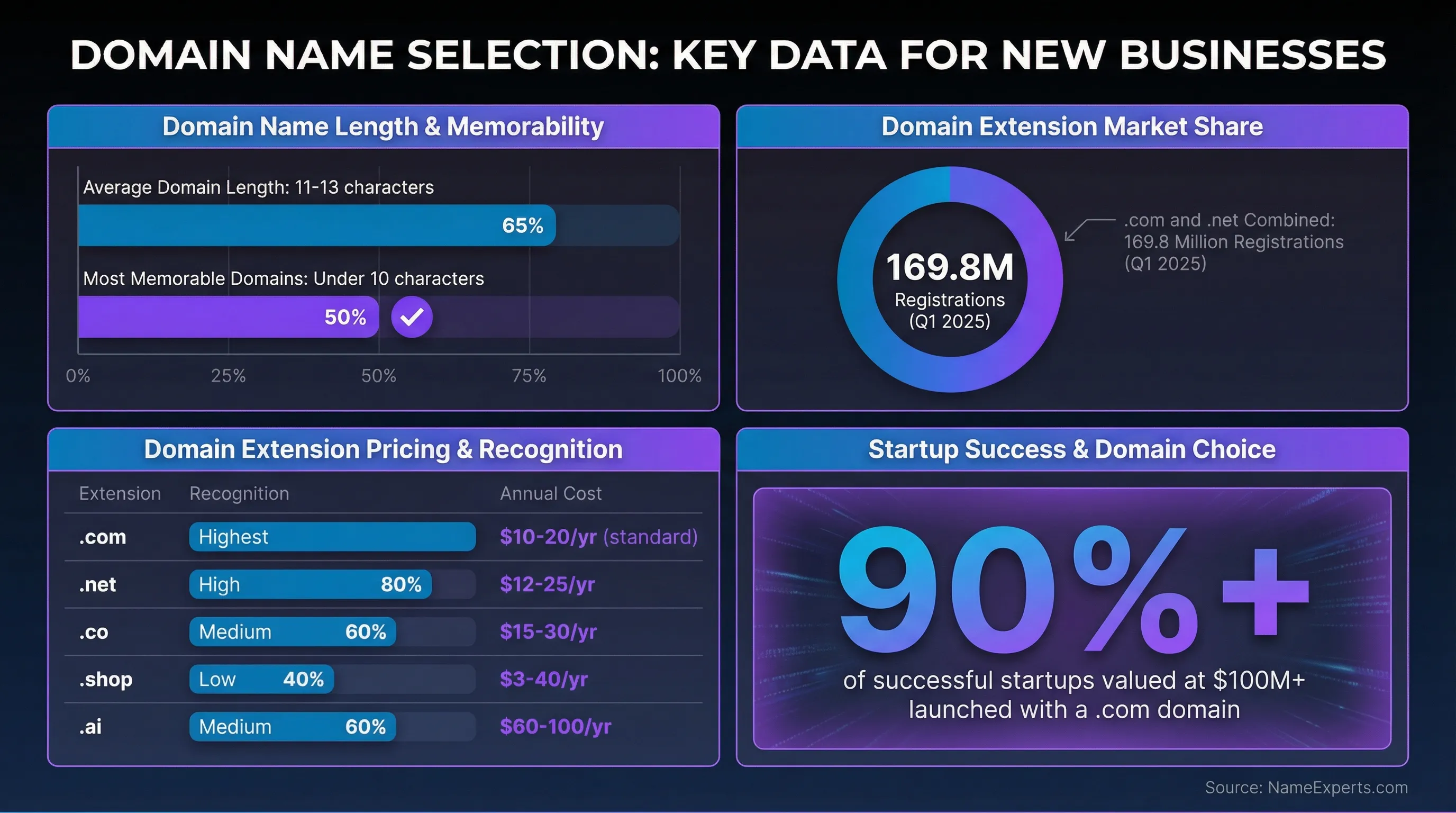
Short names stick in memory. Industry data shows that the average domain is 11-13 characters long, and those under 10 characters are significantly more memorable. When customers hear your name once, they should be able to recall and type it correctly days later.
Avoid clever spellings that require explanation. If you need to say "that's Kwik with a K" or "Photoz with a Z," you're creating friction. Every spelling clarification represents a potential customer who types the wrong address and lands on a competitor's site—or nowhere at all.
Align With Business Identity
Your domain should reflect either your brand name or what you do. Product-based businesses often benefit from descriptive names (like "OrganicPetSupplies.com"), while service companies may choose branded names that convey personality (like "Basecamp.com").
Consider your growth trajectory. A name like "ChicagoPizzaDelivery.com" works if you'll always operate locally, but limits expansion. A branded name offers more flexibility as your business evolves.
Test for Memorability and Spelling
Before committing, run practical tests. Say the name aloud to five people without showing them the spelling. Can they repeat it correctly? Text it to friends and ask them to type what they heard. These simple exercises reveal pronunciation problems and spelling confusion before you invest.
Check for unintended meanings. Read your proposed name without spaces ("expertsexchange" vs. "experts exchange") and consider how it sounds in different accents or languages if you plan international expansion.
When DIY Naming Gets Complicated
Some industries face crowded naming landscapes where finding available options feels impossible. Complex B2B sectors, regulated industries, or businesses requiring premium positioning often benefit from professional naming consultation.
With 16+ years of experience helping businesses through 200+ transactions, we've guided companies through challenging naming scenarios—from competitive tech markets to rebranding established enterprises. Professional services typically include trademark screening, competitive analysis, and strategic positioning that DIY approaches miss. If you're struggling to find names that are both available and strategically sound, expert consultation can save months of frustration.
Checking Domain Availability and Alternatives
Once you've identified promising names, verification begins. Multiple tools and strategies help you determine what's available and evaluate alternatives when your first choice is taken.

Use Domain Registrar Search Tools
Domain registrars provide search tools that check availability across hundreds of extensions simultaneously. Simply enter your desired name, and the system displays which extensions are available for registration and which are already owned.
Most registrars show pricing alongside availability. Compare costs carefully—initial registration fees often differ from renewal rates. Some extensions offer low first-year pricing but increase significantly upon renewal.
Evaluating Extension Options
The extension you choose (the part after the dot) affects perception, memorability, and cost. Over 90% of successful startups valued at $100M+ launched with a .com domain, and .com combined with .net reached 169.8 million registrations by Q1 2025.
This dominance stems from familiarity—customers default to typing ".com" when they can't remember your exact address. However, alternative extensions have grown more acceptable, particularly for specific use cases.
| Extension | Recognition Level | Typical Price Range | Best Use Cases | SEO Impact |
|---|---|---|---|---|
| .com | Highest - industry standard | $10-20/yr (standard) $1,000-$100,000+ (premium) | Any business seeking maximum credibility | No direct ranking benefit, but higher click-through rates |
| .net | High - familiar to users | $12-25/yr | Tech companies, network services, .com alternatives | Neutral - no ranking penalty |
| .co | Medium - growing acceptance | $15-30/yr | Startups, modern brands, international companies | Neutral - treated equally by search engines |
| .shop | Low - niche recognition | $3-40/yr | E-commerce stores, retail businesses | Neutral, provides descriptive context |
| .ai | Medium - tech-focused | $60-100/yr | AI companies, tech startups, innovation brands | Neutral, strong industry signaling |
Search engines treat most extensions equally for ranking purposes, so SEO shouldn't be your primary concern. Focus instead on user perception and memorability for your target audience.
What to Do When Your Ideal .com Is Taken
Finding your perfect name already registered is frustrating but common. You have several options, each with different implications and costs.
Consider variations: add a descriptive word ("GetFreshBaked.com" instead of "FreshBaked.com"), use your location ("FreshBakedBoston.com"), or try a different extension. Some businesses successfully build brands on .co, .io, or industry-specific extensions.
Alternatively, you might pursue acquiring the taken domain. This process, covered in detail below, involves contacting the current owner or using acquisition specialists to negotiate a purchase. Premium domains often cost thousands to tens of thousands of dollars, but may prove worthwhile for the right business.
Struggling to Find Available Names That Work?
The frustration of discovering every good domain is taken is common in competitive industries. If you're spending weeks brainstorming only to hit dead ends, our domain consulting services include strategic naming with built-in trademark screening, helping you identify legally defensible options you haven't considered—or determining whether acquiring your ideal taken domain makes business sense.
Trademark Screening and Legal Protection
Legal conflicts represent the most expensive domain mistake new businesses make. Launching with a name that infringes existing trademarks can force complete rebranding—new domain, new marketing materials, new everything—after you've invested months building recognition.
Search the USPTO Trademark Database
Before purchasing any domain, search the United States Patent and Trademark Office database. This free tool reveals whether someone has already trademarked your proposed name for similar goods or services.
Trademark protection extends beyond exact matches. If your proposed "CloudSync Solutions" conflicts with an existing "CloudSync Systems" trademark in the same industry, you risk infringement claims. The USPTO system helps identify these potential conflicts before you commit.
Understanding the difference between domain registration and trademark protection is crucial. According to the USPTO, registering a domain name with a registrar doesn't give you any trademark rights. Using a domain prominently as your business identifier may qualify as trademark use, but domain ownership alone provides no legal protection against others using similar names.
State Business Entity Name Requirements
Your domain name and legal business entity name are separate registrations with different rules. State-level entity registration protects your business name within that state and may be legally required depending on your business structure.
Most states prevent multiple businesses from registering identical entity names, but this protection only extends to your state. A business in California could potentially use a name similar to your New York entity registration without conflict—unless you have federal trademark protection.
Many businesses use the same name for their domain, entity registration, and trademark application to maintain consistency. However, you're not legally required to match these perfectly, and sometimes practical considerations (like domain availability) necessitate variations.
Understanding Trademark Infringement Risks
Trademark conflicts can emerge years after launch, triggered by your business growth into new markets or increased visibility. The costs extend beyond legal fees—you'll lose all brand equity built under the infringing name, confuse existing customers, and potentially face damages if the trademark holder proves willful infringement.
Research indicates that 46% of small businesses say a custom domain increases credibility. That credibility evaporates instantly if you're forced to rebrand due to trademark issues.
Professional Naming Services With Built-In Trademark Screening
Professional naming services integrate trademark screening into the creative process, eliminating names with legal risks before you see them. This approach prevents the disappointment of falling in love with a name only to discover it's legally unavailable.
Our naming process includes comprehensive trademark vetting across relevant categories, ensuring the names we recommend are both strategically sound and legally defensible. For businesses in competitive or regulated industries, this integrated approach prevents costly mistakes while accelerating your path to launch. Learn more about our naming process.
Acquiring Premium or Taken Domains
When your ideal domain is already registered but not actively used—or used by a business willing to sell—premium acquisition becomes an option. This path requires understanding market pricing, negotiation dynamics, and when professional representation makes sense.

When Premium Domains Make Business Sense
Premium domains—short, memorable names with commercial value—command higher prices because they deliver immediate benefits. An exact-match domain for your industry (like "OrganicCoffee.com" for an organic coffee company) provides instant clarity about what you offer.
The strategic value extends beyond clarity. Premium domains often attract more direct traffic from users typing category terms into browsers. They're easier to remember after a single exposure, reducing your customer acquisition costs. For businesses in competitive markets, the right premium domain can provide meaningful differentiation.
Consider premium acquisition when your business model justifies the investment—typically when customer lifetime value is high, competition is intense, or brand positioning is critical to success.
Typical Premium Domain Pricing
Premium domain pricing varies enormously based on length, extension, keyword value, and market demand. Industry marketplace data shows transactions ranging from a few thousand dollars for decent names to six or seven figures for premium .com domains in valuable categories.
Most small business premium acquisitions fall in the $1,000-$50,000 range. Single-word .com domains or exact-match category names command premium pricing. Longer phrases, alternative extensions, or less competitive niches cost considerably less.
Pricing also depends on the seller's motivation and knowledge. Some domain owners hold portfolios as investments and price aggressively. Others registered names years ago without clear plans and may accept reasonable offers. Professional valuation considers comparable sales, search volume for keywords, extension, and commercial potential.
DIY Negotiation vs Professional Acquisition
Contacting domain owners directly seems straightforward but carries risks. When you reach out personally, you reveal your interest and potentially your budget constraints. Sophisticated domain investors research inquiring parties, adjusting prices based on your company size, funding, or apparent urgency.
Direct contact also lacks leverage. Individual buyers have limited negotiation power compared to professional brokers who complete dozens of transactions annually and understand market dynamics, pricing psychology, and negotiation tactics.
The transparency of direct contact can work against you. If the owner knows you've built your brand around their domain name, they gain significant negotiating advantage.
Domain Acquisition Specialists
Professional domain acquisition specialists negotiate on your behalf while maintaining buyer anonymity. This stealth approach prevents sellers from inflating prices based on your specific circumstances or perceived ability to pay.
Experienced brokers understand market pricing, can identify motivated sellers, and know when to walk away from unreasonable demands. They handle the technical transfer process through secure escrow services, protecting both parties and ensuring clean ownership transfer.
We've completed 200+ domain transactions over 16 years, including high-profile acquisitions for companies like Monday.com (formerly Dapulse.com). Our stealth acquisition approach has consistently secured better pricing than clients could achieve independently, often saving multiples of our service fee. When the right domain is critical to your business strategy, professional representation protects your interests and maximizes negotiating leverage.
Registering and Securing Your Domain
Once you've selected an available domain or successfully acquired a premium name, proper registration and security setup protects your investment and establishes your online presence.
Choosing a Reputable Registrar
Domain registrars handle the technical process of connecting your chosen name to the internet's domain name system. Not all registrars offer the same service quality, pricing transparency, or customer support.
Look for ICANN accreditation, which ensures the registrar meets international standards for domain management. Compare pricing for both initial registration and renewal—some registrars advertise low first-year rates but charge significantly more for renewals.
Evaluate included features. Quality registrars include DNS management tools, domain forwarding, and email forwarding at no extra cost. Customer support quality matters when technical issues arise or you need to modify settings.
Essential Add-Ons Worth Getting
Privacy protection (WHOIS privacy) shields your personal contact information from public databases. Without this protection, your name, address, phone number, and email become publicly searchable, inviting spam and unwanted solicitation. Most reputable registrars include privacy protection free or charge a small annual fee.
SSL certificates encrypt data between your website and visitors, essential for any site collecting information or processing transactions. Many hosting providers include SSL certificates automatically, but verify this is configured correctly.
Automatic renewal prevents accidental expiration. Domains that lapse enter redemption periods with expensive recovery fees, or worse, become available for others to register. Enable auto-renewal and keep payment information current to avoid losing your domain.
Register Multiple Extensions and Variations
Brand protection extends beyond your primary domain. Register common misspellings, alternative extensions, and variations that competitors might use to capture your traffic.
If you're building your business on "YourBrand.com," also register "YourBrand.net," "YourBrand.co," and common misspellings. Forward these variations to your main site so customers who mistype still reach you rather than landing on error pages—or competitor sites.
This defensive registration costs relatively little (standard domains run $10-30 annually) but prevents brand confusion and protects against cybersquatting, where others register variations of your name hoping to sell them back to you later. For comprehensive guidance on protecting your brand across multiple domains, consider professional portfolio management services.
Set Up Professional Email Immediately
Email addresses using your domain (like [email protected]) build credibility from your first customer interaction. Free email services (Gmail, Yahoo, Hotmail) signal amateur operations, while domain-based email demonstrates professionalism and commitment.
Most hosting providers offer email services, or you can use dedicated email platforms that integrate with your domain. Set up key addresses (info@, support@, your name@) immediately, even before your website launches, so you can use professional email addresses in all business communications.
Don't Negotiate Premium Domains Alone
Reaching out to domain owners directly reveals your interest and eliminates your negotiating leverage—sophisticated sellers will research your company and adjust pricing accordingly. Our stealth acquisition approach has secured better pricing in 200+ transactions by maintaining buyer anonymity throughout negotiations. When the right domain is worth thousands, professional representation typically saves multiples of the service fee while protecting you from overpaying.
Common Domain Selection Mistakes to Avoid
Learning from others' mistakes saves time and money. These frequent errors trip up new business owners who rush the domain selection process.
Choosing names too similar to competitors creates confusion and may trigger trademark disputes. If "BlueSky Marketing" dominates your market, "BlueSky Media" or "BlueSkyline Marketing" will cause problems. Differentiate clearly to avoid legal issues and customer confusion.
Ignoring mobile and voice search considerations becomes increasingly important as more users find businesses through voice assistants and mobile devices. Names that are difficult to pronounce or spell phonetically perform poorly in voice search. Test how your name sounds when spoken aloud and whether voice assistants interpret it correctly.
Forgetting to check social media handle availability creates brand inconsistency. Before finalizing your domain, verify you can secure matching usernames on major platforms (Instagram, Facebook, LinkedIn, Twitter/X). Brand consistency across channels strengthens recognition and makes you easier to find.
Skipping the trademark search represents the costliest mistake. The time invested in USPTO database searches and professional trademark screening is trivial compared to the expense and disruption of forced rebranding after launch. Never skip this step, regardless of how perfect your chosen name seems.
Your domain name forms the foundation of your online presence, influencing how customers find you, remember you, and perceive your business. The strategic approach outlined here—balancing creativity with legal protection, considering premium acquisition when justified, and securing your choice properly—sets you up for long-term success. Take time to get this decision right, because changing later means starting over with brand recognition, marketing materials, and customer awareness.
Ready to Secure Your Perfect Domain?
Whether you're struggling to find available names that pass trademark screening, considering premium domain acquisition, or need strategic guidance on naming that supports long-term growth, we've navigated these exact challenges in 200+ transactions over 16 years. Our no-bullshit approach combines naming strategy, legal vetting, and stealth negotiation to secure domains that strengthen your brand from day one. Schedule a free consultation to discuss your domain strategy and discover whether prof
Schedule a free consultation to discuss your domain strategy







Frequently Asked Questions
A strong choice is short (2-3 syllables), easy to spell and pronounce, memorable after one exposure, and clearly aligned with your brand identity or what you offer.
.com remains the most trusted extension with highest recognition, though .co works well for modern brands and .ai signals innovation for tech companies—choose based on availability and your target audience's expectations.
No—including "LLC" makes your web address longer and harder to remember without adding brand value, and your legal entity designation belongs on official documents rather than customer-facing branding.
.com delivers broader recognition and trust across all audiences, while .io works specifically for tech startups and developer-focused products where the extension signals industry alignment.


