
Key Takeaways
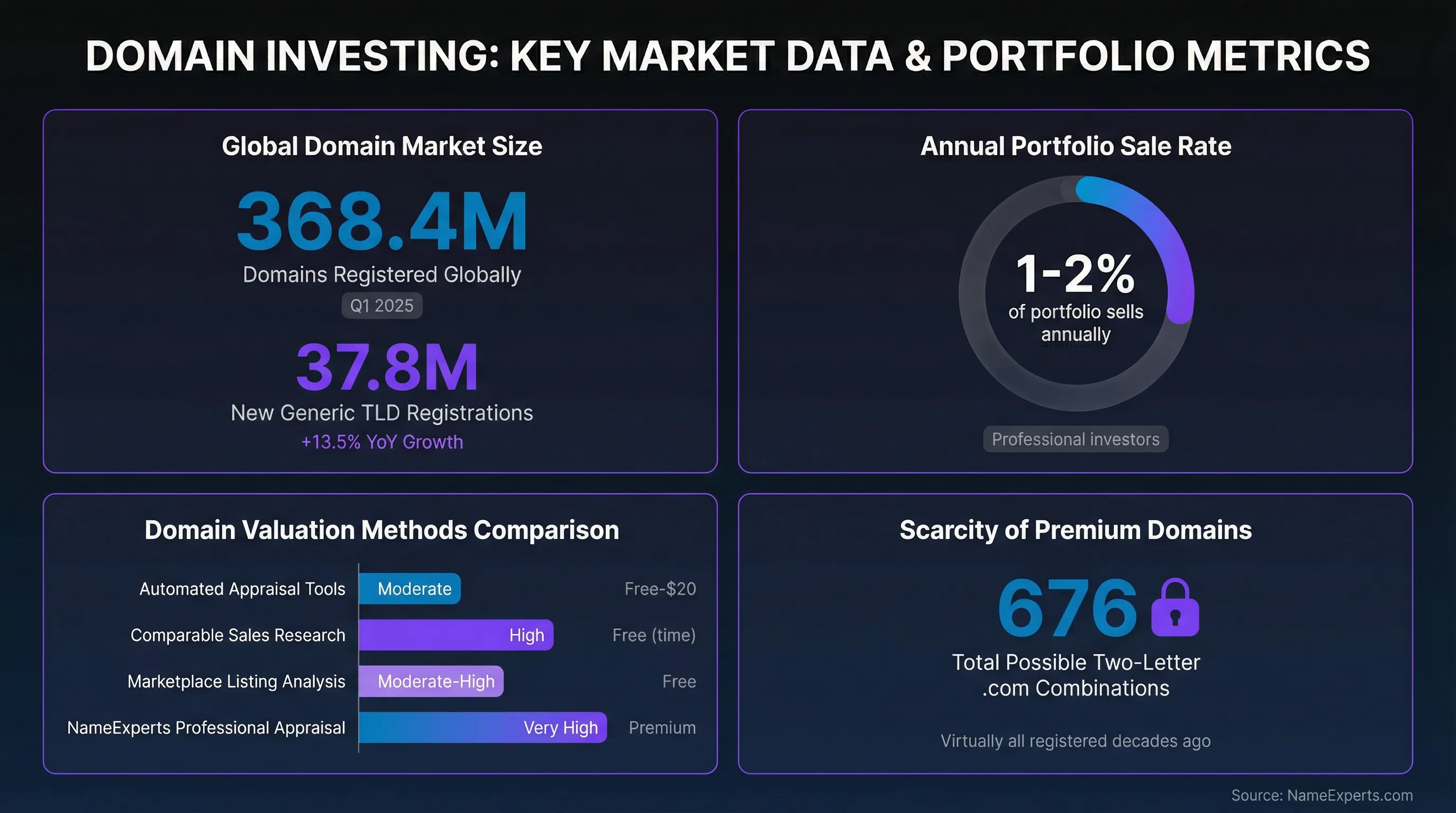
- Domain investing has matured into a legitimate asset class, with 368.4 million domains registered globally as of Q1 2025
- Professional investors typically sell only 1-2% of their portfolio annually—patience and strategic planning are essential for success
- Success requires understanding valuation fundamentals, market trends, and acquisition strategies rather than luck alone
- NameExperts provides professional-grade domain appraisal and brokerage services backed by 16+ years of experience and 200+ transactions
- New opportunities emerge through semantic search tools, blockchain innovations, and strategic TLD selection
Domain investing has evolved dramatically from its early "Wild West" days into a sophisticated asset class that generates hundreds of millions in annual transactions. What was once dismissed as digital squatting has become a legitimate investment strategy practiced by professionals worldwide. With the right knowledge and approach, acquiring valuable domain names can provide substantial returns—but success requires understanding what makes these digital assets valuable and how to strategically build a portfolio.
This guide draws on real market data and professional insights to help you navigate the investment landscape. Whether you're an entrepreneur looking to understand domain value or an investor exploring new asset classes, we'll cover the essential frameworks for evaluating, acquiring, and managing domain names profitably.
Understanding Domain Value: What Makes a Name Worth Investing In
Not all domain names are created equal. The difference between a $10 registration and a six-figure sale comes down to specific characteristics that professional investors recognize immediately. Understanding these value drivers is the foundation of successful investing.
Scarcity and Memorability
Short domain names command premium prices for good reason. One-word domains, two-character combinations, and three-letter acronyms are inherently limited in quantity. There are only 676 possible two-letter .com combinations, and virtually all were registered decades ago. This scarcity creates lasting value, particularly under established extensions.
Length directly impacts memorability. A domain that passes the "radio test"—meaning someone can hear it spoken once and spell it correctly—has inherent marketing value. Businesses pay premiums for names that customers can easily recall and type without error. Examples like tech.com, rocket.io, or elect.co demonstrate how brevity enhances brand potential.
Brandability and Commercial Appeal
Generic domain names targeting products or services maintain consistent demand. Terms like speakers.com, cellphones.net, or yogamats.co naturally fit within specific industries, making them attractive to any business in that space. These names work particularly well for investors using parking strategies with type-in traffic.
Brandable domains—unique combinations that sound professional without being generic—represent another valuable category. Made-up words that are pronounceable and distinctive can become powerful brand identifiers. Companies like Spotify, Etsy, and Hulu built global brands on invented names that started as available registrations.
Extension Authority and Market Perception
The top-level domain (TLD) significantly impacts value. While .com remains the gold standard due to decades of consumer familiarity, alternative extensions have gained traction in specific contexts. According to industry data from Q1 2025, new generic TLDs reached 37.8 million registrations, growing 13.5% year-over-year, indicating expanding acceptance beyond traditional extensions.
Country-code TLDs like .io (originally for British Indian Ocean Territory) have been reinterpreted by the tech industry as representing "input/output." Similarly, .ai domains have surged in popularity as artificial intelligence companies adopt them for branding. These semantic reinterpretations create investment opportunities as industries evolve.
Search Traffic and SEO Potential
Domains with existing search traffic carry additional value, particularly for buyers focused on content strategies. A name that already ranks for relevant keywords or has established backlinks provides immediate SEO advantages. Before acquiring any domain, professional investors use tools like the Wayback Machine to review historical content and assess whether previous usage built authority or created liabilities.
Numeric domains deserve special consideration, particularly for international markets. Individual numbers and combinations carry cultural significance—the number 8 is considered lucky in Chinese culture, while 4 is avoided due to its association with death. Understanding these nuances can reveal value that automated appraisal tools miss entirely.

Professional Valuation Methods Compared
Pricing domains accurately separates successful investors from those who overpay or undersell. Multiple approaches exist, each with distinct advantages and limitations. At NameExperts, we've completed 200+ transactions involving high-value domains for brands like HBO/Max.com, Monday.com, and TripAdvisor, giving us real market pricing data that goes beyond algorithmic estimates.
| Valuation Method | Cost | Accuracy Level | Best Use Case | Key Limitations |
|---|---|---|---|---|
| Automated Appraisal Tools | Free-$20 | Moderate | Quick portfolio screening | Algorithm-based, misses context and nuance |
| Comparable Sales Research | Free (time investment) | High | Understanding market ranges | Requires expertise and significant time |
| Marketplace Listing Analysis | Free | Moderate-High | Current market sentiment | Listing prices don't equal actual sale prices |
| NameExperts Professional Appraisal | Contact for pricing | Very High | Investment decisions, portfolio strategy | Premium service best for valuable domains |
Automated tools provide useful starting points but often fail to account for industry-specific demand, emerging trends, or cultural factors. Comparable sales research—studying actual transaction prices through historical databases—offers more reliable guidance but requires understanding which comparisons are truly relevant. A three-letter .com that sold for $50,000 in the healthcare space may not indicate value for a similar domain in an unrelated industry.
Professional appraisal services like those offered by NameExperts bring market expertise and transaction history to the evaluation process. Our team has brokered domains for major brands and understands the factors that drive end-user pricing versus investor-to-investor sales. This distinction matters significantly—end users often pay multiples of what investors would pay for the same name.
Acquisition Strategies: Finding and Securing Valuable Domains
Building a profitable portfolio requires knowing where to find undervalued domains and how to acquire them efficiently. Multiple acquisition channels exist, each with distinct advantages, costs, and success rates.
Hand Registration: Identifying Emerging Opportunities
Manually registering unowned domains remains the lowest-cost entry point for investors. While premium .com names in obvious categories were claimed decades ago, opportunities still exist for those who think creatively or anticipate trends early.
Successful hand registration strategies focus on emerging industries, new terminology, and alternative extensions. When artificial intelligence began mainstream adoption, investors who registered AI-related terms early positioned themselves ahead of demand. Similarly, as new top-level domains launch, early registrants of short or generic terms under those extensions can secure valuable assets at standard registration prices.
Keyword research tools provide insights into rising search trends. Google Trends reveals which terms are gaining traction, while keyword planners show search volumes that indicate commercial interest. Combining these insights with industry knowledge helps identify registration opportunities before they become obvious to the broader market.
Expired Domain Auctions: Competing for Dropped Names
Thousands of domains expire daily when owners fail to renew them. Many of these names enter auction platforms where investors bid for acquisition rights. This channel offers access to aged domains with existing history, backlinks, and sometimes residual traffic.
Major registrars operate expired domain auctions with varying rules and bidding structures. Some platforms allow proxy bidding, while others use live auction formats. Understanding the expiration cycle—including grace periods and redemption windows—helps investors time their participation strategically.
Due diligence is critical before bidding on expired domains. Check historical content through archive services to ensure the name wasn't associated with spam, adult content, or trademark violations. Review backlink profiles to assess whether previous SEO value remains. A domain with a problematic history may prove difficult to monetize regardless of how attractive the name appears.
Backorder Services and Drop-Catching
When multiple investors want the same expiring domain, backorder services provide a competitive acquisition method. These services attempt to register domains the moment they become available after completing the expiration process. If multiple backorders exist for a single name, it typically enters a private auction among those who placed backorders.
Drop-catching success rates vary by service and domain popularity. Highly desirable names may receive dozens of backorder requests, driving auction prices well above standard registration costs. Less obvious opportunities with fewer competing backorders can be secured at reasonable prices, making this a strategic middle ground between hand registration and marketplace purchases.
Marketplace Purchasing: Acquiring Listed Domains
Domain marketplaces host millions of names listed by owners seeking buyers. These platforms range from major aftermarkets operated by registrars to specialized exchanges focused on premium inventory. Listings typically offer "Buy It Now" pricing, "Make Offer" negotiation options, or auction formats.
Successful marketplace investing requires recognizing undervalued listings—domains priced below their true market value due to seller urgency, poor presentation, or lack of visibility. This skill develops through experience and market knowledge. Investors who specialize in particular industries or TLDs often spot opportunities that generalists overlook.
Negotiation plays a significant role in marketplace acquisitions. Many sellers list domains at aspirational prices but will accept reasonable offers. Starting with 40-60% of the asking price is common practice, with room for counteroffers. Patient negotiation often yields better prices than immediate purchases at listed rates.
Direct Acquisition and Broker-Assisted Purchases
The most valuable domains rarely appear on public marketplaces. Owners of premium names often hold them long-term or wait for serious buyers to approach directly. This creates opportunities for investors willing to conduct outreach and negotiate privately.
WHOIS lookup services provide contact information for domain registrants (when privacy settings allow). Crafting professional inquiry emails that demonstrate serious interest without revealing desperation is an art form. Successful outreach emphasizes mutual benefit and respects the owner's position.
For high-value acquisitions, engaging professional brokerage services offers significant advantages. At NameExperts, our buy-side domain acquisition services conduct stealth acquisitions where revealing the end buyer's identity would inflate pricing. Our established relationships and negotiation expertise often secure domains at better prices than direct approaches, even after accounting for service fees. With 16+ years of experience and transactions involving major brands, we understand the nuances of premium domain negotiations.
Avoid Costly Valuation Mistakes
Overpaying for domains or missing hidden value can make or break your investment returns. NameExperts brings 16+ years of experience and 200+ transactions to provide professional-grade appraisals that go beyond algorithmic estimates—giving you the real market intelligence you need to invest confidently.
Building a Strategic Portfolio
Individual acquisitions matter less than overall portfolio strategy. Professional investors think in terms of diversification, risk management, and systematic approaches rather than one-off purchases.
Diversification Across Categories and Extensions
Spreading investments across multiple categories reduces risk. A portfolio concentrated entirely in one industry becomes vulnerable if that sector declines. Balancing generic terms, brandable names, geographic domains, and trend-based acquisitions creates resilience.
TLD diversification follows similar logic. While .com domains anchor most professional portfolios due to their universal recognition, strategic positions in .io, .ai, .co, and relevant country codes can capture opportunities as these extensions gain acceptance. According to industry analysis, extensions like .design have been actively adopted by major companies including Facebook and Airbnb for design-focused content, demonstrating that alternative TLDs can achieve mainstream credibility in specific contexts.
Budget allocation between premium acquisitions and volume plays represents another strategic decision. Some investors prefer owning 10-20 high-quality domains worth $1,000-$10,000 each. Others maintain portfolios of hundreds of names acquired at $10-$100 each, accepting that most won't sell but a few exceptional performers will drive overall returns. Both approaches can succeed with proper execution.
Portfolio Management and Organization
As portfolios grow, systematic organization becomes essential. Spreadsheets tracking acquisition dates, costs, renewal dates, listing status, and valuation estimates prevent costly oversights. Missing a renewal on a valuable domain represents a complete loss of investment.
Categorizing domains by investment thesis helps evaluate performance. Group names by industry vertical, acquisition channel, TLD, or intended monetization strategy. This organization reveals which approaches generate returns and which consistently underperform, informing future acquisition decisions.
Annual portfolio reviews identify candidates for pruning. Not every domain deserves indefinite renewal. If a name hasn't generated interest after 2-3 years despite active marketing, continuing to pay renewal fees may not make economic sense. Professional investors regularly cut underperformers to focus resources on higher-potential assets.
Risk Management and Legal Considerations
Trademark infringement represents the most serious legal risk in domain investing. Registering domains that incorporate established brand names or trademarks—even unintentionally—can result in UDRP (Uniform Domain-Name Dispute-Resolution Policy) proceedings. According to WIPO statistics, domain name disputes continue to be filed regularly, with trademark holders actively protecting their intellectual property.
Avoiding trademark issues requires research before acquisition. Search trademark databases to verify that domain names don't infringe on registered marks. Generic terms and common phrases generally present lower risk than names closely associated with specific companies. When uncertainty exists, consulting with legal professionals specializing in intellectual property can prevent expensive mistakes.
Budget discipline prevents overextension. Investing more than you can afford to lose—or more than you can sustain through renewal fees—creates financial pressure that forces poor decisions. Conservative investors never allocate more than 5-10% of their investment portfolio to domains, treating them as alternative assets rather than primary holdings.
Value Enhancement Through Development
Some investors enhance domain value by adding content or functionality. A parked domain with a simple "for sale" page demonstrates less potential than one with a basic website showing possible use cases. This strategy works particularly well for generic domains where demonstrating commercial application helps buyers visualize opportunities.
Content development requires time investment but can significantly increase sale prices. A domain about a specific topic with 20-30 quality articles, basic SEO optimization, and some organic traffic presents much more value than an empty name. This approach works best when you have expertise in the domain's subject area and can create genuinely useful content.
However, development isn't always worthwhile. For highly brandable domains or obvious premium names, buyers often prefer blank slates they can build according to their vision. Assess whether development will genuinely increase value or simply consume time better spent on other portfolio activities.
Monetization and Exit Strategies
Acquiring domains represents only half of the investment equation. Converting those assets into profit requires effective selling strategies and realistic expectations about timelines.
Marketplace Listing Optimization
Most domain sales occur through marketplace listings where potential buyers browse available inventory. Optimizing these listings increases visibility and conversion rates. Professional-looking "for sale" landing pages with clear contact information and pricing guidance perform better than generic parked pages.
Pricing strategy significantly impacts sales velocity. Domains priced at fair market value based on comparable sales move faster than those with aspirational pricing. However, leaving room for negotiation is standard practice—listing at 20-30% above your minimum acceptable price allows buyers to feel they've negotiated successfully while you still achieve your target.
Multi-platform listing expands reach. Major marketplaces each have distinct user bases, so listing valuable domains across multiple platforms increases exposure. Some services offer distribution networks that syndicate listings to partner sites, further amplifying visibility.
Direct Outreach to Potential Buyers
Proactive outreach to businesses that might value specific domains can accelerate sales. Research companies in relevant industries and identify decision-makers who handle marketing, branding, or digital strategy. Personalized emails explaining why a particular domain fits their business often generate more interest than passive marketplace listings.
This approach requires tact and professionalism. Aggressive sales tactics or spam-like mass emails damage reputation and rarely produce results. Thoughtful, researched outreach that demonstrates understanding of the recipient's business and explains genuine value propositions yields better outcomes.
For premium domains where end-user sales offer the highest returns, engaging brokerage services makes strategic sense. At NameExperts, our sell-side representation services leverage our industry relationships and negotiation expertise to connect domains with qualified buyers. Our experience with high-profile transactions means we understand how to position premium names and navigate complex negotiations that individual investors might find challenging.
Realistic Timeline Expectations
Domain investing requires patience. Professional investors typically sell only 1-2% of their portfolio annually. This means a 100-domain portfolio might generate 1-2 sales per year. Understanding this reality prevents frustration and helps set appropriate expectations.
Holding periods vary dramatically by domain quality and market conditions. Exceptional names in high-demand categories might sell within months. Average domains may take 3-5 years to find the right buyer. Some names never sell at prices that justify their carrying costs, which is why portfolio pruning matters.

Market timing influences sales velocity. During economic expansions when businesses launch frequently and marketing budgets are healthy, domain sales increase. Recessions typically slow the market as companies reduce discretionary spending. Recognizing these cycles helps investors adjust expectations and strategies accordingly.
Transaction Security and Transfer Protocols
Secure transaction handling protects both buyers and sellers. Escrow services act as trusted intermediaries, holding payment while domain transfers complete and releasing funds only after successful transfer confirmation. This protection is essential for transactions over $500 and strongly recommended for all sales.
Understanding transfer protocols prevents complications. Domains must be unlocked at the current registrar, and authorization codes (EPP codes) must be provided to initiate transfers. Transfer processes typically take 5-7 days to complete. Clear communication with buyers about these timelines and requirements ensures smooth transactions.
Emerging Opportunities and Market Innovations
The domain investment landscape continues evolving as technology and market dynamics shift. Staying informed about emerging trends helps investors position portfolios for future opportunities.
Semantic Search and Discovery Tools
Traditional domain search relied on exact-match keyword queries. Modern semantic search tools use artificial intelligence to suggest brandable alternatives and creative combinations based on concepts rather than specific terms. This technology helps businesses discover available domains they wouldn't have found through conventional searches.
For investors, semantic search changes which domains hold value. Previously overlooked creative combinations and invented terms gain relevance as discovery tools surface them for buyers. This shift creates opportunities in brandable domains that don't rely on exact-match keywords but instead offer distinctive, memorable alternatives.
Blockchain Domains and Decentralized Naming
Blockchain-based domain systems represent an emerging category with uncertain but potentially significant implications. These domains function differently from traditional DNS, often serving as cryptocurrency wallet addresses or decentralized website identifiers. While adoption remains limited compared to conventional domains, the technology continues developing.
Investment in blockchain domains carries higher risk due to technological uncertainty and limited current utility. However, early positioning in emerging technologies has historically rewarded risk-tolerant investors. Those exploring this space should treat it as speculative allocation within a broader, more conservative portfolio.
New TLD Performance and Adoption Patterns
Hundreds of new generic TLDs launched over the past decade with varying degrees of success. Some extensions like .io and .ai achieved mainstream acceptance in specific industries. Others remain largely unused despite initial optimism. Understanding which new TLDs are gaining real traction versus which are stagnating helps investors make informed decisions about where to allocate resources.
Industry-specific extensions show the most promise. Extensions that clearly communicate purpose—like .tech for technology companies, .design for creative professionals, or .law for legal services—have achieved better adoption than generic alternatives. This pattern suggests that meaningful differentiation drives TLD success more than simple availability.
Secure Premium Domains Without Revealing Your Hand
When you're pursuing high-value domains, direct outreach can backfire—revealing your interest inflates prices instantly. NameExperts specializes in stealth acquisitions, leveraging our industry relationships and negotiation expertise to secure premium names at fair market prices while keeping your identity completely confidential.
Common Pitfalls and How to Avoid Them
Learning from others' mistakes accelerates your progress and prevents costly errors. These common pitfalls trap inexperienced investors regularly.
Overpaying Without Proper Research
Excitement about a domain can cloud judgment, leading investors to pay prices that make profitable resale nearly impossible. Always research comparable sales before making offers. If similar domains sold for $2,000, paying $5,000 leaves little room for profit after holding costs and marketplace fees.
Automated appraisal tools sometimes generate inflated valuations that don't reflect actual market conditions. Cross-reference multiple sources and prioritize actual sales data over algorithmic estimates. When considering significant investments, professional appraisal from experienced brokers like NameExperts provides more reliable guidance than free tools.
Ignoring Trademark Risks
Trademark infringement can result in forced domain transfers through UDRP proceedings, representing total loss of investment plus potential legal fees. Before acquiring any domain, search trademark databases to verify it doesn't infringe on protected marks. Generic terms and common phrases generally present lower risk than names closely associated with specific brands.
Even unintentional infringement carries consequences. Claiming you didn't know a term was trademarked provides no protection in dispute proceedings. Due diligence before purchase is the only effective prevention strategy.
Unrealistic Profit Expectations
Stories of domains selling for millions create unrealistic expectations for new investors. The vast majority of domain sales occur in the $500-$5,000 range, not six or seven figures. Building sustainable returns requires volume, patience, and realistic pricing rather than hoping for lottery-ticket outcomes.
Understanding that 80% or more of acquired domains may never sell at profitable prices helps set appropriate expectations. Successful investors achieve overall portfolio returns through a few strong performers offsetting many modest or break-even outcomes. This reality makes diversification and disciplined acquisition essential.
Poor Portfolio Organization
Missing renewal deadlines on valuable domains represents an entirely preventable loss. Implementing systematic tracking of renewal dates, costs, and portfolio performance prevents these costly mistakes. Calendar reminders, spreadsheet tracking, or dedicated portfolio management tools all work—the key is having a system and following it consistently.
Getting Started: Your First 90 Days
Beginning domain investing with a structured approach increases your likelihood of success. This 90-day framework provides a roadmap for new investors.
Month 1: Education and Market Research
Spend your first month building foundational knowledge before making significant investments. Study completed sales through historical databases to understand pricing patterns. Join domain investor communities and forums to learn from experienced participants. Practice valuation by estimating prices for domains before checking actual sale data—this develops your appraisal instincts.
Set a realistic initial budget. Most advisors recommend starting with $500-$2,000 for your first investments. This amount allows meaningful participation without excessive risk while you develop skills and market understanding. Resist the temptation to invest more heavily until you've completed several successful transactions.
Consider scheduling a consultation with NameExperts to review your investment strategy. Our team can provide guidance on portfolio approach, valuation methods, and acquisition priorities based on your specific goals and budget. This professional input early in your journey can prevent expensive mistakes and accelerate your learning curve.
Month 2: Initial Acquisitions and Portfolio Setup
Make your first acquisitions during month two, applying the research and knowledge from month one. Consider starting with 10-15 hand-registered domains at standard registration prices, or 3-5 aftermarket domains in the $100-$500 range. This diversification provides experience with different acquisition channels and domain types.
Establish your organization system immediately. Create a spreadsheet tracking acquisition dates, costs, renewal dates, and notes about each domain's investment thesis. Set up calendar reminders for renewals. Implement whatever system works for your workflow, but make organization a priority from the start.
Create professional "for sale" landing pages for your domains and list them on major marketplaces. Even if you plan to hold domains long-term, making them discoverable to potential buyers creates opportunities for unexpected sales.
Month 3: Refinement and Strategy Adjustment
Analyze your first two months of activity during month three. Which acquisition strategies felt most comfortable? Which domains generated the most interest from potential buyers? What aspects of the process took more time or money than expected? Use these insights to refine your approach.
Begin proactive outreach to potential buyers for your strongest domains. Research companies that might value specific names and craft personalized inquiry emails. This active selling approach complements passive marketplace listings and accelerates your learning about buyer psychology and negotiation.
Consider whether your initial strategy is working or needs adjustment. Some investors discover they prefer focusing on specific industries where they have expertise. Others find they enjoy the research and acquisition process more than selling. Adjust your approach based on what you've learned about your strengths and preferences.
The Long-Term Perspective
Domain investing rewards patience, continuous learning, and strategic thinking. Unlike day trading or short-term speculation, success in this asset class typically comes from systematic approaches executed consistently over years rather than months.
The most successful investors treat domains as a component of diversified investment portfolios rather than get-rich-quick schemes. They understand market cycles, maintain realistic expectations about sale rates and timelines, and continuously refine their strategies based on results.
At NameExperts, we've spent 16+ years helping clients navigate the domain investment landscape. Our experience with 200+ transactions involving premium domains for major brands gives us unique insights into what drives value and how to position domains for successful sales. Whether you need professional domain appraisal services, acquisition assistance for premium names, or sell-side representation to maximize returns, our team brings the expertise and market relationships that individual investors often lack.
The domain investment market continues evolving as technology changes how we discover, value, and use internet addresses. Staying informed about these changes while maintaining disciplined investment practices positions you to capitalize on opportunities as they emerge. With the right knowledge, realistic expectations, and strategic approach, domain investing can become a valuable component of your investment portfolio.
Ready to take your domain investing to the next level? Contact NameExperts to discuss your portfolio strategy, get professional appraisals on potential acquisitions, or explore how our brokerage services can help you secure premium domains or maximize sale prices on your existing holdings.
Work With a Domain Expert
Domain investing rewards strategic thinking, accurate valuation, and patient execution—but you don't have to navigate this landscape alone. Whether you need professional appraisals to avoid overpaying, stealth acquisition services for premium names, or sell-side representation to maximize your returns, NameExperts brings 16+ years of experience and a no-bullshit approach to help you succeed. Our team has brokered domains for HBO/Max.com, Monday.com, and TripAdvisor—we understand what drives real
Schedule Your Consultation







Frequently Asked Questions
Investors acquire domain names at registration or aftermarket prices, hold them as digital assets, and sell to end users or other investors at higher prices—typically selling only 1-2% of their portfolio annually with holding periods of 3-5 years for most names.
Yes, buying and selling domains is completely legal as a legitimate business practice, but registering names that infringe on trademarks (cybersquatting) violates UDRP policies and can result in forced transfers and legal consequences.
Yes, many investors generate returns through strategic acquisitions and patient selling, though success requires understanding valuation fundamentals, market trends, and realistic expectations—most portfolios see only 1-2% annual sales with holding periods of several years.
Domains can provide substantial returns as alternative assets when approached strategically, but they require patience, expertise in valuation, and disciplined portfolio management—conservative investors allocate only 5-10% of their portfolio to this asset class due to liquidity constraints and holding period uncertainty.


