
Key Takeaways
- Domain flipping is the legitimate practice of buying domain names at low prices and selling them for profit, distinct from illegal cybersquatting
- Success requires research, patience, and strategic valuation—not get-rich-quick expectations. Most domains take months or years to sell
- The most valuable domains combine short length, brandability, keyword relevance, and .com extension, with comparable sales data guiding pricing
- Adding value through professional landing pages or starter websites can dramatically increase sale prices compared to empty parked domains
- Professional appraisal and brokerage services provide market insights that automated tools miss, especially for high-value transactions
The digital real estate market offers unique opportunities for entrepreneurs willing to invest time in understanding what makes internet addresses valuable. Over 16+ years of industry experience and 200+ transactions, professionals have seen firsthand how strategic acquisition and positioning can transform a $100 investment into thousands. This practice—buying domains at low prices and selling them for profit—requires market knowledge, patience, and a systematic approach that separates professional investors from speculators.
Understanding the Business Model
At its core, this investment strategy mirrors physical real estate. Just as location determines property value, factors like length, memorability, and keyword relevance determine what someone will pay for an internet address. The model is straightforward: identify undervalued digital assets, acquire them at reasonable prices, and connect them with end-users who recognize their worth.
The key distinction lies between legitimate investing and cybersquatting. Professional investors focus on generic terms, brandable names, or expired addresses with existing value. Never touch trademarked names—that's illegal under the Anticybersquatting Consumer Protection Act and can result in lawsuits. The profit comes from recognizing new value, not holding existing brands hostage.
Several approaches exist within this market. Raw flips involve buying and immediately listing with no changes, banking purely on inherent name value. Developed flips add professional websites to demonstrate potential. Expired domain acquisition targets aged addresses with existing traffic and backlinks. Traffic-based strategies monetize existing visitor flow before sale. Each requires different skills and timelines.
Market Dynamics and Opportunity
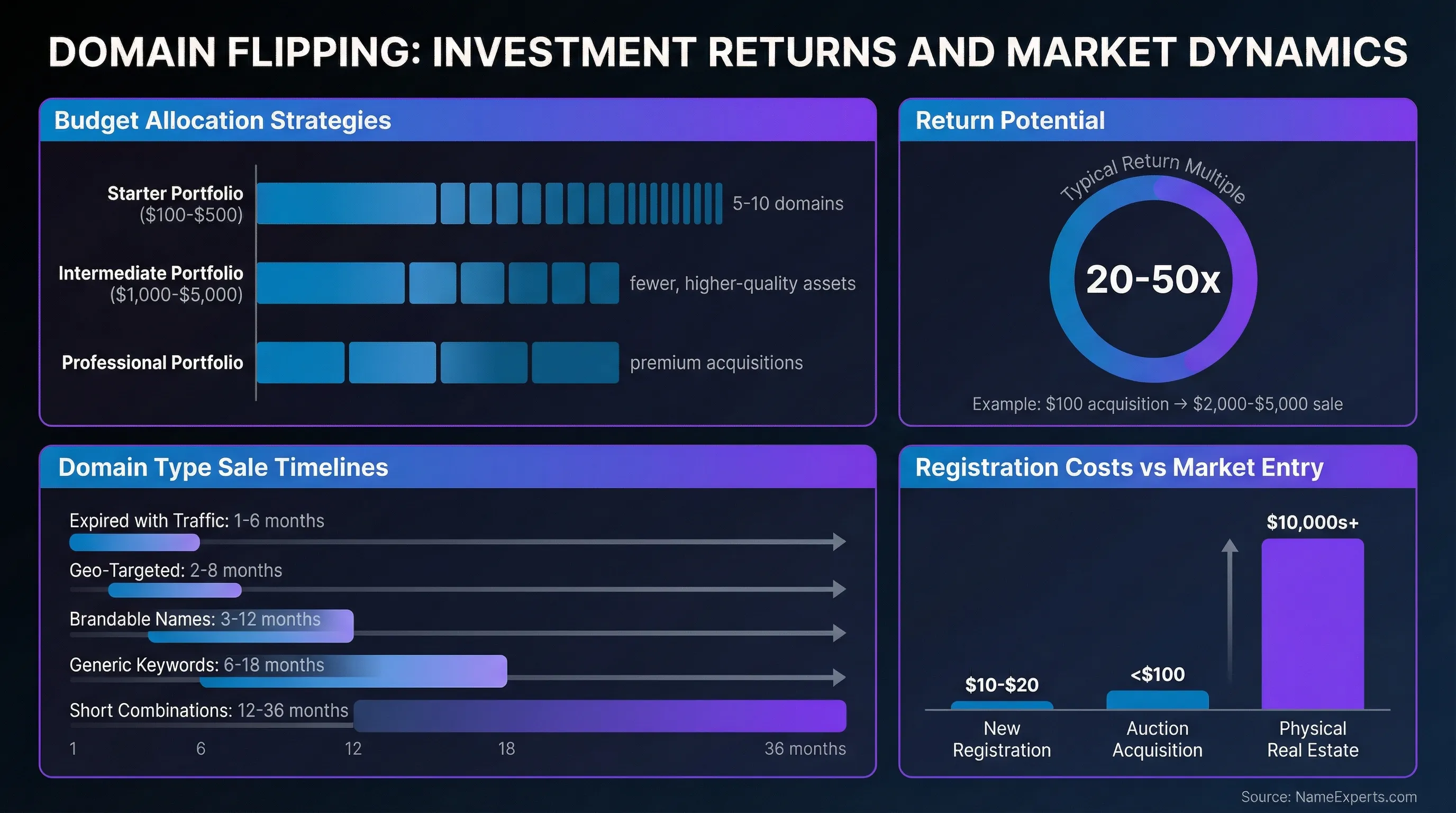
The barrier to entry remains remarkably low. Unlike physical property requiring tens of thousands in capital, you can register new addresses for $10-20 or acquire auction inventory under $100. This accessibility lets newcomers build small portfolios and learn without significant financial risk.
Return potential can be substantial. While blockbuster sales like Voice.com at $30 million make headlines, realistic expectations matter more. Industry professionals regularly see addresses purchased for $100 at expired auctions sell for $2,000-5,000 after cleanup and marketing. The 20-50x return potential drives continued market interest.
Scarcity creates ongoing demand. Only one Bikes.com will ever exist. As businesses move online, competition for short, memorable .com addresses intensifies. Market data from Statista shows .com continues dominating the landscape, though specialized extensions like .ai and .io have created niche opportunities for tech-focused investors who understand their target audiences.
Identifying Valuable Assets
Success begins with recognizing what makes certain addresses command premium prices. Length matters significantly—shorter almost always means more valuable. A four-letter combination typically outperforms a ten-letter phrase because it's easier to type, remember, and market.
Keyword relevance drives value for service-based addresses. Terms matching high-volume searches attract businesses seeking instant visibility. A name like DenverPlumber.com holds value because it exactly matches user search intent. Tools can reveal search volumes, but understanding buyer psychology matters more than raw numbers.
Brandability represents another value dimension. Memorable, catchy names that roll off the tongue command premiums even without dictionary words. Think of how Google, Zillow, or Etsy became household names from invented terms. The same principle applies to shorter addresses—while random four-letter combinations like QZBW.com lack obvious brand potential, combinations like USAA.com demonstrate how brevity can become brand identity.
Extension hierarchy significantly impacts value. The .com extension remains king for most businesses and commands the highest prices. The .net and .org extensions trail distantly behind. Newer extensions like .ai carry value for specific tech audiences, but general businesses default to .com because users type it automatically and trust it instinctively.
Research and Niche Selection
Professional investors don't buy randomly—they develop expertise in specific market segments. Focusing on industries you understand provides competitive advantage. A web developer might target programming language names or tech trend terms. Someone in finance could focus on fintech or investing terminology. This specialized knowledge helps spot trends before they become mainstream.
Industry niches like AI, green energy, ecommerce, real estate, and legal services offer different opportunity profiles. Keyword niches combining location terms with services ("Denver," "Miami") or action terms ("get," "buy") create targeted value. Pattern niches focusing on four-letter or five-letter combinations appeal to collectors and brandability seekers.
Research tools provide essential market intelligence. Sales databases offer the most powerful valuation resource—historical records of actual past sales showing what similar addresses truly sold for, not algorithmic estimates. Expired domain search tools provide free searching for expired and pending-delete inventory. These resources help identify opportunities and set realistic price expectations based on comparable transactions.
| Domain Type | Value Drivers | Typical Buyer | Sale Timeline |
|---|---|---|---|
| Generic Keywords | Search volume, commercial intent | Established businesses | 6-18 months |
| Brandable Names | Memorability, pronunciation | Startups, rebrandings | 3-12 months |
| Geo-Targeted | Local relevance, service match | Local businesses | 2-8 months |
| Expired with Traffic | Existing visitors, backlinks | SEO agencies, developers | 1-6 months |
| Short Combinations | Brevity, versatility | Investors, international buyers | 12-36 months |
Acquisition Strategies
Finding inventory requires knowing where to look and when to act. Hand registration represents the simplest approach—identifying currently available addresses and registering them for standard fees. This works for speculative plays on emerging trends or newly coined terms. The investment is minimal, but success rates are low since most obvious valuable names were registered years ago.
Expired marketplaces offer more promising opportunities. When owners fail to renew, addresses enter auction through various platforms. These venues attract serious buyers, so competition can be fierce for premium inventory. However, prices often remain reasonable because the previous owner demonstrated they no longer valued the asset.
Drop-catching services attempt to register addresses the millisecond they become available after the redemption period. This highly technical and competitive field requires understanding the 75-80 day expiration process. The value lies in capturing aged addresses with clean SEO histories and quality backlinks from authoritative sites.
Direct outreach can uncover hidden opportunities. Finding parked or underdeveloped addresses and contacting owners directly requires negotiation skills but can secure inventory not publicly listed. WHOIS databases provide contact information, though privacy services often hide it. This method demands patience and professional communication.
Budget Allocation
Starting capital determines strategy. With $100-500, focus on hand registration of emerging trend terms or participation in lower-tier auctions. This budget allows building a small portfolio of 5-10 speculative names. Expect most to fail, but one successful sale can cover all costs and generate profit.
Intermediate budgets of $1,000-5,000 enable participation in competitive expired auctions and acquisition of addresses with existing traffic or backlink profiles. This range lets you buy fewer, higher-quality assets rather than many speculative names. The professional approach prioritizes quality over quantity—one well-chosen $1,000 acquisition listed at $5,000 outperforms ten $100 names that never sell.
Risk management through diversification matters at any budget level. Don't concentrate all capital in a single address unless you have deep market knowledge and identified buyer interest. Spread investments across different types and niches to increase the probability that at least some will find buyers within reasonable timeframes.
Not Sure What Your Domain Is Really Worth?
Automated appraisal tools miss critical market factors that determine true value. Our 16+ years of experience and 200+ transactions give us the market insights to accurately price your domains based on real comparable sales data—not algorithmic guesses.
Valuation and Pricing
Determining what an address is worth represents the most challenging aspect for beginners. It's more art than science, but data provides guidance. The comparable sales method offers the most reliable approach. Search sales databases for addresses with similar keywords, length, and extension. If five similar AI-related names sold for $1,500-2,500 in the past year, your comparable address likely falls in that range.
Automated appraisal tools provide baseline estimates but require cautious interpretation. Various services offer algorithmic valuations based on keywords and historical data. These represent starting points, not final prices. The market always determines true value—what someone will actually pay matters more than what a tool estimates. For a deeper understanding of the factors that influence pricing, read our comprehensive guide on how to value a domain name.
SEO and traffic value assessment adds another dimension. Addresses with existing type-in traffic (visitors who type the address directly into browsers) carry monetization potential. Those with quality backlinks from authoritative sites offer SEO value. SEO analysis tools can analyze these factors, revealing hidden value in expired inventory that justifies premium pricing.

Through 200+ transactions, professionals have learned that expert appraisal considers factors automated tools miss. Market timing affects value—an AI-related address commands more during an AI boom. Buyer psychology matters—some will pay premiums for perfect brand matches. Negotiation dynamics influence outcomes—patient sellers often secure better prices than those desperate for quick sales.
Pricing Strategies
Three primary approaches exist for listing inventory. Buy-it-now pricing sets a fixed amount, encouraging quick, decisive purchases. Many investors list high buy-it-now prices (e.g., $4,999) while remaining open to offers. This anchors negotiations at higher levels while maintaining flexibility.
Auction formats create bidding competition and reveal true market prices. They work best for high-demand addresses where multiple interested parties exist. Seven-day auctions on major platforms attract serious buyers and can drive prices above initial expectations through competitive dynamics.
Make-offer listings invite negotiation and work well for niche addresses where exact value remains uncertain. Always maintain a firm floor price—the minimum you'll accept. Don't be afraid to counter lowball offers. First offers typically come in low, and professional negotiation often secures 50-100% more than initial bids.
Adding Value Through Development
The single most effective strategy for increasing sale prices involves building professional landing pages or starter websites. An empty parked address is just an idea. The same address with a polished one-page site becomes a tangible project that helps buyers visualize potential. Industry professionals have consistently seen this approach transform $100 acquisitions into $1,000+ sales.
Setting up a staging environment requires two components: hosting (the infrastructure) and a website platform (the building tools). Managed WordPress hosting provides a secure, fast foundation optimized for this purpose. WordPress itself offers the world's most popular website platform, giving you industry-standard, flexible technology that buyers recognize and trust.
Building a mini-site shouldn't take more than an hour. The goal isn't creating a 50-page corporate presence—it's developing a beautiful, professional one-page "coming soon" or "under construction" site. Visual page builders let you design without coding knowledge. Pre-designed templates accelerate the process further, providing professional layouts you can customize quickly.
Essential Page Elements
Effective landing pages include several key components. A simple, professional logo (even text-based) establishes brand identity. A clear, bold headline states the address's purpose—"The Future of Sustainable Fashion" or "Your AI-Powered Business Partner." A short descriptive paragraph expands on the concept. A contact form or call-to-action invites interested parties to reach out.
Content creation can be accelerated with AI assistance. Rather than struggling with blank pages, use AI tools to generate professional headlines and summary paragraphs. Highlight placeholder text and request "Write a professional headline and one-paragraph summary for a tech startup focused on AI-driven analytics." The technology generates usable content in seconds.
Speed optimization matters significantly. Slow-loading pages look unprofessional and devalue assets. Image optimization tools automatically compress visuals and convert them to modern formats, ensuring pages load instantly. This reinforces quality and value in buyers' minds.
Selling and Transaction Management
Marketplace selection significantly impacts visibility and sale probability. Major auction platforms attract the highest traffic and most buyers, making them ideal for broad appeal inventory. International marketplaces offer strong global reach and excellent parked-for-sale programs. Developed site marketplaces specialize in built-out properties, making them perfect for addresses with starter websites. Distribution networks syndicate listings across huge registrar networks, providing passive exposure. For a detailed comparison of your options, check out our guide to the best places to buy and sell domain names.
Creating compelling listings requires more than just posting names. Write clear, benefit-driven descriptions explaining why the address makes a great brand, what industries it could serve, and what keywords it contains. If you built a site, include screenshots and links. Professional presentation separates serious sellers from amateurs and justifies premium pricing.
For-sale landing pages provide passive marketing. Most marketplaces let you point addresses to sale pages showing prices and purchase options. This low-effort approach captures interested parties who discover the address through search or direct navigation. Clear pricing and simple purchase paths reduce friction and increase conversion rates.
Secure Transaction Handling
Payment and transfer security is critical. Never transfer ownership before receiving payment. Marketplace sales through major platforms include built-in transaction processes that secure buyer funds before instructing transfer. These platforms protect both parties and handle the technical transfer details.
For private sales outside marketplaces, always use third-party escrow services. The buyer sends payment to the escrow service, which notifies you to transfer ownership. After the buyer confirms receipt, escrow releases funds to you. This protects both parties from fraud and provides professional transaction management for high-value deals.
Transfer locks require awareness. ICANN mandates 60-day locks after new registration or transfers between registrars. You cannot transfer ownership to buyers during this window. Keep this timing in mind when planning sales to avoid disappointing buyers and losing deals due to technical restrictions.
At nameexperts.com, we provide professional brokerage services for high-value transactions where 16+ years of experience and market relationships can secure better prices than public auctions. Our team handles negotiations, buyer qualification, and transaction security, letting sellers focus on their core business while we manage the complexities of premium sales.
Struggling to Find Qualified Buyers?
Listing on marketplaces is one thing—connecting with serious buyers who recognize value is another. Our established network and no-bullshit negotiation approach help domain investors secure premium prices faster than going it alone in the Wild West of the domain marketplace.
Advanced Strategies
Experienced investors employ sophisticated techniques beyond basic flipping. Expired domain drop-catching uses automated services to capture valuable addresses the millisecond they become available after the redemption period. This highly competitive field requires understanding the multi-stage expiration process and bidding against other investors for catching rights.
SEO value flipping targets expired addresses with clean backlink profiles and high domain authority. SEO analysis tools analyze link quality, revealing addresses with backlinks from universities, news organizations, or government sites. These command premiums from SEO agencies who can redirect them to client sites or build them into private blog networks.
Developed site flipping takes the landing page concept further. Instead of one-page sites, investors build complete 5-10 page starter websites. For an address like BestAirFryers.com, you might create a full review site with template designs and AI-generated content. For ecommerce-focused addresses, you could build ready-to-launch online stores. These turnkey websites sell for significant premiums on platforms specializing in developed properties.

Portfolio Management
Successful long-term investing requires disciplined portfolio management. It's easy to become a collector, accumulating hundreds of addresses that never sell. Every holding costs annual renewal fees. If your portfolio is 90% non-performing assets, renewal costs will consume all profits from successful sales.
Regular portfolio review identifies underperformers. Set clear criteria for cutting losses—if an address hasn't generated interest after 18-24 months and comparable sales data doesn't support your pricing, let it expire rather than paying another year's renewal. This discipline keeps portfolios lean and profitable.
Diversification across types and niches increases the probability of sales within reasonable timeframes. Don't concentrate entirely on one extension or keyword category. Mix brandable names with keyword-rich addresses, combine new registrations with expired acquisitions, and spread investments across multiple industries to reduce risk.
Common Pitfalls to Avoid
The trademark trap catches many beginners. Registering trademarked names is illegal and can result in lawsuits and forced forfeiture. Before buying any address, search the USPTO TESS database to verify it doesn't infringe existing trademarks. Professional investors never touch trademarked terms—the legal risk far outweighs any potential profit.
The collector fallacy leads to portfolio bloat. Falling in love with names and hoarding them creates mounting renewal costs that erode profits. Be disciplined about cutting non-performers. The professional approach focuses on quality over quantity—fewer high-value assets outperform large portfolios of speculative names.
Over-reliance on appraisal tools creates unrealistic expectations. Don't price at $5,000 just because an automated tool suggested that value. If comparable sales show similar addresses selling for $500, your realistic price is $500. The market is always right—actual transaction data trumps algorithmic estimates.
Poor negotiation costs money. Don't accept first offers without countering. Have a firm walk-away price and stick to it. Lowball offers are standard practice—professional negotiation often secures 50-100% more than initial bids. Patience and confidence in your valuation lead to better outcomes.
Market Evolution and Future Trends
The landscape continues evolving with technology and user behavior. AI impacts the market in multiple ways. Name generators create more brandable options, increasing supply. Simultaneously, AI tools make developed flips easier and faster than ever. Site planning tools can now generate complete sitemaps and wireframes from simple prompts, dramatically accelerating the development process.
New extensions create specialized opportunities. While .com remains dominant, acceptance of .ai and .io grows in tech sectors. Startups increasingly build brands on these extensions, creating vibrant sub-markets for investors who understand those communities. Website statistics from Forbes show that organic search results continue driving the vast majority of web traffic, reinforcing the value of keyword-rich addresses.
Web3 domains represent the new frontier. Decentralized addresses built on blockchain technology like .eth and .sol remain highly speculative with infant markets. For experienced investors, this represents a potential high-risk, high-reward opportunity worth monitoring as the technology matures and adoption grows.
Getting Started: Your First Investment
Success in this market requires research, patience, and systematic strategy—not lottery-ticket thinking. The most successful investors don't just squat on names; they identify and create value. Building simple, professional sites transforms the conversation from "How much for this name?" to "How much for this business?"
The best learning comes from hands-on experience. Start small with a $50-100 budget. Visit an auction site and try to acquire your first address. Set up a simple one-page site. List it for 2-3x your acquisition cost. Even if it doesn't sell immediately, you'll have learned the entire process through direct experience.
Professional guidance accelerates success and helps avoid costly mistakes. At nameexperts.com, our team brings 16+ years of market knowledge and 200+ transactions to help clients identify opportunities, value inventory accurately, and connect with qualified buyers. We've brokered premium addresses for major brands and understand what drives value in today's market. Whether you're exploring your first acquisition or managing a substantial portfolio, our expertise can help you navigate this unique investment landscape and maximize returns on your digital real estate holdings. Learn more about our professional domain appraisal services to get started.
Work With a Domain Expert
Whether you're trying to accurately value your first acquisition, negotiate a fair sale price, or connect with qualified buyers for premium domains, professional guidance makes the difference between leaving money on the table and securing the returns your digital real estate deserves. Our boutique brokerage brings 16+ years of market knowledge and direct access to principal broker Joe Uddeme—no corporate distance, just honest expertise and personalized service. Get Your Free Domain Consultation
Get Your Free Domain Consultation







Frequently Asked Questions
Yes, domain flipping remains profitable in 2026 when approached strategically—industry professionals regularly achieve 20-50x returns by purchasing expired domains for $100 and selling them for $2,000-5,000 after proper valuation and marketing.
Domain flipping is completely legal when focused on generic terms and brandable names, but registering trademarked names constitutes cybersquatting under the Anticybersquatting Consumer Protection Act and can result in lawsuits and forced forfeiture.
Most domains take 6-18 months to sell, though geo-targeted addresses may sell in 2-8 months while short letter combinations can take 12-36 months—patience is essential as quick flips are rare exceptions rather than the norm.
The .com extension remains the most valuable and commands the highest prices, though specialized extensions like .ai and .io have created profitable niche opportunities for tech-focused investors who understand their target audiences.


