
Securing the perfect domain name can make or break your online brand identity. When that ideal domain is already owned by someone else, understanding the true cost of hiring a broker becomes critical to your budget planning. Brokerage fees typically include upfront charges ranging from $99-$500 plus commission rates of 10-20% on the final sale price, but the total acquisition cost involves several additional expenses that many buyers overlook.
Key Takeaways
- Standard commission rates range from 10-20% of the final sale price, with boutique brokers often charging lower percentages than budget services
- Upfront fees typically run $99-$500 and are usually non-refundable regardless of acquisition success
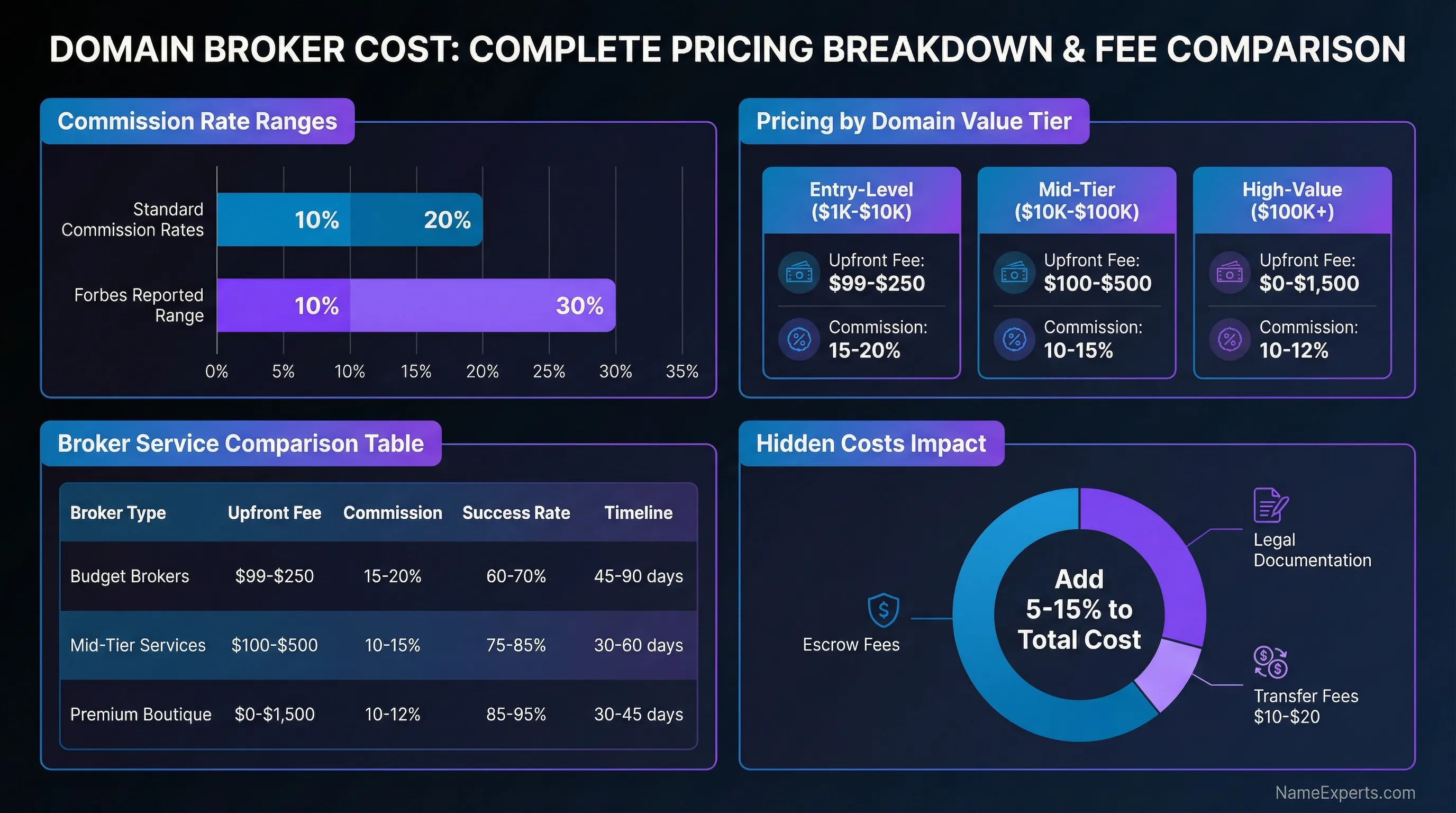
- Hidden costs including escrow fees (varies by transaction size), transfer fees ($10-20), and legal documentation can add 5-15% to your total transaction expenses
- Pricing varies significantly by domain value tier, with different cost structures for domains under $10K versus premium names exceeding $100K
- Transparent brokers publish clear fee structures upfront and provide detailed cost breakdowns before you commit
Understanding Domain Broker Fee Structures
When you hire a professional to acquire or sell a domain name, you'll encounter two primary pricing models. Each has distinct advantages depending on your transaction size and negotiation needs.
Commission-Based Pricing
The commission model is the most common structure in the industry. According to Forbes, most brokers earn a commission of between 10% and 30% of the final selling price, with the typical range falling between 10-20% for standard transactions.
Here's how this structure works in practice: If a broker successfully negotiates a domain purchase for $50,000 and charges a 15% commission, you'll pay $7,500 in fees on top of the purchase price. The total acquisition cost would be $57,500.
Commission structures benefit both parties when aligned properly. The broker is incentivized to negotiate the best possible price since their fee is tied to the transaction value. For buyers, this means your representative has a financial interest in keeping costs reasonable while still closing the deal. For sellers, it means they will work to maximize your sale price.
Who typically pays the commission? This varies by transaction and negotiation. In buy-side representation, the buyer usually covers the commission. In sell-side representation, the seller pays from their proceeds. Some high-value deals involve split commission structures where both parties contribute.
Flat Fee Models
Some brokers charge a fixed upfront fee instead of or in addition to commission. These fees typically range from $99 to $500 or more, depending on the service level and broker reputation.
The upfront fee covers the broker's time and resources to locate the domain owner, initiate contact, and begin negotiations. This fee is almost always non-refundable, even if the acquisition fails. You're paying for the broker's effort and expertise, not guaranteed results.
Hybrid models combine both approaches: a smaller upfront fee plus a reduced commission percentage. For example, you might pay $250 upfront plus 10% commission rather than 15% commission with no upfront cost. This structure reduces the broker's risk while still aligning incentives toward a successful transaction.
When does a flat fee make sense? For lower-value domains (under $5,000), a flat fee structure can be more cost-effective than percentage-based pricing. For high-value acquisitions, commission-based pricing typically provides better value since the broker's incentive to negotiate aggressively increases with the transaction size.

Pricing Breakdown by Domain Value Tier
The cost of brokerage services scales with domain value, but not always proportionally. Understanding these tiers helps you budget appropriately and choose the right service level.
Entry-Level Domains ($1,000-$10,000)
For domains in this range, expect to pay:
- Upfront fees: $99-$250 (often non-refundable)
- Commission rates: 15-20% of purchase price
- Total cost example: For a $5,000 domain with $99 upfront and 15% commission, your total investment would be $5,849
At this tier, you should question whether professional brokerage is necessary. If the domain is listed on a marketplace with clear pricing and the owner is responsive, you might handle the transaction yourself and save the commission. However, if owner contact information is hidden or the domain isn't officially for sale, a broker's resources become valuable.
The return on investment calculation is straightforward: Will the broker's negotiation skills save you more than their fee? If a domain is listed at $8,000 but a broker can negotiate it down to $5,000, the $849 in fees is easily justified by the $3,000 savings.
Mid-Tier Premium Domains ($10,000-$100,000)
This is the sweet spot where professional brokerage services deliver clear value:
- Upfront fees: $100-$500 (sometimes waived for established clients)
- Commission rates: 10-15% of purchase price
- Total cost example: For a $50,000 domain with $250 upfront and 12% commission, total cost would be $56,250
At this level, negotiation expertise becomes critical. The difference between amateur and professional negotiation can easily exceed the brokerage fee. A skilled broker understands market comparables, knows how to position offers, and can navigate complex negotiations that might take months to resolve.
Stealth acquisition capabilities also become important in this tier. If a domain owner discovers that a well-funded company wants their domain, they may inflate their asking price significantly. Professional brokers keep your identity confidential during negotiations, preventing this price inflation.
We've seen this firsthand in our 16+ years of experience. In one case, we helped a fintech startup acquire a domain with a $75,000 asking price for just $42,000 by leveraging comparable sales data and maintaining buyer anonymity throughout the negotiation. Our commission was $5,040, but we saved the client $33,000 off the asking price—a net savings of nearly $28,000.
High-Value Premium Domains ($100,000+)
For six-figure and seven-figure domain transactions, the pricing structure often becomes more customized:
- Upfront fees: $0-$1,500 (often negotiable or waived)
- Commission rates: 10-12% of purchase price (sometimes tiered)
- Total cost example: For a $500,000 domain with no upfront fee and 10% commission, total cost would be $550,000
At this tier, you're not just paying for negotiation—you're paying for strategic advisory, market intelligence, legal coordination, and often multi-party negotiations. The broker may need to identify multiple potential sellers, conduct extensive due diligence, and structure complex payment terms.
Tiered commission structures sometimes apply: perhaps 12% on the first $100,000, 10% on the next $400,000, and 8% on amounts above $500,000. This rewards the broker while acknowledging that percentage-based fees on very large transactions can become disproportionate to the work involved.
For transactions at this level, the broker's network and relationships often make the difference between success and failure. Many premium domains aren't publicly listed, and owners may only consider offers that come through trusted intermediaries they've worked with before.
Worried About Overpaying for Your Domain?
With 16+ years of experience and 200+ successful transactions, we provide transparent pricing and market intelligence to ensure you pay fair market value—not inflated asking prices. Our clients consistently save more than our commission through expert negotiation.
Hidden Costs and Additional Fees
The broker's commission isn't the only expense you'll encounter. Several additional costs can add 5-15% to your total acquisition budget if you're not prepared.
Escrow Service Fees
For transactions over $5,000, using a professional escrow service is standard practice and often mandatory. These services protect both buyer and seller by holding funds until the domain transfer is verified and complete.
Escrow fees vary based on transaction size using tiered pricing structures. For a $50,000 domain purchase, expect to pay approximately $500-$1,500 in escrow fees depending on the service provider. Some premium brokers include escrow coordination in their service, while budget brokers charge it separately.
The escrow process works like this: You deposit funds into the escrow account, the seller initiates the domain transfer, the escrow service verifies the transfer is complete and you have full control, then the funds are released to the seller. This protects you from paying for a domain you never receive and protects the seller from transferring a domain without receiving payment.
Domain Transfer Costs
When a domain changes hands, it typically needs to be transferred to your registrar account. This process incurs a transfer fee of $10-$20, which includes a one-year registration renewal.
While this cost is relatively minor, it's often overlooked in initial budget calculations. Some brokers include this in their service package, while others expect you to handle it separately.
Legal and Documentation Fees
High-value domain transactions often require legal documentation beyond a simple purchase agreement. This might include:
- Purchase and sale agreements: $500-$2,000 for attorney review and drafting
- Trademark searches: $300-$1,000 to ensure the domain doesn't infringe existing trademarks
- Due diligence reports: $200-$1,000 for traffic verification, backlink analysis, and history checks
For domains under $25,000, these legal costs may be unnecessary. For six-figure acquisitions, they're essential protection against future disputes or undisclosed liabilities.
Rush Service Premiums
Need a domain acquired quickly? Expect to pay 20-50% more in broker fees for expedited service. Rush acquisitions require brokers to prioritize your transaction, make multiple contact attempts in compressed timeframes, and potentially offer premium pricing to motivate sellers to move quickly.
Standard acquisitions typically take 30-90 days. Rush service aims to complete transactions in 7-14 days, though success isn't guaranteed since the seller ultimately controls the timeline.
Failed Acquisition Fees
This is perhaps the most frustrating hidden cost: paying fees even when the acquisition fails. Most brokers charge non-refundable upfront fees that you lose if the domain owner refuses to sell or if negotiations break down.
If you've paid $99 upfront and the owner simply won't sell at any price, you're out that money with nothing to show for it. This is why choosing a broker with a high success rate matters—you're paying for their ability to close deals, not just initiate conversations.
Renewal and Holding Costs
After acquisition, you'll need to maintain the domain registration. Annual renewal fees range from $10-$50 for standard TLDs, but premium domains sometimes carry higher renewal costs of $100-$500 per year depending on the registry's pricing structure.
Budget for at least 3-5 years of renewal costs when calculating your total investment. A domain that costs $50,000 to acquire but $300 annually to maintain will cost you $51,500 over five years.
Broker Pricing Comparison Framework
Not all brokerage services are created equal. Understanding the differences between service tiers helps you choose the right partner for your needs and budget.
| Fee Component | Budget Brokers | Mid-Tier Services | Premium Boutique |
|---|---|---|---|
| Upfront Fee | $99-$250 | $100-$500 | $0-$1,500 |
| Commission Rate | 15-20% | 10-15% | 10-12% |
| Escrow Included | Usually Extra | Sometimes | Typically Yes |
| Refund Policy | Non-refundable | Varies | Negotiable |
| Success Rate | 60-70% | 75-85% | 85-95% |
| Average Timeline | 45-90 days | 30-60 days | 30-45 days |
| Best For | Domains under $10K | $10K-$100K range | $100K+ transactions |
Evaluating Total Cost of Acquisition
To compare brokers accurately, calculate the all-in cost including every fee:
- Base purchase price: The amount paid to the domain owner
- Broker commission: Percentage of purchase price
- Upfront fee: Initial service charge
- Escrow fee: Varies by transaction size
- Transfer fee: $10-$20
- Legal costs: $0-$2,000 depending on complexity
Example calculation: You want to acquire a domain currently asking $60,000.
- Scenario A (Budget Broker): Negotiates to $55,000, charges $99 upfront + 18% commission ($9,900) + $1,650 escrow + $15 transfer = Total: $66,664
- Scenario B (Premium Boutique): Negotiates to $45,000, charges $0 upfront + 12% commission ($5,400) + escrow included + $15 transfer = Total: $50,415
In this example, the premium broker with the lower commission rate actually delivers a lower total cost because of superior negotiation results. The $16,249 difference far exceeds the commission savings you might expect from a budget service.
This is why we emphasize transparent pricing and proven negotiation results. At NameExperts, we've completed 200+ transactions over 16 years, and our clients consistently see total acquisition costs well below what they would have paid through less experienced brokers or by negotiating themselves.
Assessing Value-Add Services
Beyond the base service, consider what additional value you're receiving:
- Market research and valuation: Does the broker provide comparable sales data to justify pricing?
- Stealth acquisition capability: Can they keep your identity confidential to prevent price inflation?
- Owner identification resources: Do they have tools to locate hard-to-find domain owners?
- Legal coordination: Will they manage escrow, transfer, and documentation?
- Post-acquisition support: Do they help with DNS setup, registrar transfers, or other technical details?
A broker charging 15% with comprehensive services may deliver better value than one charging 10% who only handles basic negotiation.

What You're Really Paying For
Understanding the value behind brokerage fees helps justify the investment and set appropriate expectations.
Negotiation Expertise
Professional negotiators consistently achieve better pricing than individuals attempting their first domain acquisition. The skill difference comes from experience with hundreds of transactions, understanding of market dynamics, and knowledge of negotiation psychology.
Industry data suggests that experienced brokers save buyers an average of 15-30% on final purchase prices compared to initial asking prices. On a $50,000 domain, that's $7,500-$15,000 in savings—often more than the broker's commission.
The negotiation process involves multiple stages: initial outreach, establishing rapport, presenting the offer, handling objections, making counteroffers, and closing the deal. Each stage requires specific skills that take years to develop. You're paying for this accumulated expertise.
Market Knowledge and Valuation
What's a domain actually worth? Without access to comparable sales data and market intelligence, you're negotiating blind. Professional brokers maintain databases of historical sales, understand pricing trends by category and TLD, and can accurately assess whether an asking price is reasonable or inflated.
According to domain market analysis, the average sale price in the aftermarket ranges from $2,000-$3,000, with median prices around $500-$800. However, premium domains in high-demand categories can command prices 100-1000x higher than these averages.
Understanding where a specific domain falls in this spectrum requires expertise. Is a $50,000 asking price for a two-word .com domain reasonable or excessive? The answer depends on search volume, commercial intent, industry demand, comparable sales, and dozens of other factors that experienced brokers evaluate instinctively.
This valuation expertise protects you from overpaying. It also provides leverage in negotiations when you can demonstrate that an asking price is above market value based on comparable sales data.
Stealth Acquisition Capabilities
When a domain owner discovers that a well-funded company or high-profile individual wants their domain, asking prices often skyrocket. This is why stealth acquisition—keeping the buyer's identity confidential—is one of the most valuable services a broker provides.
We've seen domains with $20,000 asking prices jump to $100,000+ when sellers learned the buyer was a Fortune 500 company. By maintaining buyer anonymity throughout negotiations, professional brokers prevent this price inflation.
Stealth acquisition requires specific operational security practices: using neutral email addresses, avoiding disclosure of buyer industry or use case, making offers that don't reveal budget levels, and maintaining confidentiality even after the transaction closes.
For corporate acquisitions or high-profile individuals, this service alone often justifies the fee. The price inflation you avoid by staying anonymous typically exceeds the commission you pay.
Time and Resource Savings
Domain acquisition is time-consuming. The process involves:
- Owner identification: 2-10 hours researching WHOIS records, historical data, and contact information
- Initial outreach: 1-3 hours drafting messages, making contact attempts across multiple channels
- Negotiation: 5-20 hours over weeks or months of back-and-forth communication
- Transaction coordination: 3-8 hours managing escrow, transfers, and documentation
- Problem resolution: 2-10 hours handling any issues that arise during transfer
Total time investment: 13-51 hours spread over 30-90 days. For business owners and executives, this time has significant opportunity cost. If your time is worth $200/hour, you're looking at $2,600-$10,200 in opportunity cost to handle the acquisition yourself.
Professional brokers handle all of this while you focus on your core business. You're paying for the convenience of having an expert manage a complex process that would otherwise consume dozens of hours of your time.
Risk Mitigation
Domain transactions involve multiple risks: paying for a domain you never receive, transferring ownership before receiving payment, disputes over domain history or trademark issues, and technical problems during transfer.
Experienced brokers mitigate these risks through established processes: mandatory escrow for transactions over $5,000, verification of domain ownership before offers are made, trademark screening to identify potential conflicts, and technical oversight of the transfer process.
For high-value transactions, this risk mitigation is invaluable. A $100,000 domain acquisition gone wrong could result in total loss of funds, legal disputes, or acquisition of a domain with undisclosed liabilities. Professional brokers have seen every possible problem and know how to prevent them.
Protect Your Budget with Stealth Acquisition
Don't let sellers inflate prices when they discover who's buying. Our confidential negotiation process keeps your identity private throughout the transaction, preventing the price jumps that cost buyers thousands. Get a professional valuation based on real comparable sales data.
Making the Cost Decision
When should you invest in professional brokerage services versus handling a domain transaction yourself?
Broker Services Make Financial Sense When:
- Domain value exceeds $5,000: At this threshold, negotiation expertise and risk mitigation justify the commission
- Owner contact information is unavailable: If WHOIS privacy protection hides the owner's identity, brokers have resources to locate them
- You need anonymity: Corporate acquisitions or high-profile buyers benefit from stealth acquisition
- Negotiation could save more than broker fees: If there's significant gap between asking price and fair market value
- Time constraints require professional handling: When you need the domain quickly and can't dedicate weeks to the process
- Legal complexity requires expertise: Trademark concerns, international transactions, or multi-party deals
DIY May Be Better When:
- Domain listed on marketplace with clear pricing: If it's a straightforward Buy Now transaction
- Purchase price under $1,000: Brokerage fees may exceed the value added
- Owner is responsive and reasonable: If you've already made contact and negotiations are progressing smoothly
- You have negotiation experience: If you've successfully acquired domains before
- Budget is extremely tight: When every dollar matters and you have time to invest
Cost-Benefit Calculation Example
Let's walk through a real-world scenario:
Situation: You want to acquire a domain currently asking $50,000. You've contacted the owner, who seems willing to negotiate but is starting at their asking price.
DIY Approach:
- Risk paying close to asking price: $48,000 (assuming you negotiate 4% discount)
- Escrow fees: $1,200
- Transfer fee: $15
- Your time investment: 30 hours at $150/hour opportunity cost = $4,500
- Total cost: $53,715
Professional Broker Approach:
- Broker negotiates to $40,000 (20% below asking)
- Upfront fee: $250
- Commission (12%): $4,800
- Escrow included in service
- Transfer fee: $15
- Your time investment: 2 hours at $150/hour = $300
- Total cost: $45,365
Net savings with broker: $8,350
In this scenario, the professional broker saves you money despite their commission because of superior negotiation results and included services. This is the typical outcome when working with experienced brokers on mid-to-high-value domains.
The calculation changes for lower-value domains. For a $2,000 domain, the broker might negotiate to $1,700, but with $99 upfront and 15% commission ($255), your total cost is $2,054—potentially more than you would have paid handling it yourself.
Choosing the Right Broker for Your Budget
Once you've decided professional brokerage makes sense, how do you choose the right service?
Evaluate Track Record and Transparency
Look for brokers who publish their success rates, completed transactions, and client testimonials. Vague claims like "thousands of domains sold" are less meaningful than specific examples: "brokered Max.com for HBO, Monday.com for Monday.com, and 200+ other transactions over 16 years."
Transparency about pricing is equally important. Brokers who clearly state their upfront fees, commission rates, and what's included versus extra demonstrate respect for your budget planning. Those who require you to contact them for pricing may be less straightforward about costs.
Assess Domain Valuation Expertise
Ask potential brokers how they determine fair market value. Do they have access to comparable sales databases? Can they provide examples of similar domains and their sale prices? Do they understand your specific industry and domain category?
A broker who immediately agrees with any asking price may not be providing valuable market intelligence. One who can explain why a price is reasonable or inflated based on specific comparables demonstrates genuine expertise.
Understand Their Negotiation Approach
How does the broker plan to approach the domain owner? What's their strategy for initial contact? How will they position your offer? What's their process for handling objections and counteroffers?
Experienced brokers should articulate a clear negotiation strategy tailored to your specific situation. Generic approaches suggest less experience with complex acquisitions.
Verify Escrow and Security Practices
For transactions over $5,000, confirm that the broker uses established escrow services. Ask about their security practices for protecting your confidential information and maintaining anonymity during stealth acquisitions.
Brokers who suggest informal payment arrangements or who can't clearly explain their security protocols should be avoided, regardless of their pricing.
Consider Communication and Accessibility
Will you work with a dedicated broker or be assigned to whoever is available? How quickly do they typically respond to questions? What's their communication style?
For high-value transactions, direct access to an experienced broker rather than a junior team member can make a significant difference in negotiation outcomes. Some boutique brokerages offer direct access to principals with decades of experience—a valuable advantage worth paying for.
At NameExperts, we provide direct access to our principal broker with 16+ years of experience across 200+ transactions. Our clients work with the same person from initial consultation through final transfer, ensuring continuity and accountability throughout the process. This personalized approach, combined with our transparent pricing structure, has helped clients ranging from startups to major brands like HBO, Monday.com, TripAdvisor, and HubSpot acquire the domains they need at fair market prices.
Maximizing Value From Your Broker Investment
Once you've hired a broker, these practices help ensure you get the best possible results:
Be Transparent About Your Budget
Your broker needs to know your true budget constraints to negotiate effectively. If you say your maximum is $30,000 but you'd actually pay $50,000 for the right domain, you're limiting your broker's negotiating flexibility.
Provide a realistic range: "I'd prefer to stay under $30,000, but I could go to $40,000 for the right deal." This gives your broker room to negotiate while respecting your budget priorities.
Share Your Timeline and Flexibility
Do you need the domain within 30 days for a product launch, or can you wait 90 days for the best possible price? Your timeline affects negotiation strategy. Urgent acquisitions may require premium pricing to motivate sellers to move quickly. Flexible timelines allow for patient negotiation that often yields better pricing.
Provide Context Without Revealing Too Much
Your broker should understand why you want the domain and how you plan to use it—this helps them position offers effectively. However, they don't need to know your company's annual revenue, funding status, or other details that could leak to the seller and inflate pricing.
Share enough context for strategic positioning: "We're launching a new product line and this domain perfectly matches our brand." Avoid oversharing: "We just raised $50 million and our board is pushing for a premium domain regardless of cost."
Trust the Process
Domain negotiations often take 30-90 days and involve multiple rounds of offers and counteroffers. Resist the urge to micromanage or circumvent your broker by contacting the seller directly. This undermines the broker's credibility and can derail negotiations.
If you're frustrated with the pace, communicate with your broker about timeline concerns rather than taking matters into your own hands.
Be Prepared to Walk Away
The best negotiating position is genuine willingness to walk away if the price exceeds fair market value. If you communicate to your broker that you must have this specific domain at any cost, you've eliminated their negotiating leverage.
Have alternative domains identified before negotiations begin. This gives you and your broker the confidence to walk away from unreasonable pricing, which often brings sellers back to the table with more realistic expectations.
Work With a Domain Expert
Stop guessing about domain costs and negotiation strategies. With transparent pricing, no-bullshit market expertise, and direct access to our principal broker, NameExperts helps you acquire premium domains at fair prices while avoiding the hidden costs and inflated pricing that catch inexperienced buyers off guard. Our 16+ years of experience across 200+ transactions for clients like HBO, Monday.com, and HubSpot means you get personalized service that actually saves you money. Get Started Free
Get Started Free







Frequently Asked Questions
Most brokers charge an upfront fee of $99-$500 plus a commission of 10-20% of the final purchase price, with total costs varying based on domain value and service level.
A broker handles the entire acquisition process including locating domain owners, conducting confidential negotiations on your behalf, coordinating escrow and transfer logistics, and providing market valuation expertise to ensure fair pricing.
GoDaddy charges a flat 15% commission rate for domains using their brand aftermarket nameservers, with potential eligibility for their For Sale Lander pages to increase visibility.
Domain flipping is completely legal as long as you're not infringing on trademarks or engaging in cybersquatting (registering domains in bad faith to profit from someone else's trademark).


