Key Takeaways
- Premium domains typically range from $1,000 to $500,000+, with pricing based on length, keywords, extension strength, and market demand
- Three main purchasing channels exist: marketplaces (quick but limited negotiation), direct from owner (best prices but time-intensive), and broker-assisted (expert guidance for high-value deals)
- Always verify domain history, check for trademark conflicts, and assess existing traffic before purchasing
- Professional appraisal and broker assistance typically pay for themselves on domains valued above $10,000
- Escrow services are essential for secure transactions—never send payment directly without protection
Buying a premium domain name represents one of the most strategic investments you can make for your online presence. After facilitating 200+ premium domain transactions over 16 years—including acquisitions for major brands like Max.com for HBO and the Monday.com rebranding—we've learned that success hinges on understanding what you're buying, where to buy it, and how to negotiate effectively.
What Makes a Domain "Premium" (And Why It Matters)
A premium domain distinguishes itself from standard registrations through several key characteristics. These domains are short, memorable, keyword-rich, and typically use popular extensions like .com or emerging alternatives like .io and .ai.
The value drivers break down into six core factors:
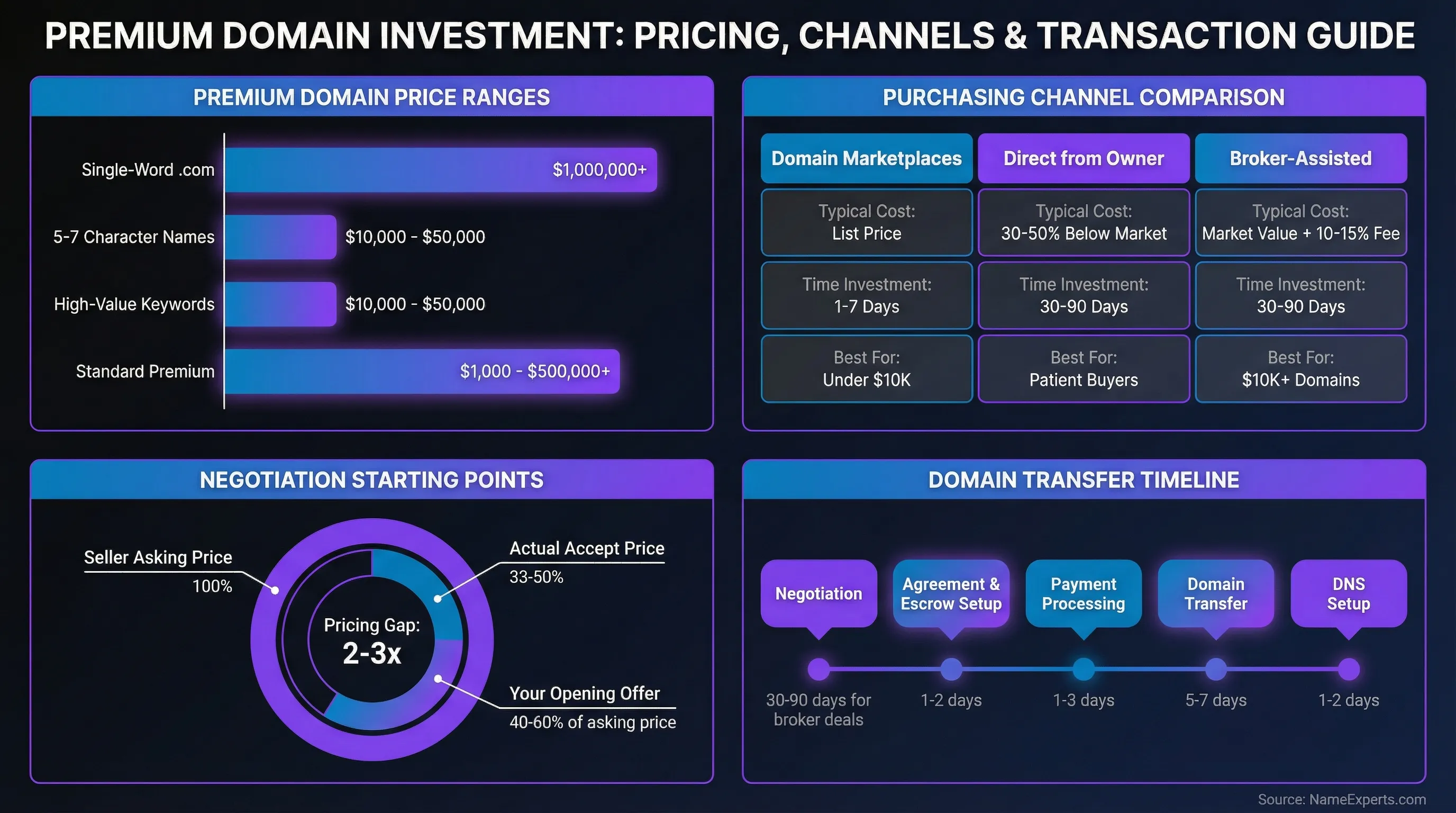
- Length: Shorter domains command higher prices. Single-word .com domains can reach six or seven figures, while 5-7 character names typically range from $10,000-$50,000
- Keywords: Exact-match domains containing high-value search terms (like "insurance," "loans," or "travel") carry inherent SEO advantages
- Extension: .com remains the gold standard, though industry-specific extensions (.tech, .ai, .io) have gained legitimacy and market value
- Memorability: Brandable names that are easy to spell and pronounce reduce marketing friction
- Traffic: Domains with existing type-in traffic or aged backlink profiles offer immediate ROI potential
- Market timing: Industry trends significantly impact pricing—AI-related domains surged in value recently while crypto domains fluctuated with market conditions

Businesses invest in these assets for credibility, brand protection, and competitive advantage. A premium domain signals legitimacy instantly—customers trust "Insurance.com" more than "GetInsuranceQuotesOnline247.net." The investment also protects your brand from competitors who might otherwise claim valuable digital real estate in your market.
Where to Buy: Your Three Main Options
Understanding your purchasing channels helps you match strategy to budget and timeline. Each approach offers distinct advantages depending on your specific situation.
| Factor | Domain Marketplaces | Direct from Owner | Broker-Assisted |
|---|---|---|---|
| Pros | Large inventory, transparent pricing, built-in escrow | Best pricing potential, no middleman fees | Expert negotiation, anonymity, market intelligence |
| Cons | Limited negotiation, higher final prices | Time-intensive, seller may be unrealistic | Broker fees (typically 10-15%) |
| Best For | Domains under $10K, quick purchases | Patient buyers with negotiation skills | High-value domains ($10K+), competitive acquisitions |
| Typical Cost | List price (minimal negotiation) | 30-50% below market if negotiated well | Market value + broker fee (often offset by better pricing) |
| Time Investment | 1-7 days | 30-90 days (often longer) | 30-90 days with expert handling |
Marketplaces work well when you need speed and the listed price fits your budget. Direct negotiations make sense if you have time and the owner's contact information is accessible. For strategic acquisitions where anonymity matters—preventing sellers from inflating prices once they know who's buying—professional domain broker representation becomes invaluable.
At NameExperts, we specialize in stealth acquisitions where revealing the buyer's identity would compromise negotiating position. Our experience with 200+ transactions gives us pricing intelligence that individual buyers simply can't access.
Don't Let Sellers Know Who's Buying
Once domain owners discover you're a serious buyer with budget, prices skyrocket. Our stealth acquisition approach keeps your identity confidential throughout negotiations, preventing the price inflation that costs companies thousands. With 200+ transactions completed, we know exactly what domains should cost—and how to get them at fair market value.
How to Evaluate Before You Buy
Due diligence separates smart investments from expensive mistakes. Follow this systematic evaluation process:
1. Check domain history and reputation
Use Archive.org to review the domain's previous content. Domains previously associated with spam, adult content, or illegal activities carry reputational baggage that can hurt your brand. Search for the domain name in trademark databases (USPTO for US markets) to identify potential legal conflicts before you invest.
2. Assess existing traffic and backlinks
Tools like Ahrefs or Moz reveal whether the domain has valuable backlinks and existing search authority. Type-in traffic (visitors who directly enter the URL) represents immediate value. However, verify that traffic is legitimate—not bot-generated or from questionable sources.
3. Verify ownership and clean title
WHOIS lookups confirm current ownership and registration details. Be wary of domains with frequent ownership changes or those registered through privacy services that make verification difficult. Ensure no liens, disputes, or pending UDRP (Uniform Domain-Name Dispute-Resolution Policy) proceedings exist.
4. Get professional appraisal for high-value domains
Algorithmic valuation tools provide rough estimates, but they can't factor in context—recent industry trends, strategic fit for your brand, or competitive dynamics. For domains above $10,000, professional domain appraisal from experienced brokers offers crucial market intelligence. We provide complimentary valuations at NameExperts for qualifying domains, drawing on real comparable sales data from our transaction history.
5. Calculate ROI potential for your specific use case
Consider how the domain will impact your marketing costs, conversion rates, and brand perception. A memorable domain that reduces customer acquisition cost by even 5% can justify a significant upfront investment. Factor in the long-term brand equity and potential appreciation in value.
Negotiation Strategies That Actually Work
Premium domain negotiations operate in what many call the "Wild West" of digital transactions. Unlike standardized markets, pricing psychology and relationship dynamics heavily influence outcomes.
Most sellers anchor their asking price 2-3x above what they'll actually accept. Your opening offer should typically land at 40-60% of the asking price for domains listed above $25,000. For lower-priced domains with "Buy Now" options, negotiation room shrinks considerably.
Effective negotiation tactics include:
- Maintain anonymity: Once sellers know you're a well-funded company, prices inflate. This is where broker representation proves valuable.
- Demonstrate serious intent: Vague inquiries get ignored. Show you're a qualified buyer ready to move quickly on fair terms.
- Use comparable sales data: Reference recent sales of similar domains to establish market-based pricing expectations.
- Be prepared to walk away: The best negotiating position is genuine willingness to pursue alternatives if pricing doesn't make business sense.
Red flags during negotiations include sellers who refuse escrow services, demand unusual payment methods, can't provide clear ownership documentation, or pressure you with artificial urgency ("another buyer is interested").
In one recent acquisition, our team saved a fintech client $45,000 on a domain initially listed at $120,000. The seller had anchored at an unrealistic price based on a single outlier sale. By presenting comprehensive comparable data and negotiating anonymously, we secured the domain at $75,000—fair market value that both parties could justify.
Avoid Expensive Mistakes with Professional Appraisal
Algorithmic tools can't tell you what a domain is really worth in today's market. Our 16+ years of transaction data and real comparable sales intelligence help you understand true market value before you commit. We provide complimentary valuations for qualifying domains—giving you the pricing intelligence individual buyers simply can't access on their own.
The Purchase Process: What to Expect Step-by-Step
Understanding the transaction mechanics reduces anxiety and helps you spot potential problems early.

1. Agreement and payment terms
Once you've agreed on price, formalize terms in writing. Specify the exact domain name, purchase price, payment method, transfer timeline, and any included assets (existing website content, social media accounts, etc.). Both parties should sign before money changes hands.
2. Secure payment methods for high-value transactions
Escrow services protect both buyer and seller. The escrow company holds your payment while the seller initiates the domain transfer. Only after you confirm receipt of the domain does the escrow release funds to the seller. Reputable escrow services charge 1-3% of the transaction value—a small price for security on five or six-figure purchases.
Never wire money directly to a seller without escrow protection, regardless of how trustworthy they seem.
3. Domain transfer procedures and timeline
The seller provides an authorization code (also called EPP code or transfer key) and unlocks the domain at their current registrar. You initiate the transfer at your chosen registrar using this code. Most transfers complete within 5-7 days, though some extensions require additional verification steps.
For marketplace purchases, expect 7-14 days from payment to complete transfer. Broker-negotiated deals typically run 30-90 days due to negotiation time, though the actual transfer process remains the same once terms are agreed.
4. Post-purchase setup
After transfer completion, update DNS settings to point the domain to your hosting provider, configure email services, and install SSL certificates. Most registrars offer straightforward interfaces for these technical steps, and hosting providers typically provide setup documentation.
Making Your Premium Domain Investment Count
The right premium domain serves as a long-term asset that appreciates alongside your brand. The key decision framework comes down to three questions: Does this domain align with your brand strategy? Can you justify the investment through reduced marketing costs or increased conversions? Do you have the expertise to negotiate effectively, or would professional representation deliver better results?
For domains valued above $10,000, or situations where competitive acquisition requires anonymity, professional brokerage services typically pay for themselves through better pricing and reduced risk. The upfront cost of expertise prevents expensive mistakes and often secures better terms than individual buyers can achieve.
Need help evaluating or acquiring a specific premium domain? NameExperts specializes in stealth acquisitions and expert negotiations for high-value domains, backed by 16+ years of experience and real market intelligence from 200+ successful transactions.
Work With a Domain Expert
Acquiring the right premium domain shouldn't mean overpaying or navigating the Wild West of domain negotiations alone. Whether you need stealth acquisition to prevent price inflation, expert negotiation backed by real market intelligence, or simply want to avoid the expensive mistakes that cost buyers thousands—we've facilitated 200+ successful transactions with a straightforward, no-bullshit approach. Get direct access to principal broker Joe Uddeme and 16+ years of domain acquisition expertise
Get Started Free







Frequently Asked Questions
You cannot permanently own a domain due to ICANN regulations, but you can maintain continuous control by renewing registration annually or setting up multi-year renewals (typically up to 10 years at a time).
A premium domain justifies its cost when it reduces customer acquisition expenses, increases conversion rates, or provides significant brand credibility—typically delivering ROI for businesses where the domain is central to their marketing strategy and online presence.
GoDaddy doesn't own most premium domains listed on their platform—these are aftermarket names owned by individual sellers who set their own prices, with GoDaddy facilitating the transaction and transfer process.
Domain flipping is completely legal as long as you're not infringing on trademarks or engaging in cybersquatting (registering trademarked names in bad faith to profit from someone else's brand).