
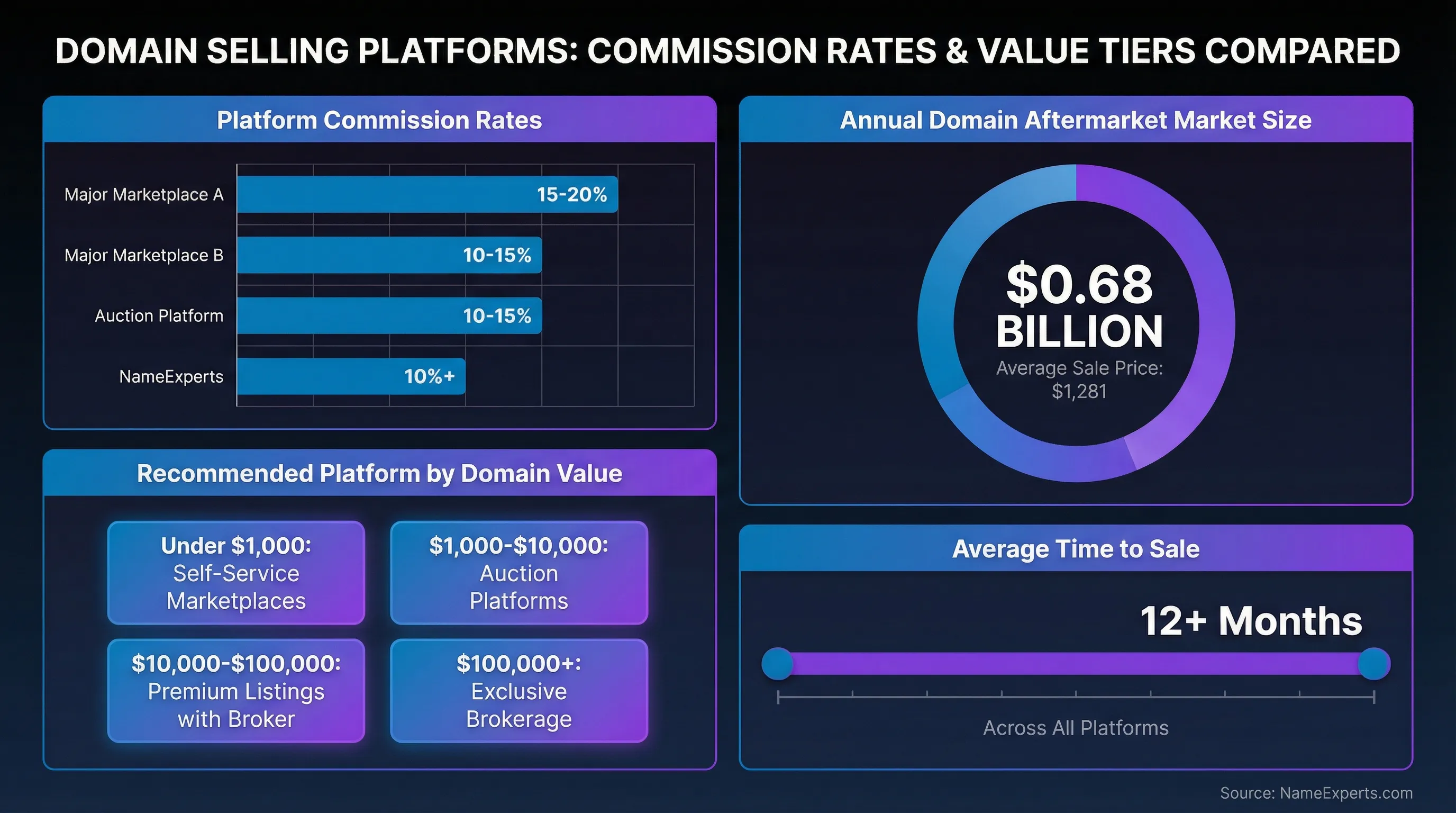
Finding the right venue to sell your domain can mean the difference between a quick sale at fair value and months of frustration with lowball offers. The domain aftermarket generates approximately $0.68 billion annually, with average sale prices around $1,281 according to industry research. Yet most sellers struggle to navigate the fragmented marketplace of self-service platforms, auction sites, and brokerage services. This guide cuts through the noise with objective platform comparisons, decision frameworks based on domain value, and strategies that actually work.
Key Takeaways
- Commission structures range from 10-25% across major platforms, but distribution reach matters more than fees alone
- Premium domains ($10,000+) typically benefit from professional brokerage and negotiation expertise
- Self-service marketplaces work best for domains under $5,000 with clear commercial appeal
- Average time-to-sale spans 12+ months across platforms; pricing strategy significantly impacts velocity
- Always use escrow protection regardless of platform to secure both payment and transfer
Top Domain Selling Platforms Compared
The domain marketplace landscape splits into three categories: self-service marketplaces, auction platforms, and professional brokerage services. Each serves different seller needs based on domain value, desired involvement level, and timeline expectations.
Self-service marketplaces offer the widest distribution networks. When you list on these platforms, your domain appears across dozens of partner registrars through syndication agreements. This exposure translates to more buyer eyeballs, though you'll handle negotiations yourself.
Auction platforms create competitive bidding environments that can drive prices higher than fixed listings. They work particularly well for domains with multiple interested parties or those in trending niches. The time-bound nature of auctions also creates urgency that static listings lack.
Professional brokerage services provide white-glove representation for high-value assets. Brokers actively identify qualified buyers, manage complex negotiations, and coordinate legal aspects of the transfer. This hands-on approach commands higher commissions but typically delivers superior results for premium inventory.
| Platform Type | Commission Rate | Best For | Key Advantage | Distribution Reach |
|---|---|---|---|---|
| Major Marketplace A | 15-20% | Volume sellers | Wide distribution network | Extensive partner network |
| Major Marketplace B | 10-15% | Premium .com domains | International buyers | Global marketplace |
| Auction Platform | 10-15% | Tech/startup audience | Built-in analytics | Active buyer base |
| NameExperts | Custom (10%+) | $10K+ domains | Expert negotiation | Targeted outreach |
Distribution Networks Drive Visibility
The most successful platforms leverage partnerships with major registrars to syndicate listings. When you list through these networks, your domain automatically appears on partner sites where buyers already search. This passive distribution eliminates the need to manually post across multiple venues.
According to marketplace analysis, platforms with extensive distribution networks sell domains up to three times faster than isolated listings. Major distribution networks connect sellers with buyers across dozens of registrars, creating a multiplier effect on exposure.
Commission Structures and Hidden Fees
Understanding fee structures prevents surprises at closing. Most platforms charge percentage-based commissions on successful sales, but the details vary significantly. Some charge sellers, others charge buyers, and a few split fees between both parties.
Seller-paid models typically range from 10-20% of the sale price. Buyer-paid structures shift the commission burden entirely to the purchaser, which can be attractive for sellers but may reduce buyer interest due to higher total costs. According to industry data, commission rates vary from 10% on some platforms to 25% on others.
Beyond commissions, watch for listing fees, featured placement costs, and renewal charges. Some platforms charge upfront to list domains in auctions, while others only collect fees on successful transactions. Calculate your net proceeds before committing to any venue.
Choosing the Right Platform for Your Domain
Domain value serves as the primary decision factor when selecting a selling venue. A $500 domain requires a different approach than a $50,000 asset. The approach that works for one won't necessarily suit the other.
Decision Framework by Domain Value
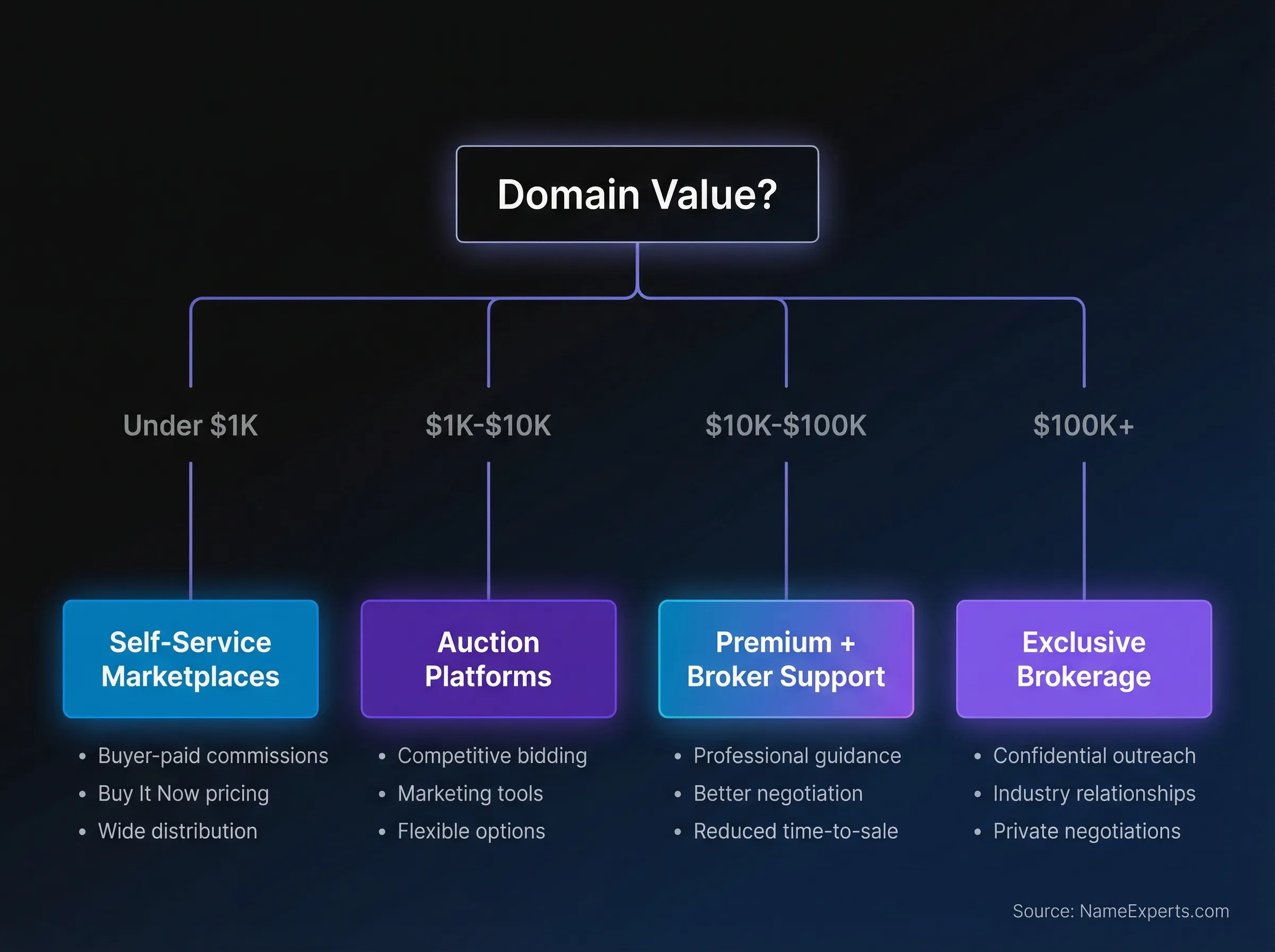
Under $1,000: Self-service marketplaces with buyer-paid commission models offer the best fit. These platforms provide sufficient exposure without eating into already-thin margins. List with clear Buy It Now pricing to eliminate negotiation friction and accelerate sales.
$1,000-$10,000: Auction platforms with marketing tools deliver optimal results in this range. The competitive bidding environment can push prices above your initial expectations, while built-in promotion features increase visibility. Consider platforms that offer both auction and fixed-price options for flexibility.
$10,000-$100,000: Premium listings with broker support become worthwhile at this tier. Professional guidance helps position your asset correctly and identify serious buyers. The higher commissions pay for themselves through better negotiation outcomes and reduced time-to-sale.
$100,000+: Exclusive brokerage with confidential outreach is essential for six-figure domains. At this level, deals happen through private negotiations rather than public listings. Experienced brokers like those at NameExperts leverage industry relationships to connect with qualified buyers who have the capital and motivation to close quickly.
Portfolio Size Considerations
Managing dozens or hundreds of domains requires different tools than selling a single asset. Bulk listing capabilities, portfolio analytics, and automated pricing updates become critical for volume sellers. Platforms that offer these features save hours of administrative work.
For small portfolios (under 20 domains), manual management remains practical. You can optimize each listing individually and respond personally to inquiries. This hands-on approach often yields better results than automated systems for quality assets.
Large portfolios (100+ domains) benefit from platforms with robust management dashboards. Look for bulk import tools, automated renewal management, and performance analytics that identify which assets deserve more marketing investment versus which should be dropped.
Domain Quality Indicators
Not all domains warrant premium selling efforts. Quality indicators help determine appropriate pricing and platform selection. Short, memorable domains with clear commercial applications command higher prices and justify more expensive selling venues.
Length matters significantly. Single-word .com domains represent the gold standard, followed by two-word combinations. Domains exceeding three words face steeper selling challenges unless they perfectly match a specific business need.
Keyword relevance drives value in commercial domains. Assets containing high-value search terms or industry-specific language attract buyers more readily than invented words or obscure combinations. Research keyword search volume and commercial intent before setting expectations.
Extension choice impacts marketability dramatically. .com domains dominate aftermarket transactions and command premium prices. Alternative extensions like .net, .org, or newer TLDs require more aggressive pricing to move.
Selling a Premium Domain? Get Expert Guidance
If you're sitting on a domain valued at $10,000 or more, the platform you choose is just the beginning—expert negotiation and targeted buyer outreach can increase your final sale price by 20-30%. Talk to an experienced domain broker to discover how professional representation maximizes your domain's value without the months of frustration that come with self-service listings.
When to Use a Domain Broker Instead
Professional brokerage makes sense in specific scenarios where expertise and relationships deliver measurably better outcomes than self-service approaches. Understanding when to engage a broker versus handling the sale yourself maximizes your net proceeds.
High-Value Asset Positioning
Premium domains requiring strategic market positioning benefit enormously from broker expertise. These assets need more than passive listings—they require active buyer identification and sophisticated positioning that highlights their unique value proposition.
Brokers bring market intelligence that individual sellers lack. With 16+ years of experience and 200+ completed transactions, NameExperts understands which industries are actively acquiring domains, what buyers will pay, and how to frame assets to maximize perceived value. This knowledge directly impacts final sale prices.
Consider a fintech startup seeking a premium domain. A broker with industry connections can identify the opportunity before it becomes public knowledge, approach the company with a tailored pitch, and negotiate terms that reflect the domain's strategic value to that specific buyer. Self-service listings miss these opportunities entirely.
Complex Negotiation Scenarios
Negotiations involving payment terms, asset exchanges, or multi-party transactions require professional mediation. Brokers navigate these complexities daily, understanding how to structure deals that satisfy all parties while protecting your interests.
Payment terms negotiations often make or break high-value deals. Few buyers have $75,000 in liquid capital, but many can structure payments over time. Brokers facilitate these arrangements with proper security measures, ensuring you receive full payment while allowing buyers to spread costs.
Asset exchanges add another layer of complexity. Sometimes buyers offer domains, websites, or other digital assets as partial payment. Evaluating these offers and structuring fair exchanges demands expertise that most sellers lack. Professional brokers assess the true value of offered assets and negotiate terms that protect your position.
Confidentiality Requirements
Portfolio liquidation with privacy concerns necessitates broker involvement. Public listings reveal your holdings to competitors and can trigger unwanted attention. Brokers conduct confidential outreach that keeps your identity and portfolio details private until serious negotiations begin.
Trademark considerations also warrant professional guidance. Domains containing brand names or potentially infringing terms require careful handling to avoid legal complications. Experienced brokers understand these risks and structure transactions that protect you from future liability.
Cost-Benefit Analysis
Broker commissions typically start at 10% for high-value domains, compared to 15-20% on self-service platforms. While the percentage may seem similar, the absolute difference on a $50,000 sale is substantial. More importantly, brokers often secure prices 20-30% higher than self-service listings, more than offsetting their fees.
Time investment represents another cost factor. Self-service selling demands hours of listing optimization, inquiry responses, and negotiation. For busy professionals, the opportunity cost of this time often exceeds broker fees. Delegating the process to experts frees you to focus on higher-value activities.
NameExperts offers personalized brokerage services for domains valued at $10,000 and above. Our team handles buyer outreach, negotiation, and transfer coordination, leveraging relationships with major brands like HBO/Max.com, Monday.com, and TripAdvisor. For sellers prioritizing maximum price over speed, professional representation delivers measurably better outcomes.
Pricing and Listing Optimization Strategies
Strategic pricing dramatically impacts both sale probability and final proceeds. Set prices too high and your domain languishes unsold; price too low and you leave money on the table. Finding the optimal point requires market research and psychological understanding.

Competitive Analysis Using Historical Data
Research comparable sales before setting your price. Historical transaction databases provide data showing what similar domains actually sold for, not just asking prices. This reality check prevents both overpricing and undervaluation.
Filter comparables by extension, length, and keyword similarity. A three-word .com domain shouldn't be priced based on single-word sales. Look for the closest matches in terms of commercial appeal, search volume, and industry relevance.
According to market analysis, secondary market transactions show significant variation in pricing based on domain quality and market conditions. Use industry benchmarks as starting points, then adjust based on your domain's specific attributes.
Pricing Format Selection
Buy It Now pricing eliminates negotiation friction for buyers who value certainty. Fixed prices work particularly well for domains under $5,000 where buyers make quick decisions without extensive deliberation. The clarity reduces hesitation and accelerates transactions.
Make Offer listings invite negotiation, which can work in your favor for unique domains without clear comparables. This approach lets the market determine value through actual buyer interest rather than your assumptions. However, it also attracts lowball offers that waste time.
Auction formats create competitive pressure that can drive prices above fixed listings. When multiple buyers want the same domain, bidding wars emerge. This works best for trending niches or domains with obvious commercial applications that attract multiple interested parties.
Charm pricing psychology applies to domains just as it does to consumer products. Pricing at $1,995 instead of $2,000 creates the perception of a better deal, even though the difference is negligible. This small adjustment can reduce buyer hesitation at critical price points.
Listing Best Practices
WHOIS privacy creates a paradox for sellers. While it protects you from spam, it also blocks potential buyers from contacting you directly. Consider temporarily disabling privacy for domains actively listed for sale, or use a dedicated sales email address in your WHOIS data.
Landing page optimization significantly impacts conversion rates. Professional templates that clearly display your asking price, contact information, and a compelling description outperform generic parking pages. According to platform data, domains with optimized sales landers sell up to three times faster than those without.
Description quality matters more than most sellers realize. Avoid generic copy that could apply to any domain. Instead, highlight specific use cases, keyword search volumes, or industry trends that make your domain valuable. Concrete details build buyer confidence and justify your asking price.
Cross-platform listing strategies maximize exposure without creating conflicts. Many platforms allow simultaneous listings, though you must remove them promptly after sale to avoid double-selling. Distribution networks that syndicate your listing across partner sites provide this exposure automatically.
Security and Transfer Considerations
Escrow services protect both parties during the transaction. According to industry standards, reputable escrow providers charge percentage-based fees that vary by transaction size. This fee eliminates fraud risk and ensures proper transfer procedures.
The escrow process follows a standard sequence: buyer pays escrow, seller transfers the domain, buyer verifies receipt, escrow releases payment to seller. This typically takes 3-7 business days. Never transfer ownership before payment clears through escrow, regardless of buyer promises or urgency claims.
Domain transfer procedures vary by registrar but generally require an authorization code and confirmation from both parties. Familiarize yourself with your registrar's specific process before listing to avoid delays when a buyer appears. Quick transfers improve buyer satisfaction and reduce deal-killing friction.
Maximizing Your Domain Sale Success
Successful domain sales combine the right platform selection with strategic pricing and professional presentation. Start by honestly assessing your domain's value using comparable sales data and quality indicators like length, keywords, and extension. This reality check prevents wasted time on overpriced listings.
For domains under $10,000, self-service marketplaces with strong distribution networks offer the best balance of exposure and cost-efficiency. List with clear Buy It Now pricing on platforms that syndicate to partner registrars, maximizing your passive reach to qualified buyers.
Premium domains above $10,000 warrant professional brokerage consideration. The expertise and industry relationships that brokers bring typically result in higher sale prices that more than offset their commissions. NameExperts specializes in this tier, offering personalized representation backed by 16+ years of experience and proven results with major brands.
Regardless of platform choice, always use escrow services to protect the transaction. The fee provides essential security for both parties and ensures proper transfer procedures. Optimize your listings with professional landing pages, compelling descriptions, and strategic pricing based on market data rather than wishful thinking.
Patience remains critical throughout the process. Average time-to-sale spans 12+ months across platforms, with quality domains at fair prices selling faster than overpriced inventory. Monitor your listings, respond promptly to inquiries, and adjust pricing based on market feedback. The domain aftermarket rewards sellers who combine realistic expectations with professional execution.
Ready to sell your premium domain? Contact NameExperts for a confidential portfolio evaluation and discover how professional brokerage can maximize your domain's value.
Not Sure What Your Domain Is Really Worth?
Pricing too high means your domain sits unsold for months; pricing too low means leaving thousands on the table. Instead of guessing based on outdated comparables, get a professional domain appraisal from brokers who've completed 200+ transactions and know exactly what buyers in your industry are paying right now.
Ready to Sell Your Premium Domain the Right Way?
You've learned the platforms, pricing strategies, and decision frameworks—now it's time to execute. For domains valued at $10,000 and above, professional brokerage consistently delivers higher sale prices through expert negotiation, confidential buyer outreach, and industry relationships that self-service platforms simply can't match. With 16+ years of experience and proven results with major brands like HBO/Max.com and Monday.com, NameExperts brings the no-bullshit approach and personalized ser
Request a confidential portfolio evaluation







Frequently Asked Questions
The optimal venue depends on your domain's value: self-service marketplaces like Afternic work best for assets under $10,000, while premium domains above that threshold benefit from professional brokerage services that deliver higher sale prices through expert negotiation and targeted buyer outreach.
Set a competitive Buy It Now price based on comparable sales data and list on platforms with extensive distribution networks that syndicate your listing across partner registrars, eliminating negotiation delays while maximizing exposure to active buyers.
Domain flipping is completely legal, though purchasing domains that infringe on existing trademarks (cybersquatting) violates the Anticybersquatting Consumer Protection Act and can result in legal penalties and forced transfer of the asset.
Quality domains with clear commercial appeal regularly sell for $1,000-$10,000+, making it worthwhile if you own premium assets, though average time-to-sale spans 12+ months and success requires realistic pricing based on market data rather than speculative valuations.


