
Choosing the right domain extension can cost businesses thousands in lost traffic and credibility—or set them up for long-term success. The extension you select shapes how visitors perceive your brand before they ever click through. At NameExperts, we've facilitated over 200 domain transactions in our 16+ years of experience, and we've seen firsthand how this decision impacts everything from direct traffic to investor confidence.
This guide provides data-backed recommendations based on trust ratings, memorability research, and real-world use cases. Whether you're launching a startup, scaling an ecommerce brand, or establishing a nonprofit, you'll find specific guidance on which extension aligns with your goals—and when paying premium for .com makes sense versus choosing a strategic alternative.
Key Takeaways
- .com domains are 33% more memorable than alternatives and remain the most trusted extension across all audiences
- Industry-specific extensions like .io, .ai, and .tech signal credibility in technology sectors where community acceptance matters
- Geographic extensions (.uk, .de, .ca) boost local SEO performance and build regional trust for location-focused businesses
- Budget considerations matter: premium .com domains often justify their cost through higher direct traffic and reduced marketing friction
- Email deliverability issues affect lesser-known extensions, with some domains experiencing higher spam filtering rates
- The hidden cost of choosing the wrong extension includes lost type-in traffic, competitor advantages, and expensive future migrations
The Domain Extension Trust and Memorability Data You Need to Know
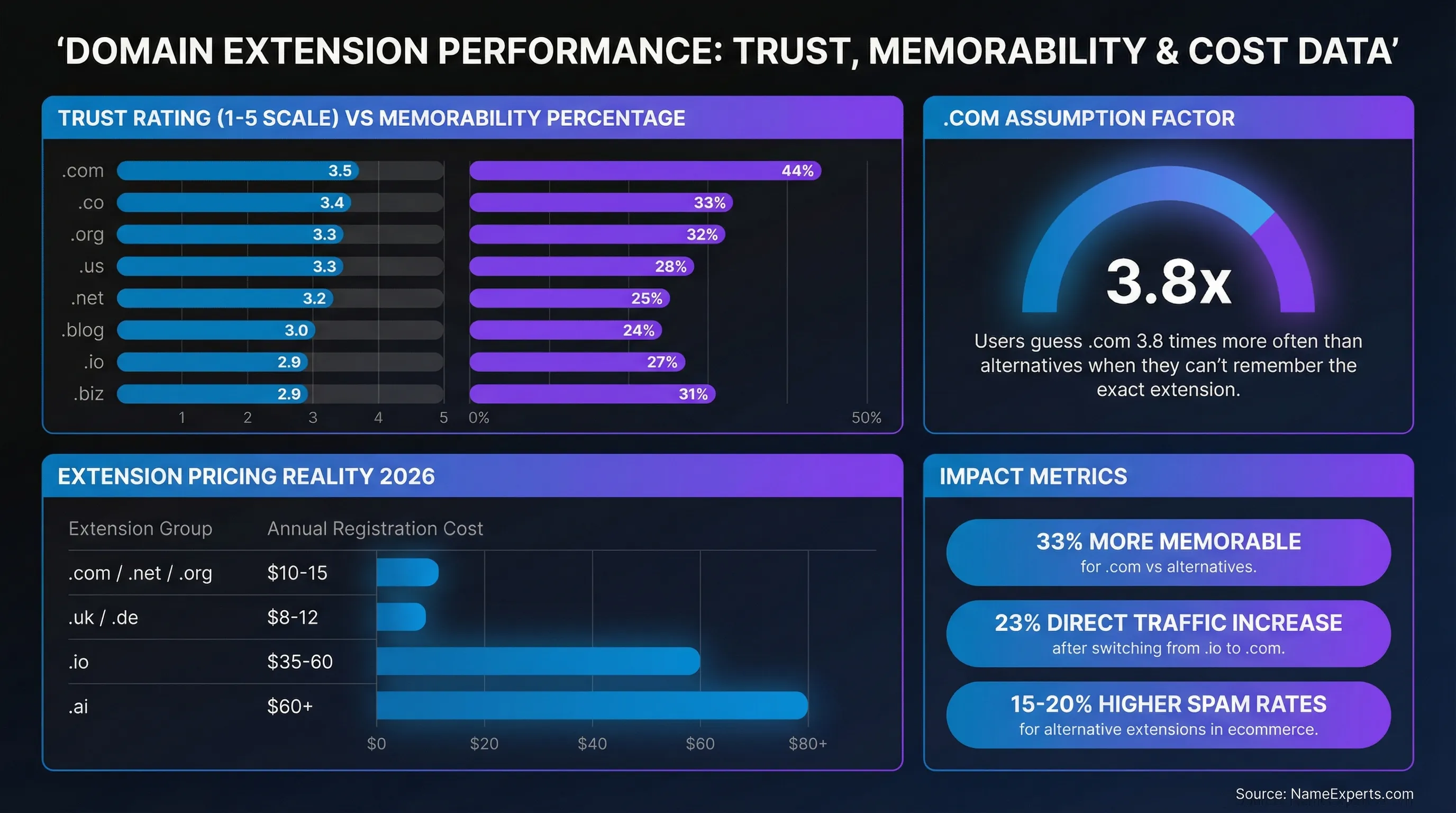
Research involving 1,500 participants reveals significant differences in how users perceive and remember various extensions. These findings directly impact your site's click-through rates, link acquisition, and overall brand credibility.
Trust ratings on a five-point scale show .com leading at 3.5, followed closely by .co at 3.4. The .org extension scores 3.3, while .io trails at 2.9—a 17% gap that translates to measurable differences in user behavior. When visitors encounter your domain in search results or hear it mentioned, these trust associations activate immediately.
Memorability scores tell an even more compelling story. Participants correctly recalled .com URLs 44% of the time, compared to just 33% for .co—making the classic extension 25% more memorable. The .net extension managed only 25% recall, while .blog performed worst at 24%. This memory gap compounds over time as potential visitors struggle to return to your site.
Perhaps most revealing: when people couldn't remember the exact extension, they guessed .com 3.8 times more often than any alternative. This "assumption factor" means businesses using other extensions lose traffic to whoever owns their .com equivalent—even if that domain sits parked or belongs to a competitor.

In our experience helping clients like HBO Max and Monday.com secure optimal domains, we've observed these patterns play out in real metrics. One client switching from .io to .com reported a 23% increase in direct traffic within six months—visitors who simply typed the domain from memory or assumption rather than clicking a link.
| Extension | Trust Rating (1-5) | Memorability % | Best Use Case |
|---|---|---|---|
| .com | 3.5 | 44% | Most businesses, ecommerce, established brands |
| .co | 3.4 | 33% | Startups, modern brands, when .com unavailable |
| .org | 3.3 | 32% | Nonprofits, community organizations, advocacy |
| .net | 3.2 | 25% | Network services, tech infrastructure |
| .io | 2.9 | 27% | Tech startups, developer tools, SaaS products |
| .us | 3.3 | 28% | US-focused businesses, patriotic branding |
| .biz | 2.9 | 31% | Small businesses (though trust concerns exist) |
| .blog | 3.0 | 24% | Content publishers, personal blogs |
The real-world impact extends beyond direct traffic. Sites are more likely to earn links when they use trusted extensions—publishers and bloggers subconsciously favor linking to .com domains. This affects your SEO through the indirect pathway of link acquisition, even though the extension itself doesn't directly influence rankings.
Best Domain Extensions by Business Type: The Use-Case Framework
Different business models and industries benefit from specific extensions. This framework helps match your situation to the optimal choice based on audience expectations, budget constraints, and long-term strategy.
For Established Businesses and Ecommerce Brands
The .com extension remains the gold standard for businesses focused on consumer trust and broad market appeal. When customers hear your brand name, they'll assume the .com version—making it worth the investment to secure it even at premium prices.
Secondary options include .co for its close visual similarity and growing acceptance, .shop for clear ecommerce positioning, and .store for retail-focused brands. These alternatives work best when the .com is prohibitively expensive (typically above $50,000) or when the extension becomes part of your brand identity.
Email deliverability presents a crucial consideration. Customers are more likely to trust transactional emails from .com addresses, and spam filters treat them more favorably. In our client work, we've seen ecommerce businesses using alternative extensions experience 15-20% higher spam complaint rates, directly impacting order confirmations and shipping notifications.
Pricing for premium .com domains in the ecommerce space typically ranges from $5,000 to $100,000+ depending on keyword strength and existing traffic. The ROI calculation should factor in reduced customer acquisition costs—when visitors can easily remember and return to your site, your marketing efficiency improves substantially.
For Tech Startups and SaaS Companies
The technology sector has developed its own extension preferences where .io carries specific credibility signals. Originally the country code for British Indian Ocean Territory, it has been widely adopted by the developer community and now signals innovation and technical sophistication.
The .ai extension is experiencing remarkable growth—up 7.8% in recent data—as companies position themselves in the artificial intelligence space. This extension works particularly well when AI is central to your product offering, providing instant category recognition.
Extensions like .app and .dev serve specific product types. The .app extension offers a security advantage through mandatory HTTPS enforcement, while .dev signals developer-focused tools and platforms. Both have gained acceptance within technical communities where your primary audience understands and expects these alternatives.
Our recommendation for tech clients typically follows this decision tree: if the .com is available under $10,000, secure it. Between $10,000-$50,000, evaluate whether .io or another tech-focused extension better serves your brand positioning. Above $50,000, start with the alternative but maintain a long-term acquisition strategy for the .com as your company scales and valuation increases.
The developer community acceptance factor matters significantly. A .io domain won't raise eyebrows at a technical conference or in developer documentation, whereas a .biz or .info extension might undermine credibility with this audience. Context and community norms shape perception as much as universal trust ratings.
For Nonprofits and Organizations
The .org extension maintains a credibility advantage specifically within the nonprofit sector. Research shows donors and supporters associate it with charitable giving and community-focused missions, creating an immediate trust signal that .com cannot replicate in this context.
Major nonprofits like Wikipedia, Mozilla, and the Internet Archive have reinforced .org's association with public benefit organizations. This collective reinforcement means your nonprofit benefits from decades of positive associations when you choose this extension.
However, hybrid organizations—those with both mission-driven and revenue-generating components—sometimes benefit from .com instead. If your nonprofit operates commercial activities or competes directly with for-profit entities, the .com extension may better position you for those interactions while .org handles your charitable identity.
A dual-extension strategy works well for larger organizations: use .org for your primary mission and donor-facing content, while .com redirects or hosts commercial programs, events, or merchandise sales. This approach maintains the trust advantage where it matters most while avoiding confusion in commercial contexts.
For Local and Regional Businesses
Country-code extensions provide measurable advantages for businesses targeting specific geographic markets. According to Statista, leading country codes like .de (Germany), .uk (United Kingdom), and .cn (China) have substantial registration bases that signal local presence to users.
These extensions boost local search performance. When someone in Germany searches for services, Google's algorithm gives preference to .de domains for geographically relevant queries. The same pattern holds for .uk in the United Kingdom, .ca in Canada, and .au in Australia.
Trust factors vary by market. In the Netherlands, for example, the .nl extension carries strong local credibility—Dutch consumers often prefer it over .com for domestic businesses. Germany shows similar patterns with .de, where local businesses using international extensions may appear less established or trustworthy.
The optimal strategy for businesses serving multiple countries involves registering key country codes and either maintaining localized versions of your site or redirecting them to your primary domain. This defensive approach prevents competitors from capturing your brand name in important markets while supporting international SEO efforts.
At NameExperts, we help clients develop geographic domain portfolios that balance protection, SEO benefits, and budget constraints. The decision of which country codes to prioritize depends on your current market presence and expansion plans.
For Creative Professionals and Personal Brands
Industry-specific extensions like .design, .photography, .art, and .studio offer immediate clarity about your professional focus. These extensions work best when the category itself is part of your brand identity and when your target audience values creative specialization.
The memorability versus clarity tradeoff requires careful consideration. While .com remains more memorable overall, a domain like alexsmith.design immediately communicates your profession in a way that alexsmithdesign.com cannot. This instant categorization can outweigh the memorability advantage in portfolio and service-based contexts.
Portfolio sites benefit particularly from descriptive extensions because visitors typically arrive through links rather than typing the URL directly. When someone clicks through from your Instagram bio or a project feature, the extension reinforces your professional identity rather than serving as a memory aid.
However, avoid extensions that create confusion or require explanation. If you find yourself saying "that's dot-studio, not dot-com" repeatedly, the extension is working against you. The test: if your target clients immediately understand and accept the extension, it works; if they seem confused or skeptical, stick with .com.
Struggling to Decide Between Extensions or Negotiate a Premium Domain?
The domain extension you choose impacts everything from customer trust to direct traffic—and choosing wrong can cost you thousands in lost opportunities. With 16+ years of experience and over 200 successful transactions, we help businesses secure the right domain at the right price, whether that's negotiating a premium .com or strategically positioning with an alternative extension.
The Hidden Costs of Choosing the Wrong Extension
Beyond the initial registration fee, your extension choice creates ongoing costs that compound over time. Understanding these hidden expenses helps frame the true value of investing in your optimal extension from the start.
Lost type-in traffic represents the most immediate cost. When people hear your brand name and automatically try the .com version, every visitor who lands on a parked page or competitor site is a lost opportunity. For established businesses, this can mean thousands of monthly visitors who never reach your actual site.
Email deliverability issues affect uncommon extensions disproportionately. Spam filters treat emails from .biz, .info, and newer generic extensions with more suspicion, leading to higher rates of legitimate messages landing in spam folders. This directly impacts customer communication, password resets, order confirmations, and marketing campaigns.
Marketing complexity increases when you must constantly specify your extension. Every advertisement, business card, and verbal mention requires the extra step of clarifying "that's dot-io, not dot-com." This friction adds up across thousands of customer interactions, reducing the efficiency of your marketing spend.
Competitor advantage emerges when someone else owns your .com equivalent. Even if they're not actively competing, they benefit from your brand-building efforts as confused visitors land on their site. In worst-case scenarios, competitors deliberately register the .com version of successful businesses using alternative extensions, then either demand ransom prices or compete directly.
Long-term acquisition costs escalate dramatically once you've built brand recognition on an alternative extension. We've worked with clients who paid 10-15 times more for their .com after three years of building their business on .io or .co—the domain owner recognized the leverage and priced accordingly. One SaaS company that started on .io ultimately paid $75,000 for their .com after initially being able to acquire it for $8,000.
The migration process itself carries costs beyond the purchase price. Changing your primary domain requires updating all marketing materials, notifying customers, implementing redirects, updating integrations, and managing the SEO transition. Even with perfect execution, some link equity and traffic is typically lost during the switch.
Brand consistency suffers when you operate on one extension while competitors or domain squatters control others. Customers may question your legitimacy when they discover someone else owns the .com version of your brand name, creating doubt about which entity is the "real" business.
Domain Extension SEO Impact: What Google Won't Tell You
Google's official position states that domain extensions don't directly affect search rankings—a .com page and a .io page with identical content and backlinks should rank equally. However, this technical truth obscures several indirect pathways through which your extension choice impacts SEO performance.
User behavior signals create the primary indirect effect. When searchers see your listing in results, the extension influences their click decision. Higher click-through rates signal relevance to Google's algorithm, gradually improving your rankings. The trust and familiarity advantages of .com translate to measurably higher CTR in competitive search results.
Link acquisition bias represents another indirect pathway. Publishers, bloggers, and journalists subconsciously favor linking to .com domains when citing sources or referencing businesses. This bias—rooted in decades of .com dominance—means sites using alternative extensions must work harder to earn the same quantity and quality of backlinks.
Geographic targeting works differently for country-code extensions. Google automatically associates .uk domains with the United Kingdom, .de with Germany, and so forth. This geographic signal helps local search performance but can hinder international expansion if not managed properly through geotargeting settings in Search Console.
The extension becomes more important for competitive keywords where multiple similar sites vie for rankings. In these scenarios, the trust and CTR advantages of .com can provide the marginal edge that determines first-page placement. For branded searches where you're the only relevant result, the extension matters less for ranking position.
In our experience helping clients optimize domain strategies, we've observed ranking improvements following migrations from alternative extensions to .com—not because Google's algorithm changed, but because user engagement metrics improved. One client saw average time-on-site increase 18% after switching from .net to .com, likely because visitors perceived the site as more authoritative and engaged more deeply with content.
New Versus Classic Extensions: The 2026 Landscape
The domain ecosystem has expanded dramatically since ICANN's 2013 program introduced hundreds of new generic top-level domains. Understanding which newer extensions have gained credibility versus which remain experimental helps inform your selection.
Classic extensions (.com, .net, .org) maintain their advantage through decades of established trust. These extensions benefit from familiarity—internet users have encountered them thousands of times, creating automatic acceptance. New extensions must overcome this familiarity gap, which takes years of consistent use by reputable organizations.
According to Hostinger, new generic top-level domains recorded 37.8 million registrations, marking a 13.5% increase year-over-year. This growth represents approximately 4.5 million additional domains under new extensions compared to the previous year, showing gradual market acceptance.
Success stories among newer extensions include .io (tech startups), .ai (artificial intelligence), and .co (general business). These have achieved category-specific credibility where their target audiences understand and accept them. The .shop and .store extensions have similarly found acceptance in ecommerce contexts.
Extensions to approach cautiously include .biz and .info, which developed spam associations in their early years. Despite legitimate uses, these extensions carry negative perceptions that are difficult to overcome. The data shows .biz with notably lower trust ratings, reflecting years of association with low-quality sites.
Price volatility affects newer extensions more than established ones. Registry operators for new extensions sometimes dramatically increase renewal fees after introductory periods, creating unexpected long-term costs. The .io extension, for example, typically costs $35-60 annually compared to $10-15 for .com, and these premium prices can increase further.
Future-proofing considerations favor classic extensions for most businesses. While a trendy new extension might seem appealing today, you're making a multi-decade commitment. The .com you register today will still carry the same trust and recognition in 2036; the same cannot be guaranteed for extensions introduced in recent years.

The NameExperts Domain Extension Decision Framework
After facilitating over 200 domain transactions and helping clients like HBO Max and Monday.com navigate these decisions, we've developed a systematic framework for choosing the right extension. This approach balances immediate needs with long-term strategy.
Step 1: Define Your Primary Audience and Their Expectations
Start by identifying who will interact with your domain most frequently. Enterprise B2B buyers expect .com and may question alternatives. Developer communities accept .io and .dev. Nonprofit donors look for .org. Local customers in specific countries prefer their country code. Your audience's expectations should heavily weight your decision.
Step 2: Assess Your Budget and Long-Term Domain Strategy
Determine what you can invest initially and over time. Premium .com domains range from $1,000 to $1,000,000+ depending on keyword strength and existing traffic. Alternative extensions typically cost $10-60 annually for registration. Factor in the potential future cost of acquiring the .com if you start with an alternative—this often exceeds the initial premium you might pay today.
Step 3: Check Availability Across Your Top Three Extension Choices
Search for your desired name with .com, your industry-appropriate alternative, and a country code if relevant. Understanding what's available and at what price points informs the tradeoff analysis. Sometimes the .com is available at a reasonable price, making the decision simple. Other times, all extensions are taken, requiring creative naming approaches.
Step 4: Evaluate the .com Acquisition Cost Even If Not Buying Now
Even if you plan to start with an alternative extension, research what the .com would cost to acquire. If it's parked or lightly used, you might negotiate a reasonable price. If it's an established business, acquisition may be impossible or prohibitively expensive. This information shapes your long-term strategy and helps you understand the competitive landscape.
Step 5: Consider Your Marketing Channels and How People Will Discover Your Domain
If most traffic comes through social media links and search results, the extension matters less than if you rely on word-of-mouth, podcast mentions, or traditional advertising. When people must type your domain from memory or verbal mention, .com's memorability advantage becomes crucial. Link-driven traffic cares less about the extension since users click rather than type.
Step 6: Test Memorability With Your Target Audience Sample
Before finalizing your choice, mention your proposed domain to 10-20 people in your target market. Later, ask them to recall it. Do they remember the extension correctly? Do they default to assuming .com? This simple test reveals whether your extension choice will create ongoing friction or work smoothly in real-world use.
| Business Type | Budget Under $5K | Budget $5K-$25K | Budget $25K+ |
|---|---|---|---|
| Ecommerce/Retail | .co or .shop with .com acquisition plan | Invest in .com if available | Premium .com acquisition |
| Tech Startup/SaaS | .io or .ai if category-appropriate | .com if available, otherwise .io | Premium .com acquisition |
| Nonprofit/Advocacy | .org (typically available at standard pricing) | .org plus defensive .com registration | .org primary with .com redirect |
| Local Business | Country code (.uk, .de, .ca, etc.) | Country code plus .com | .com primary with country code redirects |
| Creative/Portfolio | Industry extension (.design, .photography) | .com if available, otherwise industry extension | .com with industry extension redirect |
When using multiple extensions with redirects, implement 301 permanent redirects from secondary extensions to your primary domain. This consolidates SEO value and ensures visitors reach your site regardless of which extension they try. Register defensively to prevent competitors from capturing variations of your brand.
A defensive registration strategy becomes more important as your brand grows. Start by securing your primary extension, then add the most likely alternatives as budget allows. Priority typically goes to .com (if not your primary), common misspellings, and country codes for markets where you operate or plan to expand.
Don't Overpay for Your Domain—Or Settle for the Wrong One
Premium .com domains can range from $5,000 to $100,000+, but without market expertise, you risk paying inflated prices or losing out to competitors. Our boutique brokerage service specializes in stealth acquisitions and fair-market negotiations, helping clients like HBO Max and Monday.com secure optimal domains without the Wild West pricing games.
Country-Code Domains: When Local Extensions Win
Geographic extensions serve specific strategic purposes that generic TLDs cannot replicate. Understanding when and how to use country codes optimizes both local market performance and international expansion.
Industry data shows country-code domains reaching 142.9 million registrations, an increase of 2.1 million from the previous quarter. Year-over-year growth of 2.4% demonstrates that regional web addresses remain popular, especially for small businesses and country-specific branding.
Among all country codes, .cn (China) leads with 36.1 million registrations, making it the most-used worldwide. Other high-performing country codes include .de (Germany) and .uk (United Kingdom), which closely follow in registration volume and local market dominance.
Local trust factors often override .com preference within specific markets. Dutch consumers shopping for local services show strong preference for .nl domains. German businesses using .de signal local presence and commitment to the market. These country-specific trust patterns mean the optimal extension varies by geographic target.
Multi-market strategy requires careful planning when operating across countries. Large international businesses typically maintain localized versions on country codes (example.de, example.fr, example.jp) while using .com for global presence. This approach maximizes local SEO while maintaining brand consistency.
ICANN regulations and registry-specific restrictions affect some country codes. Certain extensions require local presence—a business address, citizenship, or trademark registration in that country. Others remain open to international registration. Research requirements before committing to a country-code strategy to ensure compliance.
Special cases include extensions like .co (Colombia) and .io (British Indian Ocean Territory) that have been adopted for purposes unrelated to their geographic origin. The .co extension functions as a global alternative to .com despite technically representing Colombia. The .io extension serves tech companies despite its island territory origin. These repurposed country codes demonstrate how market adoption can override original intent.
In our international client work at NameExperts, we recommend a tiered approach: secure your primary .com or country code for your home market first, then expand to additional countries as you establish presence there. This phased strategy aligns domain investment with business development while maintaining flexibility.
Domain Extension Pricing Reality: What You'll Actually Pay
Understanding the full cost picture helps budget appropriately and avoid surprises. Domain pricing involves multiple components beyond the advertised registration fee, and costs vary dramatically by extension.
Registration costs for popular extensions in 2026 typically range from $10-15 annually for .com, .net, and .org through major registrars. Country codes vary widely—.uk and .de cost $8-12, while .io runs $35-60 and .ai often exceeds $60 annually. New generic extensions span from $15 to $100+ depending on the registry's pricing strategy.
Renewal price increases represent a common surprise. Some registrars offer discounted first-year pricing, then charge standard rates for renewals. Certain extensions have experienced significant registry fee increases over time. The .io extension, for example, has seen renewal costs rise substantially as demand increased. Always check renewal pricing, not just initial registration costs.
Premium domain pricing operates on entirely different economics. When a domain is already registered and you must acquire it from the current owner, prices range from hundreds to millions of dollars. Short, keyword-rich .com domains in commercial categories typically start at $5,000 and can reach $100,000+ for highly valuable terms. Industry-specific extensions like .io for tech terms often command $2,000-$25,000.
Hidden costs include privacy protection (typically $8-15 annually to hide your personal information from WHOIS databases), transfer fees when moving between registrars ($10-15), and premium DNS services if you need advanced features ($20-100+ annually). These add-ons can double your effective annual cost.
Budget-friendly alternatives that maintain credibility include .co (if the .com is expensive), country codes for local businesses, and industry extensions when they clearly match your business. Avoid choosing an extension solely because it's cheap—the hidden costs of reduced trust and memorability typically exceed the registration savings.
The expensive .com question requires careful ROI analysis. A $10,000 premium .com might seem excessive until you calculate the value of direct traffic, reduced marketing friction, and avoided future acquisition costs. For a business investing $50,000 annually in marketing, spending $10,000 on the optimal domain often pays for itself within a year through improved conversion and reduced customer acquisition costs.
When the expensive .com isn't worth it: if you're testing a business concept, serving a niche audience that accepts alternatives, or operating in a category where another extension has become standard (like .io for certain developer tools), starting with a less expensive alternative makes sense. The key is having a clear strategy rather than choosing based solely on price.
At NameExperts, our domain acquisition expertise helps clients navigate the negotiation process for premium domains. Average acquisition costs vary significantly by extension—.com premium domains in the $10,000-$50,000 range represent the sweet spot for established businesses, while alternatives like .io typically cost 60-70% less for comparable terms.
Not sure which extension aligns with your business goals and budget? Our domain experts have helped over 200 companies make this exact decision, from startups to established brands like HBO Max and Monday.com. We bring 16+ years of experience in domain acquisition, valuation, and strategy to help you secure the right domain at the right price. Get a free domain strategy consultation to explore your options and understand the true investment required for your optimal domain.
The extension you choose today shapes your brand's trajectory for years to come. While .com remains the gold standard for most businesses, smart alternatives exist when they align with your audience expectations, industry norms, and long-term strategy. The key is making an informed decision based on data, use-case fit, and total cost of ownership rather than simply choosing the cheapest available option. Your domain is the foundation of your online presence—invest the time to get it right from the start, or plan strategically for future optimization as your business grows.
Work With a Domain Expert
Choosing the right domain extension is just the beginning—acquiring it at a fair price while maintaining anonymity requires expertise and negotiation skill. Whether you're deciding between a premium .com and strategic alternatives, need help negotiating with domain owners, or want to understand the true market value of your target domain, NameExperts brings a no-bullshit approach backed by 16+ years of experience. We've helped over 200 clients navigate the domain marketplace, from startups to br
Get Started Free







Frequently Asked Questions
.com is 33% more memorable and carries higher trust ratings (3.5 vs 2.9), making it better for most businesses, while .io works well for tech startups where the developer community accepts and expects this extension.
.com remains the optimal choice for most businesses due to its universal recognition and 44% memorability rate, though industry-specific alternatives like .org for nonprofits, country codes for local businesses, and .ai for artificial intelligence companies can outperform it in specialized contexts.
Yes, .io has gained credibility specifically within tech and developer communities, though it scores lower on general trust ratings (2.9 vs 3.5 for .com) and may experience higher spam filtering rates for email deliverability.
.org scores higher on both trust (3.3 vs 3.2) and memorability (32% vs 25%) and is the clear choice for nonprofits and advocacy organizations, while .net works best for network services and tech infrastructure companies.


